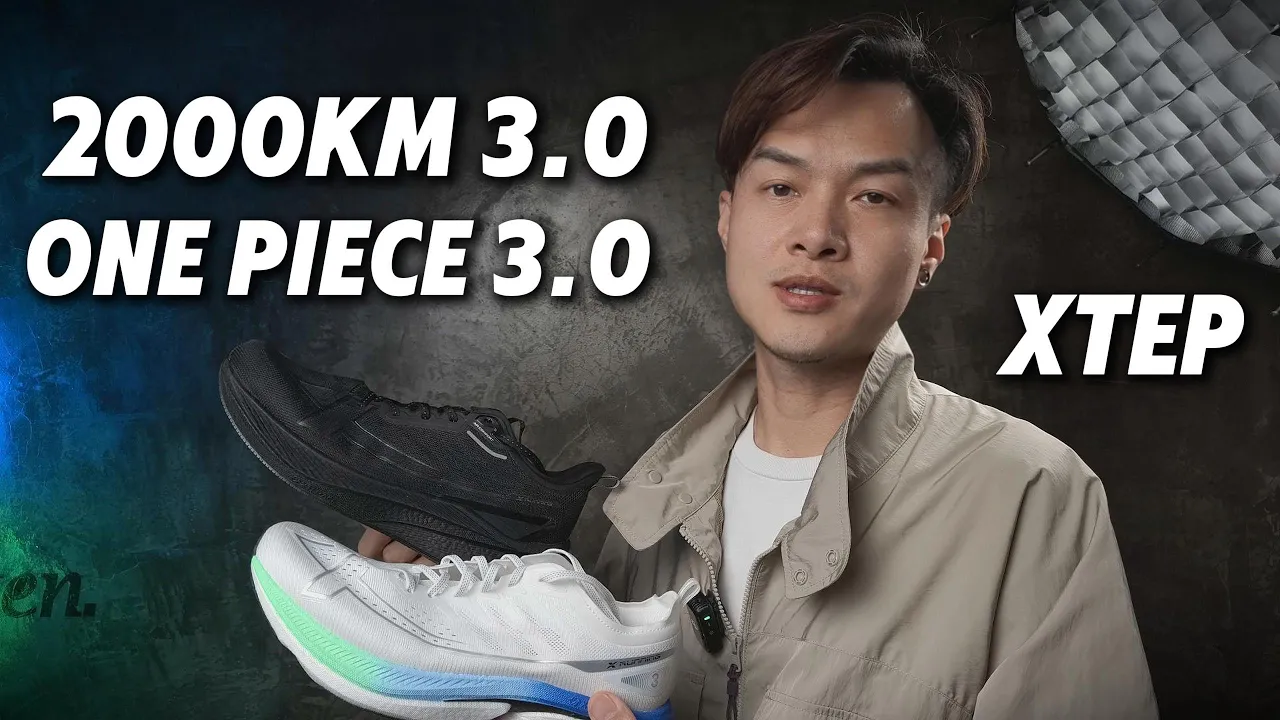
These are two budget friendly running shoes and also some of Xtep's best sellers. The main reason I'm putting both in one video is that their previous generations were very similar. Personally, I felt like they were the same shoe with two different names.
Now in their third generation, do they truly make a difference? Can they still offer great value to Runners? Today let's talk about them.
I created this channel to review Running products from Chinese Brands and improve my English speaking. Before I get into my thoughts on the Xtep third generation of 2000km and One Piece, I do want to go over some disclosures. No one's paying me to make this video and I bought these pairs with my own money.
Money doesn't grow on trees but I will say what I have to say. So let's get into it from the specs. The One Piece 3.
0 has a forefoot stack height of 22 mm and a heel of 29 mm with 7 mm drop. The 2,000 km midsole is 2 mm thinner with a slightly higher drop of 7. 5 mm.
When running I feel the drop is higher than the specs on paper. They both use the same super critical Beaded foam midsole and have a kind of plastic plate inside. On the One Piece, the plate extends more towards to the forefoot which is supposed to provide some propulsion.
On the 2,000 km the plate extends towards to the heel and forms sidewalls for extra support. I would say the plate on the 2,000km is more practical. Both uppers are breathable and single layered, giving a sturdy feel.
Because they don't feel as soft as typical single-layer uppers. Both these shoes are size 44 and run large. For reference, I usually wear size 45 in Chinese Brands and size 46 in Hoka and New Balance.
They weigh 252 G and 263 G, but there is no noticeable difference when running. After the basics, let's take a look at the details. The 2,000km has more padding, closer to a traditional daily trainer, with decent padding on the tongue and Heel.
The One Piece feels more like a speed trainer with minimal padding on the tongue and Heel. Both have reflective laces for added safety during night runs. And they both offer a lot of space in the upper.
In recent footage, you can see wrinkles in the upper everywhere, like my feet are swimming in the shoe. Actually you can see cinch down the laces pretty tightly to get a good Fit. And the laces are also longer to match the roomier fit.
Honestly, I don't think any foot shape would struggle to fit these. The 2,000 km's Tongue looks a bit rough. The one piece's Tongue loop hole is offset, while the tongue itself is centered, which looks a bit awkward.
For the outsole the 2,000km clearly WIns. It's thicker, more coverage and extra thickness in high Wear areas. But the most exaggerated thickening I've seen is on the Li Ning Yueying 4 Pro.
But the One Piece's outsole isn't less durable just because it's thinner. After my recent runs, its small details haven't worn off. The insoles of these shoes are exactly the same.
They are both quite slippery. With that out of the way, let's talk about the pros and cons of actual running in it. They offer the soft and squishy Feel most people like during easy runs and jogging.
Especially the One Piece 3. 0 with its thicker midsole. When I was considering buying of these shoes, I also checked out other International Brands offer at the same price point.
in the $50 to $70 range Adidas and Saucony and etc. Only offer Eva midsoles and regular rubber outsoles, while these have better performing supercritical foam midsoles and more durable CPU outsoles. This is where they shine and maybe explains their high sales.
But I don't want to keep praising them with the same overused compliments. I want to focus on their downsides, which you can use to decide if they are deal breakers for you. First, neither is great for forefoot or Midfoot Strikers.
Their foam is slow to rebound. If you push off quickly or forcefully, the foam doesn't have time to recover from compression before being compressed again, giving you the feeling of running on something with no cushioning. And this feeling happens right away, not after a few kilometers.
The One Piece 3. 0 is slightly better because it's 2 mm thicker midsole. Second the 2,000 km upper doesn't lock well for narrow feet.
Its first lace hole is positioned a bit further back. You can see in this footage that it's positioned further back than the One Piece. And combined with the roomy toe box, my forefoot never feels secure.
The One Piece does better, but only relatively. But the 2,000 km has surprising feature. Normally, like the car tires, the more durable the tire, the harder it is and the worse it performs in wet conditions.
But in my recent run the 2,000 km which focus on durability, can run through puddles at high speed with confidence. While wrapping up the video, I want to compare them with two other shoes around the $70 mark. One is XTep's 360x 2.
0 lite. In a previous video comment, an audience asked me to explain the 2,000 km, One Piece, 160x, 260x, and 360x all at once. I have to apologize.
Some of these shoes I haven't bought yet. But I will use this opportunity to share some background. Xtep's running shoes are designed by two separate departments: Xtep running and Xtep eCommerce, the 2,000 kilometers and One Piece come from the Xtep e-commerce.
So even in China you won't find them in specialty stores. The numbered models, like 160x, 360x Etc. come from Xtep running Department.
For Xtep as a company having two departments compete is a good thing. But for consumers, it might not be. At the $70 price point, they have both the One Piece and the 360x 2.
0 lite. If I were an overseas consumers with limited return options, I would skip both, due to the overlapping price and unclear positioning. What would you guys to choose?
Back to the 360x 2. 0 lite, it's upper fits like a more typical running shoe, with better overall wrapping and a softer, more cushioned midsole. I would recommend it over the One Piece for better ride.
The other shoe is the Li-Ning Red hare 7 Pro also around $70. Its midsole provides more energy return than the One Piece, making it suitable for Tempo runs and speed training. But it's not as soft as the One Piece.
It was also the shoe of my very first video on this channel. Although I feel a bit embarrassed when I rewatch that video. It's not very well made.
Back to the $50 segment of the 2,000 km, I haven't found alternative yet. I think if you are new to running and want a shoe to help build the Habit, it's a good choice. It's also great for any easy aerobic runs.
The 2,000 km and One Piece exceeded my expectations, showing the value of Chinese running shoes offer great soft and fun ride. But I I won’t mythologize them. Instead, I hope this video clarifies the gap between them and the more expensive shoes.
When you go from occasional running to loving it and running longer distances, you will find the importance of a secure Fit and a Midsole that maintains cushioning during your Sunday long runs without hurting your knees. That's maybe its time to invest in slightly pricier shoes. Okay, that's my thoughts on the third generation of Xtep 2000 km and One Piece after 20 km each.
Let me know in the comments if you have any questions about these shoes or any good tips on improving English speaking. Thanks for watching this video all the way through. I'll bring you more about Chinese running products, please follow me and hope you have a good one!