and there is a little secret I know about arming that we're gonna reveal right now because I heard you're a big fan of Guitar Hero oh yes yeah and my guitar and he is not only a fan is an active guitar hero practitioner and I challenging you to do a little search on youtube and show me what you found during lunch I think it's going to be rather interesting but let's move back to HR and agile and the future of recruitment what are going to be the key takeaways of your story for the audience today
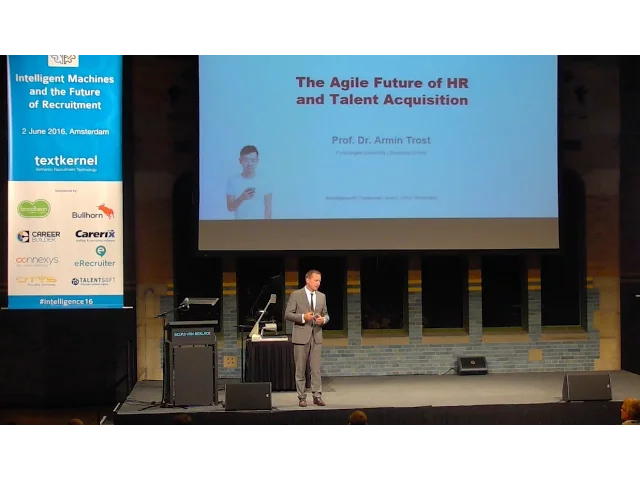
you think the key takeaway will be that we have to entirely rethink HR Billy okay yeah it sounds a smart girl rock Angelz yeah it is okay so thank you I'm intro slate okay so if you have seen the presentation from mucks we have seen nice pictures from a city called Tuebingen this actually is my hometown where I grew up and in Tubingen it's 40 kilometers thousand stuttgart and in stuttgart there are brands like Daimler Bosch Porsche and some others now when I grew up I was told that when you make it to work at
Daimler you going to be safe for the rest of your life and not only you but all you also your children and your grandchildren the market was stable the market was endless cars have been cars this was really really safe and today we don't think that way anymore bill Foulkes wagon still exists in five years we don't know what will bosch do in ten years so what we face in many businesses a huge increase of complexity dynamic uncertainty disruptive technologies Generation Y globalization and an end global warming so things become less predictable uncertain complex and
this is what many companies really worries in a daily basis and this is not only on on a big scale it's also on a small scale when we look at work the nature of work of course we have tasks where we have no this does not really okay well we have high certainty of outcome high certainty of process people know what the outcome will be people know how to get there housekeeping for instance bus driver you know I have to try from A to B so these are chops where work is absolutely clear but what
we have in the future is much more work like this well you don't know what will be the outcome be what what is the way how to get there and we have projects and there is work somewhere in the middle we can assume but all those jobs on the right hand and the left hand bottom side will disappear and will be substituted by smart technologies robotics artificial intelligence all the nice things we hear on this conference so what is left is work with a lot of complexity uncertainty dynamic this is what people do in their
daily work so since we have accepted this more or less we understood that people have high relevance people who else and because we believe in this we have invested a lot in HR we came up with talent management talent relationship management change management health management demographic management and all these nice things and so I mean when we compare HR today with HR twenty years ago there have been a lot of advancements no doubt about it but at the same time we see that the power and acceptance of the HR function constantly decreased so a question
is why is this the case and how will the future look like here now what I show you in my presentation is a kind of let's say a playing field and every company has to make a choice where to play really when I talk to CEO about HR this is the first picture I show on it as which game do you want to play and one option of course is to have something I would name basic HR oh you can also name it hire and pay you hire the people you compensate the people full-stop and
you do not any HR no training no talent management no employer branding nothing I mean that's fine you can do it that way no talent management the cream always comes to the top naturally you cannot avoid people from learning they learn whether you have HR or not yeah so no HR could work and I see a lot of companies that do it that way but the point is that in the last few years many companies move from the left hand side more more to the right hand side having processes having tools having systems having programs
having KPIs having an organization have HR professionals doing something not leaving things to chance but what we did is we move to the top right hand side most companies probably 90% of all companies move to that area which is central planning and control hair like to show you what that means I mean you all know this the right people in the right place at the right time this is exactly hierarchical traditional HR I would say if you follow this you probably will be on the wrong path in the future this is very much focused on
demand this is the idea of my company is a big machine and then speak machine there are different components there are different positions and on each position I have clear requirements an HR is to fill these positions and when all the components are right they all fit then my machine will work for the rest of of for forever but unfortunately um this might not be the answer for the future now I'd like to show you what that means classic hierarchical HR so here is here is a hierarchy okay and we have competence model of course
where we describe different competencies to make this work we have behaviorally anchored rating scales we have a chopped architecture where we have to find all the different shops in our company we build chop profiles based on this for each and every job competency profiles this is what we name competence management so when we do this we can create job descriptions we also can use these things to to assign them to all Precision's in our organization so that every position in my organization is thr profile then recruiting comes up so we have job ads and with
the chopped ads we'll recruit people so we fill the positions with people and the people on their side they have their own profiles and then they fit or they don't fit okay so overall we have a strategy and because we have a strategy we do something like strategic Workforce Planning thinking about okay this is the strategy what kind of people do we need in the next five to ten years and to make the strategy work we translate the strategy into different players using the balanced scorecard maybe but to make this work we have to have
something like a performance appraisal where every manager with every employee does an annual talk about past performance and future objectives you write things down in a form into a system and at least one outcome of performance appraisal our individual development plans but there's only one part having this on the table we go for the next step we do Talent reviews we find out who are the most potential best performing people in our organization we pick them out we do a 360 degree feedback to better understand the strengths and weaknesses of our high potentials we put
them on predefined career path and well we do this on the long run we are able to do something like succession planning knowing who is mature to fill which position in the future of course we we support all this with our HR information system which is great because with our HR information system we can also pull some some regular KPIs and this goes on and on and on okay I mean look at this slide this took me it took me half a day to prepare this light yeah but this is just this is just a
part of HR no compensation is on this no learning retention just one part and this is a very simplified very simplified picture of HR as you find it in many many organization and this is scary this is really scary this is the machine this is the machine this is hierarchical this is static and probably this complicatedness which we have created over the past decades in HR is not what we need to cope with the complexity in the uncertainty and the dynamic which we currently face and which we will face in the future so give me
I I mean I'm an HR professor and I I spent my my whole work on this one question how must h all look like in times of digitization and what you find here is definitely not the answer I see so many companies that get rid of performance appraisal now especially the most innovative ones and then hence they change talent management they they change their compensation strategies because of the changing nature of business digitization and so on so let me tell you how it looks like this is the question that people have I want a meaningful
job that fit to me in my life this is not the question the right people in the right place at the right time this is HR question but the people they don't have this question they have this question as we already have learned today the people they ask okay what is the next opportunity whom should I meet from whom can I learn what where do I get this information what is my next project how can I contribute with my competencies to what in this company what will be my future these are the questions the people
have and these questions very often are different from the questions HR have the right people in the right place at the right time so I think that in the future HR will be more in that area people centric enablement it's about enabling people to do what matters to them of course as part of being part of the entire organization of course I would like to talk about this in the last minute in the last half of my presentation I think there are three things diversity power and consequences these are the three things which characterize future
HRM eyes maybe I'm wrong but but these are some ideas some some guidance so let's start talking about diversity you all know this movie Toy Story right and the creator of Toy Story was John Allen Lasseter this guy huh John Allen Lasseter worked at Disney and he fought hard to do something in the area of animated movies he was a crazy guy very innovative he really thought out of the box and as a result Disney fired him he kicked him out so he met Steve Jobs they work with Pixar and created all these great movies
which we know where our Toy Story is finding Nemo and so on the executive search people in the room I mean how many times have you heard look for a crazy guy really but we will have to think more in this direction I mean classic HR looks like this we have a box clear competencies clear job description the person must demonstrate this and this exactly this unfortunately people are not like this they are like this and then HR comes across and say okay we have to train this guy and have to fill the gaps and
we focus on the gaps and we don't focus on the Strang and the last thing we do is we appreciate individuality but this is what we have to do in the future now what we need are a few crazy people look at what we have reached with the normal ones so diversity this is diversity now you might say no this is not diversity two men similar outfit but this is diversity because we have a technical champion and a business champion and both together make up a strong team now that it's absolutely powerful diversity is not
about bar charts it's not about stats it's not about pie charts diversity is something different diversity is appreciating individuality this is the real point appreciating individuality I mean my ultimate test for for executive is always the question would you hire her as the head of accounting would you hire her if you say uh yeah what's the point she's competent that's fine well if you say oh no better not that's a different story okay diversity this is one thing the next thing is power I mean already this day and I hear every on every conference on
area HR meeting I hear the following sentence people are our most important asset Wow yeah and as we already flown today we all agree yeah yeah what does that mean what are the consequences the consequence of this sentence is that if people are the most important asset then you trust them trusts you give them power I tell you why I mean in a classic organization we have managers like this much general knowledge much expertise now this is the T concept and the the team around the manager or below the manager all like this I know
this looks like a crazy art but was that was not intended yeah so and where when as an employee I had a head question I went to my managers and manager should we go for a or B and then the man said I don't know B it's okay B the manager is there to answer all the question the manager are there to solve all the problems and the task of the people is to do what the manager says . i know this is extreme but this is the old thinking today we have this we have
managers with much general knowledge some rudimentary expertise well and the people are like this so the employees every employee has more expertise than the manager and they have very different expertise and together diversity they make up a strong team huh so this leads us to a totally different thinking in leadership in how we deal with people yeah in the classic world we had the boss the boss what is the boss the boss has one question the boss has one question the question is how can I make my people do what I want them to do
motivate coordinate give direction control yeah this is what we have read in management literature for many decades but studies show that this role of being a boss slowly disappears now we have different roles where frauds that are much more built on trust and what you see here is Niklas Luhmann probably the most important sociologists in our times and he did a lot of scientific research around trust and if you want to summarize the outcome of his research in one sentence then it's trust reduces complexity Trust reduces complexity it's great that we have trust while mistrust
increases complexity you all know this from your daily life living if we take this seriously we have a different kind of leadership we have roles like partner ok let's think together about the problem let's together thing about where to go or the coach ok John a or B what do you think what is the risk with a what is the risk with B whom should you ask to find out whether a or b but you don't give the answer or enabler what must I do as a manager so that you are able to make the
right decisions these are the leadership roles that you have in the future if this is true and there is a lot of scientific evidence that many organisation step a step move more to those roles then we have to rethink HR I give you just one example I mean my my my hero is two classmate Craig or two class McGregor he wrote the book the human side of enterprise in 1960 and he said one sentence the role of church and the role of council are incompatible in other words a codes will never judge so managers that
coach will never do a performance review it's not possible if we an HR force our managers to do performance review with the form making your check here on the low expectation and then this goes into the system and then there are consequences that turns the feedback into a judgement and that can disturb the relationship between a manager and an employee managers who coach will never do performance appraisal which is good so we have to rethink our most commonly used method like performance appraisal this is just one thing I could talk about many many examples here
the next thing is consequences a classic hierarchical organization works like this there are decision made on the top and then the decision are conceded down to every single level so that every employee knows what to do and the sum of the individual work make up the product or the service that goes to the client and through some feedback system customer satisfaction survey or the feedback goes to top management and then they make a decision so this is the entire learning cycle which obviously is very slow and a lot of things get lost I know this
is extreme but sometimes we have to look at extremes to better understand the difference between hierarchical settings and edge chart settings or to put it more simple an employee the small circle is dedicated to the boss and from the boss comes the direction and there somewhere else is the customer but you don't have to care about the customer do what the boss tells you this is vertical thinking which you find in many many many organizations now this let's have concreting some look at it garage look at a hospital look at a classroom look at everywhere
with people do that job those who make the decisions sometimes people in the headquarter men choose how much do they know about the consequences of their decisions how much does a company like Daimler know about the consequences of what they decide in the garage where the reality takes place so if you want to have actual organization make sure that the people see on every level feel the consequences of their work by working with a customer and this looks like this the employee individual is dedicated to the customer and from the customer gets a feedback and
the manager is just there to make all this sure okay so we have things like networking chop rotation switching roles managers who walk in the shoes of the workers for a couple of days yeah mixed teams we have a lot of things in agile organization where we very encouraged lateral thinking not the vertical thinking everything we do in that direction is good to become agile so overall the future of HR will be about diversity power and consequences many things for your presence and listening thank you we have time for a couple of questions anybody with
a specific question for arming whoo you rolled them over oh there's one could you take that one thank you he's going to be dead quicker than I am hi I just had a question from what you said we would say that succession planning should be more based on the person occupying the role or the role itself which is more traditional we know from past accession planning has always been kind of static approach where we have the assumption that we can define a role and the role would exist that way in the future and then we
always try to find people that that match to this role in reality we found that especially those roles on a strategic level they very often they change if sometimes you just you just change the CEO and all the direct reports position change and they don't look the same anymore so so planning into that direction is it's a hard thing that only works in a very stable static environment in some business it might work but in dynamic environments it probably does not work so the answer is have people prepared that can fill different roles so we
see this tendency also ready in the last few years that you you let's focus on very concrete positions do not prepare people for positions but build kind of pools now which which lead to much more flexibility now I think this is the answer now one more question and then we're hello I've just a very small question you have a very nice presentation and you told that people are centric but but out that you should put people in the center of everything but but I lost in your presentation is what is the role of HR to
put people in the centre you set what managers who do not put HR should do this is a very good question what is the role of HR in this game yeah enablement enablement yeah peep you you you you build infrastructure things like things like you deliver apps to your employees where they can network where they can exchange knowledge yeah who else should do this IT I think this is a role of HR doing something like this in in in recruiting for instance we see that the future recruiting is very much about networking yeah employee referral
program is probably the most successful thing they're an employee referral program is is is something where you where you where the people in the line take over responsibility you take their networks so this is a very strong approach something like this instead of saying okay HR will take care that we fill the positions you say the line will take care of that you to fill the position but to enable them to do so you have to have a program you have to have rules like an employee referral program who else should implement something like this
like HR and then enable people to do something like this yeah okay to exam thank you very much ladies and gentlemen don't arm interest okay thank you very much for your contribution