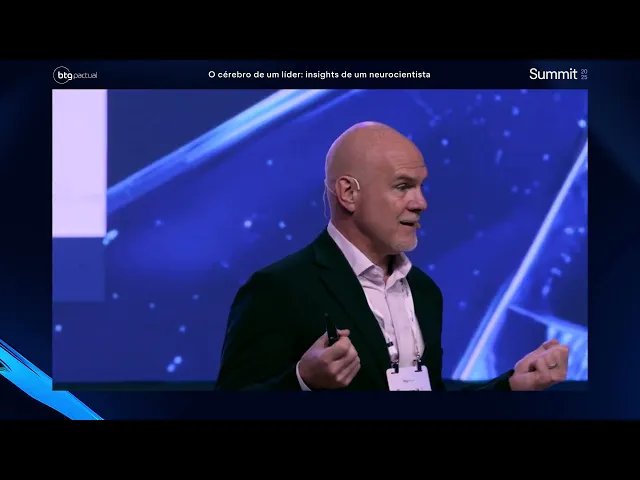
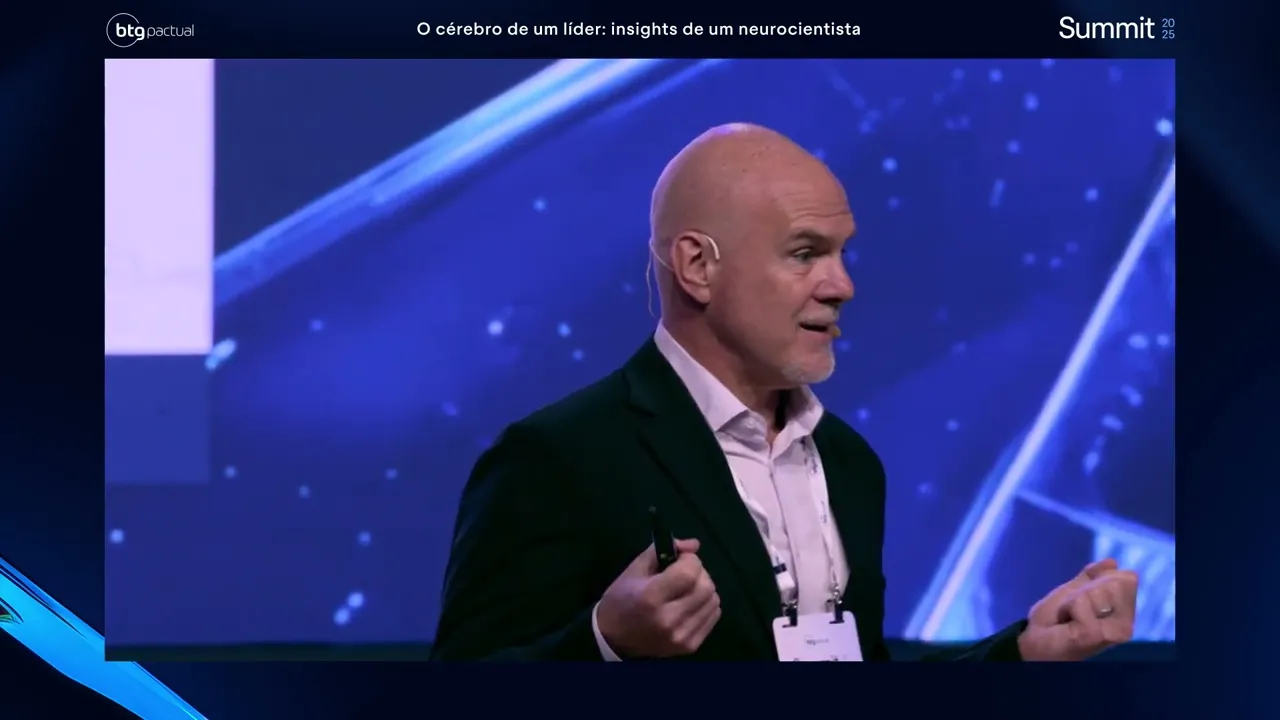
[Music] for for [Music] [Music] V Professor please join us on stage thank you welcome everybody it's a real pleasure to be here it's my first time in Brazil um believe it or not and um I'm really enjoying my time here went to the masp yesterday it was really uh quite incredible I want to start with a question uh which is why are we all here why are you all here I don't mean this in a cosmic sense like philosophically why we're here in the universe but rather why are we all here in this place at
this time because it's better to be together than to be alone right you could be potentially at home watching this on Zoom you know on your computer but it's very very important to be here together and if there's one thing I hope you take home from this talk today is is that and this is a talk on leadership if you want to be a better leader you should try to become a better human and in particular Leverage The Secret of our success as a species which is our capacity to connect with one another when you
do that and when you create the conditions so the people you lead can do that everything else flows naturally so we'll uh run through the science uh supporting that if you're interested in taking a deeper dive on neuroscience and Leadership the Neuroscience of leadership um you can check out my book The Leader brain um which uh basically provides insights from the way that our brains work into uh decision making management uh Innovation marketing and Beyond okay and it's uh I think one of the thing that's really different about this book is it's a practical guide
so there are practical steps you can take to do all of these things better based on what we know about the brain and in terms of motivating this uh this talk one of the things you should know about me and my position at the University of Pennsylvania is that I'm a practicing neuroscientist by day in the school of medicine where I try to figure out how the brain uh works and how it falls apart uh in disease or after injury how to develop better therapies and diagnostic tools to improve brain health and you can think
of my night job at the Wharton School of Business as kind of taking those insights and applying them to all domains of business so that we can all reach our Peak potential but we're here to talk about leadership okay and I think you know one thing we can all you why are you here well you might be want to be a better leader in your business in your organization uh perhaps a better leader uh in your community and certainly I think we can all strive to be better leaders in our homes and in our families
and that's one thing that I I think that's also an important take home here is that the Lessons Learned apply equally well uh in the office as they do at home so you can take these insights at home apply them and hopefully uh be a better person uh in your home it all starts here the human brain okay so this is sorry three and a 12 pounds of meat and fat between our ears 86 billion neurons making about 100 trillion connections with each other so that sounds like a lot of hardware and it is in
some ways but in fact it's actually quite limited so thinking about the brain like a computer is really the wrong metaphor it's more like a Swiss army knife that has specific tools that evolved a long time ago to do very specific jobs okay and I think we ignore that at our Peril all right we're going to talk about a few of those specific tools today now in the US I don't know if this is true uh here in the southern hemisphere but in the US over the last year or so there's been the emergence of
this um so-called founder model right that things are changing so fast such high velocity and with such amplitude like things it just seems crazy that the only way to go about dealing with this as a leader is to kind of throw away management throw away all those other tools and just say I alone can do it okay and I'm here to tell you I think that's wrong right I think we can all appreciate and you're Brazilian large you know most of you Victor and I have talked about this before it's kind of baked into the
culture okay that relationships are important relationships are key to business and there's a wealth of data to support that so for example going back um you know 10 years ago or so now uh Google's oxygen project um in which uh Google try was trying to figure out like why are teams not performing and so they asked googlers to write down all the things they thought made for a good manager did analytics on that and what you basically find is that good managers have strong social skills they have high emotional intelligence or EQ they are good
at perspective taking they uh help to support their teams right in their efforts to improve and to get ahead those were not the skills that predominated uh amongst the management at Google and so they didn't fire everybody but instead they implemented a sort of social skills training uh for them and that improved performance and if you fast forward then to for example the pandemic which really kind of upended all of our models for business and and a lot of that is still with us uh and the move to remote work which is with us in
hybrid work and we see that for example in this study three different continents showed that those people this is all work from home those workers who had better relationships at work stronger social connections actually were more productive when they went home because they had they were more engaged you know they were more accountable they were working for their friends just as much as they were working for their paycheck and if they didn't have good connections they actually weren't very productive um two years later on in the pandemic this is data from Microsoft Works Microsoft's worklab
looking at several million uh users of Microsoft products in the workplace and looking at engagement okay and the impact of engagement on the bottom line okay and and the portfol the value of that company and what they found is that those companies that had higher levels of Engagement and those are people those are workers who endorse having stronger connections to the people they work with feeling a greater sense of might be Mission that's it Mission and value okay uh they were the ones those were the companies that did best financially in fact they outperform the
S&P 500 so what I'm telling you you know is clearly important from the worker perspective but even if you didn't care about that it's critical for the bottom line so this helps to make the business case in improving the opportunities to connect uh in the work place and build those skills in ourselves and in others but I think all of us understand that it's not always easy like if you've ever been in a really tough meeting right and it's really hard to reach consensus really hard to even um debate and talk about in depth the
issues at hand uh these are these are really tricky things to do so what I'm going to tell you now is you know over the course of this session are some strategies that are based in Neuroscience to help you do that better and I think we can all appreciate as I mentioned already that this is harder online right we've all felt the difference I mean I think we're getting better at it that when you're working with your team online that there's something missing it's a little bit more challenging in fact the data supports that so
in fact when when people move to working remotely one of the things that was measurable was a drop in Innovation a drop in creativity probably because for a couple of reasons one people aren't bumping into each other at the water cooler and exchanging ideas and instead ideas are bumping up against the silos because people were only connecting with the one or two people closest to them when they were working remotely okay now there's some really beautiful data that's come out in the last couple of years this study from 2023 I really love and this study
which was published in nature the premier scientific journal examined some 4 million patents and 10 million scientific papers going back to the 1960s and they looked at the potential that any of those uh papers or patents led to a disruptive innovation something really gamechanging and they looked at as a function of distance of the teams like were you working in the same room were you working on the same floor in the same building but on different floors maybe in different parts of the same city on a different continent okay and the evidence is really Stark
okay that as you get farther apart it's harder to innovate as a team it's just really really challenging and I think we have to really take that into account that being together there's something beautiful that provokes creativity and part of that is the way that we share information uh with each other now the move to uh uh work from home and hybrid work etc over the last few years since the pandemic started and and that's just been something that is going to carry through forever I think uh unfortunately that has led to a decline uh
in worker mental health so we find that um workers are experiencing and and expressing that they feel lonely okay and that varies with the type of work that they do loneliness as we'll see in a moment is extremely bad for your mental health it's really bad for your physical health uh as well because we are wired to be together to connect with each other now this impact on Mental Health has actual business implication so again even if you don't care about your workers and you should you should care about the bottom line okay and what
we see here in this Gallup poll is that those workers who are experiencing mental health issues anxiety depression burnout really that's what we're talking about they miss more days of work they're absent more frequently they're also going to use company resources more often that hits your bottom line and what I'm going to you know again through this the next half hour or so tell you is that there are virtually cost-free ways to turn the dial up on connection which will magnify and ramify through your organization so that there's less loneliness higher productivity greater creativity and
Beyond so for all these reasons I think it's really important to figure out better ways to connect and to create Connections in the workplace but it's equally important to do it for ourselves at home in our communities so we now know from really really robust extensive epidemiological evidence Health evidence that people who have more friends or deeper friendship so basically more social support live longer healthier happier lives and they make more money for all the reasons that we just discussed okay now the converse is painfully true people who are lonely and loneliness is the gap
between the connections you want to have the interactions you want to have and what you're experiencing people who lack social support the impact on their lifespan is greater than smoking 15 cigarettes a day so think about that we know we all care about the health of our bodies okay so maybe you stop smoking you exercise more uh you know you you eat better but if you lack connection you've just wiped out all of those efforts you made to try to be healthier okay and when I consider the fact that now young people the youngest Generations
are the loneliest ever and have the worst mental health ever and the fact that maybe a quarter of young people right now will say they don't have a single friend in the US this is a really really terrifying problem as we think about the future now how these social connections protect us became very uh apparent to me uh in a in a different kind of study that I've been running for about 15 years so I've been studying a population of monkeys uh on an island off the coast of Puerto Rico called Kaio Santiago uh we've
been doing that when I say 17 years or so U when basically there are thousands of monkeys there we uh have all the behavioral data because we follow them around and we have all kinds of biological data so we do a monkey rodeo once a year we uh we capture all the monkeys we take their blood we take other measurements uh to see what's going on inside their bodies and in 2017 you're probably all aware well aware that hurricane Maria hit Puerto Rico it was devastating caused 3,000 people at least lost their lives it Unleashed
an epidemic of mental health problems suicide anxiety depression okay sorry that's the hurricane oh sorry I want to go back so that's the hurricane itself and that hurricane hit Monkey Island first okay and it didn't kill any of the monkeys they figured out how to survive the storm but what we found is that they compensated for the other Devastation of their home by becoming friendlier so what they did they became less aggressive friendlier more tolerant and they reached out and made more friends and they sustained that now for eight years okay and that has had
a big impact on their lives so it's what you're seeing here is a survivorship curve the Blue Line are monkeys who made the most friends and the red line is monkeys who made the least friends and it should be very clear if you make more friends you live longer now why do we study monkeys because they share all of the biological features that we have their brains are wired up the same way they depend on each other in the same way and it's rooted in their genetics okay so this is a shared biology so we
can learn a lot and this is the actual brain Network that does the magic this is what we call the Social brain Network a real discovery of the last 20 years in Neuroscience these green blobs in the brain are what manage Our momentto Moment interactions with other people as well as our long-term relationships okay monkeys have the exact same social brain Network and in an experiment that we published uh last year we found that um having a friend actually protects your brain from going into overdrive when you encounter a threat when you encounter stress okay
so we looked at monkeys who are either with their friend or alone and then my graduate sorry it must be this my graduate student Felipe came in and and threatened uh the monkey I'm getting help here all right thank you so my graduate student fipe comes in he threatens uh the monkey and what you see is that the brain kind of goes haywired when uh the monkey's alone but when his friends there it's completely calm and that's why having social support is so important it protects us from unleashing all of those stress related hormones into
our bodies and our brains that end up turning everything down making everything fall apart now we now know again through really robust evidence that people who have more friends actually have a physically larger social brain Network it's just bigger and a bigger social brain Network means it can do its job better it can hold more information it can process it more effectively now that raises a troubling question or deep question is this nature or nurture if you're born with a low functioning social brain a small social brain Network are you just kind of doomed right
to have fewer friends and not do as well in business and we do worry about that because we know that there are genetic conditions for example associated with autism in which people have difficulty with social interactions and so you might think there is some potential there but what we found instead is that it's more about what you do with your social brain Network than what you're born with so instead the social brain network is like a muscle the more you use it the more you exercise it the more it grows this is a photograph from
the farmers market in writtenhouse square where I live and I'm actually kind of a shy guy but on Saturday mornings I always make myself go to the farmers market and I try to talk with the mushroom guy from kenet Square talk with the Amish folk who are selling uh flowers striking up these conversations is like getting on the treadmill for your social brain you're giving your brain a little exercise a little run now it's often tempting you know at the end of the long week to just kind of sit inside watch TV chill when you
could be using that time very effectively to tune up your brain keep it healthy and then you come back to work better able to do your job okay so now you've got this social brain Network right every one of us has one in our heads how do you use it most effectively when you're at work or really in any interaction and this is where I have to admit being a little bit embarrassed because I feel like I've been doing science for 30 some years and I've validated what my grandparents and my parents taught me okay
the science is very clear what's the first step the most important step in a social interaction looking at paying attention to the people around you what we look at is turned up in our brains and what we're not looking at is turned down so if you're like this guy who's you know you're in a meeting and you think you're very cool and you've got your phone under the desk and you're looking down there texting or whatever you might as well have a bag over your head you're getting no data from what's going on you among
the other people at the table all those fleeting facial expressions you miss them that non-verbal cues your social brain network is constantly looking at the world trying to get more information and you're robbing it of what it needs to do its job this problem is magnified when we're working online right now you've taken a three-dimensional human being and squashed them flat in a little two-dimensional box and there's less information there I bet plenty of you when you're in a zoom call or teams meeting you might have other screens open or you're checking on what's going
on you know with your friends or social media diverting your attention dividing your attention we can't multitask okay and the problem is magnified when we include more people in meetings right so the more faces you have the smaller those little boxes the harder your brain has to work to get the information that it's looking for so one little tip here would be to say reduce the number of people in a meeting to only those who are most necessary or um or for example example use uh speaker rather than Gallery mode but you have to be
very careful that some loud mouth doesn't take over the conversation but I think it's very important to recognize that this is hard so if you've ever felt Zoom fatigue how many people have felt Zoom or teams or whatever fatigue you can raise your hand if you've ever felt it it's tiring right if you do these back to back to back and the neurobiological data is very clear on this Zoom fatigue is a real thing okay so sorry so uh this is don't worry too much about the details this was a pilot study done at Microsoft
where they measured brain activity in people who were meeting uh with each other and the meetings were either back toback or there was a 10-minute break between meetings and this is a signal that indicates a high level of Engagement uh attention and feeling good so blue is good that's positive yellow is bad if you take a break between meetings your brain is ready for action if you don't take a break and you go back to back to back now your brain is out the door it's tired it's exhausted it wants to go away so we
all have the capability to build in by default breaks between our online meetings but how many people actually do that right so you should do that right away now one of the the kind of unique things about the Wharton Neuroscience initiative that I lead is that we work directly with companies to help them address their challenges and apply Neuroscience okay in the service of helping them uh one of the companies that we've worked for the last five years is a management consulting company called slalom which grew rapidly uh over the last five years or so
going from I don't know 5,000 to some 12 or 15,000 employees this is slalom and in one of the studies we did last year which I really thought was groundbreaking we um we actually measured brain activity in slalom workers while they were at work but they were working together online and I'll show you the results of those in a moment moment and they all relate to this phenomenon called synchrony okay so when you say if you ever I don't know if it works in Portuguese but if you say uh I'm in sync with this person
like maybe your partner or so your best friend like you're in sync you have really good chemistry you know you almost say the same things you you you follow each other you know just perfectly we now know what that is and the reality is is that when you feel like you're in sync with somebody you you are your brains synchronize so this is another major discovery of the last decade which is that when you have a good relationship with someone whether a personal relationship or a great work relationship what happens is your brains begin to
synchronize that is the same pattern of activity occurs in one brain in and the other and the stronger that synchrony the higher the trust the better the communication the better the teamwork and what does that synchrony mean it means that you're seeing the world the same way you're feeling similar things about it you're making similar decisions and you're probably going to engage in similar actions and when our brains are in sync this actually percolates down to our bodies as well so our hearts begin to beat together as I'll show you in a moment uh we
begin to breathe together we start to move together okay if you want to know whether a couple walking down the street has a good relationship see if they're walking in lock step with each other or not okay that's a good indicator and you can run this in Reverse so if you move together that will synchronize your heartbeats and begin to synchronize your brains and that's one way that we can kind of use this knowledge to more you know to to uh make our teams more effective one of the most exciting findings uh in the last
few years is actually work that was done by my friend Talia Wheatley up at Dartmouth she hases these really amazing studies where she takes uh you know Dartmouth is in Hanover New Hampshire so it's really remote it's very far away very Northern New England and so when the MBA students arrive on a bus she uh she kind of captures them okay before they met each other takes them over to the hospital and scans their brains while they watch a bunch of short Tik Tock movies okay and what she's found found is that those MBA students
whose brains were more in sync while watching those movies are the most likely to become friends the next year you can predict who's going to become friends based on their patterns of brain activity so if you're kind of seeing the world a little bit more similarly paying attention to the same things it means you have a shared mindset and you're more likely to become friends well we leverage that observation in our work with slalom so one of the key questions okay is whether the kind of same principles of the Neuroscience of connection that we observe
in real world relationships actually occur at work and in particular in workers who are working remotely with each other so they never set foot in the same place at the same time never been able to establish those connections so what we did is we repeated that wheatle experiment we had slers we we trained them with a video how to put a little brainwave monitoring uh device headset on and they collected data on themselves so this was citizen science and they watched these Tik Tok movies and they also watched a promotional movie or video for working
at slalom why is slalom a great place to work okay and then we looked at brain activity and what we found is that this principle of synchr predicted work relationships as well so workers whose brains were more in sync with each other while watching these videos actually had a better relationship okay even though they' never been together ever so this is really I think giving me some optimism that as we continue to work in remote and hybrid settings that we can leverage right the principles of Neuroscience that I've been discussing in particular our social brain
networks to build better and stronger working relationships and in that way increase productivity Innovation and improve well-being uh at work and we found in a recent study that this synchrony translates to better Collective decision-making so we had uh hundreds of groups three to six individuals who were uh playing the role of being a hiring committee it's a pretty difficult job okay so they're evaluating applicants and it's a very structured task where we uh give everybody on the committee a sheet of information about each applicant and most of that information is uniform it's shared across the
entire committee everybody has the same information but there are one or two people who have a little bit extra knowledge something a little bit different and in order to get this task right and make the right hire not only do you have to reach consensus but you have to realize like people have to realize I know something that we haven't talked about yet and I have to feel safe enough and confident enough to introduce that into conversation and we have to have enough trust that we can really hash it out that's exactly what we found
so those committees that were in sync with each other physiologically reached consensus and made the right hire and again it was a really difficult problem only half the Committees made the right hire committees that were not in sync either never reach consensus because they were always fighting or they just went straight to the default easy answer because they didn't have a robust discussion so we think physiological synchrony in some sense is a biological marker or biomarker of psychological safety right we feel safe in this space and therefore we can have difficult conversations so now that
we know that synchrony is the foundation the glue that keeps us working together uh how can we turn it up how can we turn the dial to 11 and we've investigated that in a number of ways one of which is to study uh athletes and team sports so why do we care about sports well just because you know I love sports in general but uh Sports is a great petri dish for work and for life right because small increments in performance can be the difference between winning and losing you know being Champion or not and
it's much more it's easier to objectively measure the outcomes than it is in business sometimes so working for example with the pen rowing team we found that those boats of rowers that were more in sync with each other actually perform better okay and they entered into a state of what we call group flow if you're interested in flow this sense of like time slowing down and you're really kind of enjoying your work well they would enter into that as a group as a team okay when they got in sync with each other and one of
the most effective tools that we found for synchronizing brain activity in sports is to train together like even if it's training you could do alone talking about weightlifting you know running running weightlifting together you're forming you are syn ionizing your brains in a way that later you can draw on okay to perform better now probably the ultimate tool for getting in sync is actually through conversation like actually talking to people I mentioned that earlier about exercising your brain so when you have a conversation with somebody not only are you exercising your brain but you are
starting to move your brains into sync with each other standard you know you know just conversations that we have every day those little chats you have at the Barista at Starbucks or wherever that's that's that's doing it we work with a or we use a structured set of questions okay in the workplace to build synchrony among teams if you uh are coming to my workshop tomorrow you'll get to actually do this and one of the things that we've discovered we and our our colleagues is that having those conversations especially ones that are a little bit
challenging where you go beneath the surface not just talking about the weather that's a good start but that's something a little bit deeper that this takes our brains which might be very different and very far apart and begins to move them together so this is work from my colleague Emily Faulk uh at Penn and think of those two curves the light blue and the black one as the two brains okay and at the beginning of this conversation they start very far apart that purple shading is very large and as the conversation progresses you can see
that the purple shading gets smaller and smaller as their brains begin to synchronize just through the process of having a conversation and this has real business applications real business outcomes so uh as I said before we work with lots of companies to help them with their challenges and one that we feel really proud of is um work we did with this uh women's Artisan Collective called matriarca which is uh in Argentina and so it's a collective of indigenous women Artisans that use traditional weaving uh to make beautiful um ponchos and Handbags and whatnot and then
matriarca actually the the sort of retail side of it um sells them online and at the time that their founder um Paula Mara came to us she said we have this real problem because the women in the different Villages don't trust each other because they had Decades of fighting and and competing over resources and nobody trusted management she said can you help us I said I don't know it sounds like a tall order but we'll try so what we did is we took those cards which we call Fast Friends we had students translate all the
questions into Spanish uh we got on the students got online and trained all the women in the collective how to use zoom and then they did round robin conversations with each other over the course of about a month and then you know this was during the pandemic so we couldn't go down and measure brain activity or anything like that but what we did find is that this just boosted trust amongst everyone as Paula said we observed that relationships were improved conflicts seemed to fade and ultimately uh things got so good that um they gave the
company to the indigenous women I don't want to take credit for that but it's a pretty nice outcome okay okay I'm sure you're all beginning to think then about this question which is given our wiring to connect and it's the foundation of sort of most things good about humans how do we confront AI uh in the workplace and in our lives so we now have the intelligence you know of almost a super intelligence that can fit in our pocket okay and it is changing the game forever everything and not only that but this AI speaks
to us in our own language it's hacking it's hacked the operating system of the human species and I think that this opens opportunities and it presents challenges now we had already been doing research trying to understand how our brains work when we think we're interacting with a human versus when we think we're interacting with a simp AI in this case so we had people playing a game uh with they were lying in an MRI machine while we scan their brains um and they were playing a game with either a a live human being outside the
scanner or a simple AI okay and what was really fascinating is that a lot of it has to do with belief so if I tell you you're interacting with a human being but you're lying in a scanner all alone and you're looking at a computer screen the social brain network is active if I tell you you're interacting with a computer it's not active Okay and the more active this uh social brain network is the better people are at um reasoning through a difficult problem with each other and negotiating and things like that so that gives
us a foundation for thinking about how you know how are we going to respond and how might we best leverage AI how how might we best design it to enhance our experience and hopefully with good results for our companies and the people we employ and there's some I think really uh interesting evidence from another set of studies that we've done where we've looked at the foundation of connection to a brand okay so a brand is not a person a company is not a person and yet for forever essentially in marketing we've made the assumption that
we our brains interact with Brands the same way we do with people well now we know what that is that's a social brain Network we can test that idea so what we did here was to look at the two dominant smartphone brands in the US Apple and Samsung Apple's loyalty is Skyhigh now most teenagers in the US 90% have iPhones okay everybody's flocking to Apple um Samsung makes a really great awesome phone phone computer handheld computer it's not really any different so what's at the what's the basis of this and it's all about connection so
Apple has created an ecosystem and a brand image and an experience that draws people to it forms a human relationship and then connects them all to each other so we talked about synchrony and we've examined the brain activity of Apple iPhone user users compared that with Samsung Galaxy users while they're reading news good bad Etc about each of the brands or watching commercials ads for those Brands what we find is that Apple customers are all in sync with each other right they're like a community of friends they're like a family they're seeing the world similarly
and feeling similarly about it and each Samsung customer is an island unto himself right he's a loner he's not connected to the the rest of them and it's more of a tool all right and we dug a little bit deeper and this is what I'm showing you here which is I think still one of the most amazing things we've ever found this is looking at what we call the structure of the brain not brain activity but the size of these different brain areas and what we find is that the social brain Network in apple customers
is physically larger okay so there's a couple of uh those red spots are bigger in apple people than Samsung people this is the social brain Network okay so apple is probably recruiting people targeting with their marketing people who are already a little bit more socially wired and then turning that way up through the Apple experience what that does is it creates strong loyalty but it's also creating a sense of community amongst the Apple people which is leading to higher well-being uh Etc so I think that there's a lot of value there that we can all
learn from in terms of leveraging the social brain Network which is the foundation of Human Relationships to do so to improve our productivity our creativity and our well-being and also to move us forward as we bring more and more technology into the workplace and into our homes to create deeper connections amongst ourselves but also um with our companies for example to uh increase loyalty so I'll just give you a few key take ways and then I guess we're going to have a little bit of conversation here so if you want to be a better leader
first of all you should try to become a better human and one of the you know some of the things we can do to do that are to exercise our social brains when you do that you make them grow when you're in a meeting please put away your phone right pay attention attention is the most gen you know purest form of generosity as Simone W said we should foster social connections to make better decisions ourselves be more persuasive be more creative but also do that for our teams and if we create the space and the
time for people to actually socialize and I know that's hard to do when we feel like we just need to keep keep at it just keep pushing it work harder and harder and harder that may be a self-defeating uh method okay so instead we need to take time and space to connect with each other and synchrony may be the key to Leading with AI so thanks for your attention and now um Victor is going to come up we're going to have a little bit of [Applause] Q&A thanks well uh very insightful as usual not I
don't know if the sensum lovers really like the the end of the presentation but uh I I I must read my questions here because I I I have I have to be very intentional with my words so we can get uh sure the most of your wisdom okay so Michael uh the first question that came up to my mind I was drafting a little bit over there considering neuroplasticity know the ability that we have to eventually become better in something that we do in a frequent way what's your view on social media use slash addiction
are we becoming you know more superficial what your view on that yeah so this is a great question it's I think one of the dominant animating questions of the last decade or so uh it has been controversial but to my mind the data erased that controversy uh especially for young people so uh social media so the technology that is at the root of social media is designed specifically to grab our attention right maximize engagement because it's social in nature uh it's high typically highly emotional in nature and that's what keeps you coming back okay so
it's it's the same circuitry that uh underlies uh addiction that's why it's so hard to overcome what we're now seeing is that at least for young people who grown up as digital natives that this has a a major unhealthy impact on their brains and also on their physical development so uh it seems to lead to Greater anxiety stress depression body image issues uh in in young people that is neuroplasticity and it's a critical window what we call in Neuroscience a critical period for development When We're Young during adolescence that's when our social capacities our social
skills our EQ really develops and it's getting taken off track first I mean I think even preceding that was growing up with a phone in your hand and being able to text and so what we find is that instead of actually going out and socializing in the real world which is the most exercise you can give your social brain people weren't and then it got worse with social media so there's a movement to phone- free schools in the US more and more States and school systems are adopting that here as well here as well that's
really good I think that's that's very appropriate um and hopefully we can reverse that Trend it may be different in people our age who already went through that critical period And so a lot of that circuitry is pretty welldeveloped but U but I worry a lot for younger people great good to know and Michael could you explain of course it's a very deep answer if you go through all the steps but could you explain briefly why we cannot [Music] multitask ah yeah sure wait please don't try to multitask so uh again starting from the observation
that we have seemingly unlimited capacity in our brains we really don't okay so and one of the reasons why is that our brains are very energy intensive okay so uh every time a neuron in your brain is active it has to recharge its battery it might have to do that thousands of times a second and that what that results is our brains eat 20 to 25% of the energy we take in you can't give any away any more energy to your brain so what does that mean it means that our brains have it evolved a
lot of efficiencies their shortcuts mhm okay that um that work in you know kind of the conditions we used to live in thousands of years ago but not in the current world so what does that mean our brains uh are good at dealing with things that move relatively slowly there's not too much like too many choices uh and like I mentioned earlier the brain selectively processes information so what you're paying attention to at one moment is turned up and everything else is turned down so if you think think you are able if you're doing two
things at once that you're you're not capable you're not because you're actually making way more mistakes as you try to hold too many things in mind yeah so multitasking is not the answer it's kind evolutionary Misfit or misalignment it's an absolute Misfit yeah yeah so uh Michael going back to your your presentation about the social brain how do you how can we you know as Leaders increase social bonding in this uh in this highp speed high tech environment that we all have well let's let's take the best case scenario for AI that um when we
adopt it it improves efficiencies right so and it takes away some of the root work the drudgery the things that are kind of annoying that you have to do and that potentially frees up more time for other activities and that's in fact I'm I'm an adviser to Microsoft work lab and the work Trend report they put out last year uh demonstrated that that those power users of AI had more time for Creative tasks for social for socializing Etc so I think that's one potential solution what you have to do is you have to make time
and space it has to be intentional so if you're a leader you don't just imagine that trying to stuff more work into the day is the solution so if you provide intentionally the space the time and kind of the call to action to to work on and that can be very simple 10 minutes at the beginning of a meeting uh you know with ice breakers like like those questions that I small talk is important small talk but really try to get everybody involved that will Cascade down we've seen I presented the you know a lot
of business case data that ultimately you're work workers will be more productive more creative they'll hire well-being listen a worker who is burned out is not productive is not creative right and their attacks on the system so ultimately it's a good investment to do but you have to believe it and I think that's where the Neuroscience helps us because this isn't like just psychology or culture it's rooted in how our brains work work what they're designed for so I think when I show you that you can say well that is evidence-based it's science-based that compels
me to put my time effort energy and money into that approach and um of course as Leaders we we do not have you know control of our employees habits for instance uh eating well uh working out and these kind of things but but this is crucial right for a well functioning of the social brain would you talk a little bit more about this diet if I had to give you three well let's say three hacks to go home with I mean one is exercise your social brain the second would be exercise in general so we
I think we all understand that physical activity is important for our physical well-being health of our bodies but it's equally if not more important for the health of of our brains so uh when we physically exercise this does two things it increases blood blood flow in the brain and it reduces inflammation and we now know that inflammation is what kills us it's what makes your brain fall apart we've demonstrated that it makes your brain age faster so social exercise physical exercise and eat right and when I say eat right it again sounds like I'm talking
about bodybuilding but it's brain building uh very good science shows that you should eat a high protein diet especially first thing in the morning those carbs leave your brain deprived of essential nutrients that are the basis for chemicals that we all know are important like dopamine serotonin okay Etc and if you're depleted in those you actually make worse decisions you uh don't learn as fast right and you're not very good in social situations yeah in fact you you're bad negotiation become impulsive you reject Fair offers at a much higher rate if you eat bagels for
breakfast instead of eating bacon wow that's good to know Michael very insightful on behalf of btg Pak on behalf of the audience here thank you very much amazing insights thank you VI [Applause] [Music]