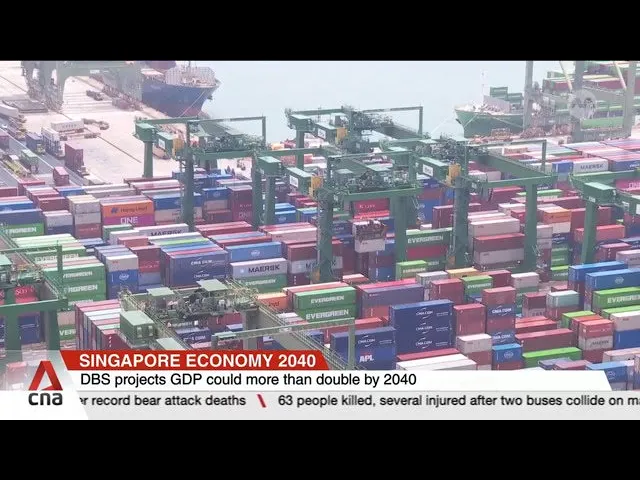
Welcome back. It's time for your business update. Singapore's largest lender DBS Bank says the country's currency could match the U.
S. greenback in the next 15 years. Its report also says by 2040 Singapore's economy could more than double.
We break down the projections. Now analysts see for the Singapore dollar to strengthen further. The country's labour productivity needs to outpace the U.
S. . And that's not all.
It needs to attract strong investment inflows and a sustained current account surplus. A continued weakening of the U. S.
dollar would also work in Singapore's fever. Now DBs is the Straits Times Index STI could vies to nearly 10,000 by 2040. And this year the benchmark broke a 17 years ceiling crossing 4,000.
It signaled a medium term bullish shift to reach the new milestone. It could be driven by global fund inflows and a top of that, a low domestic interest rate environment and support measures from the central bank would give some support. The measures include the 5 billion sing dollars Equity Market development program DBS is the country's real gross domestic product or GDP is growing and it could increase at an average of 2.
3% yearly until 2040. That means Singapore's economy could more than double to reach between 1. 5, 5 trillion dollars and 1.
8, 1 trillion dollars. That's up from about 710 billion dollars last year. This growth could be driven by more investment, better skilled workers and high productivity services me give the biggest boost.
Singapore deepens its role as a global hub. The report also highlighted several growth areas, these trade, financial services, energy and climate, the expansion of land sea infrastructure will also support the momentum expansion of the real estate sector with new homes and strong property prices will also provide some lift. Demand for healthcare and senior services could rise as the population ages unveiling the report to DBS CEO Tan so shot and urged companies to keep pace with rapid take changes.
She also called on firms to diversify the supply chain, both upstream and on the demand side, MS Tan, encourage companies to be bold and to stay competitive. So as we defend what we have. You know, we really have something going.
Everyone loves being here. It's an easy place to do what to live to do business. But can we disrupt the comfort?
Lauren? We willing to take one step back to take 2 steps forward. An economist says these projections a best case scenario.
The upbeat outlook depends on some key sectors like trade and connectivity. Singapore's ability to overcome obstacles will also be a factor. But it also comes with assumptions and how risks are mitigated.
Be able to get Sabri's to public could raise up a if the situation. The theory it will not be possible for Singapore to try even in some of the key said the see if the macro economy, environment tray or even the Wildcats, maybe inflation. What comes a couple will be caught between because if this inflation, the policy response might be to raise the interest rate and these will have to do pooch economy growth.
Speaking of the launch of the report, Singapore Central Bank Deputy Chairman Chee Hong Tat outlined plans to boost the capital markets. There also tends to strengthen Singapore's position as an international financial centre. This includes help for listed companies to create more value and prepare workers and firms to use AI.
He also says that the financial services sector remains a cornerstone of the nation's economy. Last year, the industry made up about 14% of Singapore's GDP grew by 6. 8% on year.
That's more than twice the rate of the previous year. The National Development Minister also noted that growth was broad based segments like banking insurance, capital markets and asset and wealth management helped propel the expansion. Mister chief says more details to help strengthen capital markets will be announced next month's and looking ahead.
He says Singapore will build capabilities and resilience, strengthen trade payment and financial links. They also plans to groom a pipeline of industry talent. We'll continue to invest in growing upskilling, our local workforce, ensuring that the I quit, but the skills and knowledge needed to try the new environment.
At the same time, we must remain open to attracting and integrating global talent that can complement our local workforce so that we can further strengthen the overall competitiveness of our financial services industry. And to delve deeper into the report we have in studio tonight, time or by who is the chief economist of DBS Bank. Welcome to the show.
Great to be here. Well, first of all, this report is very optimistic. Can you tell us about what the confidence is coming from?
It's optimistic. Not very optimistic. It was very optimistic will be focusing on making possessions like 3 and a half percent growth every year for the next 15 years on the back of massive capital inflow and massive pick up on for activity.
Thanks to AI. We're not doing any of that. So I want to this is more of a central optimistic scenario.
You can always go wrong. We do lots of things from trade war to tech disruption to aging that can hold growth back. But we feel look going through this pretty painstaking process writing this report, 20 analysts 125 Page report.
We feel that we have looked at these challenges and we've seen just station of solutions already in place. So that's the key issue that when we look at GDP doubling over the next 15 years, single pushing significant because the U. S.
dollar, these are based on trends and ingredients for them are already in place. We're not making them up from thin air. So let's toward deeper into the research than the report forecasts that Singapore's real GDP growth will average about 2.
3% annually. That's from a 2025 to 2040. It's going to outpace.
Advanced economies is also projection that over 15 years, which is a long time. What do you think of the critical drivers for sustainable growth at this time and also the possible risks? One word productivity.
There is a decent quantity of high school labors in this country. There's a lot of capital in this country. What we need is the leader in the capital to come together with the help of technology and good policymaking and boost productivity efficiency.
This has been a bugbear Singapore in the past decade and a half. We need to take productivity growth from very anemic levels to standard the some levels. Even if total factor productivity would agree with 0% over the next 15 years, they were in capital accumulation would take care of 22 to 2 and a half percent growth.
Not a problem. Let's look at another interesting finding in the report. It's predicting that the Singapore dollar could reach parity with the U.
S. dollar by 2040. What what?
What you see is the reason behind this projection. What is the impact of this? Singapore runs a large current account surplus.
The rest of the world find it worth their while to invest in Singapore, sustain flows, rules at the NBA level and the portfolio level would continue in our view. Singapore is also outpacing most industry economies in terms of productivity growth that will continue as well. And finally into the most important part is that there is this general tendency among global investors to look to diversify their support for the positioning and U.
S. dollar everybody's overexposed. They need a couple of countries out there with high reading good fundamentals, stable rule of law.
Singapore shines in those areas and thats what would drive the medium-term position of the exchange rate. And another interesting part of this report is that the STI is projected to reach 10,000 by 2040. What kind of specific reforms on market conditions do you think would be essential to meeting this time it?
First of all, again, rather conservative projection, we're not doing a pie in the sky projection. Very moderate mid-level earnings growth. Dividend ability decent performs.
The companies would propel Singapore STI to go to a 10,000 in 15 years. Time in our view, it would be nice to have the authorities paving the way for more financial sector liberalization, placing some capital. So the fund managers find it worth their while to invest.
Things are already happening under the Equity Development program. So we think that some not from the public sector, some degree of vitality in the local ecosystem of entrepreneurs coming up with interesting companies. Interesting ideas that can scale not just in Singapore but globally and then those companies get listed here moments dynamic like that gets unleash the rest of the world would be happy to put the capital.
Singapore stocks yet and time. Singapore has also aim to achieve net 0 emissions by twenty-fifty. What are some potential challenges you foresee might get in the we when it comes to securing long-term agreements with neighboring countries, for example, especially for renewable imports.
I just go back from the United States. There is G is a word that you want to use any Marcus. You want to push back at the federal government level against environmental and sustainability issues.
That is not the case in the rest of the world. When we look at China, when you look at Europe, when we look at Southeast Asia, move toward 0 net emissions continues unabated. Singapore needs cleaner energy cooperation with the rest of the region is important.
The region needs some degree of leadership on the technology side on the capital formation site whether discovered creating or green bonds. I think Singapore is the right place for the capital market activity on green transition to take place that itself would then fund and facilitate. Singapore's own green transition.
And speaking of that transition to green energy, Singapore fees, hydrogen as a key pillar of the path forward as you would see it. But given the high cost. And also, you know, the technological uncertainties, however, in this take on these timelines and also the targets for its implementation.
It's expensive. It's a long, arduous path. There could be setbacks, but we have solar.
We have when we have biomass related energy solutions coming up, we have small nuclear reactors coming back into vogue. So the menu of options to or to 0 or very low emission economy. It's pretty wide.
Hydrogen is a key EU potentially consequential element. It's not the only thing. Singapore has a few other cards up its sleeve so it will not be held back.
If there's a setback on the 100, yeah, diversification. He absolutely right key. Let's shift gears now to talk about health care spending.
So the report also projects that government healthcare spending will reach 30 billion sing sing dollars by twenty-thirty, especially driven by the aging population. So how does this report address the sustainability of this health care financing in the face of these rising costs and uncertainties? The rising cost is a given.
I don't think there's much uncertainty. We know the nation will continue aging and therefore, huge amount of solutions would need to be available in eldercare in logistics for the elderly and the whole suite of drug discovery. A new patient was his services old to be put in place.
So I think that asking for ages, just like the way Japan has a just with China Sea, we have to find business opportunities to take care of this aging population, keep them more productive, make them vital part of the economy. And I think that's where the opportunities and the value addition comes in. We are not looking at the silver Phuc ation of Singapore as a threat.
We're looking at as an opportunity time. I thank you so much for sharing your insights with a study.

![[Online Special] Why are our reserves a secret weapon? - Pt 5/5 | Singapore Reserves Revealed](https://img.youtube.com/vi/gt4XmU5xkP4/mqdefault.jpg)