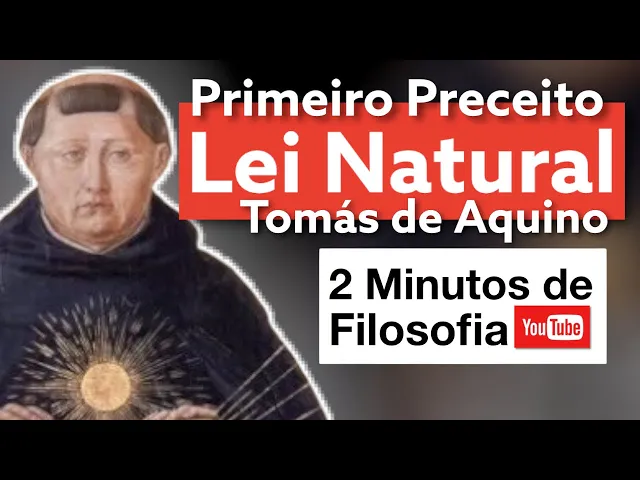
Hello everything is fine? Today, in another day of our two minutes of philosophy, we will see what the first precept of natural law is for Thomas Aquinas. Have you ever heard of jusnaturalism and natural law?
This is the law of reason. So, for Thomas Aquinas, what is the first precept of natural law, the one that is most general and most abstract? Don't forget to like the channel and activate the bell to be notified of future videos I will upload on the philosophy of law, theory of justice and theories of natural law.
Without further delay, let's see what the first precept of natural law is. In the Summa Theologiae, in the first section of the second part, question 94, Thomas Aquinas asks himself about the first precept of natural law, and he says that this first precept starts from the first principle of practical reason: the human being, as he chooses intelligently For what to act, he sets out in search of what he considers to be a good. So the first principle of practical reason, as Thomas Aquinas says, is that "the good is that which all things desire.
" And, based on this principle, human beings are able to conceive the first precept of natural law: "good must be done and pursued, and evil avoided. " To the extent that you recognize that something is good, you recognize that that which promotes that good should be brought into your life, and that that harms that good should be avoided. But Aquinas does not stop there.
He explains that the first precept of natural law is formal: "good must be done and pursued, and evil avoided. " But there are also many first precepts of natural law that are material. As good has the reason for the end and evil has the reason for the opposite, that which must be avoided arises from there.
All the things that human beings learn from reason as good must be sought, and that which harms them must be avoided. Aquinas says that we have natural inclinations that are shared with all substances. The first dimension of natural law includes those things that preserve human life, and the contrary must be prevented.
Secondly, the inclinations we share with animals, such as the union between male and female and the education of children, belong to natural law. Finally, Thomas Aquinas states that there is an inclination specific to human beings, which is the inclination to know the truth about God and to live in society. Given this natural inclination, we must avoid ignorance and not offend those we live with.
That was our two minutes of philosophy. Don't forget to like the video and share it with your friends to help spread this work on the philosophy of law and jusnaturalism. Also don't forget to comment here at the end of the video: do you defend natural law?
That is, the rational capacity of the human being to know those things that are good or bad, and that should be pursued or avoided? A hug and have a good week. These are the votes of Professor Leandro Cordioli.