At some point every evening, they disappear. One moment your yard is alive, Cardinals at the feeder, chickadees moving through the maple, a robin pulling the last worm from the lawn before the light goes. And then, in the space of about 20 minutes, they are gone.
The feeders are empty, the branches are still, the yard that was full of life an hour ago looks like a different place entirely. Where did they go? Most people assume the birds are simply somewhere else in the neighborhood, flying around, roosting vaguely in trees, doing whatever birds do when humans stop watching.
But the reality is far more specific, far more deliberate, and far stranger than most people realize. What happens to your birds between dusk and dawn is one of the least observed and most extraordinary parts of their lives. Tonight, while you are asleep, the birds in your yard will do things that would stop you mid-breath if you could see them.
Some of them will drop their body temperature by degrees to survive the cold. Some of them will pack together in spaces so small you would not believe a single bird could fit, let alone several. Some of them, the ones you never think of as travelers, will be flying hundreds of miles above your house in complete darkness.
Welcome back to Backyard Birdmind. Subscribe before you leave, because what you are about to learn happens every single night in your yard, completely invisible to you, and it will change the way you think about the birds you see every morning. Tonight, we are going into the dark, into what your birds actually do when the light leaves your yard.
Stay until the end, because the last thing we cover happens directly above your house on certain nights each spring and fall, and the scale of it is something most people never fully grasp. Number one, where your birds actually go when the sun sets. The answer is not where most people imagine, and it is different for almost every species in your yard.
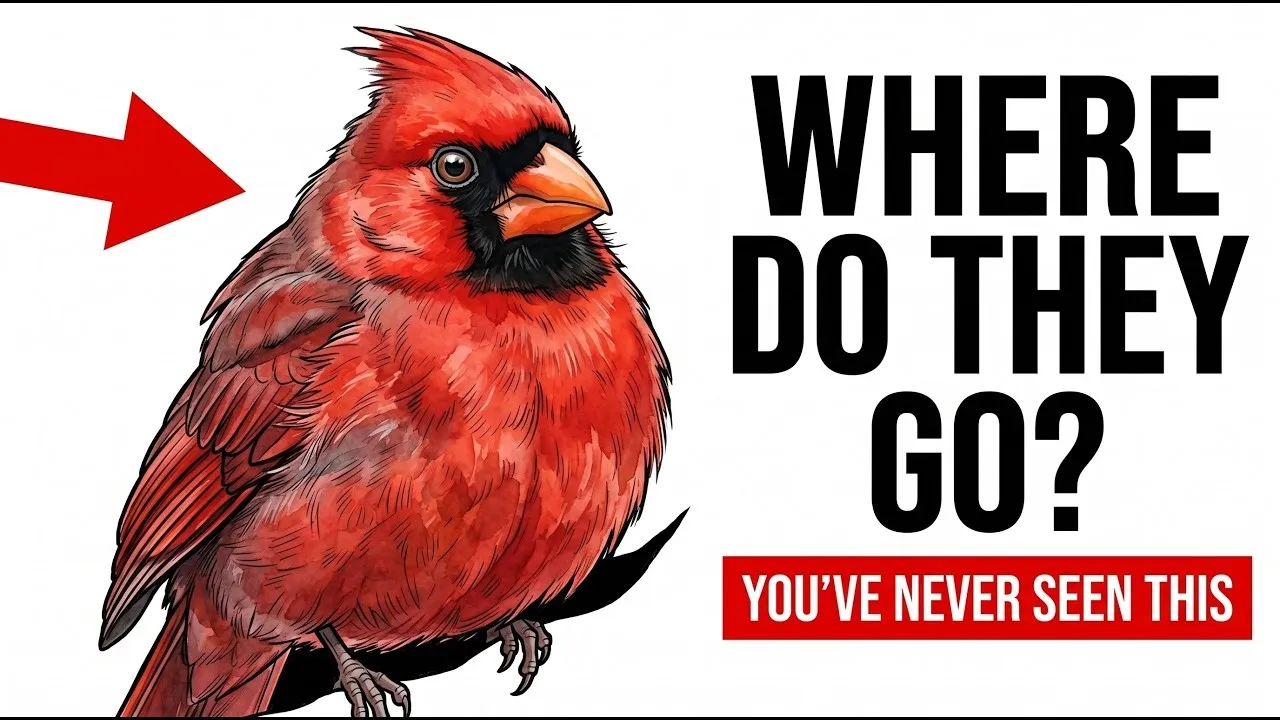
The Northern Cardinal is one of the easiest to track. Cardinals do not roost far from where they spend the day. In the hour before sunset, a male cardinal will move to dense vegetation, typically a thicket, an evergreen shrub, or a tangle of vines within a few hundred feet of his daytime territory.
He chooses the densest cover available, not for warmth primarily, but for protection. A sleeping bird is a vulnerable bird, and dense vegetation is the closest thing to invisibility a cardinal can achieve. He will go to the same roost site night after night for weeks or months at a time.
If you have a thick holly bush or a dense arborvitae hedge in your yard, there is a reasonable chance a cardinal has been sleeping in it every night this winter without you knowing. The chickadee's nighttime strategy is different and considerably more surprising. On cold nights, and in the northern United States, cold means anything below freezing, black-capped chickadees enter a state called regulated hypothermia.
They deliberately lower their body temperature by up to 22° Fahrenheit below their normal daytime temperature. Their metabolism slows dramatically, their heart rate drops. They are not fully asleep in the way we understand sleep.
They are closer to a controlled shutdown, conserving enough energy to survive temperatures that would otherwise require burning fat reserves they cannot afford to lose. A chickadee weighs about 11 g. That is roughly the weight of two pennies.
On a cold winter night, the energy budget of that tiny bird is so tight that without regulated hypothermia, it might not survive to morning. With it, it does, night after night, through temperatures that would kill an unprotected animal of that size within hours. The roost site matters, too.
Chickadees find cavities, old woodpecker holes, gaps in tree bark, nest boxes, and sleep inside them. The walls of the cavity trap the warmth of the bird's body and reduce heat loss dramatically. A chickadee in a cavity on a cold night is operating with extraordinary physiological precision.
Number two, the communal roost, when birds pack together to survive. Some of the most dramatic nighttime behavior in your yard involves species you would never expect to be social sleepers. The Eastern Bluebird is one of the most striking examples.
Bluebirds are territorial during the breeding season. A male bluebird defends his nest box aggressively from other males and will not tolerate close approach. But in winter, that same bluebird will squeeze into a nest box with up to a dozen other bluebirds and sleep pressed against them for warmth.
The territorial rules of the breeding season are entirely suspended. The calculation in winter is simple. Shared body heat means survival.
Researchers have documented nest boxes in the eastern United States that contained 12 to 15 bluebirds on a single cold winter night. Birds that during the day would not perch within 30 ft of each other, sharing a 6-in cavity without apparent conflict. The house wren does something similar, though less dramatically.
Carolina wrens, which do not migrate and face genuine cold survival challenges in northern parts of their range, will sometimes share roost cavities with other wrens, behavior that their daytime territoriality would make seem impossible. What this tells you about your yard is this. The nest boxes and dense shrubs you maintain are not just breeding infrastructure, they are survival infrastructure.
On the coldest nights of winter, those structures are the difference between birds that wake up in your yard tomorrow morning and birds that do not. Number three, how birds navigate the dark and what they are listening for. A sleeping bird is not fully switched off.
It is operating in a mode that most people never think about, a half-awake state of continuous environmental monitoring that researchers call unihemispheric slow-wave sleep. Many birds can sleep with one eye open, literally. One hemisphere of the brain enters a sleep state while the other remains active and alert, the open eye scanning for predators.
The sleeping and waking hemispheres switch periodically, so both sides get rest, but the bird is never completely unconscious in the way a sleeping human is. Cornell Lab of Ornithology researchers studying mallard ducks first documented this clearly. Ducks sleeping in a row at the edge of the group kept the outward-facing eye open, monitoring the environment, while ducks in the center of the group slept with both eyes closed.
The vigilance was distributed across the flock. The same principle applies to the birds in your yard. When a chickadee is roosting in a tree cavity on a winter night, it is not fully asleep.
It is monitoring. The snap of a branch, the scrape of a claw on bark, the presence of a predator moving through the yard, all of these can trigger immediate alertness. This is why the sounds of your yard at night are not just background.
The great horned owl that calls from the oak tree at 10:00 p. m. is being heard by every bird roosting within range.
The alarm call of a robin flushed by a cat at midnight travels to sleeping chickadees nearby. The nighttime yard has a sensory network running through it, even when it looks completely still. There is something worth sitting with in that.
The yard you look at through your window at midnight, dark, still, apparently empty, is not empty at all. It is full of birds in a state of active, distributed awareness, hidden in cavities and dense shrubs and the thick inner branches of evergreens, monitoring the dark with one eye while the other hemisphere of the brain recovers, ready to move in a fraction of a second if the information coming in through that open eye signals that something has changed. They are there.
You simply cannot see them, and they are paying far more attention to the night than you are. Number four, the birds you never knew were nocturnal. Most people think of their backyard birds as entirely daytime creatures, the cardinal at the feeder at sunrise, the chickadee through the morning, the robin on the lawn all afternoon.
Nighttime in this mental model belongs to owls and not much else. But several birds that you consider daytime yard visitors are doing something at night that would genuinely surprise you. The American robin is one of them.
Robins are early risers, often the first bird singing before dawn, which is why the robin features so prominently in descriptions of the dawn chorus. What most people do not know is that robins are highly responsive to artificial light at night. In urban and suburban areas, robins in well-lit yards will begin singing hours before dawn, sometimes as early as 1:00 or 2:00 in the morning, because the artificial light triggers the same hormonal response as natural sunrise.
If you have ever heard birdsong in the middle of the night in a lit neighborhood, it was almost certainly a robin. The mourning dove presents a different surprise. Doves are among the heaviest sleepers in the backyard bird community during the day, slow-moving, unhurried, seemingly oblivious.
But mourning doves are capable of remarkable nocturnal alertness when threatened. A dove that has been sitting motionless on a branch all afternoon will launch into fast whistling flight in complete darkness if a predator approaches. The wing whistle of a flushing dove, that distinctive high-pitched sound as the wings cut the air, is itself a communication signal that alerts other doves to danger even in the dark.
And then, there are the birds that on certain nights are not in your yard at all. Number five, what is flying over your house right now? This is the part that changes the way you think about the night sky above your neighborhood.
Twice a year, the night sky above your house fills with birds, not dozens, not hundreds. On peak migration nights in late April and early May, and again in September and October, the number of birds crossing over a single point in the eastern United States in a single night can reach into the millions. These are your birds, not exotic species from distant continents.
The wood thrush that visits your yard in summer, it left last October and has been in Central America since then. And right now, in late April, it is flying north at night above your house. The ruby-throated hummingbird that will arrive at your feeder in May crossed the Gulf of Mexico last night in one 900-mi non-stop flight, navigating by stars and magnetic field, burning fat reserves equivalent to a person running back-to-back marathons.
BirdCast, Cornell Lab's free migration monitoring system, tracks this in real time using weather service radar. On a peak migration night, the radar image of the Eastern United States shows what looks like an enormous weather system moving northward, not rain, not clouds, but billions of birds. The biological mass of migration is large enough to return radar signals that meteorologists had to learn to distinguish from precipitation.
This is happening above your house tonight and on many nights this spring. The birds that will spend the summer in your yard, singing from your trees and feeding from your feeders, are passing over you right now in darkness, navigating a continent by light they can see that you cannot, following paths their ancestors traveled for millions of years. The yard goes quiet at dusk, the feeders empty, the branches go still.
But what you are looking at when you see that empty yard is not absence, it is concealment. The cardinal is in your holly bush, the chickadee is in the woodpecker hole in the oak, its body temperature dropping, its metabolism pulling back to the minimum required to survive until morning. Somewhere above your roofline, birds you will not see until May are passing through in their thousands.
This happens every night. You have been living beside it for years without knowing the full shape of it. Now you know.
And the next time your yard goes quiet at dusk, the next time the feeders empty and the branches still, you will know that the birds have not gone anywhere. They have just moved into the part of their lives you have never been able to see. Tell me in the comments, have you ever heard birds singing in the middle of the night in your yard, or seen something moving through after dark that surprised you?
I want to hear about it. I read everyone. I'll see you in the next one.