On this dark day, Guillaume de Castelnac has no choice. He's going to have to fight. Around his home, which has been under siege for several days, enemy troops are preparing to attack. A sign of incredible success, this fortified castle, designed to withstand all manner of assaults, arouses envy and jealousy. But now, will it enable William to repel the enemy and restore peace to his lands? And above all, will he be able to protect the lives of his wife, his two daughters, his men and his villagers? At the foot of the walls, in the opposing ranks,
Seigneur de Vertou, the Castelnac family's hereditary enemy, believes he has won the day. The siege has lasted too long. The time has come to launch the assault. Lord, give me the strength to defeat this Vertou bastard. Once again, Guillaume finds that Vertou's cruelty knows no bounds. Father, for you, I will defend our honor, our lands and our castle to my last breath. Guillaume has a duty to uphold the Castelnac colors. By attacking, Vertou will make his castle the scene of a confrontation as terrible as it is inevitable. Blood will flow. We are in the thirteenth
century and this is the story of Guillaume, a valiant knight lord who grew rich through flourishing agriculture. All-powerful in his territory, Guillaume is traumatized by the death of his father, victim of an arson attack. Since then, he has had only one obsession: to finish his castle as quickly as possible to protect his wife and two daughters. For months, dozens of men and women have been working on the construction of his château, but the final stage is shaping up to take longer than expected. Visiting the construction site, Guillaume becomes aware of the difficulties faced by the
workers, and wonders whether his castle will be ready before winter. Guillaume must be dreaming of prestige. Prestige is at least as important as military value. It means a lot to have a beautiful castle. Father, as I promised you, this castle will stand proudly at the highest point of our lands. It will make our family famous. You should always build a castle on the highest possible point - a rocky outcrop - to be seen, and, above all, to be able to keep an eye on any enemy troops that might show up At any given moment. The
choice is also a strategic one, insofar as you may want to control a passageway, a road or a river. You also need to bear in mind the importance of raw materials. So you need to build your castle near quarries to extract stone, and near forests to use wood for decorations. wood for decorations, parquet flooring or carpentry, for example. At the quarry, the master builder must do everything in his power to avoid disaster. The facing stones that will embellish the château are not arriving fast enough. The construction site could come to a standstill. Hiring new workers
would be far too expensive. So he had to convince the stonemasons to be even more efficient. For the project manager, the stakes are high. The master builder is responsible for building a castle that comes close to the model indicated by the Lord or desired by the Lord. The Lord may have more modest ambitions, or be stingier, more thrifty or, on the contrary, much more ambitious. "I want better than that model." That's how it works. I can't control everything by myself. How can I trust all these people I don't know? There are men who are unqualified,
who can be people of the lord, i.e., they depend on the seigneury and are required to do chores, such as carrying baskets containing lime mortar the lime mortar used to make the joints, etc. Physical labor with no particular qualifications. Accompanied by his architect and steward, Guillaume realizes that it will be difficult to catch up. He's worried. His wife and two daughters are already settled at the château, but without the fortifications still under construction, his family remains vulnerable. At the head of the fortifications are specialized workers who are stonemasons, but who can also be masons. They
form a kind of aristocracy on the building site, and below them are the woodworkers, carpenters and joiners. And then, because iron is needed to repair tools, there are the blacksmiths, who are also paid a little less. There are also those who master the manufacture of lime. In a lime kiln, you have to build the kiln. Then there are those who make tools, because tools are always needed and tools wear out when you cut stones. So there are forges. Finally, there's a Whole world of of craftsmen and builders combining their skills. Diplomatically, the master builder reaches
an agreement with the stonecutters. A few pennies more for each of them, and the to a sufficient number of stones to supply the site. The master builder was able to deliver the good news in person to the Lord of Castelnac. Towards the end of the Middle Ages, a stonemason was paid a little more than other tradesmen working on the site. He earned about five deniers a day. That's enough to feed his family. He'll buy bread, he'll buy... He'll have a small rental house in a town, he's going to buy his work clothes. Whereas you can't
really feed yourself properly on a laborer's salary. There are Men and women in the labor force and the woman's salary is always half that of the male laborer. They're unable to live. It's impossible to live on a woman's wage. So the site will not be blocked. However, the race against time has begun. As day breaks, the cold has invaded the lands of the lord of Castelnac. Guillaume thinks conditions are ideal for hunting. His faithful gamekeeper has already spotted some prey. Naturally, he leads the troop to a site where the game passes to feed. At the
rear, Guillaume rides alongside Jean, his young squire. The Seigneur de Castelnac has agreed to train him to become a knight. The path is here, near the stream. I think it's high time For him to prove to me that he's ready to become a knight. Hunting is great training for war and part of his apprenticeship. It's only natural that Guillaume should take Jean hunting. It's how he learns to take up the knighthood. It's a ritual that's passed down from generation to generation, and above all, you have to respect the gestures of your ancestors. Guillaume wants to
know if Jean will be able to prove himself in this difficult shooting exercise. Since his arrival at the château, Guillaume has taught him everything he knows. Jean doesn't want to disappoint his mentor. Returning empty-handed from this hunting trip would be a terrible failure. Since their departure, the two men have not exchanged a word. Today, it's Jean who will have the honor of shooting first. The moment of truth was approaching. Until now, the main hunt had been wild boar or bear, which was really a hunt where you had to go hand-to-hand with the animal. And that,
the lise needle can't stand. And in the thirteenth century, the stag will become the noble animal par excellence. As he adjusts his shot, Jean knows his hand must not tremble. The opportunity is too good. A stag is within his grasp. But he misses. Guillaume and Jean practice a very specific form of hunting, that of military training after all, by learning to handle a bow and crossbow. It's a more ordinary kind of hunting. There's a bait hunt, Where you have to show off your power and wealth. This can take the form of hunting with hounds or
falcons. When you wanted to prove your nobility in the thirteenth century, one of the criteria was to own a pack of dogs. It's part of what's called living nobly. At his side, Guillaume anticipates the movements of fleeing game and aims right. Experience has made the difference. Jean feels humiliated. Throughout the Middle Ages, hunting was not a noble privilege. Peasants were allowed to hunt, but not on territories they called "The peasants were allowed to hunt, but not in the territories reserved for the lords. Peasants have the right to bring their pigs, for example, to eat glans.
He's also allowed to gather dead wood. But under no circumstances is he allowed to cut wood. Imagine if, for a single moment, he got the idea of hunting game. That would be absolutely dramatic for him. As Guillaume ponders his squire's abilities, he makes an unexpected discovery - a trap. The peasant caught poaching can't necessarily pay with money. So there's an equivalence system. If, for example, the farmer has hunted a roe deer, he will have to pay for a goat. If he has hunted a wild boar, he will have to pay for a pig. And if
it's a stag, the noble animal par excellence, he'll have to pay for the bull, which is also the most important animal on the farm. For Guillaume, this snare is a real provocation. Who dared to attack my game? I can't let such an affront go unpunished. If we take the example of Maho d'Artois, there's a farmer who's caught rabbits with a snare on his land, she makes him gouge his eyes out. It's costing him a lot of money because the executioner has to be paid. Tomorrow, Guillaume will go back to his village to solve this strange
case. The mood in the village is gloomy. Adélaïde, the wife of the richest villager, is in excruciating pain. She hasn't left her bed for several days. The attention of her relatives does nothing to help. The poor woman is wasting away, and we fear the worst. The priest administers the last rites to the poor woman, while at the other end of the village, Guillaume makes his entrance. He's come to get to the bottom of this poaching story as quickly as possible and find the culprit. The welcome he receives this morning is hostile, to say the least.
He's not welcome. That's how the ungrateful ones I feed thank me. It's me who should be showing them my anger. The relationship between the Lord and his villagers can sometimes be a bit like that between a company director and his employees, because it's in everyone's interest for things to go well. He has a domain that he exploits himself, called the reserve. The reserve is the part of the seigneury that the lord keeps for himself in direct exploitation, on which the peasants are agricultural workers, paid by him. But the bulk of the surface area is made
up of what are known as tenures, which are rented out to villagers, who pay what we'd call rent today, or what used to be called "sens". The lord's protection was far from free. Peasants had to pay their lords a kind of tax, known as taille. When the lord wanted to build a castle, he needed money, so the taille could be increased. They also had to pay him money to use the oven, the press and the mill. These are known as banalités. Contrary to popular belief, it's not the land, it's not the taxes on the peasants,
it's the rights of justice that bring in the most money for the Lord. Surprised by the welcome, the lord of Castelnac goes to meet Anselin, the villagers' representative. Guillaume trusts him completely, and hopes to find an explanation for the peasants' grumbling. Guillaume doesn't know anything about Adèlaide's condition, but he understands that something serious has happened when he crosses paths with her. and discovers Anselin's closed face. Calling on priests when you're afraid of dying is essential. You can't imagine things any other way. For medieval people, a bad death meant dying in an accident or suddenly, without
having had time to settle one's affairs and go to the afterlife. A good death can be very cruel, you can suffer a lot, but it's a good death because you've had time to say your goodbyes. time to say your goodbyes, dictate your will and say your prayers so you can go To heaven. Rough, austere and direct, Anselin, the village chief, has his ways with the Lord. Today, he has a different attitude, and Guillaume wonders if he's not about to be confronted with a peasant revolt he didn't see coming. In this tense context, he cautiously mentions
the snare found on his land. Anselin's reaction leaves Guillaume perplexed. The tension is palpable. The Lord's authority remains very clear. He has his sergeants, he has power, he has the possibility of violence but on the other side, they know how to defend themselves too. At the head of each village there are one or two village cocks. That's what we call them. The expression means that they speak the loudest. They're also called ploughmen, because they're the ones with the plough and the Ploughing train, i.e. oxen or horses. And sometimes, they rent them out to other farmers
at a good price. And so they also keep the other farmers on a bit of a leash, so to speak. There's a revolt brewing in my village, and I haven't the slightest idea what's causing it. What are they hiding from me? You can stand up to your lord. There must be meetings that look a bit like town council meetings. It must say, "No, but wait, we don't agree on this." And there's some sort of give-and-take. In an attempt to gain the upper hand, Guillaume suggests that Anselin bring his personal physician to Adelaide's bedside. It's a
gesture the villager appreciates. The village rooster finally crows and goes to explain to his lord why a peasant should poach. The village is Starving and in desperate need of food. Anselin also intends to persuade Guillaume not to force him to denounce anyone. When we think of medieval peasants, we tend to lump them all together. And in reality, that's absurd, and it was never an egalitarian society. There's a large majority of average peasants who live without hardship, who don't starve to death, and a fairly large minority landless peasants or peasants with small plots of land who
have to work for the Lord, but also, and more often, for the rich peasants of their villages. Arriving as soon as possible, the doctor could only observe the seriousness of Adélaïde's illness. As he administered his remedy, the doctor was well aware that the poor peasant would not have much longer to live. In the Middle Ages, people were often ill. We live in houses where it's very cold, so it's not uncommon to catch something, as they say. We drank water, but how do you know if it's drinkable or not, when you can catch any microbe or
bacterium by drinking water. And then there's the question of accidents in the workplace. Working in the field, you can cut yourself, you can hurt yourself badly. There are serious injuries. So you really need to be looked after in the Middle Ages, and to call on people who can help you. In the village, most medicine was done with herbs, a specialty of elderly women, the remedies of good women who were all at once midwives, bonesetters, a little suspected of being witches too, but who practiced white witchcraft In other words, they heal or prevent illness. In every
monastery, there's a plot dedicated to medicinal plants. And then There's the apothecary too, who have made potions that can work. The château also has a barber. The barber doesn't just cut beards and hair. He's also the equivalent of our surgeon. Physiotherapist surgeon, I'd say. He replaces limbs, cauterizes wounds. So, he's the one who's going to heal. Before Guillaume leaves, Anselin has time to point out that Rainier, the intendant, was well aware of the situation since the winter frosts. The vines have suffered and cereals are struggling to emerge from the ground. Everything was explained to the
steward. Why didn't Rainier tell me? What was he trying to protect me from? How could he think I wouldn't find out? Shocked by these revelations, Guillaume de Castelnac decided that a discussion with Rainier was imperative. This will take place in due course, when he decides to do so. At the construction site, Seigneur de Castelnac meets up with Rainier, his steward. Guillaume prefers to keep Anselin's comments to himself. Rainier knows nothing of the suspicions and doesn't understand his lord's sudden coldness. The intendant is the person who manages the seigneury in his lord's absence, or helps him
manage it when he is there. The intendant is not a noble or a knight, but a peasant who is much more aware of what's going on in the village, which is much more interesting, from that point of view, for the lord. He's halfway between the lord and the peasantry. He's often tough, sometimes a little cunning and sometimes a little dishonest. It's true that he can punish, he can ask for more taxes and put some in his pocket. Guillaume is on his guard. The architect tells him about the bad atmosphere on the site. Rainier's attitude is
mentioned, increasing Guillaume's doubts about him. The intendant is anything but popular, to say the least. He's a bit like the tax collector of the time. I don't know many people who like their tax collector, because the intendant, he's in charge of collecting taxes. The less you see of him, the better off you'll be. But fortunately for him, that's not his only job. The Lord often has a toll on the bridge. He has markets in the next town. The intendant is, in the final analysis, a steward in power. He's the one who sets the tempo. He
decides when and where the farmers will sow the seeds. He decides when in the calendar the farmers will go to the vineyard. He also decides, for example, to set aside a small spot in the forest for the pigs to be parked. Rainier tries to play down the delays. He refutes the architect's claims. He stubbornly refuses to discuss the workers' pay. For Guillaume, things are clear. His waiter is hiding something from him. He'll have to explain. It's very difficult to keep accounts in the Middle Ages, to know how much money you have or will have. Everything
depended on royalties, harvests, things like that. Being in debt is a chic thing. To be in debt, for a lord, is quite remarkable. We have a poem by a troubadour of the time, from the thirteenth century, which says "And old eternal and sad, he who has no debt." you have to die in debt. Now that's the way to live nobly. For Guillaume, the château is a symbol of the promise he made to his father. He also wants to offer his wife and two daughters a home worthy of their rank. But with winter approaching, Guillaume's dream
is fading. After November eleventh, Saint-Martin's Day, the building site comes to a halt because the mortar froze and the lime in the mortar wouldn't harden. That's why There's no construction between mid-November and mid-March. The idea of vacations doesn't exist. On the other hand, public holidays are extremely numerous. Between Sundays and public holidays, there are around ninety to one hundred days without work. William's castle, it can be built in a year or two, with no major problems in my opinion. No sooner had the visit ended than Guillaume curtly summoned Rainier to his study. Between the peasants'
grumbling and the workers' pay not arriving on time, he has good reason to complain about Rainier's work. The intendant's explanations are not convincing. They are not enough to quell the anger of the Seigneur de Castelnac, who prefers to interrupt the meeting. Today, the castle is in turmoil. Guillaume's vassals are getting ready for the feast organized by Seigneur de Castelnac and his lady Marguerite. At the Seigneur's table is a distinguished guest, Pastor du Mirail. He is deep in conversation with Guillaume. Although he has no title of nobility, he has made his fortune in the wine trade.
In reality, he's here because he wants to take a bridge over Guillaume's land, a shortcut that would save him time and money. This solicitation is providential for Guillaume. He saw it as an opportunity to finance the completion of his castle, provided he could negotiate the right of way as effectively as possible. The feast is one of the great poles of conviviality in the Middle Ages. The lord invites his vassals or neighbors. It was also a way of showing off his luxury and power. All vassals are obliged to attend the banquet. It would be an insult,
a casus belli, not to come to the banquet. The presence of Pastor du Mirail is the subject of much comment around the table. What's he doing sitting next to Guillaume? Why such an honor, usually reserved for the family and Jean, the Lord's new protégé? Rainier, for his part, is not at the party. Following his altercation, Guillaume has decided not to eat at the Lord's table. For the Lord, the feast is an extremely important moment when he relies on profusion. His guests are in for a real treat. It's no accident. It comes at a price, but
the Lord has a plan. In these feasts, where the Lord forges alliances, where he negotiates with his guest, he ultimately puts his Guest in a position of accountability. with his guest, he ultimately places his guest in a position of obligation. He makes his guest his debtor. When you've been invited to a banquet, you're obliged to make it even more lavish. Otherwise, you're admitting that you're inferior to the other Lord. Normally, a banquet is reserved for the nobility. And when you invite a bourgeois, a merchant, even a clergyman, it's a way of making him understand who's
the boss, who's in charge. In his heart of hearts, Guillaume is amused by all these comedies, but he has to put an end to them. By raising his glass with Pastor du Mirail, he makes it clear to the small gathering that the merchant deserves the utmost respect. If Guillaume flatters him in this way, it's because he hopes to begin his negotiations under the best possible conditions. It's all very hierarchical. The closer you are to the Lord, the more important you are. At his table, of course, are the people he particularly wants to honor. And it's
at his table that the best dishes will be served. The expression "to have the long arm" means that you can reach the best dishes, but above all, you don't ask "And over there, won't you pass me the pigeon dish?" That's not possible, that's very, very bad manners. Marguerite, Guillaume's young wife, also attracts a lot of attention. She's in charge Guillaume trusts her completely. Marguerite is capable of transforming these festive moments into unforgettable ones. The Seigneur de Castelnac hopes that his guest will appreciate the attention he receives. Dishes don't spin, they sit, meaning you can eat
what's in front of you. Over there, at the back, you'll find the Écuyer, the knights of modest stature. At this point, there'll be boiled beef, whereas over here, you'll have stuffed pigeons stuffed pigeons or cockerels or even a pan or heron. There's a huge hierarchy of flavors and the symbolism of dishes. People think it's nobler and better to eat birds than animals that drag the ground like pigs. Pigs are for peasants and lords will eat swans, herons and pans. After several hours of feasting, it's time for Guillaume to come to an agreement. He knows his
guest to be a shrewd negotiator. So Castelnac takes Pastor du Mirail away, away from prying ears. In the thirteenth century, people continued to sing chansons de geste, since they were sung poems. A chanson de geste is a song that recounts the exploits of knights. They were very, very, very fond of this kind of thing. There's a growing interest in novels that tell the stories of King Arthur and his knights of the round table. It's been a huge success. Everyone loved it, so much so that the lower nobility started naming their children after the story. Lancelot,
Tristan. It became a fad, a bit like today's American soap opera first names Jonathan, Kevin and so on. While the atmosphere is always more festive in the great hall, Guillaume's study becomes the scene of an incredible battle. The lord of Castelnac and Pastor du Mirail go head-to-head in a game of chess. For both men, equally determined, the confrontation begins. Playing chess means learning to defend the king and so on. But it's a common game. In the Middle Ages, chess wasn't necessarily played like it is today. The nobles and knights were more interested in strategy, and
played, I'd say, according to classical rules. And then there's another way of playing which is more linked to chance and uncertainty. Because we're going to play with a die. Depending on what comes up, it dictates the moves and pieces you have to use. Pastor du Mirail immediately adopts an aggressive strategy. He tells Guillaume that his sworn enemy Lord of Vertou, has made him a very attractive proposition. He offered to cross his lands for a minimal fee. For Guillaume, this was not a good start. What's this Vertou dog got to do with it? One way or
another, and whatever it costs me, Pastor du Mirail's wine will cross my land. For Guillaume, agreeing to play chess with a merchant means not dishonoring himself, but getting a little dirty. Well, the merchant is the villain, but because he's got an idea in the back of his head and he'll be able to put together a good contract that will not only bring him money, but perhaps also the merchant became totally indispensable in the thirteenth century. Guillaume doesn't want to give in to blackmail, but he also needs Pastor du Mirail's money to finish his castle. The
chess game continues. Negotiations are tense. If the wine merchant is smart, he'll lose the game to make himself look good to the Lord. Game over. On the chessboard, Guillaume has won. But in reality, he has lost the negotiation. Is the real winner the wine merchant? They say bad news never comes alone. So what are we to make of this letter received at the château in the middle of the night? Could it herald other dark omens? Guillaume will find out soon enough. Guillaume wakes up early, as always. The lord of Castelnac is in a rather good
mood. This is a special day. He has a nice surprise in store for his squire. But Jean will have to wait a little longer to find out. You really have to get over the idea that people in the Middle Ages were dirty. Bathing was quite common. Lords might have a kind of large wooden tub, lined with a cloth. Often, it was the couple who bathed together. It's part of courtesy. It's part of living nobly. Guillaume is still thinking about his difficult negotiation with the wine merchant. In reality, he's thinking mainly about Vertou's offer. He's certain
it's a new provocation and he has to admit he wasn't expecting it. Should he talk to Marguerite about it, so as to benefit from her valuable advice? For the time being, he prefers not to worry her. In town, there are what we call steam rooms. We go bathing there too, which sometimes have a bad reputation because because they can be places of prostitution. We used to wash in the country too. There were no public baths, only in town, but in the country, you simply used a bucket to fetch water from the river. We also washed
every day. No matter how hard Guillaume tried to keep up appearances, he was obsessed by Vertou's schemes. For some time now, this lawless lord seems to have been one step ahead of him at all times. This letter, which arrived at the château his bad feelings. It was one of his spies who sent the letter to William. Usually stingy with confidences, the lord of Castelnac shares his secret Information with Jean, his young squire. The message is clear. Vertou summons his allies and raises an army. Espionage and intelligence were alive and well in the Middle Ages. War
is always prepared underground in every era. We sometimes have a few indications for the Middle Ages on spies, which gives us the word spy. Espis are women, peddlers, itinerant merchants, even beggar monks, who come to see what's happening on the enemy's side, either to attack or in anticipation of an attack. But the missive contains another very alarming piece of information. Someone at the château is informing Vertou. Marguerite has no idea what is going on. She sees to her daughters' education and demands the best. To this end, she calls in a renowned tutor. Her intention is
clear: to educate her daughters well in order to qualify for the best possible marriage. Next to the castle, there's always a chaplin where the parish priest. He will give lessons in Latin to the boys and girls of the noble family, Latin grammar, singing - because you learn to read by singing - and music. Calculus is much more complicated, because we essentially calculate using the bac system. "Calculi" in Latin means pebbles. We put little pebbles in the columns. Coinage is complicated, because the smallest coin is the obol, worth half a denarius. After the denarius, we come
to the sous, the sol. A sol is twelve deniers. A pound is twenty sols. That doesn't simplify things. Blanche, the elder of the two girls, is lively and curious about everything. But she upsets Marguerite. Instead of needlework, she prefers long horse rides with her father. For Guillaume, she has only one flaw, not being a boy, the heir that fate stubbornly refused her. Her destiny as a little Chatelaine was to be a lord's wife and a mother. A mother and housewife who knows how to manage a lot of things, and who's going to be like a
small business manager, because running a château is a big job. Blanche tries to concentrate, but her mind is elsewhere. She recognizes characteristic noises coming from outside. The clash of swords. Unable to bear it any longer, she decides to slip away and head for the training tower. With each passing day, her warrior soul is revealed a little more. Blanche would like to fight and achieve the same feats as her father, An unattainable dream for the young girl she is. She'll know how to read, write and count, because she'll have to be elegant and cultured. She had
to be able to read poems aloud and play music. She has been brought up, of course, to be polite, delicate and modest. Then she prepares to be the mother of many children, pregnant all the time. She's not the equal of man, and at the same time, life shows women women of great character and psychological stature. Here we go, ready? Gentlemen, ready? Let's go! Blanche's eyes widen as she watches Jean, the young equestrian Guillaume has decided to train. All she wants to do is take his place. Until the age of seven, the little girls and boys
of the nobility are educated together by their mother. The little boy, of course, is on the side of the nannies and in the world of childhood and women. But he's well planned in his own head and in the minds of others that he's a future warrior. From the age of seven, it's time for a definitive separation, so to speak. The boy's military education really begins. He's taught to ride a horse, handle a sword and wield a spear. Hours and hours of training every day. And then hours to resist the cold, resist hunger, resist fear, resist
insults, become tough. For months, Jean has been assiduously putting into practice the advice of the castle's master-at-arms. Faced with Guillaume, Jean multiplied his assaults, but to no avail. The lord of Castelnac is definitely more experienced than he is. A squire staying with a lord to learn the trade of arms, it's often with an uncle or a relative. And there are emotional ties. This is almost always the case. Jean can't find the flaw. He gets angry and ends up losing his temper. Guillaume doesn't let anything get past him. He knows that the slightest mistake in combat
means certain death. Convinced that he is acting in his foal's best interests, the Seigneur de Castelnac taunts him and pushes Jean into a corner. Guillaume expects the best from Jean, as he will soon need him. He's counting on his squire to repel Vertou's Vertou, his sworn enemy. It's for this reason that Guillaume precipitates things and announces the surprise. He makes Jean a knight in his own right. "Adouber" is an old Germanic word meaning "to equip". So "equip" means the sword and often the horse too. And horses are worth a fortune. So the godfather, the one
who has supported his knight throughout his apprenticeship, who has welcomed him into his home, who has fed him, is going to spend money to buy him this equipment. Guillaume is proud. As he presents Jean with the weapons and spurs, he feels a sense of duty accomplished. If he's been harsh, it's only so that Jean will follow the path of loyalty and courage. For Blanche, this is too much. She prefers not to attend Jean's consecration. Consecration usually takes place around the age of fourteen. It's really what we call a rite of passage, meaning that we leave
childhood behind and enter adulthood. With this gesture, I knight you. You are free to leave to serve the Lord of your choice, but if you stay with us, I'll be proud and happy. The Lord who knights you will come and give you a pat on the back. It's a hard slap on the back of the neck. Over time, it will evolve and we'll use the flat of the sword. This is still the image used in today's films for knights. From the twelfth century onwards, the Church took over knighthood, and not only did it involve receiving
weapons, but it's also about becoming a knight who protects the widow, who protects the Orphan, who is loyal. During the ceremony, Jean keeps his face closed. He shows neither joy nor pride. What the Seigneur de Castelnac takes for modesty is something else entirely. Guillaume hasn't taken the time to organize a sumptuous celebration, as is customary in such circumstances. Jean sees this as the ultimate humiliation. Guillaume has a bad feeling. Vertou is too well informed. The lord of Castelnac is counting on Odeus, his astrologer, to tell him more. He always consults him out of sight. And
so it is that Odeus visits Guillaume at night. Why Des Conseillers de l'Ombre? Because the Lord is an anxious man by nature. He worries about the future of his offspring. Will they outlive him? Will he win the battle he's supposed to be waging against his enemy? For the astrologer, a threat hangs directly over Guillaume. He could be the victim of an ambush when he returns from the next tournament. As for the identity of the spy, it doesn't appear in Odeus' visions. All he can make out is a number. two and nothing more. There's this need
to have recourse to these shadowy advisors who are astrologers and who, at the time, at the same time trained as doctors and astronomers. It all blends together a little. All this was more or less tolerated by the Church. Is Odéus talking about my second in command? Rainier ambitious, Rainier a bit of a thief perhaps? But treacherous and manipulative, I can't believe it. Exchanges between the astrologer and his Lord must remain strictly within the castle walls. It must not get out. Guillaume wants to know for sure. He tests his expectations by suggesting a possible ambush. But
nothing shows on Rainier's face. If he's guilty, he's hiding his game well. Despite the prophet's dark prediction, Guillaume has decided to take part in the tournament. As if to defy bad luck, he has even brought Marguerite and her daughters. Guillaume made Jean his champion. The young knight will defend the honor and colors of the Castelnac family. In the second half of the thirteenth century, you have armor that is evolving quite rapidly. Knights retained the haubert, I.e. a chain mail that goes down to about the knees. On the head, the camaï de maille and a certain
number of rigid parts, i.e. the iron man, of course, the steel man, but also plates, i.e. metal elements placed on the shoulders, elbows, forearms and knees. Gradually, we're moving towards much heavier armor. For the young man, this first official joust is an opportunity to prove his mettle. A victory could change the course of his life. When Guillaume goes to the joust, he intends to show off, to meet his friends, for example, the young elders with whom he himself apprenticed, but also to see more powerful lords with whom he might negotiate a feud, a piece of
land. And then, in this case, he comes with Jean to introduce him. A lord can delegate his colors, a lord or a lady for that matter, to a champion who will fight on his behalf. It's the greatest mark of trust imaginable. Recalling his mentor's invaluable advice, Jean chooses his fighting weapon. For his part, Guillaume notices Rainier's absence. Why hasn't he come? Once again, the ominous prophecy of Odeus haunts Guillaume. The tournament is an extremely important moment. Originally, it was a ritualized war. It's military training. It's about showing one's worth as a warrior, but it's also
about showing fair play. It's not about kicking the unfortunate person who's down, it's about showing one's courtesy. The tournament is an extraordinary display of chivalry. You show off for your lord, your potential future employer and the ladies. For little knights without fortune, it's an absolutely marvelous opportunity for Social advancement. A good tournoyer is the best résumé imaginable in the thirteenth century. For Jean, the tournament is a wonderful chance to get noticed. In front of the grandstand, he looks for the noble lady to whom he can prove his strength and courage. A knight's worth is only
important if he has succeeded in seducing a lady. To become a knight, the rider literally needs a lady. A lady to save, a lady to impress. In fact, the tournament combines two things at once. It is both a warrior ritual and a ritual of courtly love love par excellence. Marguerite obviously supports her husband's champion. However, Jean's gaze for the dame de Castelnac is not lost on anyone especially Guillaume, who seems troubled. Courtly love, by definition, is adulterous love. You can't love your wife - it was frowned upon in the Middle Ages. The lover must love
his lord's wife. Always a lord higher than himself. In the Middle Ages, it wasn't the result that counted, but the ritual, the whole process of achieving a goal. In reality, she's not a real woman. She's just a kind of idealized woman who's made to honor her husband. In fact, by flattering the lady, you're flattering the husband. In the end, it's a rich duchess with a sulphurous reputation who throws herself Jean, much to Guillaume's relief. Jean will now face his first adversary. Guillaume has already fought and defeated him Guillaume knows just how formidable he can be.
Will his champion be up to the challenge? It's with fear in his belly that Jean's gaze darts forward. With diabolical precision, his opponent's stroke is unstoppable. In the stands, disappointment binds the faces. For Jean, disillusionment is cruel. The humiliation is total. The victor normally takes back the equipment and horse of the vanquished, and sometimes even demands ransom. For Guillaume, defeat is unacceptable. The honor of the Castelnac family is at stake. He must react. Without a thought for his young protégé, he decides to take up the challenge himself and takes part in the next joust. If
Guillaume had made Jean his champion and then publicly stripped him of this prerogative, It's a tremendous slap in the face. He loses face in the literal sense, because it's public. As a knight emeritus, Guillaume has chosen his tactics. He will lower his spear as late as possible his opponent from choosing his angle of attack. He doesn't want to be the laughing stock of chivalry. Victory is imperative. Our family came close to dishonor. I could never have lived with that. Despite the victory, Guillaume is worried. If Odeus' prediction comes true, the road home could be perilous.
To avoid endangering his wife and daughters, he has ordered them to return home under escort. But there's another reason for Guillaume to protect Marguerite. She has just told him she is expecting a child. Between Guillaume and Vertou, there is clearly a war of honor and vendetta. In old Germanic law, this is known as a faide. There's a blood feud that must be washed away in blood. There has been a murder on one side, an eye for an eye, a tooth for a tooth. Guillaume knows what Vertou is capable of, but he's not afraid to face
it, On the contrary, he's obsessed with avenging his father's death. Vertou, who seems to be particularly nasty, may decide not to wait for the retaliation. So, having killed the father, he'll try to kill the son. That way, he'll avoid the son's revenge. For the moment, it's not revenge that obsesses Guillaume. On the outskirts of the village, an unusual calm Lord from his thoughts. He fears the worst. We realize that these lords are very virulent towards each other, and that peace is an extremely fragile thing. Despite Saint-Louis's ban in twelve forty-five on private wars, these inter-seigneurial
conflicts lasted until the end of the nineteenth century. inter-seigneurial conflicts lasted until the fifteenth century. During a tournament, in fact, the seigneury is weakened. So it's fair game for Vertou to send men to forage or pillage the villages in its territory. enemy, knowing that the local Lord and his best men are elsewhere. So it's a very good idea. From the point of view of honor, it's absolutely detestable. Vertou's cowardice knows no bounds. He didn't hesitate to attack poor defenseless peasants. Between looting and prediction, Guillaume can have no doubt. If Vertou knows when and where to
strike, he has a particularly well-informed accomplice. They burn the churches, they take the peasants hostage, they make them pay ransoms, they steal the cattle, they burn the crops. It's really these private wars that create such a sense of insecurity in the countryside. Too weak to flee, Adélaïde, who had been in agony for several days, was found lifeless. Guillaume was devastated, but had to face the facts. Everything points to Rainier's betrayal. How could his faithful waiter, the man he trusted, become an accomplice to such a massacre? What stratagem did Vertou use to win him over? Guillaume,
like most lords of his time, must have been afraid of traitors, because there are as many as you want. They can be servants, they can be squires. You distrust those around you, and at the same time, betrayal is a terrible crime because in the Middle Ages, it was all about keeping one's word. And once you've given your word, once you've pledged your loyalty, it's the most horrible thing in the world to betray. Damn you, Vertou. I feared for my life and you slaughter my peasants. You can be sure I'll find you and avenge them. At
the château, Guillaume is still in shock. When these men return with a fugitive, the soldiers are adamant. It's one of the looters. He is immediately thrown into prison. The medieval prison is no place to spend a vacation. When someone is arrested, he's put in a room used as a gaol, which is often actually a cellar. He's interrogated, especially if he's an emissary of Vertou, an emissary of the enemy. At this point, he is subjected to questioning and brutally interrogated by one of Guillaume's men. For Guillaume, the arrest is a golden opportunity to regain the upper
hand over Vertou. He is prepared to use any means to make the prisoner talk. Contrary to popular belief, not every lord has his own executioner. Executioners are expensive. The answer William had been waiting for was not long in coming. The prisoner Confessed. Vertou, the sworn enemy, was indeed behind the violence and disorder in the Castelnac lands. He usually speaks very quickly. Vertou won't have such reliable men who can withstand torture. Besides, to turn someone over, very often, all you have to do is give him the coin. Despite the violence of his crimes, the accused will
have the right to a public trial. A shrewd strategist, Guillaume takes advantage the opportunity to set a trap and confound his betrayer. In the meantime, Guillaume feels the need to confide in Marguerite, his wife. Confessing that Rainier is probably is probably the traitor in front of his wife. To show such a lack of insight naïveté is unworthy of a lord of his rank. With her usual gentleness, Marguerite remains attentive. Like Guillaume, she's worried, but doesn't let on. On the contrary, the lady of Castelnac finds the words to comfort her husband. The couple of a seigneury
is a bit like a small family business that needs to be kept running. So we talk about doubts, worries, the people around us, the direction to take, the management of the estate. There really is a shared interest. The couple are united in their desire to run the estate together. This exchange does Guillaume a world of good, and he entrusts Marguerite with the broad outlines of the plan to catch the traitor. Together, they worked out the final details. The traitor will not be able to escape. The trial goes according to Guillaume's plan. The accused is quickly
found guilty. To avoid the death penalty, the pillager tries one last maneuver. He proposes a deal. The traitor's name in exchange for his life. The Lord hesitates. He wants to give himself time to think before accepting the prisoner's proposal. In reality, it's all part of William's plan. He hopes that the traitor has heard the terms of this arrangement and will attempt to eliminate the raider before he speaks. Contrary to popular belief, the Lord doesn't have all the rights. For one thing, he's a Christian lord. He is harshly condemned by the Church if he doesn't respect
Christian laws. The more important the Lord is, in the Middle Ages, a distinction was made between petty justice, medium justice And high justice. Low justice dealt with everyday matters, such as fines and minor offences, and was a form of justice that paid off. medium justice is already an armed robbery or a bloody brawl. High justice is all about capital punishment, and as a symbol of its justiciary power, are the pitchforks, the gallows and the pillory. The trap has worked. The prisoner is poisoned. It's not difficult to get the soldier who served the lethal beverage to
talk. He quickly reveals the identity of the poisoner. Guillaume is speechless. The traitor is none other than Jean. Afraid of being unmasked, the young knight takes the time to steal the castle plans before escaping. Powerless, Guillaume can only watch as the man he once considered his son flees. I was ready to give you my daughter and my castle. How could I have been so wrong? You don't deserve to live. I'll kill you with my own hands. The traitor is unmasked. Guillaume can once again place his trust in Rainier. He even decided to forgive him for
having enriched himself on his and the peasants' backs. He just asked him to return the embezzled money. Now it's time to finish building the château as quickly as possible. From Philip Augustus onwards, we see a castle designed to fight back and inflict maximum losses on the attacker. The castle is more like an organized war machine. Every possible angle of fire Is covered. As a result, any soldier wishing to approach the wall risks being caught in the crossfire from the towers to his left and right, and of course, above him, by the soldiers holding the wall.
In the company of the master builder, Guillaume can see the latest improvements to the castle. The defensive works are perfectly in line with his expectations. Enough to contain an assault and to retaliate. We're going to multiply the number of archers, and to ensure effective firing angles, for example, we're going to place them in staggered rows. On the outside, it looks like a simple narrow slot. On the inside, they flare out a little to provide a firing angle for the archer inside the tower. Thanks to this fortification, Guillaume feels reassured. He knows that his wife, daughters
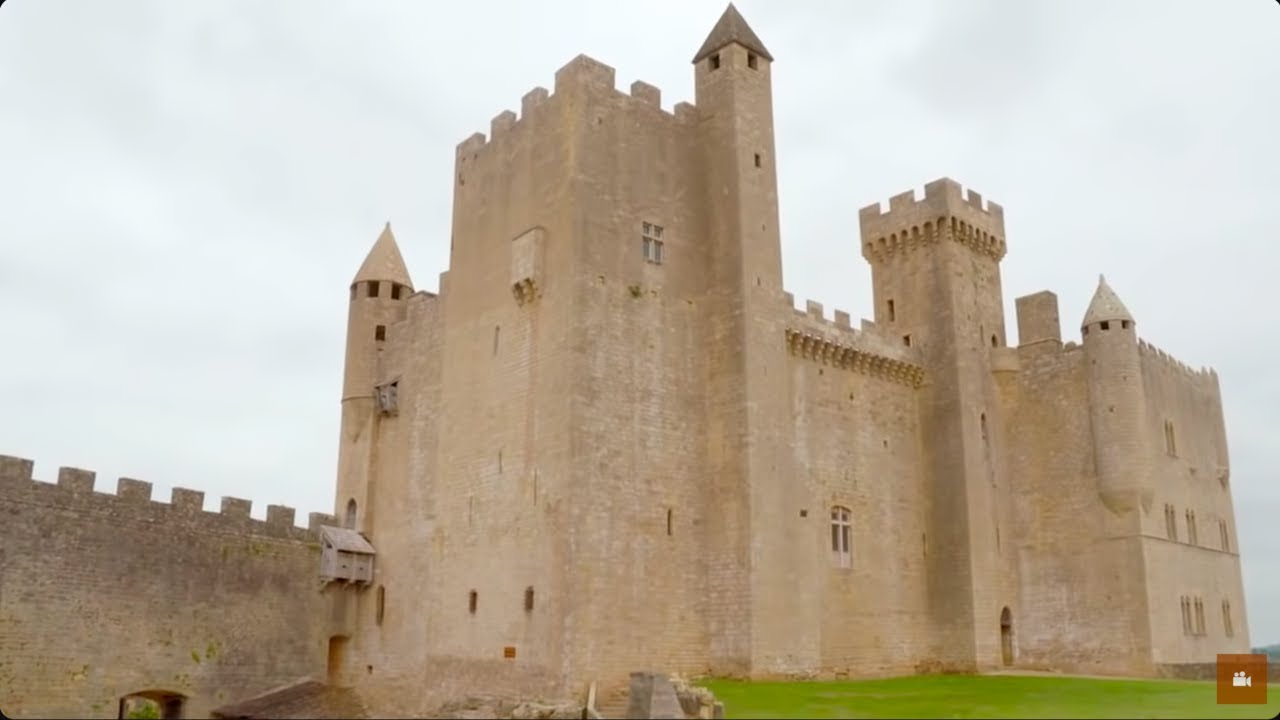
and unborn child are safe. The castle's defensive system against assailants also included the superstructures, the upper parts of the castle known as crowns. In the thirteenth century, these were essentially crenellated. There are other possibilities, such as placing the parapet walk more on the outside of the wall, projecting outwards. In such cases, machi- coulis are used. This allows for vertical shooting, with either archery or stone-throwing. William's château was built precisely to accommodate this active defense. Work was completed on schedule before the winter break. Guillaume was eagerly awaiting his hereditary enemy. Vertou will have all the trouble
in the world to take such a castle. The Seigneur de Castelnac doesn't like to be disturbed while reading, but today is different. Marguerite is in labor. Guillaume is in a daze, both impatient and worried. At this moment, he recalls with sadness that the previous birth had ended in tragedy. Marguerite had almost lost her life and the child had not survived. It was a boy, the son Guillaume had so hoped for. I implore your kindness, Lord. Give me the son Marguerite and I have been longing for. What seems to us today to be the most beautiful
day in a woman's life was both hoped for and feared by mothers in the Middle Ages. Female mortality between the ages of fifteen and thirty-five and forty is enormous. So a woman expecting a baby knows that she may die while bringing her baby into the world. Marguerite suffers martyrdom, but she clings to the idea of giving William a son. As the Lord's wife, this is her role. What's at stake in this room is the perpetuation of the Castelnac name and the future of the couple. In the Middle Ages, childbirth was really a woman's business. Men
were not allowed to attend, not even husbands. There were those known as matrons or midwives because they look after the mother's womb. Are there. These are truly specialized women who know a lot more than the male doctors. So they help the woman give birth. In a country home, in an isolated hamlet, it's possible for the father to help. It's obvious that these men, who see their ewes lambing or their cows calving may also have some kind of know-how. Marguerite's cries echo throughout the castle. In the bedroom, we hold our breath. Jeanne, the matron, understands that
the birth is going to be long. She is worried. She wants to keep the chatelaine and her child alive at all costs. If the baby doesn't turn out well, a Caesarean section will not be performed, or only very rarely. and they'll die without being able to bring their baby into the world. The other risk, which would last until the nineteenth century, was puerperal fever. In the Middle Ages, there was no cure for infection. Nothing. No antibiotics. One last time, the matron puts the baby back in its best position. It seems that this last gesture is
the right one. At the end of these interminable efforts, Marguerite is finally delivered. She gradually regains her composure. The baby's first cries are a relief to everyone. Not only are mother and child doing well, but, miraculously, it's a boy. There's a whole arsenal of superstitions to ensure that the baby is born in good shape. For example, knots are untied in the stable or in the house to prevent the baby from being strangled by the umbilical cord. And the Lord is always very keen to have a boy. So here too, there's a whole system of the
craziest possible ideas, all of them superstitious, to ensure that the Lord can have a boy. To have a boy, you need hot food, because man is hot by nature, while woman is cold. If the mother wants a boy, we'll tell her stories about knights and lions and tigers. So there's a whole by the female environment. Mothers, aunts, cousins and so on. Of course, when a baby is born, we're generally surprised. The nanny has to be a very good milkmaid, because to have milk, a woman already has a child. So she's not going to feed her
own child, which she'll entrust to someone else or feed her own plus that of the chatelaine. As well as being a nurturer, the nanny is a real surrogate mother. You could say she's really a second mother. She follows the baby until he's four, five or six years old. She accompanies him throughout his early childhood. Very often, she comes from the lower nobility Nobility, because the parents know that their child will be in good hands and receive an education worthy of his or her rank. Riddled with anxiety, Guillaume finally discovers his child. He can congratulate himself
on being the father of a handsome boy. My son, I welcome you. I promise I'll always be by your side. For Guillaume, this little man already has the Castelnac features. Tonight, the Lord is happy. A new arrival is sleeping at the château, and he already has a multitude of plans for him. The arrival of this child brings a breath of fresh air to the castle, an enchanted interlude. But the respite is short-lived. Terrible news has just broken. The Lord of Vertou's troops are on the march. Vertou, you've got the devil inside you, but I'm waiting
for you. I'm ready for you. If it's taken Vertou so long to attack the Castelnac estate, it's because he's taken care to surround himself with allies, lords he's managed to convince with false promises of power and money. Thanks to his reinforcements, his army is stronger and more dangerous than ever. Vertou, in fact, if he wants to attack his enemy's castle, has to call up all his allies. On his own, it's virtually unthinkable that he could carry out a large-scale attack. He needs many more men, much more equipment, much more time. So he'll call on allies,
relatives with resources of their own. That's how the siege will be possible. When the arrival of the enemy troops was announced, the peasants left the village in great confusion. By taking refuge in the castle, they place their lives in the hands of the Lord. For Guillaume, this is a heavy responsibility. Guillaume's castle is not just the Lord's castle, it's also the Seignerie's castle. Rural populations have a right to protection. So, in the event of an attack, they're the first to suffer, because it's their villages that are set on fire. They take refuge inside the walls,
and the Lord has no right to stop them. Vertou's troops will soon be at the foot of Castelnac castle. The felon can't wait to do battle with his hereditary enemy. In the early hours of the morning, there's an unusual bustle outside the château. The vanguard of Vertou's army is rushing to set up camp before their lord arrives. Everything must be ready on time, or Vertou will be furious. The camp master rudois his teams and they scramble. This flat plot of land is at a distance ideal for setting up the command tent. At the castle, too,
the siege was being organized. The bravest and most courageous peasants lend a hand to William's soldiers. On the Chemin de Ronde, all forces were requisitioned. All those who can watch out for, slow down or destroy the enemy are on guard. It takes enough time for an army to approach for the lord of the castle to be warned. This gave William the opportunity to to bring in provisions and ammunition. Arrows were cut, weapons were oiled and greased. Stones were brought in, and he also took vigorous, strong and resourceful men into the castle, And women too, who
will be able to take part in the defense. Our Lord! Captain! Opposite the château, Vertou entered the camp. His new ally, Seigneur de Bourdeille, accompanied him. The first phase of the operation was to isolate the castle and try to impress the besieged. To achieve this, the war machines will scare off even the most reckless. Vertou and Bourdeille hoped that the Lord of Castelnac will surrender before the assault. All the subtlety of the art of warfare is to avoid actually waging war. An army arriving at a castle will try to avoid sieging it. So, the first
phase consists in setting up siege machines, catapults, trebuchets and possibly even trebuchets, in full view of the besieged, trebuchets, even assault towers, to intimidate the defenders and encourage them to open their gates. You bring along military engineers with their teams. We bring planks, beams, ropes, metal, fittings, because it's out of the question to transport huge pieces of equipment huge machines that weigh tons. Vertou had thought of everything when it came to defeating his enemy. Machiavellian and calculating, he never leaves anything to chance. He tells the Seigneur de Bourdeille that he has convinced Jean, Guillaume's faithful
scuttle, to be his informant. The traitor has even delivered a document the plans for the castle. The opportunity to take the castle may come through treachery. Either the attacker, or someone in the attacking force has a snitch or traitor inside the castle, whom he placed there before coming. In general, the castles look pretty much the same and there's no mystery to it. But when it comes to certain weak points, it's important to know where they are and for someone to know. There's an agreement that the door should be opened, or that this corner of the
walkway should be left unguarded for a certain period of time. or that the postern is not very well closed and easy to break into, for example. In both camps, long days of waiting and worrying begin. The war of nerves has begun and is likely to drag on. Guillaume knows that time is on his side his favor, provided he can keep his men's morale up. Vertou, for his part, is multiplying combat training exercises to ward off boredom. The siege had to go fast, because there were no logistics. So, very quickly, men and beasts are hungry. We
ransack and pillage, we forage. The correct term is forage. We forage the country within a radius of forty km, but soon there's nothing left to eat. Men who don't get enough to eat are no longer good fighters. Under feudal law, a lord's knights owe forty days of oste to their suzerains. During these forty days, it's free. After that, if he wants to keep them to last The siege, he'll pay them. Of course, he also has paid soldiers - that's the right word for soldier. So he has paid warriors. If he runs out of money, they're
all going to leave. So sometimes a siege doesn't last for lack of money. After endless weeks, Vertou realized that Guillaume would not yield to the pressure of the siege. Lord Félon no longer has a choice. He can't wait any longer. He orders his men to build a final war machine. The hammer blows will echo late into the night. Lord, let this torment end, let Vertou finally dare to face me. For the men of the castle, this night has been particularly exhausting But they know the worst is yet to come. In the oratory, Guillaume prays as
he does every morning. Today, he appeals to the celestial to keep his family and men alive. Opposite the château, Vertou will once again demonstrate his determination and cruelty. He is about to pay Jean for his services services rendered when he suddenly changes his mind. The blow is fatal. Vertou has got rid of a character who was no longer of any use to it. Since Le chemin de Ronde, Guillaume has seen it all. The assassination of the man he regarded as his own son doesn't seem to move him. In fact, he has only one regret, That
of not having been able to kill the wretched traitor with his own hands. Halfway through the day, Vertou launches hostilities. To attack the wall, you need counterweight artillery, known as trebuchets. When there are two counterweights, it's called a couillard. At that point, you can send one hundred to one hundred and fifty kilo stones, always at a distance of one hundred and fifty-two hundred meters, so you have to be very ready. You can easily send five or six an hour. A lord like Vertou can't have more than two or three so you don't see that many
cannonballs. We try to attack the weakest point of the wall, especially those that have been mined or bombarded. So the curtain walls, which used to be fifteen to twenty metres high, are now Maybe only five or six. So we attacked from that side. And of course, the front lines were particularly hard hit by arrows and crossbows. Vertou's men managed to break through a gap in the wall. Then, using their axes, they storm the heavy gates of the inner courtyard. Hand-to-hand combat is inevitable. Eventually, the gates give way. After a brief moment of panic, William's soldiers
pull themselves together. Their lord can be proud of them. With swords and spears, they fight like hell. From the top of the curtain walls, archers try to prevent the progress of those who want to storm the keep, the refuge of the Lord's family. An assailant risks receiving an arrow, or rather a crossbow bolt, as the most accurate weapon In the thirteenth century was the crossbow, with a useful range of two hundred meters. But it's a slow weapon to reload, because it's very heavy and sometimes requires a small winch. If the shooter isn't protected, he runs
the risk of being shot while loading his weapon. The bow allows for shooting in different directions, including head-on, in the air, and vertically. The crossbow lacks this versatility. The crossbow is a taut, horizontal shot. It's much more powerful than the bow. It's much more effective on impact. With a bow, you can cover a maximum of fifty meters. The crossbow goes further, smashing even more into the chest of a battleship. On the other side of the château, a second wave of assault wreaked havoc. Bourdeille's men were able to break through. Guillaume's soldiers were outnumbered and unable
to stop the intrusion. The Enemy clearly had the upper hand. Vertou and Bourdeille were already dreaming of a resounding victory. But Guillaume had not said his last word. As a fine strategist, he modified his battle plan. He ordered a withdrawal to the courtyard of the keep to provide cover for his men and lure the attackers into a trap. An army attacking a castle needs to be much larger than the number of defenders. More to the point, there are many more professional warriors in the attacking army. William's strategy paid off. For the first time since the
assault began, the men of Vertou and Bourdeille are in trouble. Some of them are even beginning to retreat. To besiege it, there are all the projectiles you can throw from machicolis or warps. Boiling oil is part of the folklore, part of the image of the château fort that Was widely disseminated in the nineteenth century, But boiling oil is completely fictitious and fantasized about, given the price of oil and the difficulty of heating it. You really have to stick to the idea of You have to stick to the idea that you're throwing solid projectiles that can
knock people out, that can break a ladder you've put up against the wall, that can bounce off and dissuade someone from approaching, and so on. Sometimes, the women are up there too. The children have helped to put up the stones on the walkways. And there, you can sometimes find women who know how to throw stones very well. Back at camp, the lord of Bourdeille quickly realized that the outcome of the battle was increasingly uncertain. Before it's too late, he decides to recall his troops. Vertou is furious. He sees his ally as a coward and intends
to make him pay for his treachery. Traitor, felon, you shall hang. The assailants' last-ditch attempt was a resounding failure. Their corpses now litter the terrace of the keep. William's men had not fought in vain. The honor of the Castelnac family is safe. Guillaume savors this victory and can't help thinking of all the lives sacrificed. The time has come to make Vertou pay for all his crimes and ignominy. But vengeance will come later. Vertou fled cowardly. The Castelnac castle stood firm. Father, with this victory, I keep my promise. By restoring peace, Guillaume has also re-established a
climate of trust with The peasants. Harvests have been good for several years now. Every day, Guillaume thanks the heavens for giving him a son who already proudly bears the Castelnac name. You too, son, will be a true fighter.