I'm going to try and find an equation that will or derive one that will show us how energy is related for example if you drive your car to 50 miles per hour you want to pass a car you step on the gas and it goes now 70 miles per hour there's a change in the kinetic energy what made that change in kinetic energy that's your engine there's work done by your engine to make your car goes from 50 to 70 so you can pass that car now if you remember Newton's second law says F equals
MA remember that one theorem yep F equals MA remember that one from this equation you can write the acceleration as with F over m let's take another equation from the early chapters and that says V final equals what squared the initial squared plus 2a times theta X right let's use the instead of Delta X distance you know the distance traveled Delta X the new years D and in place of that remember that equation equation number five we found squared equals V initial squared plus 2a Delta X the distance traveled I decided to use D instead
of Delta X now let me do a substitution replace a here with F over m see it was do that substitution and let me play with this this becomes V squared equals v-0 squared plus I can read that 2 over m I'll make like this how about 2 times f D F times D over m and what is f times D what did we see early to the F times D equals what the work plan is with isn't that F times D and let me bring that V squared v-0 squared to this site survey found
squared minus v-0 squared equals 2 times W over m I don't like fractions to get rid of that I'm going to multiply the entire equation with M that means I might not matter this side by M and I'm gonna multiply this side by them to get rid of the fractions so 2 times W equals enormous lemongrab in the equation and V found squared minus M V initial squared and to solve for W are gonna divide each one of these ballot by 2 I met my better half doesn't really matter / - the same as multiplication
by 1/2 so what is the work then it's really 1/2 MV squared minus 1/2 MV initial squared the topic is kinetic energy this is ask you what kinetic energy kinetic energy is defined as one-half MV squared our book uses care sometimes I read ke for kinetic energy I'm guilty of using that that other book you just use is just care it's 1/2 the mass times the velocity square that's called the kinetic energy kinetic because something is moving if a car is moving it has kinetic energy you know it has kinetic energy because if it hits
another cars gonna dent it as a lot of energy in it and that amount of energy is the mass of the cloud times the velázquez divided by 2 or 1/2 that number now if you want you get to get your craft to go from 50 to 60 miles per hour how much work is done by you that is the change in the kinetic energy how much kinetic energy initially had now you stepped on the glass now you're going faster you're gonna have more kinetic energy the difference between them is the work done so work is
actually labeled as the change Delta means change in kinetic energy yep the change in kinetic energy which is one-half MV squared minus one-half MV zero squared we'll take few examples on that with these equations so these are the two equations that I'm going to be using the work then is the change in kinetic energy or one-half MV final squared minus one-half MV initial together one you should know the kinetic energy equals one-half MV squared we know that familiar today so so far these are the equations now let me take an example here a truck moving
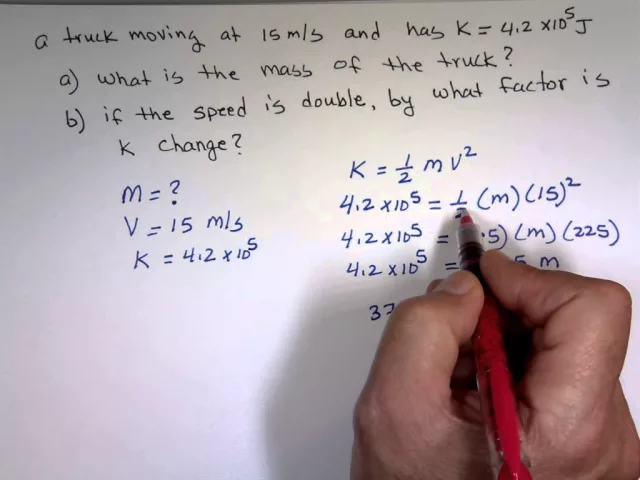
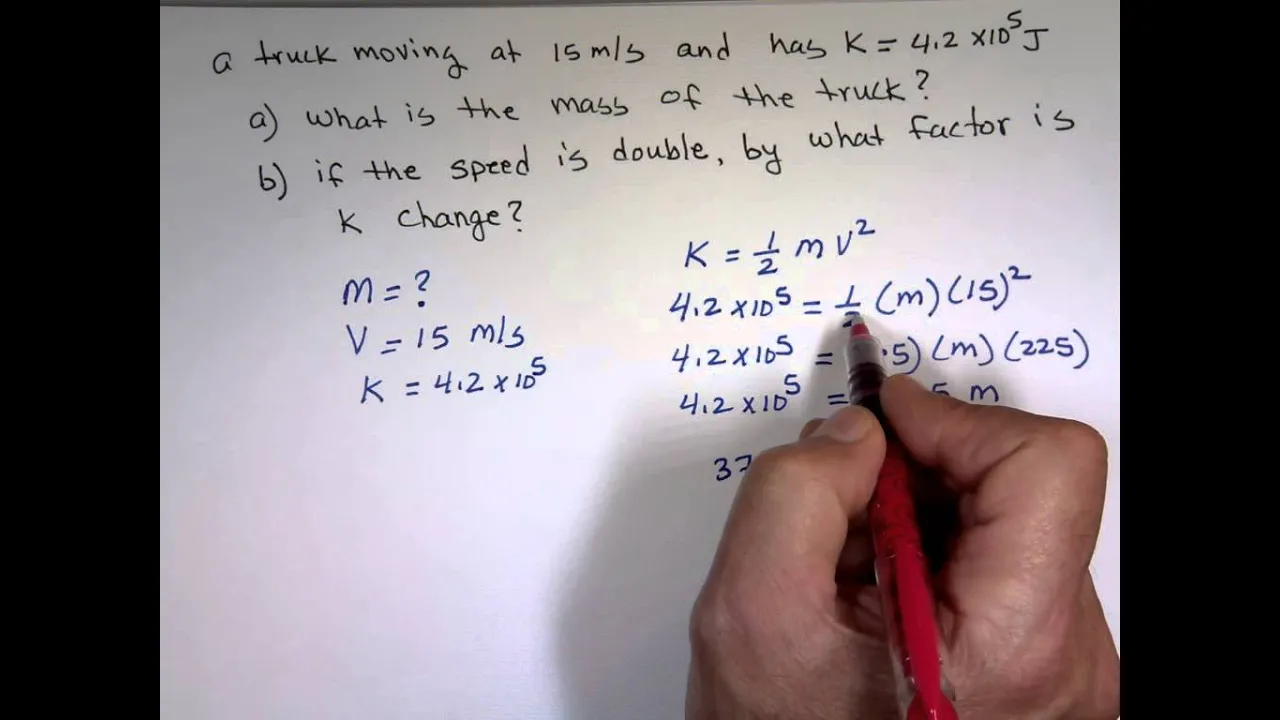
at 15 here we go we have a truck moving at 15 m/s and has a kinetic energy K kinetic energy equals four point two times 10 to the 5 joules 10 to the 50s question a what is the mass of the truck and question B if the speed is doubled come by what factor is the kinetic energy change by if the speed is doubled by what factor does the kinetic energy change well let's look at the first one we know the mass wouldn't have the mass of tech we're looking for great the mass is unknown
we know the velocity of the truck which is what 15 meters per second we know the kinetic energy which is 4 point 2 times 10 to the 5 is there an equation that tie these things together you have kinetic energy equals what 1/2 M V squared remember that two minutes ago do we know the kinetic energy for point two times 10 to the 5 equals one-half the mass is unknown the velocity is 15 you gotta square it 15 squares to 25 question Oh point five times M times to twenty five point five times to 25
its 112.5 and equals four point two times ten to the fifth what is the mass of the truck 4 point 2 to the power 5 divided by 1 12.5 and now go three seven three threes are you got kilogram fuse two significant digit that's three point seven hundred or times ten I was what I changed my mind halfway through its thirty seven hundred or you can read that three point seven times ten to the third kilograms and no either way work two significant digits now if we bubble that it says if the speed doubles by
let's factor I will say four right because that's going to be two times that number when you square the - what's the factor four because that doesn't change and that doesn't change I'll show you the math let's double that speed so now what is the kinetic energy of the speed is double one-half we know what the mass is three seven three three and now the speed is doubling instead of 15 becomes what 30 squared square the 31st or of operations times three seven three three times 0.5 the kinetic energy which is with one six seven
nine eight five zero joules let's compare it to that number so what is one six seven nine eight five zero divided by 4.2 times ten to the five let's see if that number equals to four three point nine nine nine six so what is that four times and again if you double that number you write two times that when you square the 2 becomes 4 that's why arch if the speed is doubled to energy changes by a factor of four when you're going five miles per hour than your head of car you're not gonna pay
as much damage as you go in ten miles per hour fifty miles five versus a hundred the damage by 100 miles per hour is a lot worse than a lot worse than going 50 miles per hour let's try another one there we go example to accelerate a certain car from rest so we have a car initial velocity equals zero at rest accelerate that to a speed yeah pick a number four then five a speed of five meters per second how much work is required for this we call w1 and my next question would that be
the same amount of work as to give the car from five meters per second to now double that ten because that work to so to go from zero to five how much energy is required and to go from five to ten how much energy is required and do you think these values will be the same well let's look at the first case to go from zero to five meters per second how much energy or work is required it's even the word work because work is changing kinetic energy so the work required as bad engine to
go from zero to five meters per second let's find out how much work is required that's w1 we say work is change in kinetic energy which means one-half the mass of the final speed squared velocity minus one half the mass the initial velocity squared now I never give you a mass for the car we can leave the answer in terms of M or we can use a number you want to use a number instead let's pick a mass for the car thousand kilogram between two hundred pounds that's what an average car is Honda Accord Toyota
Camry by twenty two hundred pounds no so let's see how much work is required so the work two girls I'll be 1/2 the mass which is a thousand what is the phone velocity for the first case found velocity of the cloud from zero to five so ever found velocity is five and you're going to square that minus one half the mass which is a thousand times the initial velocity which is zero is it 12,500 jewels I think 12 five let's see the work required now to go from five to ten meters per second again work
is change in the kinetic energy which is one-half MV final squared minus one-half MV initial squared the mass is what a thousand found the last is ten squared minus one half a thousand times the initial velocity is five squared and look how much work is required thirty-seven thousand five hundred years I lap mare jewels almost what is that / 1250 three times that amount so the faster you're going out you the more that work your need to give the car to move faster and the reason because you squaring that number you're going from 55 to
65 or 55 to 60 I can tell you what that number to go from 55 to 60 I'll just do all my calculator ready for that number from 55 to 60 will require two hundred and eighty seven thousand five hundred joules two hundred and eighty seven thousand five hundred joules now all these farms I'm assuming it's actually you're on a flat surface because of the surface not really flat then that changes I'm assuming the force is constant is the force always constant the answers really no not always constant there are cases where the force is
not constant like what how about spring the more you stretch it what happened to that force the more pulling on it right so as you come closer and closer and closer that force started decrease so and there are some cases where the force is not constant or we dealing here with this section with a constant force you