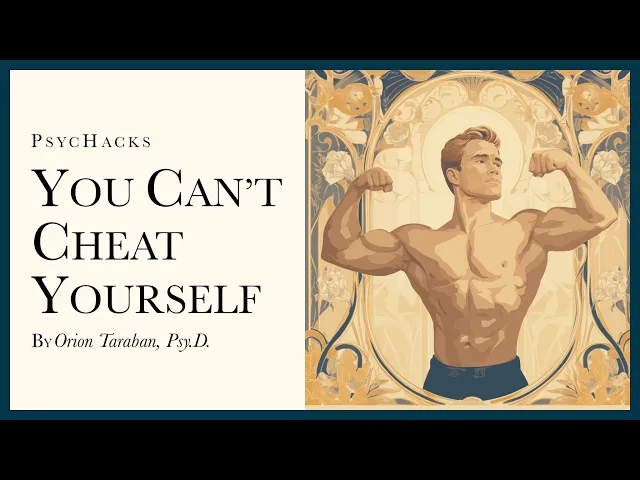
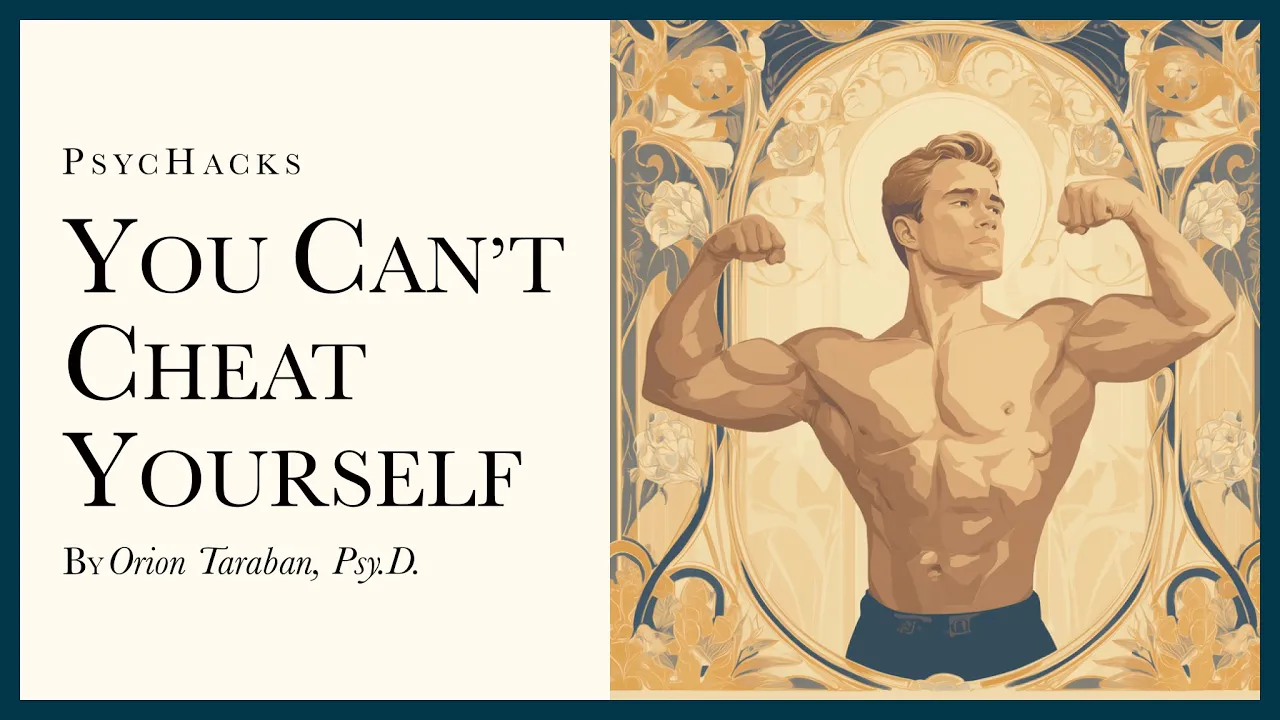
I'm Dr Orion Teraban and this is Psychax better living through psychology and the topic of today's short talk is you can't cheat yourself. You can cheat other people but you can't cheat yourself. And there are a number of important consequences to this reality that I want to discuss with you today.
To begin with, let me explain what I mean when I say you can't cheat yourself, but you can cheat other people. Well, let's imagine that you hired a trainer who asked you to do eight reps of a heavy press, but when the trainer wasn't looking, you only did five and passed it off as eight. Now, you might succeed in tricking the trainer and succeed in eliciting the same validation from him as if you had completed the full set, but you absolutely did not trick your body.
Your body cannot be deceived. It will note that you spent less time under tension, that you completed fewer reps, etc. , etc.
And if repeated over time, this continued deception will create real and observable differences between those who cheat and those who don't. You can't fake the delta in physical strength you develop by completing eight versus five reps. And this, of course, will make it harder and harder to continue to deceive the trainer.
By the same token, you could potentially take someone else's notes into a test and trick the teacher into thinking that you know more than you actually do. And if you're clever enough, you might succeed in deceiving the teacher and succeed in eliciting the same score from him as if you actually knew what you seemed to know. But you absolutely did not trick your mind.
Your mind is not deceived. Pretending to know something can only fool other people, but it can't fool yourself. And if repeated over time, this continued deception will create real and observable differences between those who cheat and those who don't.
You can't fake the delta in skill in any behavior based on your understanding or mastery. And this of course will make it harder and harder to continue to deceive the teacher and so forth and so on. Basically, you can cheat other people, but only for a time.
And you can only cheat people for a time because you can't cheat yourself. And because you can't cheat yourself, the differences between actually being and merely seeming will become more and more evident over time. But it is true that you can cheat other people.
And this is why there are so many frauds in the world. People are more likely to become frauds when two conditions are met. A when they really want something someone else controls and B when they desire the thing more than the process of obtaining the thing.
Both are required. For example, a validictorian might really want something another person controls, say an A from her teacher, but she typically enjoys the process of learning. And it's this commitment to the process that on some level lends a guardianship against being tempted into fraud.
Make sense? Now, people want all kinds of things from all kinds of people. And they learn from the time they are children that they can at least some of the time get those things by merely seeming as opposed to actually being.
This is a risky gambit, but given the fact that seeming is almost always significantly less work than being, a certain percentage of people will always resort to fraud a certain percentage of the time. We can blame their morals or their character, but it's really an economic calculus, even if entirely unconscious, coupled with the satisfaction of the two criteria already discussed. You don't have to get angry if you understand.
And what's more, your understanding is much more likely to create social structures to prevent fraud than your anger is. If you appreciate the insights on this channel, I would highly encourage you to get your hands on a copy of my book, The Value of Others. Over the course of 432 pages, [music] I delve deep into my economic model of relationships and explain the behavior of both men and women in the game of mating and dating.
I also provide a lot of actionable advice on how [music] to get and keep more of what you want in the sexual marketplace. Once you read The Value of Others, you'll never look at relationships [music] the same way again. Now available in ebook, audiobook, and paperback formats.
[music] The links are in the description. Now, to complicate this issue even further, it's sometimes the case that people actually are a certain way, but they don't seem a certain way. And this lack of seeming often causes them to get passed over in reality.
People often say that we shouldn't be deceived by appearances, but my brother in Christ, what else are we to go on? That's like saying we shouldn't be deceived by empirical evidence, which in order to be so must appear to our instruments. People only have appearances to go on.
They can't search your secret heart or your eternal soul. So don't chide people for using really the only source of data they can acquire to make their decisions. This means that to get the things we want from other people, we have to seem as well.
In most cases, it's not sufficient to merely be. If they fail to keep up the proper appearances, people often don't continue to secure the interpersonal outcomes associated with being the thing itself. This means people can sometimes get what they want from others by seeming without being and that they can sometimes fail to get what they want from others by being without seeming.
And this is why especially in cultures and communities that rely on short-term or anonymous relationships, we typically see a prioritization of seeming over being. And in cultures and communities that are founded upon long-term personal relationships, we typically see a prioritization of being overseeming. It's not really about values because most people will only abide in their values at their own personal loss to a point.
It's about a rational and often unconscious calculus with respect to risk, value, and other economic principles. Of course, the best would be to both be and seem to be as you are, right? Socrates once said that if you're concerned about other people's opinions, it's best to be as you would seem to others.
And I would agree with that, as it's also typically easier to seem a certain way if you actually are a certain way. So, how do we go about cultivating our being? Especially in light of the fact that being is always more difficult and expensive than merely seeming.
Well, as previously mentioned, it's a good thing to enjoy the process of becoming. People who learn to love the process of becoming typically persist in that process far longer as they find participating in that process rewarding over and above the rewards they may receive from being which might be a long way off. Enjoy the process of becoming and you will not only be less tempted to fraud, but you will often eventually receive better outcomes as well.
And the second way is by cultivating selflove. Now selflove like love is a concept that gets thrown around a lot without deep consideration as to its real meaning. But it's actually quite simple.
If love is sacrifice for the good of the other, then selflove is sacrifice for the good of the self. That's it. And this means that self-love is generally not about doing what feels pleasurable or relaxing in the moment.
It's about sacrificing certain things now for the betterment of the self now and in the future. Why? Well, let's bring it full circle.
If you can't cheat yourself, then every time you say resist procrastination, you have enacted a form of self-love as you are sacrificing certain things now like watching another episode of a show for the betterment of your future self who might as a result have advanced closer to his goals like building a business or taking care of his fitness or getting better with women etc etc. You could potentially cheat others by making them believe that you are making progress without actually doing anything. But you can't cheat yourself.
And self-love is the mechanism by which you resist the all too human urge to do so. Hopefully that makes sense. But what do you think?
Does this fit with your own experience? Let me know in the comments below. And please come on, send this episode to someone who you think might benefit from its message.
I know you know someone who needs to hear this because it's word of mouth referrals like that that really help to make the channel grow. Other value ads. Anyone looking to join my free weekly newsletter for which I write original content or book a paid one-on-one consultation with yours truly can do so on my website.
There's also my best-selling book, The Value of Others, in which I explore my economic model of relationships, and my private member community, The Captain's Quarters, where, among other things, I host bimonthly group consultation calls and Q&As with invited guests from all over the internet. It's a great group. Check it out if you are so inclined.
The links to everything are in the description below. And as always, I appreciate your support and thank you for listening.