The perfect biceps training needs some things I took years to gather, and this content is gold! This muscle will look just incredible. First, how do we stimulate the muscle to hypertrophy?
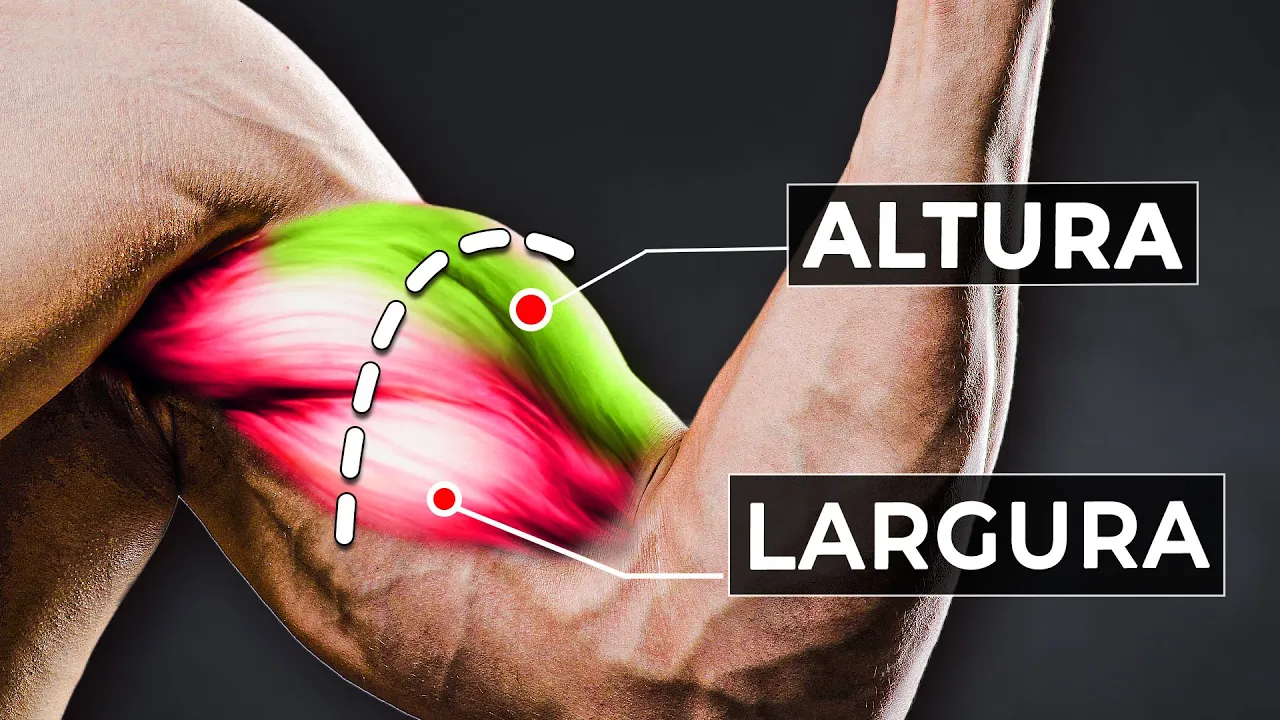
There are 3 main things that we need to include: mechanical tension, muscular hypoxia and tissue damage. When we say "bi", we are talking about two heads in this muscle. One of them is stuck to the bone, if you move the arm up and down, it makes no difference.
However, there is another more salient head, which comes from all the way up, going through your shoulder. Save this info, because we'll cross all that, and that's where you'll the genius - in this workout. - Ha, genius!
We'll start like this. Remember the three factors I mentioned? We'll focus on them, to get the best use out of them, using the exercises with their peculiarities.
The first one we'll include is for you to exert a lot of strength. When you do that, you optimize the use of your central nervous system by turning the biggest number of motor units, which is an entire circuit starting in your brain and going to the muscle, telling it to contract. The exercise which does that has medium stretching and shortening, as science says that when the muscle isn't stretching or shortening a lot, it is stronger.
The long head goes through the shoulder, right? If I put this arm back here, I stretch it, and here I shorten it. So, I'll place it in the middleway point.
You can do biceps curls at this moment in your workout. It's a simple exercise, and you'll do with an elegant posture, flexing and extending your elbows. A common mistake that people do a lot is moving their elbows away, dissipating their force vectors.
Other muscles are working more, the biceps are working less. Also, don't swing. If you swing, the weight goes to the swing, not the biceps.
That's not nice. Proper posture, tucked in elbows. What do we want here?
Overload, to make the nervous system work and turn on the muscles. Something else we get: mechanical tension. Remember?
You need to write things down. We have 3 things to check, so check them! When we talk about mechanical tension, - we're talking about tension in your muscle.
- I'm dying! When you have a huge load, there are several sensors in the muscle's membrane, and when the muscle tenses a lot, they feel that, and the pressure in the muscle is gigantic, the muscle is receiving a large load, and the membrane tells the muscle's core to grow, things are getting wild. Which means we are stimulating hypertrophy via mechanical tension.
How many sets? It's the first exercise, so do 2 warm up sets, and then you do 3 to 4 sets. This exercise is here to add weight.
I want you to do heavy sets. Don't cheat, so rest more, about 90 to 120 seconds between each set. Now, for the second exercise, I want muscular hypoxia.
That's essentially what happens when there's no oxygen in your muscle, and studies show that this improves hypertrophy through IGF-1 growth. It's GH's cousin which makes everything grow. To stimulate muscular hypoxia, we'll sue an exercise which leads a bigger shortening, specially to the long head.
Scott curls. It can be done on a machine or on a bench. I prefer the former.
If we emphasized the overload on the biceps curls, here, we'll emphasize the shortening stage. You'll bring your arms in and squeeze it more, adding that extra shortening. On a Scott machine, the fact your elbows are higher, you shorten the long head, the one responsible for the biceps peak.
Which means you're stimulating that head through active insufficiency, when the muscle is shortened, and you can add peak contraction to make that muscle more pumped, and it comes in to make that muscle contracted for longer, shortened for longer, and thus, it has less oxygen. It leads to muscle hypoxia. Biceps curls leads to mechanical tension, and Scott machine curls, muscular hypoxia.
For the Scott machine, I want a bigger number of reps, because we want to keep that muscle more time under tension, consuming all the oxygen in it, and it'll reach hypoxia. Just a detail: that muscle will burn a lot, it'll be frying, so you'll do a bigger number of reps, around 12 to 15 reps, but trying to apply the "No Reps" methodology, which is based on not being stuck on the number of reps, but on the feeling of muscle resistance. The rest time between sets can be shorter, around one minute.
Now, the third exercise. Let's rewind: biceps curls, overload and mechanical tension. Then, Scott machine curls, hypertrophy through muscular hypoxia.
And now, tissue damage. We get all that and orchestrate it in a way that one optimizes the other, which I do on Muscle 60D, for all the workouts. Here, you understand what I do for the biceps.
Imagine the other muscles. Now, what we'll do. Raniel, did the Scott curls shorten the muscle?
Yes, it got hardened. It tensed up, it got hard and it hurt. Imagine if we stretched this now.
This tighten muscle, imagine stretching it. Now, we'll move to the third step, the tissue damage. Elongating it to damage the tissue as much as possible.
The exercise which works the biceps like this, stretching it, are the 45° curls. When we do it, we stretch the long head. You'll be seated on an inclined bench and will place your elbows back, already elongating the biceps.
Your hands can't go beyond the line of your chest. If it does that, you are taking the elbow from where it shouldn't have moved. Listen, when we did the Scott curls, didn't we optimize it's shortening factor, with peak contraction?
Now, for the 45° curls, it stretches the muscle. Now, you are going to force that stretching, moving your arm down to elongate that fiber, and we are optimizing the characteristic we want, optimizing the tissue damage. You can do 3 to 4 sets of this exercise, and this will rely on your periodization.
All this is ready on Muscle 60D, and the rest time doesn't take long, around 1 minute. In this video, we prepared a quad workout, taking into account all the science you saw here, but we directed it to the quads. Click it, having skinny legs is not a good look!