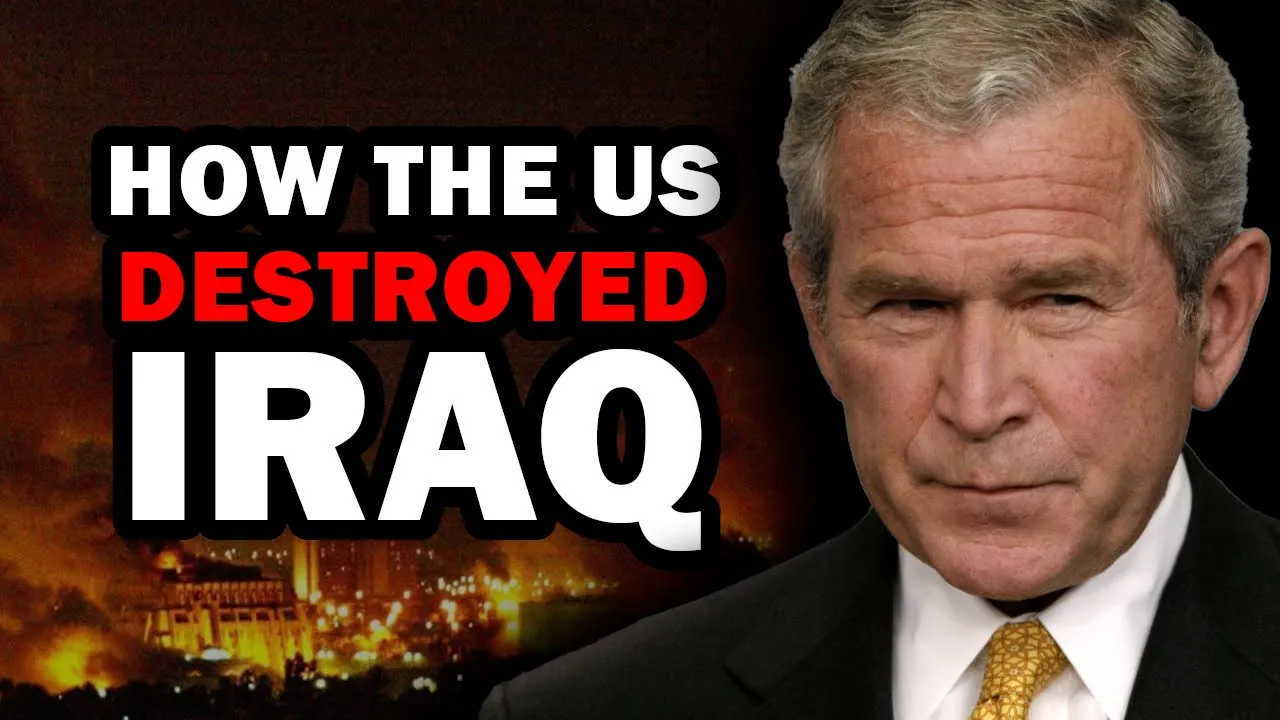
Jason Washburn I was a Corporal in the United States Marine Corps my first two tours were with uh the first Battalion fourth Marines Charlie Company during the course of my three tours The Rules of Engagement changed a lot for example during The Invasion we were told to use Target identification before engaging with anyone but if the town or the city that we were approaching was a known threat if the uh the unit that went through the area before we did took a high number of casualties um uh we were basically uh we were allowed to shoot whatever we wanted it was deemed to be a free fire zone so we would roll through the town and anything that we saw everything that we saw we engaged it and opened fire on everything and uh [Music] it's been 20 years well since the second American invasion of Iraq to many Iraqis the War Began in 1990 not 2003. nonetheless 2003 certainly marked an incalculable unimaginably massive and World altering cataclysm so where do I even begin I'll start before 1990. we'll ask hard questions first what exactly was taken away and what exactly was destroyed in Iraq throughout the year 2023 the 20th anniversary of the second Iraq war I'll be covering stories related to The Invasion and if you want to support me and get a glimpse of behind the scenes action or join my Discord server or watch my two graphic for YouTube Abu grave documentary check the link in the description or go to patreon.
com gdf official to become a patron it's a great community over there and we'd love to have you I also accept donations through PayPal and cash app and those are on the screen now also those links are in the description as well now on to the video in 2001 DrW kreisel of the World Health Organization prepared a report titled Health situation in Iraq it's worth quoting at length because it obliterates the common view of Iraq that was portrayed to me as a kid quote before 1990 Iraq with a GNP per capita of 2 800 US Dollars belonged to the group of middle-income countries the large investments in infrastructures and in Human Resources development had led to the development of an efficient health system that was considered one of the best in the Middle East malnutrition was virtually not seen as households had easy and affordable access to a balanced dietary intake Healthcare Services were guaranteed by an extensive network of well-equipped well-supplied and well-staffed health facilities the access of patients to higher levels of care was easy and effortless supported as it was by a distributed network of secondary and tertiary hospitals and institutions ambulances and Emergency Services were well developed and benefited from a properly maintained network of roads and Telecommunications water and sanitation services benefited from large investments in water and sewage treatment plants during earlier decades assuring nearly universal access to Abundant safe drinking water and to a relatively clean environment electricity had been made available even to remote Villages end quote indeed kaisal Paints the picture of a somewhat modern country the bath regime provided free health care and education for virtually everyone proportionally Iraq had a very large middle class but as has been well documented the bombing campaign during the Gulf War was one of the most ferocious in modern history Human Rights Watch would describe the destruction in abysmal terms quote the recent conflict has wrought near apocalyptic results upon the economic infrastructure of what had been until January 1991 a rather highly urbanized and mechanized Society now most means of modern life support have been destroyed or rendered tenuous Iraq has for some time to come been relegated to a pre-industrial age [Music] the air campaign targeted vast quantities of critical civilian infrastructure including water treatment facilities food processing plants food and Seed storage warehouses flower mills and even a dairy plant being a modern country Iraq was heavily reliant on electricity and the deliberate bombing of its electrical grid decimated as Central Services such as water purification and distribution sewage removal and treatment the operation of hospitals and medical laboratories and agricultural production a Harvard study team would report on the ground on the effects of not only the bombing but also the notorious sanctions placed on the country all the way to the second invasion according to them War damage and continued sanctions led to a virtual collapse of basic public services such as Healthcare water supply food distribution sewage and sanitation pathogenic microbes born in the contaminated water supplies are creating epidemic levels of waterborne diseases typhoid gastroenteritis and cholera are epidemic though many quibble over the number of just how many died from starvation and disease a figure of five hundred thousand children was given to then U. N Ambassador Madeleine Albright by reporter Leslie Stahl we have heard that a half a million children have died I mean that's more children than died when in Hiroshima and and you know is the price worth it I think this is a very hard choice but the price we think the price is worth it Iraq would hit rock bottom in 1994. hospitals ran out of medicines and even soap to wash bedding malnutrition was widespread infant mortality exploded clean drinking water was unavailable in many areas and runaway inflation virtually wiped out the new middle class but despite this Iraq was miraculously able to make somewhat of a comeback rebuilding power stations and transmission lines Building Bridges and treating sewage even oil exports were able to moderately increase and by 2000 Iraq was earning more than 30 billion dollars from oil exports in many histories of the war 911 is the turning point and in many ways it was but the reality is that the writing was on the wall for several years after the Gulf War the U.
S spent roughly a billion dollars a year to operate a no-fly zone over Iraq a strategy known as containment things took a dramatic turn in 1998 when President Bill Clinton launched yet another bombing campaign on The Battered country that same year a letter would be drafted by a small but influential group of conservative Republicans calling for the end to the containment strategy as well as Saddam Hussein's ouster the letter is significant since several of its authors would come to hold prominent positions in the coming Bush Administration and were key players in planning the war these included Paul wolfowitz Donald Rumsfeld Richard Armitage future un Ambassador John Bolton and several others who would move back into the government three years later this click part of a small but influential group known as the neoconservatives pushed relentlessly to turn the tide of Republican opinion in favor of the war which would bleed into the liberal mainstream following the invasion of Afghanistan and the subsequent fall of Kabul the formal plans for an invasion of Iraq began in earnest What followed was a sustained years-long disinformation campaign straight from the Bush Administration that's how this he is not developed any significant capability with respect to weapons of mass destruction he is unable to project conventional power against his neighbors became this we know that Saddam Hussein is determined to keep his weapons of mass destruction is determined to make more and not only the Bush Administration but also of course the liberal media most notoriously being the work of Judith Miller of the New York Times Miller got the ball rolling as early as December of 2001 when she quoted a so-called Iraqi Defector who claimed to have helped renovate facilities used for weapons of mass destruction or wmd turns out it was a complete [ __ ] story just entirely as noted by Jonathan landay of the now defunct Knight Rider in May of 2004 Miller's article was published three days after the CIA and defense intelligence agency rejected the so-called defectors account as quote unreliable turns out he had even failed their lie detector test Miller's journalistic standards proved to be particularly sloppy admitting that there was no means to independently verify the defectors allegations nevertheless a Pandora's Box had opened and Judith Miller would be one of the most prominent Hawks during the lead-up to the war the Bush Administration and a disgraced fraudster named Ahmed chalabi would be the Principal source of Intelligence on Iraq's wmd chalaby was a Shia Iraqi Exile who founded the Iraqi National Congress or Inc a cia-backed group responsible for fomenting Saddam Hussein's ouster chalabi would be propped up as a candidate for the future leader of a liberated Iraq what's obvious now is that his intelligence was again total [ __ ] in fact chalaby eventually switched his Allegiance and began feeding intelligence to Iran after the invasion his importance though cannot be overlooked according to Bush's Chief defense adviser Richard pearl one of the neoconservatives who was considered to be one of the architects of the Iraq War Ahmed chalabi's organization the Inc has been without question the single most important source of intelligence about Saddam Hussein and it was chalabi's so-called intelligence that would fill the pages of the New York Times in an embarrassing internal email to Tom's colleague John Burns Judith Miller admitted that Ahmed shalabi quote has provided most of the front page exclusives on wmd to our paper the importance of Miller's reporting can't be overlooked either one of the most Punchy sound bites from this era you know the one where the Smoking Gun turns into a mushroom cloud that was a quote from Miller's article from September 8 2002 that same day Condoleezza Rice would pair at the same quip on CNN but we don't want the Smoking Gun to be a mushroom cloud we cannot wait for the final proof The Smoking Gun that could come in the form of a mushroom cloud I believe that that you helped the administration take us to like the most devastating mistake in foreign policy that we've made in like 100 years but you seem lovely combat for the Iraq War Began on March 20th 2003. while it was still the evening of March 19th in the United States like the war itself the initial attack was based on [ __ ] intelligence Saddam was supposedly at a complex of houses west of the Tigris river called Dura Farms he wasn't and they lobbed cruise missiles and two thousand pound bombs at nothing in the six long weeks of the 1991 Gulf War the U. S Navy had fired 288 Tomahawk cruise missiles on the second day of the 2003 Invasion on March 21st U.
S forces would fire over 500 in a single day from March 20th to May 2nd the weeks of quote major combat U. S forces dropped more than 30 thousand bombs on Iraq as well as 20 000 precision-guided missiles which was 67 of the total number ever made 1800 aircraft flew 41 000 sorties in just the first month of the war according to Central Command Chief Tommy Franks who oversaw U. S troops during The Invasion quote B-52s b1s and a whole range of Air Force marine and Navy fighter bombers would be flying above strike aircraft of all sizes were moving over a wide curve Kill Zone end quote this so-called Kill Zone stretched over 100 miles east and west just south of Baghdad Frank's continues quote the bombardment that lasted from the night of March 25th through the morning of March 27th was one of the fiercest in the history of warfare end quote ten thousand civilians were probably killed in just the first three weeks of the bombing and whole areas were completely obliterated by the heavy use of cluster munitions just 13 000 cluster bombs dropped on the country exploded into two million bomblets and the ones that didn't explode were effectively turned into land mines ground troops with close support from helicopters swept through the South and made their way towards Baghdad a force of about 145 000 troops formed less than three Army divisions there was also one large Marine Division and a British division about 250 tanks and 250 Bradley Fighting Vehicles made their way up from Kuwait they were confronting a weak ragged military that was a third the size of what it was during Operation Desert Storm roughly a decade earlier They seized airfields Bridges and oil fields on the way on the night of March 28th as U.
S troops approached Baghdad the U. S military destroyed most of the city's telephone Network four telephone switches were hit with massive 5 000 pound bunker Busters which instantly cut millions of phones across the city in all they would Target 12 of baghdad's communication centers by April 2nd there was barely a phone working in all of Baghdad in the Frantic Panic of the Air Raids it was now impossible for Iraqis to call family members loved ones to see if they were all right and if they were still alive and it wasn't just the phones that were targeted but also television and radio transmitters making watching or hearing any news of the assault feudal the Western media whose coverage was heavily tailored by the US military made liberal use of the term smart bomb as they did notably under the first Gulf War referring to precision-guided Munitions the term smart bomb denotes a highly calculated accuracy but while precision-guided bombs fare well under controlled tests in the real world on the battlefield so-called smart bombs are vulnerable to all manner of environmental factors that may change its trajectory these include human error mechanical malfunction software error the fluctuating accuracy of GPS weather and just poor Military Intelligence as noted by an investigation by Human Rights Watch The Real World efficacy of the so-called smart bombs was overwhelmingly negative quote all of the 50 acknowledged attacks targeting Iraqi leadership failed while they did not kill a single targeted individual the strikes killed and injured dozens of civilians end quote but the targeting of civilians was no accident the magic number was 30. said Mark garlasco garlasco was the pentagon's chief of high-value targeting during operation Iraqi Freedom quote that means that if you hit 30 as the anticipated number of civilians killed the airstrike had to go to rumsfelder Bush personally to sign off end quote in the opening of the war according to the New York Times over 50 of these more than 30 civilians killed strikes were called and every single one was approved the reporting of these casualties was not an undertaking of the military whatsoever which went all the way to the head of Central Command who said simply quote we don't do body counts on other people thankfully a massive epidemiological study led by Les Roberts of Johns Hopkins University would provide a serious and vitally important figure that would cause a major upset in the liberal press the year was 2000 and Les Roberts a PhD alumnus and regular lecturer at Johns Hopkins embarked on a study for the International Rescue committee where he was tasked with estimating the numbers killed as a result of the second Congo War which is now considered the deadliest war since World War II as a veteran epidemiologist Roberts was uniquely suited to study the Fallout from such a war the spread of disease is of course one of War's most devastating characteristics so his specialization in studying disease via sampling and surveying was valuable Roberts and his team would disperse throughout Eastern Congo the epicenter of the conflict and conduct a survey of over one thousand households participants were asked various questions including if anyone in their family had died and if so then how the data were extrapolated to Regions across the Congo the results were grim They concluded that 1.
7 million excess deaths had occurred since the start of the war in 1998. this included two hundred thousand from direct violence and well over a million more who had died of disease malaria diarrhea diseases that otherwise could have been treated had the war not occurred and to drive the point home the areas with the most violence accounted for the most excess deaths this was because quote the higher the number of victims of violent deaths the higher the number of victims from infectious disease and malnutrition access to any kind of Health Service is severely limited in areas where there is a high level of violence or for populations forced to flee unrest end quote this study was as far as I can tell uncontroversial when it was released its estimates were held in high regard and was subsequently cited by the UN Security Council when voting to send more peacekeeping troops and increase Aid to the Congo Colin Powell cited the figure while he was Secretary of State Powell's State Department would increase Aid to Congo by 10 million dollars following the study unless Roberts would testify before Congress about his research liberal Democrat and conservative papers alike would cite Robert's number without question Roberts would even make the New York Times quote of the day on June 9th 2000. when Roberts was summoned to conduct a similar survey of Iraqis following the U.
S Invasion seemingly everyone's opinion of Robert Soward and his otherwise highly regarded methodology would now be put to new and wildly intense scrutiny in September of 2004 the war in Iraq had been going on for 17 months and Roberts along with a team of researchers at Johns Hopkins would disperse throughout Iraq and Survey roughly a thousand households again over 8 000 people in all with similar methodology asking households if any family members had died and how the results this time round were again staggering in just over a year and a half Robert said Al concluded that there had been over 100 000 excess deaths in Iraq the result of the survey published in the prestigious landsat medical journal was vastly different from the figures that were used at the time which were just in the low tens of thousands but it wasn't only the scale that made the report daring but also its assertion that the majority of those killed were killed by the combined U. S led Coalition I'll read a sample of the report directly which is needless to say worth quoting at length quote violent deaths were widespread and were mainly attributed to Coalition forces most individuals reportedly killed by Coalition forces were women and children making conservative assumptions we think that about 100 000 excess deaths or more have happened since the 2003 invasion of Iraq violence accounted for most of the excess deaths and air strikes from Coalition forces accounted for most violent deaths end quote the study describes how before The Invasion the main causes of death were from heart attack and stroke but that quote After the War Began violence was the most commonly reported cause of death end quote out of a cluster of 61 violent deaths 58 or 95 percent were killed by quote helicopter gunships Rockets or other forms of aerial Weaponry end quote data from the besieged city of Fallujah was so eye-popping that it had to be excluded so as to not skew the report therefore the one hundred thousand estimate was not even a complete number since the death toll of Fallujah wasn't even included but these numbers paled in comparison to the follow-up study conducted by a different Johns Hopkins team two years later when the 100 000 figure had increased staggeringly quote we estimate that between March 18 2003 and June 2006 an additional 654 965 Iraqis have died above what would have been expected as a consequence of the Coalition invasion of these deaths we estimate that 601 027 were due to violence our estimate of the post-invasion crude mortality rate represents a doubling of the Baseline mortality rate which constitutes a humanitarian emergency the proportion of violent deaths attributed to Coalition forces might have peaked in 2004 however the actual number of the Iraqi deaths attributed to Coalition forces increased steadily through 2005.