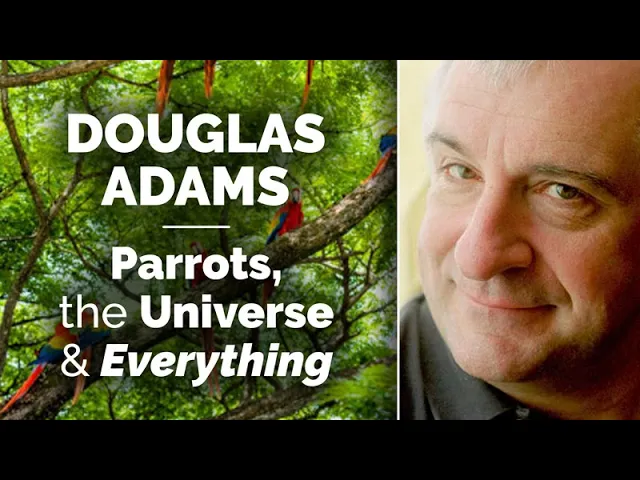
Thank you very much ladies and gentlemen spirit it's very interesting in the unusual and weird experience for me to be we talking in my hometown which is now amongst the the the books the constants I mentioned when she was introducing me Hitchhiker's Guide gently and so on was not my favorite book my favorite book is what I'm here to talk about tonight it's funny how how often but virtually Every author I know their own favorite book is the one that sold the least it's somehow so it's the runt of the litter so that's the one
you always just sort of love the most and I won't tell you about how this came about sometime in about the mid-1980s the phone rang and the voice said we want you to go to Madagascar we want you to look for a very rare form of lemur called the aye-aye the plane leaves in two weeks we'd like you to be on it Now I assuming they got the wrong number said yes before they could discover a mistake but in fact it turned out that they decided well here's somebody who doesn't know anything about lemurs anything
about the aye-aye anything about Madagascar let's send him and so I started to try and find out something about it and turns out it's very interesting um lemurs used to be the dominant primate in all the world and They were very very gentle Pleasant creatures they were a little bit like sort of but sort of cat's eyes and they used to hang around in the trees having a nice time and then Gondwanaland split up there's always like sounds like some sort of 70s rock group going their own way for reasons of musical differences but as
you probably remember Gondwanaland was was that vast continent landmass that consisted what then became South America Africa India and Southeast Asia Australasia under Australia Australia and not and this will turn out to be significant later not New Zealand which turns out to be just a lot of gunk that came up from under the ocean and as I say lemurs were were dominant the dominant primate around the world and when when when all his land masses split up and Madagascar was one of the Madagascar kind of sailed off into the middle of what then suddenly became
the Indian Ocean and took with it a Representative sample of the livestock of the period which included a lot of lemurs and they basically sort of sat there for millions and millions of years in glorious isolation while in the rest of the world a new creature emerged a new creature arrived that was much more intelligent than the lemurs according to it much more much more competitive much more aggressive and incredibly interested in all things you could do with twigs twigs Were absolutely wonderful so much you can do with twigs you can dig in the ground
for things with twigs you can borrow under the bark of trees for grubs you can hit each other with if there have been copies of twig user magazine around in those days these creatures would have been would have been lining up for it and these creatures which were as you probably guessed called the monkeys because they were more competitive and more aggressive and they Lived in the same habitat as the lemurs they successfully supplanted the lemurs everywhere in the world other than Madagascar because Madagascar was right out in the middle of the Indian Ocean and
they couldn't get there they couldn't get there until about 1500 years ago when due to startling advances in twig technology they were able to get there in boats and eventually planes and suddenly the Lemurs that had had this place to themselves for millions and millions and millions of years were suddenly facing their old enemy the monkey so this is Madagascar and it turns out that the rarest of the lemurs and when I say the rarest the lemurs at this particular point in the mid-80s they were thought to be the rarest of lemurs we've now discovered
an even rarer lemur called the the golden bamboo lemur which went straight to the number number one of Endangered lemurs but the aye-aye is a very very peculiar animal it looks like had agglomeration of all sorts of other different animals so for instance it has it has a sort of foxes ears and it has little sort of bitey rabbit's teeth and it has a kind of ostrich tail as an ostrich feather as a tail and it has it has very weird eyes there's got actually this it has Marty Feldman's eyes they're kind of sort of
looking slightly beyond you into a sort of other dimension just Over your left shoulder and but it also has one very very very peculiar characteristic which is its middle finger on both hand is skeletally thin and very very long and it turns out there's only one other animal in the entire world that has this feature and this is called I love zoologist to have such a vivid imaginations it's called the long fingered possum and this is a creature that lives in New Guinea and in fact it has its its it's Full finger that's skeletally thin
and elongated and this this is the thing that tells us that there's no relationship between these animals it's pure convergent evolution because the the fact the common factor between Madagascar and the aye-aye and New Guinea and the long finger is that in both habitats there are no woodpeckers and you see the thing is life is very very life is very very opportunistic and it'll take advantage Of any food source it finds around the place and if if there are no woodpeckers looking for the bark looking under the bark of trees for grubs then then in
this case it'll be the mammals that that grow this skeletally thin long finger to burrow under the bark of the tree and get at this source of food which is the grubs under the bug so the aye-aye is this very very very strange creature and at the time at this time it's thought there Were only about 15 of them left and they lived actually not a Madagascar itself but on a tiny little rainforest island just off the coast of Madagascar called nosy mangabey and it was just off the northwest tip of Madagascar and I forget
their what she had to do is you had to fly in a 747 to Madagascar and then in a terrible old jalopy of an aeroplane from Madagascar up to the Lord up to the Northwest port and from there you had to go in a kind of decreasing Lee excellent Series of carts and trucks and so on to a little port where there was going to be a boat that was going to take this to mozi mangabey so we arrived there and arrived at the port and we were looking around for the boat that was going
to take us to nosy mangabey and we couldn't see it and we kept on asking people you know where's this boat and they would say it's there it's there and we couldn't see what they're pointing at because there was this terrible rotting Old Hulk in the way well I guess this is their terrible rotting old Hulk that we had to go to and as you mangabey him and it didn't fulfill what to my mind was sort of basic criteria of a boat ended in that it was basically full of ocean and it seemed to me
look the whole point of a boat was to keep the ocean on the outside anyway so we crossed who knows him anger beam and it's his tiny little very very beautiful little rainforest Island and we hit a major problem which of course is the term this animal not only lives in trees nobody's seen it for years and years and years no lives in trees it is also it's a nocturnal animal and the quality of batteries in Madagascar is very very poor so we spent night after night after night traipsing through the rainforest and what can
only be described as the rain getting rather ratty and basically spent Night after night sort of huddled under tarpaulins look as it stopped raining in and everywhere whistle go out and try and find this damn animal and we actually this is wonderful we found this Hut it used to be the sort of game wardens had not game warden Rangers Hut it was a tiny little Hut and it was actually full of wildlife and what happened you see is you them you'd open the door and you would hear all this noise and you turn on like
and would all Stop and you'd see these sort of giant spiders around the wall each with a sort of half-eaten bug in their mouth so yes you turn the light out so this is our shelter you know we were having a great time and eventually but event but one night one night we were all so as I huddled under our tarpaulins and I sort of got out and had a wander around and suddenly suddenly I looked up and on a branch about that high above my head This creature came out as creature came out along
the branch looked down at me and I looked at it and as it looked to me it obviously didn't at all like the look of what it saw it turned around and went away again whole encounter about ten seconds and that's what we'd come for that I had actually seen and we saw we all just managed to get a quick photograph of it when it appeared but I suddenly realize we'd seen an aye-aye now I was absolutely transfixed by that Moment for reasons that I couldn't entirely explain to myself immediately because a month earlier I'd
never even heard as animal and now here I was staring at it thinking there's something extraordinary happening here so I began to sort of think about a little bit and the thought I put together was this that in travelling here in travelling on the 747 to Tanana which is the capital of Madagascar and there's terrible loppy of an aeroplane that took us up to the Northwest corner and then in the decreasing excellent series of carts and trucks and then in the rotting L help that took us to the rainforest where we basically walked through the
rainforest night after night it was as if we were taking a kind of time journey a time travel journey back through the history of twig technology and what this encounter had been what this encounter had been was I was a monkey looking at the Lemur and you Suddenly think there is a huge amount of history to this moment that we don't think we don't realize we carry around all this are our roots in this planet go back an awfully awfully awfully long way and we don't tend to think about that very much and it takes
a confrontation like this suddenly to be a to realize how sort of broad and deep your family goes so I thought well this is terribly interesting and I talked to the guy who'd been kind of my guide out there Who is a zoologist who's been sent along to make make sure I didn't sort of fall out of trees and so on and his name is Mark Karr warden and I said I would love it if we could come do you fancy the idea sort of going around the world and looking for other rare and endangered
species of animal maybe doing a book about he said well that's what I do for a living so yeah okay and so we did now I there was a pause at that moment because I had a couple of novels I just Contracted to write so I wrote Dirk gently's holistic detective agency and the long dark teatime of the soul and then it was time to go and the first place we went we went to look for a particular animal which is the Komodo dragon lizard now you know what lizards are like don't you I mean
this sort of lies a little green this the Komodo dragon lizard is a little bit bigger than that the biggest one we saw actually was about 13 feet long and his Head came up to about here huge I think is a technical term it's thought they're the origin of the Chinese dragon myth because they are cute with giant giant lizards their scaly they're man-eaters literally they are man-eaters and they don't actually breathe fire but they do have the worst breath of any creature known to man and and they live on this island called Komodo now
it's not enough it turns out that this island has 1,500 1,500 Man-eating dragons on it it turns out that actually the most endangered animal on the on the island is anything other than the Dragons and in fact that when I say they're man-eaters they don't actually that they don't actually eat you sort of straight out and it's sort of lunge at you and just gobble you up they sort of sneak around and they come and give you a bit of a bite because they're the saliva is so virulent that out that your wound will not
heal and After a while you will die and it does and so one of the Dragons will get to eat you doesn't matter it's the same one that Xu they just saw they don't have a strategy of having as many dead and dying creatures lying around the island as they can manage and that kind of keeps them going but it turns out it's not enough that the island has 1,500 man-eating dragons on it just to make it a little bit more interesting it also has more poisonous snakes on its per Square meter of land than
any equivalent area of land anywhere on earth so we approached Komodo I have to say slightly nervously and a slightly roundabout way in fact we approach it in such a roundabout way that we went via Melbourne in Australia and the reason we're environment was as somebody who wanted to go and see them a man called dr. struensee Berland and I actually want to read you a little bit Of about him he was a a great expert in in snake venom and I should apologize before I read this actually for the fact that I don't do
it my Australian accent isn't very good but then what the hell you're all Americans you won't know the difference anyway there is in Melbourne a man who probably knows more about poisonous snakes than anyone else on earth his name is dr. struensee Burland and he has devoted his entire life to a study Of venom and I'm boarded talking about it he said when we went along to see in the next morning laden with tape recorders and notebooks can't stand all these poisonous creatures all these snakes and insects and fish and things wretched things biting everybody
and then people expect me to tell them what to do about it I'll tell them what to do don't get bitten in the first place that's the answer I've had enough of telling people all time hydroponics now That's interesting taught you all you like about hydroponics fascinating stuff growing plants artificially in water very interesting technique we'll need to know all about it we're going to go to miles and places where did you say you're going camuto well don't get bitten that's all I can say and don't come running to me if you do because you
won't get here in time and anyway I've got enough on my plate look at this office full of poisonous animals all Over the place see this tank is full of fire ants venomous little creatures what are we going to do about them anyway I've got some little fairy cakes you know in case you were hungry would you like some little cakes a cot remember where I put them there's some tea but it's not very good anyway sit down for heaven's sake so you're going to komodo well I don't know why you want to do that
but I suppose you have your reasons there are 15 Different types of snake on Komodo and half of them are poisonous the only potentially deadly ones are the Russell's Viper the bamboo Viper and the Indian Cobra the Indian Cobra is the 15th deadliest snake in the world and all the other 14 are here in Australia that's why it's hard for me to find time to get on my hydroponics all these snakes all over the place and spiders the most poisonous spider is the Sydney funnel-web we get about 500 people a Year bitten by spiders a
lot of them used to die so we had to develop an antidote stop people bothering me with it all the time took us years then we developed a snake bite detector kit not that you need a kit to tell you when you've been bitten by a snake you usually know but the kid is something that will detect what type you've been bitten by so you can treat it properly would you like to see a kit I've got a couple here in the venom fridge yeah Let's have a look oh look the cakes are in here
too quick I've one while they're still fresh fairy cakes to buy to myself he handed round these snake venom detection kits and his home-baked fairy cakes and retreated back to his desk where he beamed it as cheerfully from behind his curly beard and bowtie we admired the kits which were small efficient boxes neatly packed with tiny bottles I prepared a syringe and a complicated Set of instructions that I wouldn't want to have to read for the first time in a panic and and then we asked him how many of the snakes he'd been bitten by
himself i none of them he said another area of expertise i've developed is that of getting other people to handle the dangerous animals well i do it myself don't want to get bitten do i you know what it says on my book jackets hobbies gardening with gloves fishing with boots traveling with care that's the answer What else well in addition to the boots we're thick baggy trousers and preferably have half a dozen people tramping along in front of you making as much noise as possible the snakes pick up the vibrations and get out of your
way unless it's a death adder otherwise known as the Deaf Adam which just lies there people can walk right passing over and nothing happens I've heard of 12 people in line walking over a Death Adder and the 12th person Accidentally children it got bitten normally you're quite safe if you're 12th in line you're not eating your case come on get on down here is plenty more in the venom bridge we asked tentatively if we could perhaps take a snake bite detector kit with us to Komodo of course you can of course you can take as
many as you like when do you blind but a big good cause rainy for Australian snakes so what do we do if we Get bitten by something deadly then I asked he blinked at me as if I was stupid well what do you think you do he said you die of course that's what deadly means but what about cutting open the wound and sucking out the blood sucking out the poison I asked well rather you than me said I wouldn't want a mouthful of poison shouldn't do you any harm though I mean snake toxins of
the high molecular weight so they won't penetrate the blood vessels in the mouth Away the alcohol or some drugs do and then the poison gets destroyed by the acids in your stomach but it's not necessarily going to do much good either I mean you're not likely to be able to get much of the poison out but you're probably going to make the wound a lot worse trying and a place like komodo means you quickly have a seriously infected wound to contend with as well as a leg full of poison septicemia gangrene you name it it'll
Kill you well what about a tourniquet I asked well fine if you don't mind having your leg cut off afterwards you'd have to because he because the blood supply to it completely it'll just die and if you can find anyone of that part of Indonesia you trust to take your leg off and you're a braver man than me now I'll tell you the only thing you can do is apply a pressure bandage to rec to the wound and wrap the whole leg up tightly but not too tightly slow the Blood flow but don't it awful
you lose the leg hold your leg or whatever bit you've been bitten in lower than your heart and your head keep very very still breathe slowly and get to a doctor immediately if you're on komodo it means a couple of days which time we were well dead now the only answer and I mean this quite seriously is don't get bitten there's no reason why you should any of the snakes they will get out of your way well before you Even see them you don't really need to worry about the snakes you've a careful now the
things you really need to worry about the marine creatures what scorpion fish stone fish sea snakes much more poisonous than the on land get stunned by stone fish the pain alone will kill you people drown themselves just to stop the pain where are all these things oh just in the seat unzoom I would go near it if I were you full of poisonous animals hate them is there anything you Do like yeh said hydroponics no I said I mean other any poisonous creatures you particularly fond of he looked out of the window for a moment
otherwise he said but she left me anyway in fact my favorite of all the animals we went to see my favorite was an animal called the kakapo and the kakapo is a kind of parrot it lives in New Zealand it's a flightless parrot it's forgotten how to fly sadly that has also forgotten That it's forgotten how to fly so a seriously worried kakapo has been known to run up a tree and jump out of it opinion divides as to what next happens some people say it has developed a kind of rudimentary parachuting ability how people
say it flies a bit like a brick but the thing is let talk about a seriously wired kakapo the fact is you're not likely to find the seriously worried kakapo because kakapos have not Learnt to worry now seems an extraordinary thing to say because worrying is something we're all so terribly good at and which comes so absolutely naturally to us we think it must be as natural as breathing but it turns out that worrying is simply an acquired habit like anything else it's a and it's it's it it's something you're genetically disposed to do or
not to do and the thing is that the kakapo grew up in New Zealand which was until man Arrived a country which had no predators and its predators that over a series of generations will teach you to worry and if you don't have predators then the need to worry will never occur to you now I said earlier that New Zealand turns out to be just a log gunk that came up from under the ocean and this is why when it emerged it didn't have any life on it at all maybe a few dead fish so
the only animals that inhabited New Zealand were the animals that could fly There ie birds and there are also a couple of species of bat which are mammals but you get the point so it was only birds that lived on New Zealand and in an absence of predators there was nothing for them to worry about now it's very very peculiar for us to try and understand this because we have never ever encountered and an environment with no predators in it why not because we are predators and because therefore if we Are in that environment it
is a predated environment and you know for for the Europeans who originally arrived in New Zealand sorry but that straud anything to say of course the the Mauer is before them and before them the Marauders the Mallory's at the murari's and then the Europeans came along but before before all that happened to say the island the the island had no predators and the birds basically led or worry-free life now you can actually see another example Of this if you go to the Galapagos there is a type of animal there's a bird on the Galapagos Islands
called the blue footed boobie and the blue footed boobie is so called I believe for two reasons one of which has to do with the color of its feet and the other has to do with this piece of behavior I'm about to describe because apparently you can walk up to a blue footed boobie that will be sitting there on the beach or on a branch and you can walk up and you can Just sort of pick him up and what the booby will be thinking is that once you finish with him you'll put him back
and if you haven't lived through generation after generation of people trying to eat you it's very easy to come to that conclusion so the kakapo SSA had grown up in an environment without predators and because they were all birds and because Nature has a way of as I say very Opportunistic and life will flow into any niche where it's possible to make a living so if I can be very naughty and anthropomorphize for a moment it's as if some of the birds figured out well this flying stuff is very very expensive it takes a lot
of energy you have to eat a bit fly a bit eat a bit fly because everything every time you eat something you know you're weighed down it's a heavier to fly say eat a bit fly a bit I mean there are other ways of life Available and so as if some of the birds said well actually what we could do is we could settle in for a rather larger meal and go for a waddle afterwards and so gradually over many many generations a lot of the birds lost the ability to fly they took up life
on the ground the Kiwi the most famous bird I guess of New Zealand and the whacker and and and the old night paratis it was called the kakapo which is this had a big hat soft fluffy Lugubrious bird and because it has never learned to worry when man arrived and brought with him his deadly menagerie of dogs and cats and and Stokes and and that most that most destructive of all animals other than man which is Rattus Rattus the ship's rat suddenly suddenly these birds were waddling for their lives except in fact they didn't know
to do that because when they were confronted with an animal as a predator they didn't Know what to do they didn't know what the social form was they just wait for the other animal to make the next move and of course it's usually a fairly swift and deadly one so so suddenly from there being a population of we don't know exactly how many probably not as many as a million but hundreds of thousands of these birds their population plunged at an incredible rate down into the low 40s which is roughly where it is at the
Moment and and so those up there are groups of people who dedicate their entire lives to try to save these animals trying to conserve them and one of the problems they come across is that it's it's all very well just to protect them from predators which is very very very hard to do but the next problem they come across is the is the mating habits of the kakapo because it turns out that the mating habits of the kakapo are incredibly long drawn-out Fantastically complicated and almost entirely ineffective some people will tell you that the mating
call of the male kakapo actively repels the female Keiko probe it is a sort of behavior otherwise only fine really and discotheques the people who've heard the mating call of the male kakapo will tell you you can hardly even Eve even hear it it's like a sort of it I'll tell you what they do this animal every for about a hundred nights of the Year it goes through its mating ritual and what it does is it finds some great rocky outcrop looking out over the great rolling valleys of New Zealand because acoustics are very important
to what's about to happen and it's certainly it burrows out this kind of carves out this kind of bowl that it sits in and it sits there and it puffs out this great sort of air sacs around its chest and it sits there and these are reverberation chamber this is kind of reverberation Chamber and it sits there and for night after night after night for a hundred nights of the year for eight hours of the night it performs the opening bars of Dark Side of the Moon now I see some gray hairs hairs here so
you'll you'll know the album I'm referring to which as you remember starts with this great sort of is a heartbeat it's a heartbeat sound and this is the noise that the the kakapo makes but it's so it's so deep that you More kind of feel it like a wobble in the pit of your stomach just just a tune you're hearing into it now I didn't there never managed to get to hear it but um those who do sense a feel that it's a very eerie sound because you don't really hear it you more kind of
feel it and it's it's bass sound it's very very deep bass sound just below the level are hearing now it turns out the bass sound has two important characteristics to it one of which is That these great long waves these great long sound waves travel great distances and they fill these great valleys of the South Island in New Zealand and that's good that's good but there is another characteristic of bass sound which you may be familiar with if you've got those kind of you know the kind of sort of stereo speakers you can get where
you have two tiny little ones that give you your treble sound and you have to put them very Carefully in the room because they're going to define the stereo image and then you have what's known as a sub woofer which is the bass box and that's going to produce just the bass sound and you can put that anywhere in the room you like you can put it behind the sofa if you like because the other characteristic of bass sound and remember we're talking about the mating call of the male kakapo is that you can't tell
where it's coming from So just imagine if you will this male kakapo sitting up here making all this booming noise which if there's a female out there and if she likes the sound which there probably isn't and if she likes the sound of this booming where she probably doesn't then she can't find the persons making it but supposing she does supposing she's out there she probably isn't she likes the sounds as booming she doesn't supposing she can find him which she probably Can't she will then only consent to mate if the podo carp tree is
in fruit now we've all had relationships like that but supposing they get through all those obstacles but supposing she managing the supposing she manages to find him managers may she will then lay one egg every two or three years which will promptly get eaten by a stoat or rat and you think well so far from sort of trying to sort of save them and conserve Them how on earth has it managed to survive for this long and the answer is terribly interesting which is this it seems like absurd behavior to us but it's only because
its environment has changed in one particular and dramatic way that is completely invisible to us and its behavior is perfectly attuned to the environment it developed in and completely out of tune with the developed with the environment it now finds itself in because in an Environment where nothing is trying to predict you you don't want to reproduce too fast and it turns out you can actually actually sort of graph this in a computer um that if you if you take a given reproduction rate and you take the the ability of any given environment to sustain
any particular level of population and you start say with a fairly low reproduction rate and you just plot it over several generations and you'll find the population goes up And up and up and then sort of steadies out and achieves a nice platter tweak the reproduction rate up a bit and it goes up a little bit higher and then maybe settles down and levels out tweak the reproduction rate a little bit higher yet and it goes up and it goes too high and it drops down goes too low drops goes up too high and settles
into an oscillating sine wave tweak it a bit more and it starts to oscillate between four different values tweak it more and More and more and you suddenly hit this terribly fashionable condition called chaos where the where the where the the population of the animal just swings wildly from 1 January from one year to another and we'll just hit zero at one point just out of the sheer mathematics of the situation and once you've hit zero that's kind of no coming back and so because nature tends to be very parsimonious and is not going to
expend Expend energy and resources on something for which there is no return so so the the the reproduction rate of an animal in an environment with no predators will tune itself to an appropriate level of reproduction now if there's nothing trying to eat you particularly then that reproduction rate will be very low and that is the rate at which the kakapo used to reproduce and continues to reproduce despite the fact that has been per day today it doesn't know any better Because nothing nothing has managed to teach it anything different along the way because the
change that occurred happened so suddenly there was no kind of slope there was no slope of a gradual evolutionary pressure which is the thing that tends to bring about change if you have a sudden dramatic change then there's there's no direction to go and you just have disaster so again if I can anthropomorphize for a moment what seems to have happened is that the the animal Suddenly reaching a crisis in its population things well I better just do do what I do fantastically well do what is my main thing which is i reproduce really really
slowly this population goes down well I better really do what I do and reproduce really really really really slowly and and it seems absurd to us because because we can see a larger a larger picture than they can but if that is that the type of behavior that you evolved successfully to to produce then To do anything else will be against kakapo nature will be an inner kakapo thing to do and it has nothing to teach it any other than to just do what it's always done to follow it's successful strategy and because times have
changed around it it's no longer a successful strategy and the animal is in terrible trouble there's another animal we went to find which is in even worse trouble now and this is the by gene the Yangtze River Dolphin which is an almost blind River Dolphin the reason it's almost blind is that there's nothing to see in the Yangtze River thousands and thousands of years of agriculture along the banks of the Yangtze River have washed so much mud and silt and so into it that the river has become completely turbid which is a word I didn't
even know the meaning of until I saw the Yangtze River and basically you can't see anything in it and so these animals dolphins are the Same gradually they abandoned the use of cycnus as we all know marine mammals also have this other faculty available to them which they can develop which is data sound and so what the Yangtze River dolphins did was over over thousands of years as their as their eyesight deteriorated so their sonar abilities became more and more and more sophisticated and more powerful and more complex and it's very interesting you Can actually
watch if you feel like it the the development of a Bhaiji fetus and you will see that right at the curb as you may or may not know there is a certain amount of truth in the idea that the development of the fetus recapitulate stages and the evolutionary development of an animal and you see right at the beginning of the development of the fetus its eyes in a normal dolphin position which are kind of relatively far down on the side Of the head and gradually as the generations have gone by its its eyes are kind
of migrated up the side of the head and you see this happening as the fetus develops because gradually over the generations is only light coming directly from up above and there's no ambient light and then as that two dies out so the eyes gradually atrophy and instead the the the sonar abilities take over and these animals developed incredibly sensitive and incredibly Precise abilities to navigate themselves around in the water just using sonar and all is well and good until the 20th century when man invents the diesel engine and suddenly all hell breaks loose beneath the
surface of the Yangtze because it's suddenly full of noise and so suddenly these animals find themselves trapped by something that they nobody had any means of foreseeing that the thing they now rely on has been completely overwhelmed by the noise Pollution that we put in in in the oceans and so suddenly these animals that used to be so sophisticated in their ability to find their way around are sort of bumping into things bumping into boats bumping into ships propellers finding themselves and snared in fishermen's nets and so on because we've basically screwed up the next
of their faculties and it's it's a very curious feeling I remember sort of sitting on a boat on the Yangtze River and looking While trying to look into it you couldn't look into it because it's turbid and you remember what turbid means and and realizing that all this noise down there as well is means that even it it's very curious to think that there may have been a dolphin somewhere near me I didn't know I mean by this stage this is ten years ago there were only 200 left in a stretch of water about 200
miles long so you had no idea there's one Anywhere near you but as Chris because you think if that if if you and another person another creature kind of in the same world then you must be feeling roughly similar but one of the things you begin to realize when you look at different animals is that because they've because of their evolutionary history and because of the forms they have developed into and the ways they have developed of perceiving the world they may be inhabiting the same world But actually a completely different universe but actually a
completely living universe because you create your only own universe from what you do with the sensory data coming in so it's so you realize that you're here and there's a dolphin there and you're comfortable and the dolphin may be actually in a species of hell but but has no means of communicating that with you because we've kind of taken we kind of taken charge and we that there's no way of Kind of communicating with the management that there's a problem so I suddenly became very interested and what it must actually sound like in the Yangtze
River now we had gone to record some BBC radio programs while we were there so as well as mark awarding the zoologist we also had a sound recordist in the BBC so I said to him could we actually drop a microphone into the Yangtze so we can see what it actually sounds like in the river and he said Well I wish you'd said that before we left London I said why I said well because I could have just checked out a waterproof microphone but you know you didn't you didn't mention anything about recording underwater I
said no I didn't um is there anything we can do about he said well there is there is actually one technique they teach us at the BBC for recording underwater in an emergency do either you have condoms with you and we Didn't wasn't that kind of trip but we decided we'd better go and buy some and so we went into the streets of Shanghai trying to buy some condoms and I just want to read your little passage about this the friendship store seemed like a promising place to buy condoms we had a certain amount of
difficulty in getting the idea across we passed from one counter to another and the large open-plan department store CH consists of many different individual Booths stalls and counters but no one was able to help us we first started at the stalls which looked as if they sold medical supplies but had no luck by the time we got to the stalls which sold bookends and chopsticks we knew we were on to a loser but at least we'd found the young shop assistant who spoke English we tried to explain to her what it was we wanted but
seemed to reach the limit of her vocabulary pretty quickly so I got out my notebook and drew a Condom very carefully including a little extra balloon on the end she frowned at it but still didn't get the idea she brought us a wooden spoon a candle a sort of paper knife and surprisingly enough a small porcelain model of the Eiffel Tower and and then at last lapsed into a posture of defeat some other girls in the stall gathered round to help but they were also defeated by our picture at last time plucked up the bravado
to perform a Delicate little mime and at last the penny dropped ah the first girl said suddenly wreathed in smiles are yes they all beam delightedly at as they got the idea you do understand I asked yes yes I understand do you have any no she said not have oh but but but yes I say you where you go okay thank you thank you very much yes you go 6-1-6 nanjing road okay they have there you ask rubber over okay rubber over rubber over you ask they Have okay have nice day she giggled happily about
this with our hand over her mouth we thanked them again profusely and left with much waving and smiling then you seem to spread very quickly around the store and everybody waved at us they seem terribly pleased to been asked when we reach 6-1-6 Nanjing Road which turned out to be another smaller department store and not a knocking shop we'd have been expecting our pronunciation of rubber over seemed To let us down and produce another wave of baffled incomprehension this time I went straight for the mine that has served us so well before and it seemed
to do the trick at once the shop assistant a slightly more middle-aged lady with severe hair marched straight to a cabinet of drawers and brought us back a packet and placed it triumphantly on the counter in front of us success we thought open the packet and found it to contain a bubble sheet of pills right Idea said mark with a sigh wrong method we were quickly floundering again as we tried to explain now slightly affronted lady it wasn't precisely what we were after but by this time a crowd of about 15 on lookers had gathered
round us some of whom I was convinced had followed us all the way from the friendship storm one of the things you quickly discover in China is that we are all at the zoo if you stand still for a moment people will gather round and stare at you The unnerving thing is they don't stare intently or inquisitively they just stand there often right in front of you and watch you as blankly as if you were a dog food commercial ad last one young and pasty-face man with glasses pushed through the crowd and said he spoke
a little English who could he help we thanked him and said yes we wanted to buy some condoms some rubber overs and will be very grateful if it explained that for us he looked puzzled picked up The rejected packet lying on the counter in front of the affronted shop assistant and said not want rubber over this better no mark said we definitely want rubber over not pills why want rubber over pill better you tell him said mark it's to record dolphins I said or not the actual dolphins about what we wonder Accord is the noise
in the Yangtze that it is to go over the microphone you see and I'll just tell him you're someone said sound Recorders and you can't wait but by now the young man was edging nervously away from a suddenly realizing that we were dangerously insane and should simply be humored and escaped from he said something hurriedly to the shop assistant and and backed away into the crowd the shop assistant shrugged scooped up the pills opened another drawer and pulled out a packet of condoms we bought nine just to be safe So a couple of days later
we were standing on the banks of the Yangtze at a very desperate drizzly gray day and we put the microphone in this little sort of pink thing and dropped it into the water and I don't usually do impressions but I'm going to do for you an impression of what it sounds like under under the surface of the Yangtze River and it's something like this and what an appalling thing we had inflicted on these poor animals that that lived in a World of super sensitive sound and hearing and this was why these animals were now desperately
endangered because we had having having removed one way of life from them we were now removing a second the problem is we're about to remove a third I said that when I was there ten years ago there were 200 of these left today there are 20 and because the the Chinese are building these giant dams to dam the Yangtze at one of the most Beautiful and spectacular sights in all the world the Three Gorges and their damning it there which means that the Yangtze Dolphin will at that point definitely go extinct and it's it's it's
it's terribly sad the peculiar thing about dams is that we keep on building them and none of them ever do any good it's not quite true because unfortunately there are in the history of down making - that did work well as the Hoover the other is the The one up in the Northwest Pacific Northwest the Coolidge Dam and every other one doesn't work and for some reason we never managed to be able to quite stop us and we always think we'll just build one more I think we must have some sort of beaver genes deep
in our but the sad thing is to say is that the is that the Yangtze River Dolphin is definitely and without doubt bound for extinction and it's very peculiar to me that we are living at the moment in an Extraordinary age an extraordinary Renaissance because we have got to the point where we suddenly understand the value of information you never had before we recall the age we live in that of information and we've discovered that information is the the most valuable resource we have and as you will know we've just spent billions of dollars quite
rightly in trying to understand the human genome and that's just one species that's just us and we've come to Understand realize how incredibly valuable this information is and we've never understood kind of how it all worked together before because before we had let me let me put it this way in the past we've done science by taking things apart to see how they work and it's led to extraordinary discoveries extraordinary degrees of understanding with the problem with taking things apart to see how they work these even though gets you down to the sort of Fundamental
particles the fundamental principles the fundamental forces at work we still don't really understand how they work until we see them in motion one of the things that Keio Balthazar result of understanding these fundamental principles we came to invent this thing called a computer and the great thing about the computer is that unlike every previous analytical tool and there have been two that the OPA it's funny how many of these have to Do with glass when we first came across a glass which is you know is from sand and we invented lenses and we looked up
into the the sky and we discovered from that the fundamental by studying the sky we began to discover fundamental things about gravity and we also discovered that the universe seems to consist terrifyingly enough almost entirely of nothing the next thing we did with glass was we put them in microscopes and we looked down into This very very very solid world around us and we see the fundamental particles they're the atoms made up of protons and neutrons with electrons spinning around them we also discover that they seemed to consist frightening ly almost entirely of nothing and
that even we do find something it turns out isn't actually there it isn't actually a thing they're merely merely the possibility that there may be something there it kind of doesn't feel quite as real as This so it's only one of them the next thing we do with sand with silicon is we create the computer and this finally enables us to start putting things together to see how they work and it allows us to see actual process at work and we begin to see how very very simple things lead inexorably by iteration after iteration two
enormous ly complex processes emerging and blossoming and to my mind one of the the most extraordinary things of our age I mean Those of us who around will remember you know seeing man walking on moon for the first time but I think the most dramatic and extraordinary thing that we have seen in our time is being able to see on computer screens the process by which enormous ly simple primitive things processes instructions repeated many many times over very very fast and iterated over generation of instructions produce enormous ly complex results so that we can stick
an suddenly Start to create just out of fundamentally simple primitive instructions we can create the way in which wind a wind behaves in a wind tunnel the turbulence of wind we can see how how light might dance in an imaginary dinosaur's eye and we do it all out of fundamentally simple instructions and as a result of that we have finally come to an understanding of the way in which life has actually emerged now there are Awful lot of things we don't know about life but any life scientists will tell you that although there's an awful
lot we don't know there is no longer a deep mystery there's no longer a deep mystery because we have actually seen with our own eyes the way in which simplicity gives rise to complexity so that when I say there's no mystery as rather as if if you if you imagine taking a detective from the 19th century teaming him up with a detective from the late 20th Century and giving them this problem to work on that a suspect in a crime was seen one day to be walking down the street in the middle of London and
the next day we're seeing somewhere out in the desert in the middle of New Mexico now the nineteenth-century detector will say well I haven't the faintest idea I mean it must be some species of magic has happened and he would have no idea about how to begin to solve what has happened here For the 20th century detective now he may never know whether the guy went on British Airways or United or American or where he had his car from or all that kind so he may never find those details but there won't be any fundamental
mystery about what has happened so for us there's no longer a fundamental mystery about life it is all the process of extraordinary eruptions of information and it's information that make gives us this fantastically rich Complex world in which we live but at the same time that we've discovered that we are destroying it at a rate that has no precedent in history unless you go back to the point that we are hit by an asteroid so there is there is a kind of terrible irony that at the point that we are best able to understand and
appreciate and value the richness of life around us we are destroying it at a higher rate than has ever been destroyed before and and we are losing species After species after species day after day just because we're burning the stuff down for firewood and this is a kind of terrible indictment of our understanding but you see we make another mistake because we think somehow this is all right in some fundamental kind of way because we think that this is all sort of meant to happen now let me explain how we get into that side kind
of mindset because it's exactly the same kind of mindset that the kakapo gets Trapped in because his what what has been a very successful strategy for the kakapo over generation after Jennifer thousands and thousands of years suddenly is the wrong strategy and he has no means at night because he's just doing what has been successful up till them and we have always been because we're tool makers because we take from our environment the stuff that we need to do what we want to do and it's always been Very successful for us you know I'll tell
you what's happened it's right it's as if we've actually kind of put the sort of pause button on our own process of evolution because we because we have put a buffer around us which consists of you know medicine and education and buildings and all these kinds of things that protect us from the normal environmental pressures and it's our ability to make tools that enables us to do this now generally speaking what Drives speciation is if a small group of animals gets separated out from the from the main body by population pressure some geographical upheaval or
whatever so imagine a small bunch gets suddenly finds itself stranded in a slightly colder environment then you know over a small number of generations than those genes that favor a thicker coat will come to the fore and you come back a few generations later the animals got a thicker coat man because we are able to Make tools we arrive in a new environment where it's much colder and we don't have to wait for that process because we see an animal that's already got a thicker coat we say we'll have it off him and so we've
kind of taken control of our environment and and that's all very that's all very well but we need we need to be able to sort of rise above that process of we have to rise above that that that vision and see a higher vision and see and understand The effect we're actually having now imagine if you will an early man and let's just sort of see how this sort of mindset comes about he's he's he's standing looks surveying his world at the end of the day and he looks at and thinks this is a very
wonderful world I find myself in this is a this is pretty good I mean look I'm here I'm that the behind me is the mountains and the mountains are great because there are there are caves in the mountains where I Can shelter I'm either from the weather or from bears that occasionally come and try and attack me and I can shelter there so that's great and then then in front of me there's the forest and the forest is full of nuts and berries and trees and they feed me and they're delicious and they sort of
keeping a and and here's a stream going through it's got fish rowing through it and the waters delicious and I drink the water and everything's fantastic and there's My cousin ugh and ugh ugh has caught a mammoth yay ugh has got a ma'am mammoths are terrific there's nothing greater than a mammoth because a mammoth basically you can wrap yourself in the fur from the mammoth you can eat the eat the meat of the mammoth and you can use the bones of the mammoth to catch other mammoths this is now this world is a fantastically good
world for me and part of how we come to take command of our world to Take command of our environment to make these tools we were able to do this is we asked ourselves questions about it the whole time so this man thinks starts to ask himself questions such as this this world he says well who so who made it now of course he thinks that because he makes things himself so he's looking for someone who will have made this world and says well so who would have made this well he must be something a
little bit like me obviously much much Bigger and necessarily invisible but he would have made it now why did he make it now we always ask ourselves why because we look for intention around us because we always intend we'd do something with intention you know we we boil an egg in order to eat it so we we look at the rocks and we look at the trees and we wonder what intention is here even though it doesn't have intention so we think so what did this person who made this world intend it for And this
is the point where you think well it fits me very well you know the caves and the forests and the stream and the mammoths he must have made it for me I mean there's no other conclusion you can come to and it's rather like a puddle waking up one morning I know they don't normally do this but allow me I'm a science fiction writer a puddle wakes up one morning and thinks this is a very interesting world I find myself in it fits me very neatly in fact It fits me so neatly I mean really
precise isn't it it must have been made to have me in it and the Sun rises and is continuing to narrate the story about this hole being made to have him in it and the Sun rises and gradually the puddle is shrinking and shrinking and shrinking and by the time the pebble ceases to exist it's still thinking it's still trapped in this idea that the hole was there for it and if we think the world is here for us We will continue to destroy it in the way that we've been destroying it because we think
we can do no harm there's an awful lot of speculation one way or another at the moment about whether there's life on other planets or not Carl Sagan as you know was very keen on the idea the the must be the sheer numbers dictate because our billions and billions and billions as he famously did not say in fact of Wells out there so the chance must be that there are other Other there's other life out there there's other intelligent life out there there are other voices at the moment you'll hear saying well actually if you
look at this set of circumstances here on earth they are so extraordinarily specific that the chances of the being something like this out there or I should pre remote now in a way it doesn't matter because think of this I mean a Carl Sagan I think himself said this there are two possibilities either There is life out there on other planets or there is no life out there on other planets they are both utterly extraordinary ideas but there is that there is the possibility there is a strong possibility there isn't anything out there remotely like
us and we are behaving as if this this planet this extraordinary utterly utterly extraordinary little ball of life is something we can just screw about with Any way we like and maybe we can't maybe we should be looking after it just a little bit better not for the world's sake we talked rather grandly about saving the world when we don't have to save the world the world's fine the world has been through five periods of mass extinction 65 million years ago when as it seems a comet hit the earth at the same time that were
vast volcanic eruptions and in India which saw off the Dinosaurs and something like 90% of the life on the planet time go back another I think it's 150 million years earlier than that to the permian-triassic boundary another giant giant giant extinction we the world's been through it many many times before and and what tends to happen what happens invariably after each mass extinction is that there's a huge amount of space available for new forms of life sub to emerge and flourish into it just as the the Extinction of dinosaurs led were made way for us
without that extinction we would not be here so the world is fine we don't have to save the world the world is big enough to look after itself what we have to be concerned about is whether or not the world we live in will be capable of sustaining us in it that's what we need to think about thank you very much ladies and now if anybody has any questions I'm very happy to take questions and there Are microphones down here at the front and I suggest you use them yeah hi thank you for wonderful talk
you say we should take care to not destroy the planet there's one suggestion that's been made is that the reason why we destroy the planet is that we don't pay the true cost of things when we consume them the price of gasoline has been falling in real dollars and the vehicles get bigger and bigger we have these selfish useless vehicles I think they're called the SUVs You know I have to say as a bridge you know we sit the thing the Americans are complaining again because their gas prices have reached now nearly a quarter of
what we pay so so I just wonder whether you think that's a that's a good solution is that if we would pay the true cost of things if we would pay the ten dollars a gallon or whatever really costs in terms of the impact on the environment that that might make a difference it may be that there is a There is a problem I'm very very conscious of here which is that yeah even though I'm talking from a conservationist point of view very very strongly you look back over the history of what we in the
conservation movement have said in the last ten years in the previous 10 years in the previous 10 years of that and most of what we've said we have to do about it all the ways we've gone about it have actually turned out to be wrong now so it's very hard For me to pretend I can stand up and say we have to do this and we have to do that because they may not be the right solution I mean I'm terribly aware this as far as I mean just going back again I mean thinking about
sort of a protection of animals in Africa for instance that time after time we've gone about it the wrong way and yeah the conservation efforts of one set of ten years well as much as be about as much as anything else undoing The problems caused by the last ten years so it is a it is it is a question of constants of self education trying to assimilate the information trying to see what the consequence of what we've done so far has been what we can learn from that now it may well be that if we
say what we're going to multiply the cost of gas by by ten times or whatever that may have effects that we will put into there will be the law of unintended consequences which which come comes into Comes into play I think the best thing we can do is continually inform ourselves be as as aware of plus as possible of what is actually happening now that is that kind of feedback loop saying what we're going to put make the true cost of the damage we're causing be part of what you have to pay then that may
very well be a very good answer but I'm also worried that it may not be the answer which is is as a complicated way of saying I don't know Two questions first do you know where your towel is nope okay is always my problem Kaleo it is very funny that thing about a towel because I'll tell you where it came from I was um I was in holiday with a bunch of people and we were in a villa in Corfu and every day we'd set out for the beach and just as we were setting out
for a beach for the beach it would be a problem and the problem would be that Douglas could not find his towel where was my towel was it under the bed was it on the end of the bed was it in the bed was in the bathroom was it hanging on the line outside was it in the washing was it I had no idea day after day whether my towel was and after a while I just began to think this must be symptomatic of somebody who is so sort of deeply chaotic that I am I
then something I think I don't know with like even came up with the first or Somebody on the holiday account the idea that you know somebody who was rather more together than I would lose some of you really know where the towel was and so and so then when I was writing a bit of hitchhiker SII I sort of put you very often put things in because you know what they mean and it's really kind of a flag to yourself that in the next draft through you're going to put something in that me that means
to everybody else what this thing Means to you and then it kind of stays there and it turns out it does mean something to everybody else as well does that answer your question okay and also do we behave like people descended from stick using monkeys or people descended from telephone cleaners I think I think we have both Lots they're in our genes I'm afraid I'm absolutely going to kill myself I get out of here without asking this this Question occurred to me when my friend bodily forced me to pick up the first book in the
hitchhikers guy and I read the very first sentence on the very first paragraph what on God's green earth does this man have against digital watches um well I have to admit they've improved since I since since I actually wrote that bit but if you think about it I mean the first digital watches which were well I mean you look at you look at a regular Watch with hands and and you've got a pie chart you remember the time when we used to get very excited about pie charts being the thing that computers did for us
pie charts but at the same time we were getting terribly excited about pie charts and what they could do for our understanding of the world well say we don't want pie charts on our wrists that's old-fashioned technology no what we want is not something you just glance At and see what the time is we want something that you've got to go into a dark corner and put down your suitcase and press a button in order to read oh it's 1143 now this time how many how long is that before twelve o'clock and this was progress
but which is here's a great I mean the great thing about human beings I mean I mean while you make fun of it is not only that we invent stuff that's new and better and and does things better but even stuff that works Perfectly well we can't leave well enough alone and it's really it is it is the most sort of charming and under delightful aspect of human beings that we keep on inventing things that we've already got right once I mean like you know bathroom faucets I mean it's very very simple you turn it
on the water comes out you turn it off the water stops and we kind of got the hang of that that works but it's amazing you know you go into a sort of in a hotel Lobby or an airport and you approach the basin with a certain amount of sort of anxiety you know okay what what do i do do I turn something do I push something do I pull something do I need it do I just have to sort of be near it and once it started to once the water started to flow because
it's picked up some sort of brainwave energy from here or whatever so I don't know how do I stop it is it my job to stop it will it stop itself I mean I think we've Got the faucet down okay I just think but you know it I just think it's wonderful we just have to keep on inventing it even though though it works pretty well because it's the way of it's the way of getting ourselves off local maximums isn't it I think that's all I have to say that
![Beginner to T-SQL [Full Course]](https://img.youtube.com/vi/cACat4KNncg/maxresdefault.jpg)





![Business Analyst Full Course [2024] | Business Analyst Tutorial For Beginners | Edureka](https://img.youtube.com/vi/1QKIvt05LmA/maxresdefault.jpg)