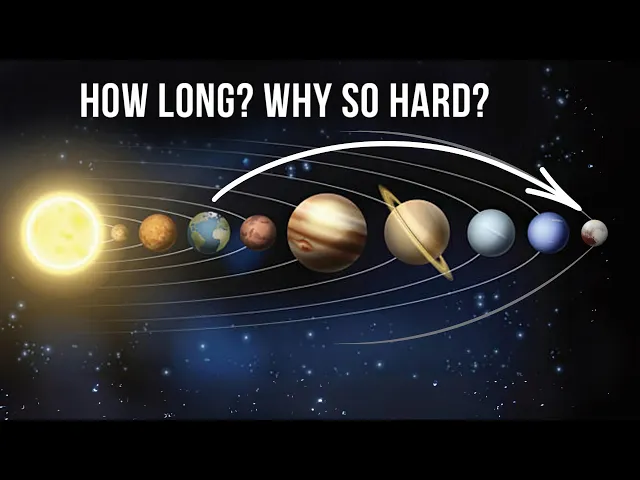
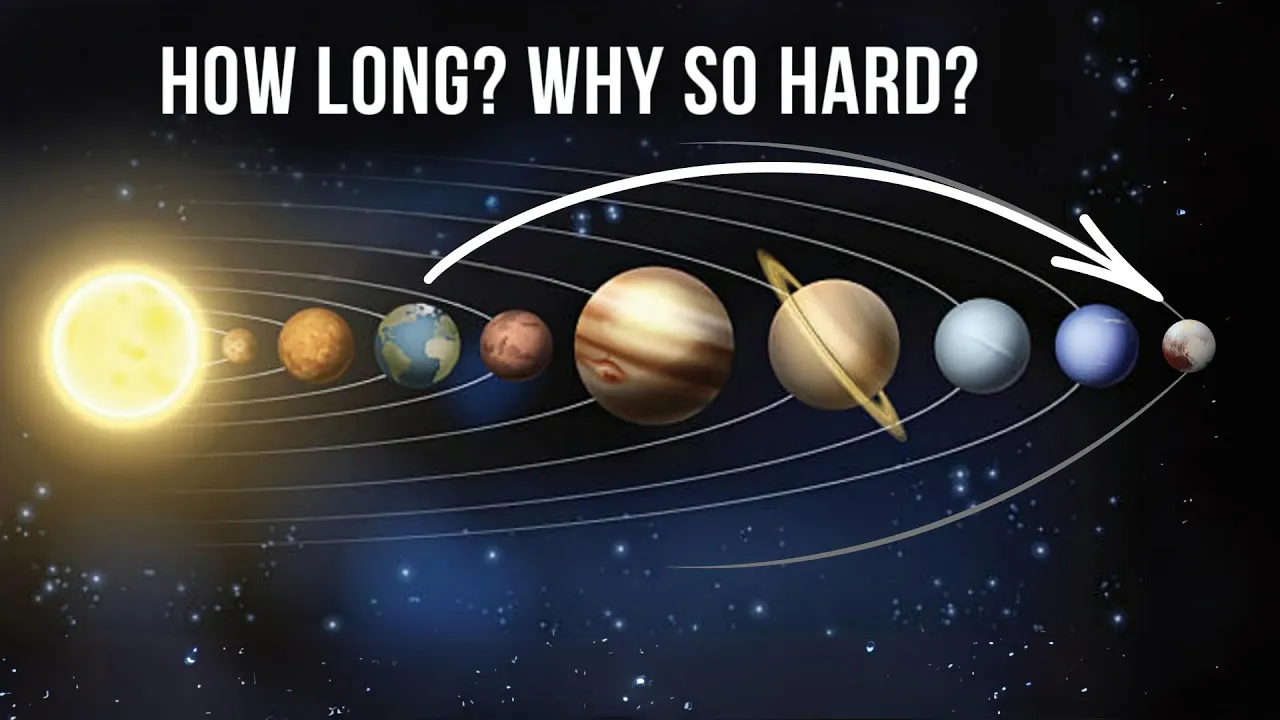
Why Is so tought to go to pluto and How Long would it take us to go there? In our long journey from planet to planet, documented in this video series to explain how long it takes to reach each one, we've finally arrived at Pluto. Many of us remember from school that Pluto was once considered the ninth planet in the solar system.
After 1992, its status was questioned following the discovery of several similarly sized objects in the outermost region of the system called the Kuiper Belt. A fierce debate arose among astronomers, and after the discovery of Eris, which is more massive than Pluto, the International Astronomical Union was forced to formally define the term "planet" in 2006, effectively excluding Pluto from the list of planets. Did we do the right thing or the wrong thing?
We still can't say for sure. . .
What we aim to explain in this video, is how long it takes to get there, considering all possible options! “Roll intro” After 9. 5 years of travel and 5 billion kilometers covered, going farther than any other spacecraft has ever gone, in 2015 New Horizons forced us to completely rethink our ideas about a celestial body considered at best a sterile ball of ice.
Far from being a dwarf planet, Pluto has a diameter of 2400 km. . .
it's a large rocky core similar to Earth, wrapped in a mantle of frozen water (and perhaps even an underground ocean), itself covered by layers of more volatile ices like nitrogen, methane, and carbon monoxide. All these gases sublimate and then precipitate back onto the surface, freezing and creating an incredibly varied topography with exotic plains, craters, canyons, hills, steep mountains, and perhaps even ice volcanoes. And of course, all this differentiation makes Pluto one of the most colorful worlds in the Solar System.
. . so much so that New Horizons' sensors revealed a landscape of stunning vistas.
. . Scientists studying the images believe that the incredible variety of these landscapes comes from eons of interaction between the highly volatile and mobile ices of methane, nitrogen, and carbon monoxide and the inert water ice, with fascinating cycles of evaporation and condensation.
Cycles even richer than those on Earth, where there's only one material that condenses and evaporates, water. On Pluto, however, there are at least three elements interacting in ways we still don't fully understand across the entire surface. One of the most intriguing features of Pluto's landscape is surely the large heart-shaped plain known as Sputnik Planum.
This enigmatic expanse is considered geologically young because it's crater-free, but its topography turned out to be much more complex than expected: the floor is made up of irregularly contoured nitrogen ice cells, where methane has filled the gaps; hills of water ice float in a sea of frozen nitrogen; ripple-like dunes and clustered pits make the smoother areas anything but monotonous. The plain seems to be dominated by active processes that slowly transform it, such as the thermal and cyclical convection of nitrogen ice. But that's not all.
. . The atmosphere surrounding Pluto is equally spectacular.
With its deep blue color, it contains layers of haze and is colder and denser than expected. This affects how the upper atmosphere escapes into space and its interaction with the solar wind. We discovered that pre-New Horizons estimates of Pluto's atmospheric loss were greatly overestimated.
We thought Pluto's atmosphere escaped like a comet's tail, but in reality, it escapes at a rate much more similar to Earth's atmosphere. We also found that methane, rather than nitrogen, is the primary gas escaping from Pluto. This is quite surprising, as near the surface, the atmosphere is over 99 percent nitrogen.
Thanks to complex photochemistry, methane and organic compounds in the atmosphere are hit by ultraviolet rays from solar radiation, forming reddish soot particles known as tholins. These create low-altitude hazes and fall back onto the surface, giving it a brick-red color. Besides being visually striking, these low hazes suggest that weather conditions change daily on Pluto, much like on Earth, and much more than on Mars, with the formation of very complex cloud systems.
Another element that justifies our total disagreement with Pluto's exclusion from the list of planets is the presence of an incredible satellite system, consisting of Charon (1200 km in diameter! ), plus four much smaller ones, with diameters ranging from about 40 kilometers for Nix and Hydra to about 10 kilometers for Styx and Kerberos. They have highly anomalous rotation rates, unusual orientations, and icy surfaces with albedos and colors very different from those of Pluto and its major moon Charon.
There is evidence that some of them are the result of the merger of two smaller bodies, and the craters present date their formation to at least 4 billion years ago, reinforcing the idea that they formed following a collision that produced the binary system Pluto-Charon. Speaking of this rare "double planet" configuration, so similar to the Earth-Moon system (with the two objects locked in a gravitational resonance, always showing the same face to each other), what would you think of a planet that has a satellite in the sky almost eight times the angular diameter of our Moon as seen from Earth? Would you really call that a "dwarf" planet?
In short, folks, in those few minutes the probe took to fly over it, Pluto revealed itself to be such a complex world that it immediately made us think we absolutely have to go back soon! But how? New Horizons took more than nine years to get there.
. . Is that a lot?
Is that a little? To those unfamiliar with the distances and times that govern the cosmos, it may seem like an eternity. .
. But can we do better or not? You can't answer this question without first understanding that the duration of a journey to such a distant celestial body depends on many variables dictated by initial choices, so there can't be a single answer.
But how did the New Horizons probe reach Pluto so quickly? "before moving on, don't forget to subscribe to our channel if you haven't already . .
. make sure to hit the notification bell so you don't miss out on our daily videos! " New Horizons was launched on January 19, 2006 (when Pluto was still a planet), and thanks to its relatively small mass of about one ton, boosted by a powerful Atlas V launch vehicle, it is still the fastest spacecraft to have left Earth.
When the rocket's engine in the launch vehicle's final stage shut down, New Horizons was traveling at 16. 21 km/s (58,000 km/h or 36,000 mph) relative to Earth. Thanks to this impressive speed, it crossed the Moon's orbit just nine hours after launch, while Apollo missions took three days to cover this distance.
However, fast or not, the probe did not travel directly to its final destination, Pluto and its family of moons. Instead, New Horizons spent its first year in space taking a longer, indirect route through the solar system towards Jupiter. As it approached the giant planet, New Horizons began to accelerate as Jupiter's gravitational influence increased, while its trajectory began to change as Jupiter pulled the probe towards itself.
Seen from above, the probe's path would have developed a sharp curve as Jupiter brought it into a new trajectory. On February 28, 2007, the small probe made its closest approach at about 2 million kilometers from Jupiter, then continued on its path, traveling about 4 km/s (14,400 km/h or 8,950 mph) faster than before the encounter with Jupiter. This might be surprising.
. . Where did this speed increase come from?
Well, it was essentially stolen from Jupiter. The loss of speed for Jupiter is proportional to the size difference between the giant planet and the spacecraft, so Jupiter was slowed by about a millionth of a trillionth of a millimeter per second! Thanks to this ingenious maneuver, four years were cut from New Horizons' travel time to Pluto in one fell swoop.
There was a serious reason to make the journey as fast as possible: scientists wanted New Horizons to reach Pluto before its thin atmosphere disappeared, freezing as the planet moved away from the Sun. Less happily, this great speed meant it was impossible for the probe to achieve orbit around Pluto. New Horizons flew past Pluto without stopping, effectively passing between the dwarf planet and its largest moon, Charon.
No available propulsion system could have slowed the probe enough to enter orbit around Pluto. So, from this, it's clear that the duration of a journey to Pluto depends on several factors, including the very important one of launch speed. Then, the type of propulsion used, the nature of the mission (flyby or orbital insertion, automated or crewed mission), and the position of Pluto along its highly eccentric orbit also play a role.
Let's examine these factors one by one, okay? Pluto's distance from Earth varies. Pluto has a highly eccentric orbit, meaning its distance from Earth ranges from 4.
28 billion kilometers (28. 58 AU) at perihelion to 7. 52 billion kilometers (50.
3 AU) at aphelion. An impressive difference, isn't it? This means that to minimize travel time, missions should be scheduled when the distance is near its minimum.
This is exactly what happened with New Horizons, which took advantage of the period when Pluto was near its perihelion. This is a significant limitation for current propulsion technologies, as the optimal launch window repeats at intervals of about 120 years. If New Horizons had launched when Pluto was at aphelion, it would have taken twice as long!
Types of Propulsion Current Chemical Propulsion Chemical propulsion is currently the most widely used technology for space travel. It uses the chemical reaction of fuels and oxidizers to generate thrust. As we've seen, using chemical propulsion and gravitational assists, the journey to Pluto can take between 9 and 20 years, depending on its orbital position.
Chemical propulsion is well-tested and reliable, but its efficiency is limited, requiring large amounts of fuel and offering relatively long travel times. Ionic and Solar Propulsion (Near-Future Technologies) Ionic propulsion uses electricity to ionize and accelerate a propellant (usually noble gases like xenon) to very high speeds. Solar propulsion, on the other hand, uses the pressure of sunlight on thin sails.
These technologies could reduce the travel time to about 7-9 years, depending on Pluto's distance from Earth at the time of launch. Ionic propulsion, for example, was successfully used in the Dawn mission to Vesta and Ceres. These systems are much more fuel-efficient than chemical propulsion but provide less thrust, making them ideal for long-duration, unmanned missions.
Futuristic Propulsion (Nuclear and Antimatter) Nuclear propulsion uses nuclear reactors to generate heat and thrust, while antimatter propulsion exploits the reaction between matter and antimatter, releasing enormous amounts of energy. With nuclear propulsion, the journey could be reduced to about 3-5 years, while antimatter propulsion could theoretically reduce travel times to a few months. These technologies offer enormous potential for reducing travel times but are still in experimental development and pose significant technical and safety challenges.
Types of Missions Automated Flyby Mission An automated flyby mission involves a close pass of a probe without entering orbit around the planet. As demonstrated by the New Horizons mission, using chemical propulsion and gravitational assists, a flyby mission to Pluto can take about 9-10 years. Flyby missions allow for close-up data collection without the probe having to slow down for orbital insertion, but the downside is that they offer only a brief observation period.
The flyby of Pluto by New Horizons lasted only three minutes… Automated Orbital Mission This mission involves the probe entering orbit around Pluto for extended studies. Using chemical propulsion, the duration could be similar to that of a flyby. It offers a prolonged period of observation and data collection but requires more fuel and more complex maneuvers for orbital insertion, as well as significant deceleration in the final stretch.
The estimated travel time would be 12-15 years. Crewed Mission A crewed mission to Pluto would represent one of the greatest challenges in space exploration. With current technology, a crewed mission (including orbital insertion) would take about 15-20 years.
The spacecraft would have to be a large vessel where astronauts could live for years, making it extremely heavy and requiring an enormous amount of fuel. There is no possibility of this happening without a propulsion system capable of reducing the travel time to just a few months. To conclude, Planet or Dwarf Planet?
Pluto doesn't care: however we decide to classify it, it will continue to travel silently along the edge of the Solar System. If we want to try sending another spacecraft to its vicinity, perhaps equipped with a rover to explore its surface, we will need to find a more powerful energy source as soon as possible. And, above all, we should keep in mind that the longer we wait, the farther Pluto moves away, greatly increasing travel times.
All in all, the simplest solution would be to send another New Horizons right away, this time to enter orbit. If launched in about ten years, it would arrive around 2045, when Pluto would still be relatively close, at 39. 5 AU, or 5.
9 billion kilometers.