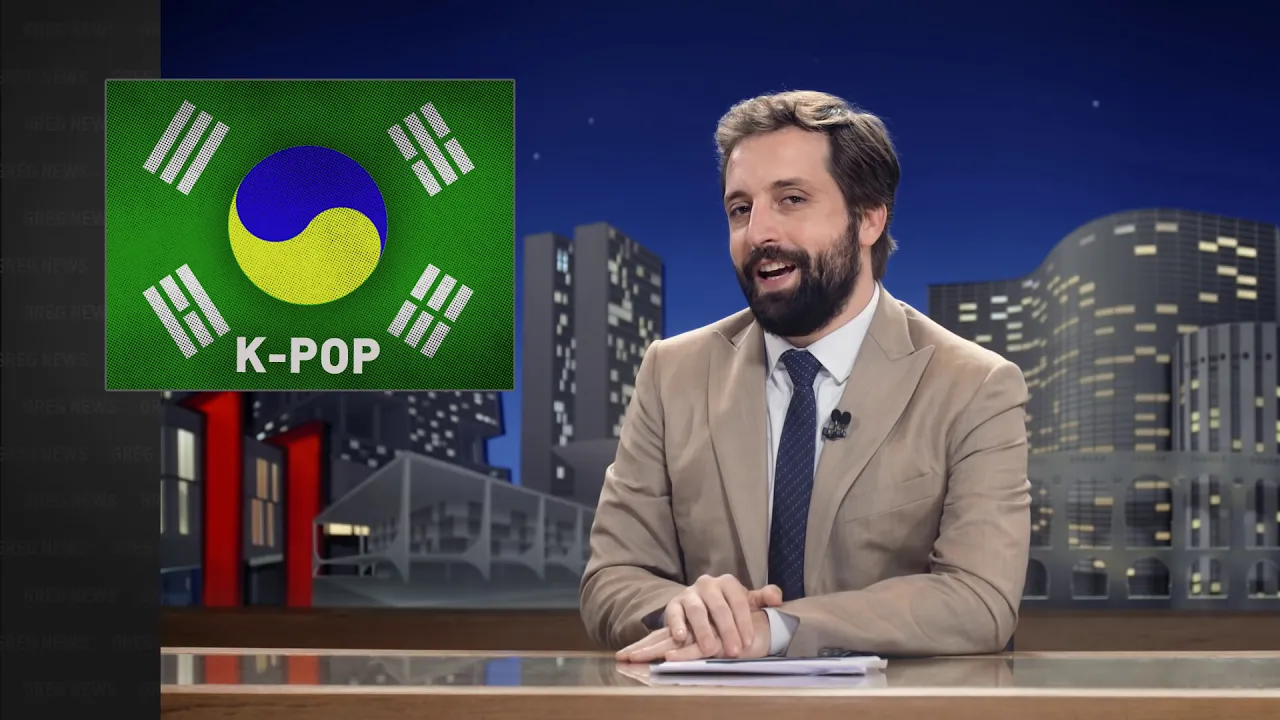
K-pop. Nobody can talk about Bolsonaro anymore and how many times he talked shit. Clearly, we're in a toxic relationship.
So today we're going to talk about a much bigger movement than "Bolsonarism". A movement that has captivated all the youth of the planet. It's US$57 billion industry.
Today we're going to talk about K-pop, the biggest Korean explosion since Samsung launched the cellphone that catches on fire. This is K-pop. It looks like they're wearing a cyclist's helmet, but it's actually to protect themselves because they all have a Galaxy Note 7.
If you've never heard of K-pop, it means it's been a while since you've talked to a teenager. Otherwise they would've put K-pop on for you to listen. They would have told you about K-pop.
K-pop is the teenagers' "Bacurau". That's their only subject. In fact, have you watched "Bacurau"?
K-pop is a musical genre created in the early 90's in South Korea that mixes western pop with traditional Korean music, along with postmodern music production, along with postmodern music production, and a little bit of Carimbó. No, just kidding. Besides K-pop, there's also J-pop, which is Japanese pop music and C-pop, which is Chinese pop music.
And in Brazil, we have Super Pop. Besides, of course, Push-pop. Remember?
That lollipop that you stuck your finger in and suck like this. And that was ridiculous because your finger got all droopy, with a mix of drool and sugar, your finger got sticky. So, that was Push-pop.
And, of course, Rafael Pop. <A lot of love, girl <that I'll give you <"Um Grande Amor" <The most played music in Brazil and in the world! Rafael Pop!
The most played music in Brazil and in the world may be an exaggeration, but from now on it's the one that is playing in my heart. The K-pop artist has a special designation, being an idol. The artist may have a solo career, or either be in boy bands and girl bands.
The idol needs not only to know how to sing very well, but also to dance very well, act very well, tell jokes very well, have media training, act in soap operas, present TV shows, and to be a model for a perfume brand. Look, Leonardo da Vinci paints and does autopsies, but he never did a music video. Michelangelo didn't have media training.
He couldn't tweet. Most idols have been training since they were 12, like a classic ballet dancer or an Olympic gymnast. It's like they're not only artists, It's like they're not only artists, So much so that there's an annual event called Isac, which is the "idols' Olympics".
And even in sports they stand out. In the bow and arrow, this idol goes so well that she hits the camera that stays in the middle of the target. <Now, Irene, from Red Velvet.
-What? -She hit the camera! IT WASN'T AN ACCIDENT.
YOU'RE LOOKING AT THE ARROW. My God! She hit the camera!
Yes! She did! -Did it break?
-Yes, it did! <Check, please! She hit the camera!
<It looks like we're eating chicken today. -<Did she hit it? -<Yes.
I really like her reaction, which is like this. It's a mix of pride and shyness at the same time. It's the same face I make when people say this is the most depressing show on Brazilian television.
Come on! Come on! My writers write these jokes.
Just like in a soccer team, each member of a K-pop band has a position and responsibility. You can be the lead singer of the band, like Yuju from Gfriend, or you can be the lead dancer of the band, like Sugui from Red Velvet. You can also rap, like J-hope from BTS.
Sorry, I mispronounced it. They get mad when you say it wrong. It's "BTS", like "HBO".
MTV, HBO, BTS. All right? Learn this.
There's even a special function for the youngest of the band, or "maknae", in Korean. He's in charge of the charisma and the cuteness of the group. Unlike our own, Caçulinha, who was responsible for playing bank's jingles.
Do you remember? There are cases in which the oldest person ends up fulfilling the youngest person's function, like Naeyon, from Twice, and then she is called "false maknae" or "false youngster", because she is responsible for those moments of tenderness. It's Rodrigo Maia's job as the Brazilian House speaker.
He looks like a child whose mother forgot to pick up at school. Always. He's always so cute!
He's so cute! My God! I'd like to take him home, keep him in a little box!
Besides, every idol needs to know how to do a thing called "aegyo". This is when someone makes a cute face and cute voice. Like talking in a baby's voice.
This is "aegyo". It's K-pop's tradition. Such as the tradition to improvise in jazz, hip-hop battles, or to tell people to jump in Axé Music songs.
Here we have examples of Korean idols doing "aegyo". Can you imagine if you had that in Brazil? The moment when Mano Brown makes a cute face for us?
Although Mano Brown was very cute when he tried to use Snapchat and accidentally turned on the kitty filter. So cute! <Here I am, one more day <under the bloodthirsty gaze of my auntie <You don't know what it's like to walk <with a babysitter aiming at your head Unlike C-pop, J-pop and Rafael Pop, K-pop has taken over the world.
The example that almost everyone knows is "Gangnam Style", by the artist Psy, whose music video on Youtube currently has 3. 5 billion views. A more recent example is BTS, which is currently the biggest boy band in the world.
One direction, sorry, they're gone. Or, as *NSYNC would say: "Bye Bye Bye! " In one year, BTS managed to take three of their albums to the first place on Billboard, a feat that only the Beatles had achieved until today.
And all this, with four letters less in the name. Yes, they took out the E, the A, even the L. They have a lot more success per letter than the Beatles.
But how did K-pop become this global phenomenon? At the end of the 1990s, Asia was going through a major financial crisis. South Korea then began to adopt policies to mitigate the recession.
Among them, investing in culture. And they didn't even start with music. The popularity of a South Korean soap opera in China, "What Is Love", made the government think about globalizing their pop culture.
It's hard to "What Is Love" without going: <Baby don't hurt me> I had to contain myself What Is Love. . .
From then on, they started subsidizing popular music, creating a department within the Ministry of Culture entirely dedicated to K-pop, a genre that was already a phenomenon in the country, but was until then, unknown in the rest of the world. It's as if Brazil created the secretariat of the Yellow Street Dog, a dog that is already a phenomenon in Brazil, but until now, unknown in the rest of the world. In Korea, they made programs to protect the music industry.
They built huge stadiums, put money even in karaoke. A sort of "Família Lima" program. Was it a good idea to invest money in popular culture in the midst of an economic recession?
What does a government gain by helping the entertainment industry? Nobody says: "People, the country is in crisis! We need more dancers!
" It doesn't seem to make much sense, but it does. First because the country, by investing in culture, increases its exports and generates jobs. After the Korean government began to promote the music industry, the genre became an Asian phenomenon.
In 2018, the K-pop industry finally got out of the Eastern World and established itself as a global power. BTS alone is responsible for bringing nearly U$$4 billion a year, to Korea. That's almost US$1 billion in merchandising alone, BTS' merchandising alone.
Sorry, I mispronounced it. Don't kill me. The last thing I want to do is annoy BTS fans.
Meanwhile, Brazil has made less than US$500 million selling niobium, yes. Follow my reasoning. Korea makes twice as much selling BTS mugs and trinkets then Brazil makes selling niobium.
If Brazil wants to sell more niobium, we need niobium bars with the faces of the guys from BTS on it. Sorry, that's the truth. Culture is worth more than niobium!
Second, by investing in culture the country also gains influence. This is not so easy to measure in dollars, but the world's interest in K-pop has also made people interested in Korean culture. Tourism in Korea has tripled in the last 15 years, and a survey revealed that 1 in 13 tourists went there because of BTS, not just because K-pop, but because BTS.
It's the same as people who go to Xérem to see Zeca Pagodinho. Me, for example. Right?
K-pop also made many people around the world consume other products from South Korea, like the South Korean soap operas, known as K-drama. And South Korean cosmetics, known as K-beauty. Because everything from Korea has a letter "K" in front.
Which begs the question: Is that where they're hiding Queiroz? Maybe. .
. Korean cinema started becoming popular in 2011, when Fox started investing in feature films made there. At the time, Ambassador Young Sam Ma attributed this growth to K-pop.
For him, foreigners who listen to this music tend to find Korea more attractive and have a more favorable impression of Korean products, unless they explode. But it was just one thing. In the US, over the last 20 years, there was a growth of 8,500% in the number of people studying the Korean language.
A phenomenon that is happening in Brazil as well. The Korean government is even giving scholarships to Brazilians to learn Korean there. It's like you that learned to say "Insha'Allah" because of a soap opera.
That's good. It was good at the time, for Morocco, I imagine, I don't know. .
. That's good for South Korea! But why is that good for South Korea?
I'm serious. Not only because consumption of Korean products increases, but also, and this is the most important thing, because this way the State strengthens its Soft Power. Don't confuse it with "Limp Power".
"Limp Power" is what Doria has, for example. Soft Power is another thing. It is the power a country has to influence other countries through cultural and ideological means.
With K-pop, Korea manages to sell the image of a cheerful, modern, fun and, above all, cute country. Korea has become like the "Maisa" of countries. Everybody likes her.
China, is the Silvio Santos of countries. No wonder, in 2018, BTS was chosen to make a speech at the UN for young people from all over the world. Imagine if, to mediate the conflict between Israel and Palestine, they called Sorriso Maroto.
It was like that. Also last year, the South Korean government sent one of its most famous girl bands, Red Velvet, to perform in the impenetrable North Korea. The dictator Kim Jong Un was a big fan of the band and even cancelled several appointments to attend the concert.
North Korea was so envious of K-pop that they created their own girl band, Morabang. But their kind of K-pop isn't so popular. <Let's study let's study <for the benefit of our country <Let's study let's study <for the benefit of our country "Let's study for the benefit of our country".
It's such communist and doctrinal lyrics as is: "Analyzing this hereditary chain I want to get rid of this precarious situation" The K-pop industry also influenced geopolitics when Twice's singer Tchui appeared on TV with the flag of her native Taiwan. The problem is that China does not recognize Taiwan as an independent country, and the Chinese population ended up mad with Chui. The singer, who was 16 at the time, was coerced into making an apology and filmed it, but was visibly bothered by it, which then provoked a negative reaction among the Taiwanese, who took her side.
Her influence was so great among the Asian population that the three Taiwanese presidential candidates had to speak out defending Chui. The victorious candidate, Tsai Ing-Wen even quoted Chui in her inauguration speech. Chui is like Taiwan's Olavo de Carvalho, without the part about believing the Earth is flat, and fascism, the bad breath.
. . I bet he has a stinky breath, I don't know.
I have no evidence, but I'm sure he does. Korea's cultural influence in other countries is so strong that China has invented a term for it, "Hallyu", or the "Korean wave". And "hallyu" arrived strongly in Brazil.
<Maria, how was it? Wonderful! -Really?
-I lost my voice. Wonderful! After three months camping here, you're going home, right?
-No. -No? I'm camping here for another night.
You're going to tomorrow's concert? I'm taking my granddaughter. "My grandmother keeps taking me to BTS concerts.
I can't take it anymore". "Come on, you got to go! It's Culture".
This lady camped out for three months and will stay another day to see the BTS. The Homeless Workers Movement should adopt this tactic, to avoid the police. "It's not an unproductive property occupation, we're just queuing up for the BTS concert.
It's not scheduled yet, but we're waiting". The truth is that fostering the country's culture through public incentives is nothing new. It's quite a common practice.
For example, cinema in most countries has State incentive. In countries like Argentina, France, Estonia, Canada and Malaysia. Even countries that, at first, do not seem to do that sort of thing, such as the US.
The US has always done this, unofficially. A classic case is the CIA's relationship with Pollock and De Kooning, who were funded by the agency <to strengthen American cultural hegemony <and influence in other countries. Even Disney had a little help from the CIA to build Disney World.
Maybe that's what's missing for Monica's Park to be a hit. Terra Encantada, for example, had no help from the militia. Beto Carreiro was boycotted!
Bolsonaro, on the other hand, before he even took office. . .
Shit, I mentioned Bolsonaro. I'm sorry. I fooled you.
I pretended to talk about K-pop, but it was all a plan to get your attention, and talk about the Rouanet Act. No. To talk about popular culture, using South Korea's hit case.
While the Koreans are investing in K-pop, Bolsonaro announced the extinction of the Ministry of Culture even before taking office. He ended up merging this Ministry with the Ministry of Citizenship, along with the Ministry of Sports, all in the hands of Osmar "Flat-Earth". In July of this year, Bolsonaro defended the extinction of Ancine, the National Film Agency, because, according to him, "the State doesn't have to get involved in film making".
Recently, Bolsonaro criticized Ancine again in a Facebook live and said: "If I could fire everyone at Ancine I'd say 'Off with their heads'". He likes to say "off with their heads". He thinks he's in Game Of Thrones.
Man. . .
If you want to cut someone's head off, you must learn how to do push-ups. There's an order, you know? Bolsonaro has appointed as Secretary of Culture a guy who's never worked in the cultural sector.
But there's nothing so bad that can't get worse, right? In September, he announced a 43% cut in the audiovisual fund for 2020. And the obsession with Ancine doesn't seem to have an end.
The same project also foresees a drastic reduction in the authorizations to raise private funds for cultural projects. Next year, this budget will be decreased from $650 to $300 million Brazilian reais. In addition, weeks ago Ancine cut off financial support to promote Brazilian films at 11 international festivals.
Speaking of which, have you watched "Bacurau"? I was just wondering. .
. This week, Bolsonaro spoke about his cultural policy during a conservative symposium in Ribeirão Preto. Congresswoman Bia Kicis, who was present, tweeted: "That's what we have at the conservative symposium.
It has no funk music or Axé music, just high culture. Vive la haute culture! " But there's no such thing as "haute culture" in French.
I learned that on one of my many trips to Paris financed by the Rouanet Act. There was me, Chico Buarque, Caetano Veloso, partying. .
. No, seriously. This expression doesn't exist, okay?
There's the expression "haute couture", which means "high fashion". You can see that Bia Kicis' culture is really low, because it doesn't really exist. Low culture is an expression that doesn't exist.
She even posted a 5-second video, which is a funny part, of the sound she considers to be high culture at the conservative symposium. Take a look. I think the song was "Jesus, Joy of Man's Desiring", by Johan Sebastian Bach.
Yet neither Jesus deserves that, with all due respect, nor men, nor joy, nor Bach. It managed to take the joy out of everybody. But the contempt for funk music and Axé music isn't just Bia Kicis' problem.
The Brazilian government has a long tradition of thinking that all culture that comes from the people is ugly, corny, low and even illegal. Playing Samba, for example, was once a crime. From the beginning of the 20th century until the government of Getúlio Vargas, samba was considered an act of vagrancy.
João da Baiana, a musician, needed help from a congressman to avoid being arrested on the streets. Senator Pinheiro da Fonseca, who was a samba fan and one of the most important politicians at that time, signed João's tambourine, so that he could show the instrument with the signature, when he was stopped by the police. This is what Brazil is about: a mixture of racism with pulling rank, with samba.
It's the infamous "pandeirada". Do you know who you're talking to? Then we criticized Axé music, snubbed Forró, ignored Carimbó, and now, the persecuted rhythm is the funk music.
In 2017, there was a bill in the Senate that tried to criminalize the rhythm. In Rio, resolution 013, signed by security secretary José Mariano Beltrame, gave police officers the chance to end any funk party, and any other cultural event, in the city's favelas. The resolution was only annulled after mobilization of the favela's residents.
And it was not in vain, at the time, funk music generated over 10,000 direct jobs in Rio, alone. Because after all, "batidão" was born in Rio. There are a lot of funk musicians but they are family men.
Baile da Gaiola alone, in Complexo da Penha, has taken over 30,000 people to the streets of the favela. Developing the local commerce and generating income for thousands of families. It's the black people's and favela's music, but when it plays nobody can stand still.
Funk music has everything to be the Brazilian K-pop. Look, it's a contagious rhythm, completely Brazilian and full of international references. Since 2016, funk music has grown over 3000% in streaming, outside Brazil.
The "Bum-bum-tam-tam" music video, for example, by Mc Fioti, was the first Brazilian music video to reach over a billion views on Youtube and almost 2/3 of those views are not from Brazil. French people watched "Bum-bum-tam-tam" 56 million times. Maybe because Mc Fioti, knows how to make good use of a Bach's song.
For those who are curious, he uses Bach's "Partita in A minor", and mixes it with his own references, in an appropriation of this baroque composer, dialoguing with the era of technical reproducibility and syncopating the "big butt". Hence the title, Bum-bum-tam-tam. Bum-bum-tam-tam that refers to the Yanomame language.
. . Just kidding.
Anyway, that's "haute culture". Funk music already makes all that success, even without any incentive. Funk already has its idol, which is often the Mc, and like K-pop, it's a style with fun, and complex dances.
Funk music has its young representatives, which are Loma and Mc Brinquedo. And they're both full of cuteness. Funk music borrows national and international styles, in a mix of crazy and postmodern samplers, which makes it a style of easy assimilation for people abroad.
And that's a lot like K-pop too. Even Beyoncé is dancing funk music. There you can see the Brazilian talent.
Even Beyoncé didn't get it right. Let's be honest, that's not the proper dance. It's kind of right.
She almost got it right. "But funk music is so obscene! " That's what the old people always said about the popular music of their time.
They said it about rock, rave, hip hop. All of them have always been called obscene. And for one reason: it was obscene.
If you think funk music is too obscene, but sings "Lick my pussy and my back", you don't understand English. Even the most played Brazilian song of all times, "Garota de Ipanema" is about an underaged girl. Yes.
But instead of celebrating funk music and fostering this industry like Korea did with K-pop, we're literally arresting whoever's successful with it. In October 2015, a complaint filed with the Public Ministry accused DJ Rennan da Penha of aiding criminals "by organizing clandestine parties in the communities". Clandestine?
30,000 people? Congratulations. You're good at hiding.
Congratulations for hiding 30,000 people. Like that book, "The Secret", sold to 500,000 people. It should change the title.
You can't call it "Secret". It can't be a clandestine party with 30,000 people. "And making music praising the drug traffic".
At the time, Rennan was even put in jail for six months but in 2016, when a court of first instance released him for lack of evidence. The Rio de Janeiro Public Ministry appealed the decision, and in March 2020 Rennan was sentenced to six years and eight months in prison for the crime of association for drug trafficking. In the appeal, the prosecutor's office added to the case a picture Rennan posted on the Internet, with a cardboard gun, made for Carnival.
About the photo, the judge who convicted Rennan said: <"It seems evident that, the exhibition of a gun, <it doesn't matter if it's real or not, <contributes, without a doubt, <to show the existence of an armed criminal group. <After all why would someone show off <with a fake gun <except to demonstrate power and arrogance? " Is taking a picture with a gun evidence that the person is a criminal?
Okay, so I would like to read the prosecutor's letter with these photos in the background. <"It seems evident that, the exhibition of a gun, <it doesn't matter if it's real or not, <contributes, without a doubt, to show the existence of an armed criminal group. After all why would someone show off <with a fake gun <except to demonstrate power and arrogance?
" Rennan's story is symbolic of how we treat our popular artists, especially black ones, and how we waste the potential of funk music by not creating our B-pop. But even with Rennan in prison, more and more people listen to the "150 bpm" the cultural movement he helped to create. The Mc's who were born at the Baile da Gaiola are making huge success.
Kevin O Chris has a music video about the party with over 51 million views on Youtube. Mc Rebecca, who also started at Baile da Gaiola, has 500,000 listeners per month on Spotify and 32 million views on Youtube. And the song "Hoje Vou Parar na Gaiola", by Rennan da Penha with Mc Livinho, has over 230 million views.
In addition to that, at the end of last month, Rennan da Penha received the news that he is running for the Latin Grammy. You may not like it. .
. Let's hear it for him. You may not even like funk music, and a lot of Korean people may not like K-pop either.
I don't like soy, but Brazil exports soy. But that's not the point. The point is that this is a 100% Brazilian product that's already a success, that sells, that's already drawing crowds.
It's black people's music, from the favelas, that raises the GDP and helps the market. And that's why today BTS is not playing here. They insisted a lot, kept calling, begging us.
No. Here, Brazil is above all. We really want to hear Mc Rebecca!
Come here. Thank you, Greg News! It was a pleasure to sing for all of you!
Freedom for Rennan da Penha!

![Morning Coffee ☕️ [lofi hip hop]](https://img.youtube.com/vi/1fueZCTYkpA/maxresdefault.jpg)