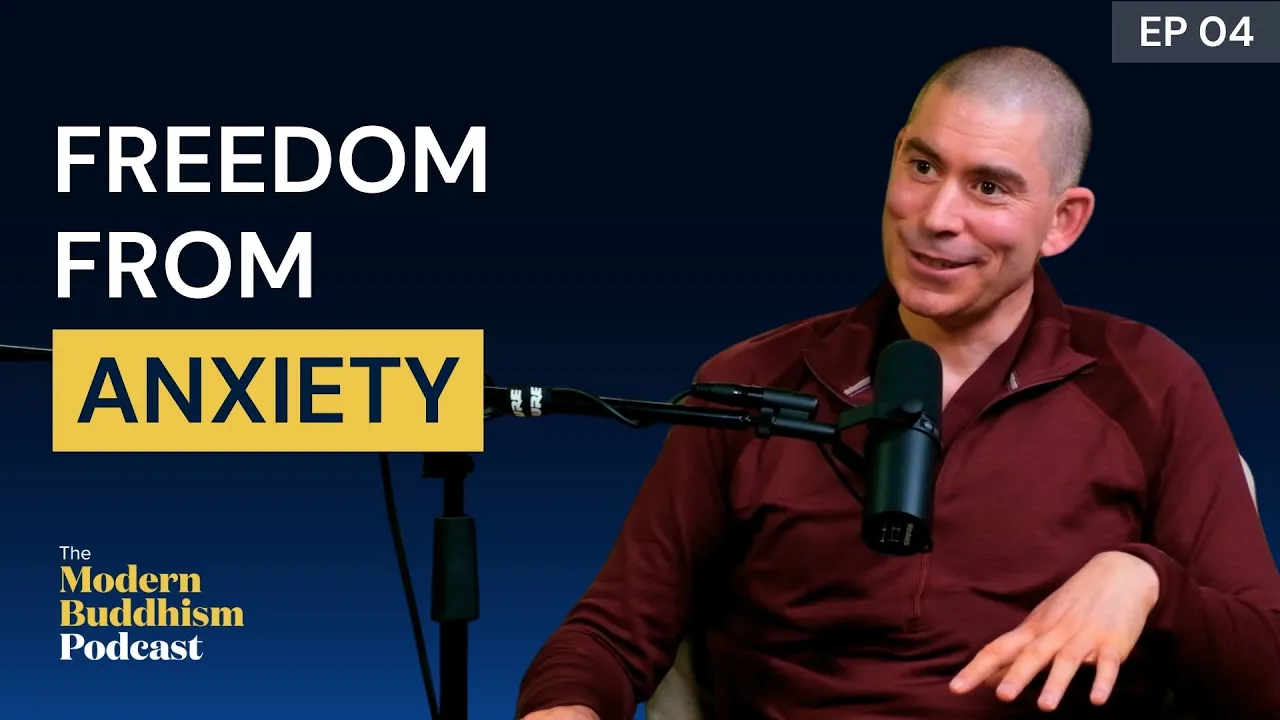
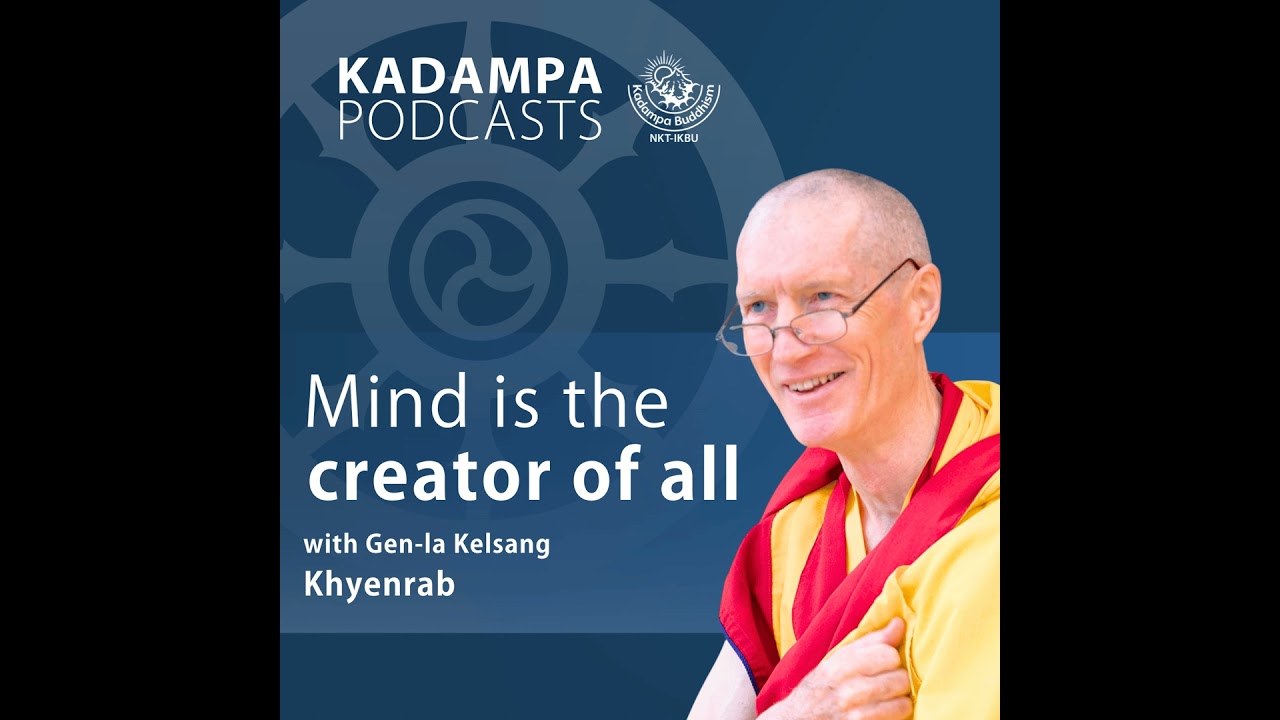
And today I'm in conversation with Gen Kelsang Rabten. He's been studying, practicing and teaching meditation and Buddhism within the Kadampa Buddhist tradition for many years now, and living as a Buddhist monk for over 30 years. And in this amazing conversation, we really explore one of the challenges we all have. One of the things that our anxiety shows us is the superpower of our mind. If we harness that, what we can achieve and quite quickly is really extraordinary. I mean, it's just such incredible advice, really. What I previously thought was my weakness, the power of my
mind to create my reality, it's now actually my strength, my superpower to create this whole new experience of reality free from anxiety. It's just the mind. And when we realize that, then we have a chance of winning. So again, Rabtan, thanks for dropping into the podcast today. I'm really looking forward to this conversation because I think there's so much in this topic that we're going to explore today that can be so helpful for so many people. It's a pleasure to be here. And I agree, I think this is a really, really important topic. It's going
to help a lot of people. Exactly. So that's where we start today is this topic that we're exploring, as we both know, is around really how we can all learn to deal with anxiety and stress in a much healthier way than we're experiencing today. And in the world we're living in at the moment, anxiety is definitely on their eyes. People are experiencing this more and more and more and more consistently. And even if you're not the kind of person who's prone to high levels of anxiety in the world we live in and the lives we
live, it's very easy for that anxiety to begin to ramp up in your life and feel quite stuck in it. So I guess that's what we really want to explore today, like really practical techniques that people can use in their everyday life to be able to turn to that anxiety without feeling overwhelmed by it, begin to deal with it in a healthier way and gradually over time to move beyond it more and more. So I guess that's where we start is really in the understanding of this kind of training using meditation, Buddhist timeless wisdom in
everyday life, how would do we frame this understanding of anxiety? I think it's really important to recognise that anxiety affects people in different ways. It comes in different forms. It's unusual for people to be completely free from anxiety, but on the spectrum of the experience of it there is also really debilitating experiences of anxiety. We can be anxious about specific things. There can be specific triggers for our anxiety or it can be a much more generalised experience. But essentially what I believe we're talking about here is an uncontrolled fear. Fear in itself isn't necessarily a
bad thing. Within the Buddhist meditation there are fears that we almost deliberately cultivate because they will then induce certain responses that are positive and effective, help us prepare better for challenging situations that are coming by sort of thinking ahead of time. But in the anxiety response it's an uncontrolled fear that isn't helping us. A lot of people will have for example social anxiety where they are worried, what will People think about me? What are people saying about me behind my back? And then almost in a sort of self-censoring way not enter into situations where they
could get a lot of fulfilment and a lot of connection and that would be very healthy for them. But those fears are controlling them. They're not controlling the fear and empowering them at all. They are being controlled by those experiences. Medical anxieties, people might avoid seeking treatment until unfortunately whatever was there underlying has now become much more serious and much harder if not impossible to treat when it could have been dealt with perhaps quite easily. But that uncontrolled fear was governing their choices. And so understanding anxiety and its mechanisms is really, really helpful for us
in terms Of gradually being able to dismantle that. One of the main ways that anxiety works is by taking us out of the moment we're in. For example, imagining a future scenario. What if this happens? What if that happens? And imagining it so vividly that we're having the feelings of it now even though it hasn't happened, even though it might never happen. We worry more about things that never happened than things that in fact do. Quite often when the thing, if the thing ever does actually eventuate, we're much better equipped to deal with it because
now we're in a doing mode. But the anxiety is projecting us into a future that hasn't happened. So we can't necessarily do anything about it except just worry and be paralyzed. Similarly, sometimes the anxiety is a burden that we're carrying into the present from a past. Now, we might have, as many people have, experienced quite traumatic things in earlier life or in childhood to which we developed certain coping mechanisms, certain mental strategies that perhaps were needed then or useful perhaps then that are no longer appropriate. We might find ourselves in a present where we're being
much too aggressive or we're being much too distrusting of the people around us. People are genuinely showing us an affection that perhaps we could trust. But because of this sort of trauma response that we've carried from the past, we are reacting in a way that can be quite toxic and undermining of our present relationships. And so at the most basic level, the foundation techniques that we use to help us address our anxiety are simple meditations like the meditation on the breath where we're gathering Our self into the present. We're practicing being present. We can observe
the physical sensations of our body, the sensations of the breath as it enters and leaves, and we're just anchoring our self into the moment we're in. And that obviously takes some practice. But with a bit of effort, with a bit of consistency in practice, we will find that we are able to just tone down, like turn down a bit of the volume of those intrusive anxious thoughts because we're more present in the moment we're in. We're a little bit taking away the energy from those imagined horrors for the future or a little bit more able
to let go of a past that doesn't exist in the present. That's a sort of a general overview, I think, of anxiety as uncontrolled fear and some of the mechanisms that are inducing it. And I guess what that opens up for somebody listening today is a lot of people are obviously understandably feeling that actually the reason I'm anxious is what's happening in the world. It's what's happening at work. It's what's happening in my relationship. That's what's inducing my anxiety, my fear. But actually in reality, what we're pointing to here is it's all coming from how
we're perceiving things, how we perceive the past, how we still relate to the past, how because of how difficult that past was and maybe we didn't have the tools to begin to, such as meditation to work through it, let go of it, it's still inducing this quite intense anxiety when we meet similar kind of situations that trigger that tendency. Or when we're looking to the future, we're thinking it's this situation in the world and what's going to happen in the world, actually it's the response in the mind at that time. And so what I find
endlessly helpful and liberating about that is for everyone listening, it's like, okay, so that's where we're at today and we're looking at the world in this way and we think that's the problem. But actually when we begin to explore it in the way that you're explaining clearly there, we begin to understand now the anxiety is coming from how I'm perceiving things, how I'm relating to things. And that's the one thing in this out of control world that we can gradually begin to control because at the moment we're experiencing this uncontrolled mind, this fear and anxiety
that arises. But what most people think is that's the one thing I can't control. But what you're saying is actually through this, we open a door even through simple breathing meditation to bring our mind fully into the present and then we can begin to start to See I can control my response, I can control my mind. I mean I'm reminded of one of the most powerful quotes that for me anyway moves my heart every time I think about it. It's in the book Living Meaningfully, Dying Joyfully where Geshe Kelsang talks about this. He says, "When
we learn to control the mind through correct meditation, we overcome all fear and anxiety." Because when we really think about that deeply, that's incredibly liberating because we feel our mind is out of control, there's nothing I can do. And he says, "Why is this so?" He says, "Because all fear comes from the untamed mind." So even what you're describing as an entry point with breathing meditation is moving towards understanding what correct meditation is. And so as you begin to engage in a practice like that, you're beginning to tame that uncontrolled fear and anxiety that we're
experiencing and at least you're opening the door to seeing a better way forward. I think it's incredibly empowering to know or to at least hear, even if we can't fully accept it for a long time, that it is possible to arrive at a fearless state, a state completely beyond anxiety. When we suffer from anxiety, particularly if it's quite severe, it is initially very difficult to imagine not experiencing that in the kind of situations that we find triggering. It is absolutely possible, but it is quite a journey. I think there are many, many steps along the
way. And I do think along that journey, we learn some really valuable insights. Something I imagine many people suffering from anxiety will recognize and relate to Is that there certainly there is a stage, there is moments of anxiety where we very firmly believe it's because of this or this that's happening to me. But one of the mechanisms of anxiety that's very common is this sort of closed loop that happens where there's a situation, we find it triggering, we can feel that anxiety rising within us. And then our anxiety switches from being so much about that
situation to being about the anxiety itself. We're anxious about our anxiety. We're worried. What is this going to make me do? Am I going to pass out? Am I going to or in a panic attack situation, we might think, am I going to have a heart Attack or we might think, am I going to just run out of the room and embarrass myself? Am I going to just blurt out something that I won't be able to take back? And we start to become anxious about the anxiety. And that's now a closed loop, which is a
very difficult thing to get out of because it's no longer about the situation anymore. It's about entirely what's happening inside. And that's where one of our fundamental practices is so, so helpful, which is about becoming more comfortable with uncomfortable thoughts and feelings. The anxiety mechanism isn't going to disappear overnight. And so we build a basic kind of background or foundation of the breathing techniques and so forth. Then we can start to introduce these more observational techniques. One of the things in Buddhism is the first thing to do is do nothing at all. Just watch, pay
attention, see what's actually happening. Sometimes just this exercise alone, and I'll describe how we do it in a moment, but sometimes just this exercise alone frees us from that loop, from that closed loop mechanism. I'm reminded of, I think it was an Instagram reel or something that I saw one time and it was a little boy. He was in a swimming pool and he was screaming for his life. He was flailing around in the water and clearly in great distress. And he was laughing, which you might think was a little bit callous. But eventually this
child is wailing for help, finally gives up and you can see it's like, that's it, I'm drowning. And then his feet hit the ground and he's waist high in water and there was no chance He was ever going to drown. And the parents or the adults around him were just laughing because there was no danger. There was no danger. And sometimes our anxiety mechanism is like that. The situation isn't nearly as bad as the imagined. It's like the echo in a cave or a shadow that frightens us on a street. There isn't actually a basis
for the degree of fear that we're having, but our anxious mind isn't letting us check how dangerous is the situation I'm in. It's not letting us take our feet to the bottom just to see, can I touch the bottom of the pool? And so one of our first mechanisms is stop and just look what's happening. And Geshe Kelsang gives this incredibly practical way of looking at our mind. He describes the mind as a sky and the various thoughts and feelings that arise within it as clouds, perhaps sometimes storm clouds. They might be raging thunder and
lightning storm clouds. But that way of relating to our thoughts and feelings, our anxious thoughts and feelings, is recapturing the power. He gives us a little change of description, this change of the way of framing the situation to ourselves. So rather than saying to ourselves, I am anxious, I am anxious, which is basically I equals anxiety. In that way of framing it, we are inside the anxiety and all there is, we are completely immersed, consumed and subsumed into the anxiety. There's no perspective on that experience at all. Instead of that, we try to frame it
anxious thoughts and feelings arising within my mind. Like a storm cloud in the sky, there's room for it. And no matter how fierce the storm is, it's never going to destroy the sky. And it takes a little while to get into that sort of observer mindset. And it's an exercise we can do when there's nothing wrong, when we're not feeling anxious. We can just take time from time to time to look what thoughts and feelings are arising, get used to observing our experience in that way. And then when we need to, it will be to
hand. We can call upon it. We can observe. Yes, there are anxious thoughts and feelings. We're not pretending that they're not there. We're not trying to push them down or immediately stop them. We're allowing their presence. But we're just in a state of being. Yes, there are anxious thoughts and feelings. But we feel like the sky. Do you know what's so powerful about that is it's for someone who's struggling with anxiety today, when they identify the anxiety within the mind, of course, they will be able to see it. And they will say, understandably so, that
immediately when I identify it, I'm identified with it. And therefore the last thing I want to do is look at it and begin to explore it. But as you say in this observational approach, what's pivotal in this is what you said at The beginning. The whole idea of this is that one of the reasons we get so anxious is because of the way our minds are hardwired at the moment for most of us is we get very closely involved with the situation as soon as we bring it to mind. And then we lose that mental
balance, that mental equilibrium. But even a simple breathing meditation will gradually slowly establish that sense of mental balance and equilibrium will give you the space in the mind to feel that slightly more sky like nature of the mind. So it's important for everyone listening is that that aspect that you made very clear at the beginning, we start to prepare ourselves through a simple breathing meditation. So there's something you can do from today. And if you're doing that every day, and you're getting more familiar with it, and you're Improving your concentration and that respect, you will
create this space in the mind to create what you're explaining there, which is just this observational approach. Now I can identify the thunderous clouds even of anxiety arising in the mind, but there's just enough space to begin to think, okay, instead of Oh, no, how interesting. Here it is again. But now I have opened a little door in my heart to begin to explore this look at it with wisdom, because I'm identifying with it now. But I'm sorry, I'm identifying it, but I'm not feeling deeply identified with it. And so these simple steps we can
take at the beginning puts us in a space now where we can begin to explore it. And I guess that's really what we're beginning to open the door to. And an absolutely that is one of the things I have always loved and most loved about Buddhist Teachings, and the Buddhist techniques, is that we examine what's happening inside of ourself to understand the mechanisms within us. And I know full well from my own experience and other things that that can initially be confronting. Sometimes we want to hide from what's going on inside of ourselves. But whenever
we do these kind of exercises and get a bit more transparent to ourselves, the power those thoughts and feelings have over us massively diminishes. You know, it's a little bit like if we were director of a horror film, you don't show the monster for as long as possible, because the moment the audience sees the monster, they're like, Oh, is that it? When it's in the shadows, when it's a scream, when it's a noise, that creates the fear. But when we look at it straight on in full, in full light, it's like, Oh, that's just Some
CGI or that's just some red rubber. It's not, it's not that frightening. So that point about looking at what our mind is doing, that's the avenue where we start to make a lot more progress in dismantling this mechanism. One of the main mechanisms that induces our anxiety is a tunnel vision, where only one outcome is acceptable to us. I have to pass this exam. I have to get well again. I have to get to this airport on time. I have to. Only one outcome is acceptable. And that is as perfect a breeding ground for anxiety
as there could possibly be. Because the one thing that we know about life is that there is no certainty. We can't control these variables. We can't guarantee that it's going to turn out how we want. And if only one of the many, many possible outcomes is acceptable, we're going to be fraught. We are, of course, going to be anxious. And so observing that mechanism, and I'll give some practical examples from my own experience. Hopefully that will be useful. If we can see that that's what the mind is doing to ourself, and that's where the anxiety
is coming from, then we can consciously see, can I broaden the palette? Can I broaden the options? Can there be a plan B that's OK? A plan C? A plan D? Ideally, eventually, the ultimate outcome of this is that whatever happens is OK. That's the kind of elite level of freedom of the mind, where whatever turns out is fine. So I've been very fortunate in my time as a monk and as a teacher that I've been given some quite exciting projects, where we've tried to build temples and Buddhist centers and so forth. And in those
times, as rewarding and enjoyable and so forth, fulfilling as they are, that's the moments where I see the parts of my mind that haven't yet been properly worked on and properly kind of figured out or whatever. So there have been times where my mind has got incredibly stressed and anxious. Building work is not my thing. I'm not naturally given to DIY. But working on a big building project in Australia one time, we've got a team of volunteers, and we've got quite a tight deadline, quite a tight budget. We're trying to do as much of the
work as we possibly can ourselves. For example, the thing that always comes to my mind when I remember it is the days we had rented some big serious tools with some demolition saws. I don't know if you ever handled a demolition saw, but it's basically like an angle grinder. But the blade is the size of an old vinyl LP. It's got teeth that are bigger than a shark's teeth. And it's wearing. It's a cutting tool that's designed to go through concrete, to go through steel. It'll slice through a wall like nobody's business. And you can't
help thinking that could go through a limb pretty easily. And obviously it's got all sorts of safety mechanisms. Obviously we're doing all the health and safety checks and everything like that. But nonetheless, it's quite a sort of pressurized environment. Not to say that an environment or a situation induces anxiety, because if the mind is right, we're free in any situation. But there's a certain amount of pressure there. And I was noticing as the project manager for this, that my mind was quite tight. There's quite a lot of anxiety about this. What might happen to myself?
What might happen to the other workers? What might happen about the project? Is this going to get done on time? And so I decided, partly because as a Buddhist monk, my main job description is be calm. And I wasn't sure I was doing a great job of that. So I have to sort this out. I have to try to be a good example in this setting. And so I get up, you know, we were working pretty much dawn till dusk every day and a bit longer. I got up earlier just to spend some time trying
to prepare my mind. And I was asking myself, why am I finding this so stressful? Why is so much anxiety coming up around this project? And the first thing that my mind said was, because this is for everyone. I'd had some meetings with various people and Ven. Geshara and so forth. And a lot have been said about how important this project was. And I was thinking, this is for everyone. If this project works and many people come and receive teachings and it will change lots of people's lives. And luckily, I've been around Buddhist teachings for
a long time. And I could tell myself, no, you're lying. This is not about other people. Compassion doesn't induce anxiety. The thing that induces anxiety is the ego. Clearly I have a stake in the game. Clearly my mind, my reputation is on the line. People know about this project. Is rapture going to succeed? Is rapture going to fail? And that's where the anxiety at a deep level is coming from. And so having identified this tunnel vision, I need this to turn out on budget, on time. It needs to be a big success. And observing my
mind mechanism, the reputation that's at stake. Then I can do a meditation which diffuses that. And the meditations that I tried to do were meditations on the faults of success and the benefits of failure. And we can look at that from an external point of view. In general, the faults of success, we get promoted to the level of our incompetence. I think most people in a work environment know that you do a good job, you get a harder job. You do good at that, you get a harder... Eventually, we might have loved it at the
beginning and then sooner or later, we feel like we're drowning in a way that we can't handle. So there's that external side. But there's also an internal side, which is much more, I think, significant in this context, which is that in general, when we succeed, our ego inflates, our pride inflates. And pride is such a damaging thing on the spiritual journey. It's like this slow suffocation, asphyxiation of our spiritual growth. When we're new, when we first start, our heart is open. We don't have any, "I know this, I know that, I've already done this." We
just absorb wisdom and blessings and insight and we practice with a real need and we may get enormous leaps and bounds. And quite often after a while, that starts to plateau out. Not because there isn't more progress to be made, but that sort of pride somehow has crept in and it's starting to a little bit block the blessings and the wisdom. And so the faults of success, there's the external faults, but the internal faults is there's a real risk that the ego grows and becomes a barrier, an obstacle. The benefits of failure, again, external, there
are benefits to failure externally. You kind of get left alone and put out to pasture and that's quite enjoyable. But internally, the benefits of failure is often that's the only way to humble the mind. When we do fail, it's painful, of course, but very often that's the moment where we reset and we realize, "Oh no, I still have work to do. I'm not that person that my ego kind of bought into. I've got work to do." And Venmo Geshra says, "We are as likely," I'd imagine what he's really saying is more likely, "but as likely
to learn from our failures as our successes." And certainly that's been certainly my experience. A lot of things happen and it helps the mind be more humble. It helps the mind be more aware and empathetic of others because we realize, "No, I messed that up." We can't judge people when the taste of our own failures are so fresh in our mind. And so then having been through that exercise, the faults of success, the benefits of failure, then the ego relaxes. I don't need this to turn out this way. If it turns out that way, okay.
If it turns out that way, okay, I can find a way to make that useful. And then there's room in the mind to think, "Well, then why am I going to try? Why am I going to get up, work from dawn till dusk again and again?" And then there's room to be motivated by a genuine compassion and that suddenly makes everything flow. So of course, the example of working on a project of a Buddhist temple or a Buddhist center may not resonate for everyone, but the mechanism there of tunnel vision, of the mind getting caught
in only one acceptable outcome, and then realizing I can be creative, I can think other options and find a way to fold them into the healthy, positive life that I want. I think that has a real value. I mean, it has such value and in the way you've described it there, anyone who's listening is thinking, "Actually, what I normally think is this anxiety will pacify if I succeed in this project or this venture." And so we seek success, partly also driven by our anxious mind and our identifying with that anxiety, "I'm never going to let
go of this until I succeed." And actually failure is why I'm anxious. And when you reframe it inside this wisdom context like you're talking about, actually you're very likely to be able to create the conditions to become increasingly free from anxiety if you allow yourself to be open to the possibility and sometimes the likelihood of failure because then it creates a space in your heart and your mind to allow that humility to come. And in this case now I'm open to learning. I'm open to learning a different way forward, whereas as you say, but success
often for many of us does come certainly in my experience in the past and very much so that your ego intensifies, your pride increases. If your pride increases, guaranteed your anxiety is going to increase with it. As they say, pride comes before a fall and often that not necessarily that external success leads to an intensified ego and a lot of pride. It just depends on where you come from. But if we do it this way and we reframe it inside this wisdom context, if I fail, it opens the door to humility. If it opens the
door to humility, I'm open to learning from my failures. I'm open to learning a better way of dealing with it. And actually that's success. That's real success, especially for somebody who wants to become increasingly free of anxiety, because then we can learn the methods, we can learn to work with it in a healthier way, we can get rid of this tunnel vision approach to life and just open our hearts to the many different possibilities that could come. And therefore we're beginning to every time through those failures actually become stronger, more resilient, less anxious. Absolutely. And
I think the Buddhist response to anxiety, the thing that's healing the mechanism is really shifting perspective. And there are teachings where people went to Buddha, you know, anxiety, although it's so prevalent in the modern age and fueled, I think, by a lot of the social media and devices and the weight and the new cycle, there are many things perhaps now that are Amplifying it more than in the past, but it's not a new thing. And so people would go to Buddha and they would express their experiences, their feelings, their anxieties and ask Buddha, what meditation
could I do? And there are many texts and there's many references to this in Geshe Kelsang's books where Buddha would say the best meditation, the best meditation for dealing with anxiety. And it's not what people are going to imagine. And so I'm going to, I want to give a bit of space to this just to address the fears because the meditation that Buddha suggested is the meditation on death. And a lot of people quite reasonably might say, well, hang on a minute, that's the main thing I'm anxious about. That's that's what's driving my anxiety. I'm
anxious about death and dying. And now you're telling me to think about it more. That's crazy. And a lot of people do have this idea that thinking about death is morbid. But I can't imagine anything more life affirming. The one certainty in our life is that we're going to die. And if we hide from that, if we pretend that that's not going to happen, then each moment of our life is probably left a little bit unlived. And when death inevitably does come for ourself or for others, we don't know what to do. We're unprepared for
the one certainty that there ever was. There's a story Geshe Kelsang tells, which I think really helps to convey how thinking about death is an incredibly healthy thing to do and how it's quite a natural part of living a good life. And so he tells this story of a child going to the beach and digging and making a little sandcastle, a little moat, and is loving it. Maybe they're adorning it. It's the first time they've been at the beach the first time. And they've invested so much creativity and energy into this magnificent palace. And then
of course, inevitably at a certain point, the tide changes, the water is coming in and the child realizes the tide, the water is going to take away my castle. And there's an anxiety response. No, no, no, no, no, no, no, no, no, no. And maybe they turn to the parents with these sort of like needy looks and the parent might be flattered. I love the fact that you think I'm that powerful, but I cannot turn back the tide for you. And so inevitably the water comes and it washes away their creation. Maybe there's floods of
tears, maybe, you know, all of that carries on. And it's a big, it's a big nightmare disaster day. But quite possibly the next weekend, the same child is at the beach again, digging a sandcastle, a little bit better this time. They've got a bit more practice. Shells are adorning things. They've even brought some Star Wars figures and they're putting them in. Who knows? They've invested just as much. They're having just as much fun. But this time when the wave comes, they always knew it was coming. They always knew. And so it becomes almost part of
the enjoyment. Like now it's just washing away. There was this, there was this creation that dissolved. And now the child is in tune with the natural cycle of things and is able to enjoy it. And that's the kind of flavor that we can get in our life when we start to think about our own death a lot. Now, I was recently in Hong Kong and one of the students who came to, there's a big Buddhist festival there. And she wanted to tell me about her mother's passing. Her mother had passed a few months before. Her
mother was a very, very devout Buddhist. Her whole life she had spent praying to Guan Yin or Avalokiteshvara, the Buddha of compassion. And the way she died was so inspiring to her daughter. She was literally on her deathbed and her daughter was there a little worried. And she would just say to her, it's okay. I am so ready. I am so prepared. There's nothing to worry about. I am going into the embrace of Guan Yin, the Buddha of compassion. I'm going to the pure. It's all fine. So the mother who was dying was able to
pacify and reassure the child. And I think if whoever has thought about death a lot will find that they have a superpower In those moments, which can be the most painful and uncomfortable moments. Let's say we're the child and it's our parent who's facing their death. For parents, I think it can be incredibly difficult to die because the sense of responsibility that comes from bringing a child into the world is huge. You know, like my own mother, you know, I won't say how old she is. I'm not sure she'd appreciate that. But you know, she's,
I'm getting old, so she therefore must also a little bit be. But she's still looking out for me. She's still, you know, she's calling me up and checking. Are you eating right? Are you resting well? Are you exercising? The sense of responsibility is huge. And I think for a lot of parents on their deathbed, they feel I can't go. This is a big job. But if from the side of the child, probably the adult child at this stage, they're able to almost give permission, not necessarily verbally. So sometimes that can be a beautiful thing to
say, but to communicate by the mindset that we're in, we're going to be okay. You've done a great job. You've raised us well. You've given us what we needed. We're going to be okay. This is your time now. You can, whenever it's right for you, just let go. You've done a great job. And that can help that person just gently relax and let go. And then equally, as I was saying with the story of this woman in Hong Kong, when it's our turn to die, if we can be in that place where we're okay with
it, the peace that we can give the family that might be worried about us is enormous. And the example that we're setting is such a powerful teaching. These things don't happen by accident. Like a lot of people think, oh, I'm not afraid of death and fine, fine, fine. I think we know from having tried to spend a lot of time really sitting with it, there is a moment where it's quite confronting and there is time where we have to work through these quite deep truths. But the reward at the end of that is enormous. And
then specifically with respect to anxiety, what our anxiety always does is it zooms in, it amplifies, it exaggerates. It doesn't feel like that, that that's the mechanism, but that is what's happening. Our life can feel a little bit like a soap opera, like a drama of the week where we lurch from one serious situation to another serious situation. And if we could bring in death awareness, realizing I'm going to disappear, I'm going to leave all of this behind. Most of the things that our anxiety kind of hooks onto, people's opinions of us. And so forth.
Whereas when I go, when I'm on my deathbed and beyond, it's really not going to matter. It's really not going to matter. And this can come in as a sort of gentle calmness. Or also we can use this as a sort of emergency release from our anxiety in the same way that the breathing meditation can be an emergency anchoring. The mind has got caught up in the past or the future into the present. To be present. We can start to use something a bit more powerful like death as that. You know, when I was first
appointed to be a teacher at a bigger Buddhist center, I had a couple of years at a quite small center. And then I was asked to be the main teacher at a big center. And I did find it quite overwhelming initially, or at times anyway. And the thing that really helped me when I noticed this sense of pressure or anxiety, what I would do, my sort of default was just, I would stop for a moment and think, maybe I'm dying now. Maybe this is it. And that, it's a little bit like a slap in the
face. But what it does is it really clarifies. If I am dying now, and you know, it's a bit of an act of imagination, but at the same time death is uncertain. We could die at any moment, we don't know. Like it may have felt a little bit unlikely at the time. But nonetheless, I can think maybe this is it. And if this is it, I don't need to worry about that. I don't need to worry about that. There's this sort of clearing of the mind that happens. What's important, what's not important. What's important is
my stillness. Where am I at? Who am I? What kind of being am I bringing into this world and will I carry into my next world? And it's incredibly effective to just clarify what matters and what doesn't matter and just get still. And a minute of that then allows the mind to go back to whatever was going on. But now with a sort of a wiser approach where it's not the, I have to make this turn out this way or I have to make this turn out that way. It's I have to be the best
version of myself for these people in this situation. Even if I can't fix it, even if it still falls apart, I need to try to be the best version Because that's what matters for me. And that's the best benefit I can bring to them. And that meditation on death makes that so, so much easier. And it's so true because when we're thinking about that, when anyone's listening today is thinking about that, it's often the very thing that we all avoid, as you say, it's we're avoiding ever thinking about death because that seems to be seriously
amplify the anxiety I already have with respect to everything else because I just don't feel prepared. I don't feel prepared in any way for that. So I really don't want to think about that. But the irony is when you think about that, you start to prepare yourself for that. So how I leave this life is really how I've lived this life. And if you think at some level in your heart gradually over time through familiarity with That meditation, or just that increasing mindfulness of that reality in daily life, this could be my last day. Well
if this really was my last day, how would I like to live it differently? One I wouldn't be one to have so much anxiety and worrying about a future or tomorrow that may never come. I want to bring everything into the present into this day, actually to be more precise into this present moment because I may only have this moment. Okay, so I'm going to try my best to live from a peaceful mind and a good heart. Because what I can discover over time through this kind of training, that's what brings us the deepest peace
and happiness. In this moment and in the last moment, that will always bring us the deepest peace and happiness. So as you say, the thing that everyone's avoiding thinking about, death, because we think it's just going to add to our anxiety, it's actually profoundly liberating. And also we start to liberate ourselves from so many of the things that bother our minds, what people think about us. All of the various things we're thinking about the future, have enough wealth, have enough fortune to really protect me in the future. Not saying that you shouldn't prepare for that.
I'm just saying you shouldn't be so worried and anxious about that situation because it may never come. I remember this actually just reminded me of a story. I was in Spain with my parents once and it was this gentleman who had like a quite a large pension. And at the time I met him, I think he may have been in his 70s or something, but there was some hitch with the pension and he couldn't release it. I don't know what it was, some technical hitch, he couldn't get the pension. So he said, this has been
going on for a few years now. He said, I'm getting to that point where I think I'll probably never see this pension because I don't have that many years left to live. And he was spending a lot of the time worrying about this, anxious about this. But that one point that actually may not be around to have this. So it's not that we don't prepare for the future, but just give yourself a break. Stop worrying about a future that may never come and just pay attention to the present, do the best you can here and
now. But I do think that's also that, that deepening understanding of I may die today. This may be my last day, so I'm going to live my best day today. Not only does it reduce anxiety around that general situation, but also it liberates us from so many of the concerns that bother us and induce anxiety, what people think and so forth. And my, you know, like I've had some various anxieties in my teaching role and so forth, public speaking and all these different things. But one of my main anxieties since I was a child is
like a medical, a medical phobia I've had. And thinking, I recently had a medical procedure, not very significant, but it was general anesthetic. And you know, you never know what's going to turn out there. And it did involve doctors and syringes and all sorts of stuff like that. And the, the thing that really helped me because I'd been going through a phase of doing a Lot of this meditation on death. And in particular, the Buddhist way of doing the meditation on death is not so much just thinking about death from the point of view of
this life, which I think for a lot of people that's perhaps where we start. But obviously as Buddhists, we believe that we are spiritual beings. We journey from life to life to life. And so death is not a final end. It's only a separation of the body and mind and the mind like a bird leaving one nest to travel to another, flies from this life to another, guided by our karma and so forth. And so in preparing for this procedure, what my mind was mostly thinking about is, you know, who knows what's happening? Where will
my mind go? And because of that, because of being in that framework, then lots of things that I know if, you know, many years ago, if that happened, would have been really quite traumatizing or anxiety inducing. We're just really like, okay, I've already, my mind is already almost in another life anyway. And I'm just trying to make sure that it travels in the most beautiful way. So there was a sort of, so I think these things are incredibly helpful. And you're talking about how we can think I'm not ready, I'm not prepared. One of the
things that our anxiety shows us is the superpower of our mind. You know, I know from my own experience, you know, I mentioned that that medical phobia, that with anxiety, a lot of us can feel ashamed, we can feel a bit broken or inadequate, less than and yet, our anxiety is showing us the power of our mind. It's showing us how powerful our imagination is. Our imagination, unfortunately, in the context of anxiety is working against us. But nonetheless, everyone who has suffered from anxiety knows full well the power of the mind. If we harness that
and turn it to our advantage, what we can achieve and quite quickly is really extraordinary. So for example, one of the one of the main manifestations of anxiety that I imagine lots of people listening will have had at some point or another is the anxiety dream. One of my roles, one of the responsibilities I had for quite a long time was the managing the kitchen at the Buddhist festivals that we organize. So thousands of people gather and obviously they need feeding. Someone's got to be in charge of that. For many years, I was the kitchen
manager. These days, there's a lot of reality shows and even drama shows about kitchens. And so people have a sense that it's quite a pressurized environment. The kitchen is a little bit bigger than this room, but not much bigger. The equipment in it is fantastic, but it's not modern. It's not state of the art. And we have I remember one festival in particular where we were catering for we were producing two and a half thousand meals three times a day, which is in itself quite a lot, especially from a small room with with with limited
equipment. But also everyone in the team is coming along to attend the festival. Everyone's a volunteer. You know, no one's being paid to do this. We're volunteering. And so everyone's also going to the teaching. So from the 11 to 1230, the kitchen's empty. We have to we have to squeeze in all the kitchen work in the time before in the time after. Again, four to five thirty, the kitchen shut down. Everything's off. Nothing's cooking. And so we're making what was already a fairly challenging situation, much, much more difficult perhaps. And running the kitchen like sometimes
I would I would have these dreams where I get into the kitchen and I've got all the kind of the mise en place, the prep list. I say to someone, can you go and bring, you know, bring us in 30 kilos of onions or whatever It is we need that day. And they wander off. I send someone else somewhere else and then they come back and they're like, couldn't find the onions. I couldn't find the this couldn't find that. Oh, you need something doing better. Do it yourself. And so I wander off to the store,
open the door and there's nothing in the store. There's no food at all. There's no I've forgotten to order any food. And then I wake up, I wake up from that with this cold sweat and sort of rush to the kitchen. And of course, the food has been ordered and it's going to be fine. Not that things didn't go wrong. A lot of things did go wrong during the kitchen, which we roll with. But that anxiety dream, that's the mind has conjured an entire reality. Another common type of anxiety dream, which again, I've had quite
a few times. I travel a lot. I travel a lot from from country to country teaching here and there. And sometimes the schedules are quite tight. And sometimes I've had those dreams where I've got my boarding pass. I've got to the airport early. It says, you know, gate 49. Great. Fantastic. I'm going to get there. I'm going along gate 47, gate 48, gate 50. What happened to gate 49? For some unknown reason in that particular airport, gate 50 is, or gate 49 is the other end of the airport. It's going to take 20 minutes to
get there. None of the travelators are working. The ground has turned to toffee. I can't get the last call, last call for Mr. Rabton. We're offloading. We're going to get all the passengers are waiting. I wake up and it's like, you know, like an hour before I have to get up into a to get The airport. The mind has created a whole world. And our anxiety mind does that a lot in lots of different ways, like social anxiety. We can think about these people think this about me. They're talking about me. And very rarely is
that true. But our anxiety can really get caught up in that. You know, like we can have a lovely afternoon with someone, say a few daft things perhaps, which they found quite endearing. But we can then perseverate on that the whole evening thinking, oh, no, they think I'm an idiot because I said that. And that's all we've taken away from what was actually a beautiful day. Our mind has zoomed in on a little bit and made it really painful. Or again, you know, I mentioned I've mentioned medical things a few times, but most of us
these days, if we find something, a rash, a bump, a lump, something, we go quickly to Dr. Google or Iamdefinitelydying.com, type in some symptoms and almost invariably it's going to say, you know, this is a brain tumour or you're about to have a cataclysmic health event, you must go to any emergency immediately. And to be clear, obviously, if you do find a rash, a lump or a bump, get it checked out, get a doctor's opinion. Obviously, if you don't feel that they have checked thoroughly enough, if you still have some hesitation, get it retested, get
a second opinion. All of that's reasonable. But there does come a point where we've had the check, we've had the second opinion, we've Had all of the tests. People who are very knowledgeable and caring are telling us there is nothing for you to worry about in this context at this time. And if our mind is still churning over and hyper focusing on a particular thing and making it because we can make something really dramatic. I don't know, I probably shouldn't go into this level of detail. But I'm started, so I'm going to now. But I
remember one time after having eaten a lot of raw beetroot, going to the toilet, I think you can imagine what happens. And in my mind, I'm massively, internally hemorrhaging and it's too late to get to an interval. It's too late to do. So I just went back to my room and lay down to do the dying practice that we have, the meditation transfer. Okay, I guess this is it now. After a while, I realized I'm still fine. I'm still totally fine. It was just, I'm remembering that. Yeah, excuse me, a lot of beetroot. Anyway, so
one of the practices that we do and this starts off as a simple thing, but grows into something really, really profound, is that we pay attention to the mistakes our mind makes. There's a chapter in Geshe Kelsang's book, How to Understand the Mind, on wrong awareness. Because we have this tendency to believe whatever our mind tells us. And very often our mind is deceiving us. You know, there's, he gives lots of examples, like sensory examples, we might see a shadow on a wall, but in our mind, we're seeing a terrifying spider. We might see a
length of striped rope in long grass, and our mind sees a snake. We might, you know, we might be sitting on a train and the train next to us departs and we think we're moving. There's so many examples of the mind kind of falling for an illusion, or that's the way, you know, modern magic is all about illusions and so for optical illusions and these things. We're wrong so often, and that's a really valuable thing to realize. My mind can conjure a whole reality. If we can remember that, we can use that to sort of
talk ourself off the ledge. Like our anxiety can be, I've definitely got this, I've definitely got that, it's awful, I'm going to, this is terrible, they are definitely thinking about me. And then just the knowledge, my mind is so powerful, my imagination is so powerful, it can conjure a reality, I don't have to buy into this. I don't have to buy into this. Now this is the foothills of the meditations on selflessness and emptiness, just realizing that our mind can fool us in that way. And in fact, a long time ago, Geshe Kelsang asked me
to move from England to Australia, it's around 2002. And we had a little chat and I was going to a center and you never know, I'm traveling halfway around the world and I, you know, who knows how it's going to go. I asked Geshe Kelsang for some advice to help and very kindly we were able to have a chat and he asked, sorry, he said, the piece of advice that he gave me was he said, when you Go there, it may go well or it may go badly, but either way, always remember, it's just your
mind. And that really changed my whole paradigm for the way I practice and the way I try to act. Up until then, you know, the Buddhist centers that I was involved in in the UK, I was very much trying to make everything work. Like a lot of my energy and focus was on the externals, trying to make sure there were good relationships and so having meetings and conversations and trying to check in. And not that I don't do that now, but what I was realizing is the focus was on if I do the externals right,
then everything will work. And Geshe Kelsang's advice gave me permission to look at it from a completely different point of view, get the mind right, get the mind right and let everything flow from that Place. And so with that shifted my emphasis, trying to always get the folk, make sure that I am the best version of myself that I can be. And then who I am for others is the kindest version that I can be for others. And what certainly seems to happen in general anyway, is that things then just flow from that place. And
the world we say, in Buddhism, it's a big tenant of our tradition, is that the world is a reflection of our mind. And so if we get our mind right, then everything else will flow from that. And that, you know, like you've been saying, that's something that we can control. Like we can't, you know, even if we say all the right things or think what we think are the right things, we can't guarantee that people are going to respond well, we can't Guarantee that anything's going to turn out how we hoped it would. That kind
of external focus is such a breeding ground for anxiety. The one thing we have a chance to control is our own mind. The one thing that we have a chance to ensure is in the right place is our own mind. And the more aware of that we are, the more likely we are to then live and behave in a way that is conducive to the kind of outcomes that we really want. You know, I often think about managers who read books on, you know, how to manage. And there probably is a tick box or parents
who read books on how to parent and there's a, you know, tick box, do this, do that. And in my experience of both of those fields, not as a parent, not particularly as a manager, but as someone who's managed and someone who's parented, then what really matters is someone's heart. You know, if the person's coming at the situation with a genuine affection and genuine care, what comes back is a loyalty and a wish to, you know, to help that maybe that maybe the manager lacks certain skills in certain areas. But if the team feels that
that person really cares, they will pick up the slack and they'll make it work for them. You know, if a parent manifestly loves their child, the child is going to respond to that, even if, you know, they don't have the tick box skills of do this, say this, you know. And so that advice from Geshe Kelsang, from Geshe, I feel it's really, from one point it's very simple, but it's also very, very deep and profound. It's just the mind. Realize it's just, it's everything is mind, everything is mind, every situation we're in is a mind
game. And when we realize that, then we have a chance of winning those mind games within ourselves, because it's not about the outside, it's about who I am. And that's something which we have some considerable influence and power over. Yeah, I mean, it's just such incredible advice, really. I mean, I think that's the way you've broken that down for me is like, we're really, like say somebody's listening today and thinking, well, at the moment, all I can tell you is my mind's completely out of control. There is no way I can control that anxiety. It's
like I'm tied to the front of a runaway train when my mind gets into that space and it just intensifies and amplifies and I feel more identified with it and stuck in it. But as you explained beautifully there, it's just simply your understanding already just by reflecting on your life, the power of your mind to create your perceived and experienced Reality that has a flip side. It can create a nightmare and someone who struggles with chronic anxiety, they know what we're talking about here is it creates a hell for me when I'm in that space
and somebody's listening thinking that's what it is. What you're also understanding actually through that experience is the power of your mind to create your reality and the good news is when we do understand whether it's a good day or a bad day, it's all as Geshe Kelsang is saying in that advice to you, it's just coming from the mind and that's the one thing you can learn to establish control of. If we go back to the beginning, if we learn how to control the mind through correct meditation, we can overcome all fear and anxiety. That
quote from Geshe Kelsang, just think about that deeply. I mean, I'm thinking about as you're explaining it, just really taking it all back home to Your heart, to your mind. If you learn the methods to control the mind and control your response instead of your reaction to situations, you can choose with wisdom to look at that situation differently and now you're harnessing the power of your mind to create the most peaceful, liberated, joyful reality gradually over time. Again, we're not in any way insinuating that this is something you just flick a switch and you're good
to go. Certainly, in my experience, it hasn't been but you gradually lean into that new way of seeing things, that new way of relating to things. Now you're harnessing the power of your mind in the most incredibly creative way, in the most healing way and liberating way and then we start to see actually what I previously thought was my weakness, the power of my mind to create my reality. It's now actually my strength, my superpower to create this whole new experience of reality free from anxiety and so forth. And then we get to really lean
into that. And one of the meditations that we're taught, the meditation on taking, in particular, the meditation on taking giving, which is really at the very core of the mind training techniques that we rely upon. It's so, so powerful. It's so beautiful. And there's a skill to it. So we have, let's say, anxious thoughts and feelings arising. We've been able to create that space where we're acknowledging, we're observing, we're not trying to repress, we're not trying to get rid of them immediately. We've become more comfortable with those uncomfortable feelings. So there's that levelness. And then
we can start to think, okay, what am I going to do with these feelings? How can I respond to these in a constructive way? What value can I find in these feelings? And in the meditation on taking, we harness the power of our imagination. So first of all, we use the uncomfortable feelings as a bridge of compassion. Who else feels like this? Am I alone in feeling like this? And certainly with respect to something like anxiety, we can probably quite quickly think of either people we know or certainly people we've heard of whose anxiety is
vastly more severe. There are people who haven't left their homes for years. There are people whose daily experience is of just almost uninterrupted terror. The mind is so malfunctioned and it's horrifying. I mentioned before, people who aren't seeking medical treatment, who urgently need it. And that, even if our anxiety itself is quite severe, turning our heart to those, even if it's the same level, even if we're at that level and other people, we think about other people who are at that same level of anxiety. What will happen by knowing what it feels like for us,
we get an insight into how it feels like for others, and that will naturally induce a compassion. Our heart will start to feel close to them and think, I wish you didn't have to go through this. I wish you didn't have to carry this burden. I wish you didn't have this obstacle to your enjoyment of life and good fortune and so forth. And the thing we do in the meditation on taking is we imagine, and it's just an act of imagination, but we imagine and we imagine strongly that we could take their anxiety from them.
Even we take their anxiety into our own. I already have these anxious thoughts and feelings, but if I could imagine taking their anxiety into my own and we imagine that that person that hasn't been able to leave their home, suddenly they feel lighter. They feel less afraid. They have a sort of a burgeoning, if that's a word, a growing just sort of feeling of confidence and they open their front door and they see an outside world that they've been terrified by and they just feel free to go into. It's such a beautiful thought. The person
that's been not seeking out medical attention when they need it, finding that confidence, the person that hasn't been, you know, going out to see friends, the person that's been through their social anxiety, feeling too awkward or ashamed or whatever. We imagine, excuse me, we imagine we take all of that from people into our own anxiety and we do that so fully, like we believe it's actually happening. Some people with this meditation will get a, like a sort of a cynical or skeptical interrupt and not be able to go into it fully. We need to jettison
that. You know, the paranoia we have is often based on things that are untrue and yet it has this huge power over our mind. We're going to take that powerful energy of imagination but make it work for us. What will happen from this is we will feel so close, our compassion will become so strong and in particular, like a side benefit, is that our relationship with our anxiety completely changes where previously it was something that we were afraid of, even ashamed of and just wanting to run away from and have nothing to do with. In
this meditation, we start to embrace it. If by my having these thoughts and feelings, I am freeing them from those thoughts and feelings, then I will take this every day of the week. I am happy to have these uncomfortable thoughts and feelings. Something is only difficult and fear inducing for us if we're not accepting of it. The moment we embrace something, all of its power over us disappears. You know, like in the mind training teachings, we sometimes talk about transforming adverse conditions and use the analogy of manure for someone who's not a gardener and I
suspect Neither of us are. The idea of a big load of manure is not very interesting or exciting. We'll be like, I don't want anything to do with that. But for a keen gardener who knows how to turn it into delicious vegetables and beautiful flowers, then it's a delight. So for the person who's training their mind in taking and feels I can take the anxiety of others away by drawing it into my own, they lose all their fear. The anxiety itself has to disappear. This is a really powerful way of harnessing the imagination. For some
people, it might be a little bit at the beginning we worry, am I going to get more anxiety? That's not what happens. Economically, that's not possible for that to happen. What we give out comes back, what we take, we lose. If we're taking anxiety, it will disappear. It will definitely disappear. But what's really happening is our compassion is becoming incredibly strong. And then of course, it's not literally taking away others anxiety, but it's positioning our mind to be aware of and most able to say and do the right things in the right moments for people.
So it's an incredibly powerful meditation. Yeah, that's a perfect way to kind of on the journey we've been in this conversation, so many practical aspects you've touched on here from the very basic breathing meditation practice which anyone listening today can start there, creating some space in your mind to be able To respond a little bit more constructively a little bit more wisely to the inevitable difficulties we all face. But we go on this whole journey and everything we've explored today and this meditation is so powerful, this practice of taking it actually begins to deeply undermine
the very basis of all your anxiety, which is our especially people know this who suffer from anxiety, this excessive and sometimes obsessive self concern that we get caught up in when we're struggling when we train in this practice, actually, you're beginning to undermine that very basis of all your anxiety. And as you say, you're growing continually these beautiful qualities of compassion and love and so forth and another aspect of this meditation as we know is just we feel like we give love and we give peace to those people who previously were struggling with anxiety, we
give them the deepest happiness. So there's other aspects of this, we'll explore that in other podcasts, but I just think like the way you've brought that in at the end is like, okay, now I have a practical meditation that I can learn over time, even if you're not quite sure of all the mechanics of it today for anyone who's listening, you can definitely learn this and it is the most profoundly liberating practice you can engage in. There are many profound, but this is so profound and beginning to liberate yourself from the basis of all anxiety.
And also, any of the aspects we've looked at today, you know, looking at the chat, the reality of any of us could die today, if we start to really internalize that we realize I'm going to live my best life today might be the only day I have and I'm going to work to let go of this anxiety and so forth. So so much in this conversation today and as always, when I chat with you, there is So much more we could go into and I'm sure we will do in future podcasts. But again, Robton, thanks
a million for dropping in today. Really enjoyed that. I think that's going to be so helpful for so many. Thank you. It's been a pleasure. Thanks so much. Hey, everyone, just a quick one. We'd love to get these podcasts to more and more people over time so that many people can benefit from these conversations. So to help us get there eventually. And also if you think it might be helpful to somebody today, maybe like like or share This episode. Also to help us grow this channel over time, please feel free to subscribe. Thanks very much.


![A Monk's GUIDE To True HAPPINESS | Gen Kelsang Dornying [4K]](https://img.youtube.com/vi/4K9BdaODofg/maxresdefault.jpg)