in this video we're going to look at calculus and riding a bike up a hill this video will accompany the video a 2018 pittsburgh dirty dozen bike race that shows uh some highlights of people trying to climb a 37 percent grade on canton avenue in pittsburgh during a bike race canton avenue in pittsburgh is the steepest public road in the u. s that clocks in at 37 grade now we're going to use the trigonometry here if we have a theta here and we take the opposite over hypotenuse and get 37 over 100 then we have the tangent of theta is 37 over 100 and we can compute that theta is the inverse tangent of 0. 37 which is about 20.
3 degrees and that would be the angle of elevation of that hill okay so suppose we have the following example and i looked at the hill from the website and i'm going to guestimate that it goes about 150 feet that's like i said totally totally an estimate here i haven't been to that part of pittsburgh before so i don't know exactly how long it is but we're going to assume this biker comes in their helmet on there's a handlebars and they're coming in at 10 meters per second and we're going to assume that the biker plus the bike clock in at 120 kilograms and here's the 20. 3 degree angle okay so here's what we'd like to know so here's a question what acceleration does the biker need to make it up the hill and come to a stop without breaking at the hilltop all right so the biker is going to be up here and they come to a stop so the velocity up here here is zero meters per second all right so what we're going to do here is we're going to apply the idea of a free body diagram and so in general if you have a say we have a box here and gravity is going to act this way that's going to be the acceleration due to gravity but it's broken up into two components there's an acceleration due to gravity times the sine of theta now the sine of theta as you go from zero to 90 degrees progressively goes up from zero to one so if you have like a really gentle angle like a two degree angle then acceleration due to gravity is only going to contribute about the negative 9. 8 meters per second squared times sine of 2 degrees but if you're trying to go like rappelling up a cliff with an 88 degree angle and you have some sort of like sliding apparatus um to get you up to the top then you're gonna have acceleration you know the multiple is going to be like sine of 88 degrees which is almost going to be the full acceleration due to gravity if you're trying to go straight upward all right so the a g sine of theta is the acceleration component on the ramp okay and what they want to do is they want to have an acceleration due to effort of this the acceleration due to their effort pedaling effort and we're going to assume in this problem that the acceler that the friction deceleration is negligible so the only acceleration components we have we've got a um the acceleration due to gravity we've got a negative 9.
8 sine of 20. 3 degrees going this way and this way we've got an acceleration due to effort and if the bike like removes a constant velocity then the acceleration is zero and that's what we want we want the acceleration oh we knit met so if they have an acceleration that's not zero then you know yeah that is a true statement there but we want to be able to um all right so we want the you know the biker is going to have to exert some force here so we need an acceleration component that's greater than negative 9. 8 sine of 20.
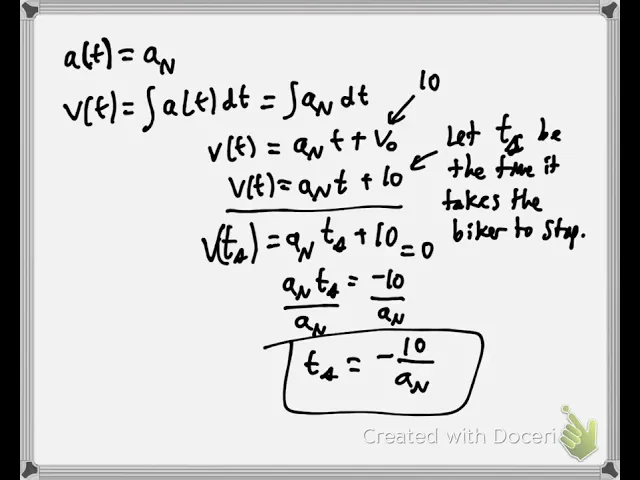
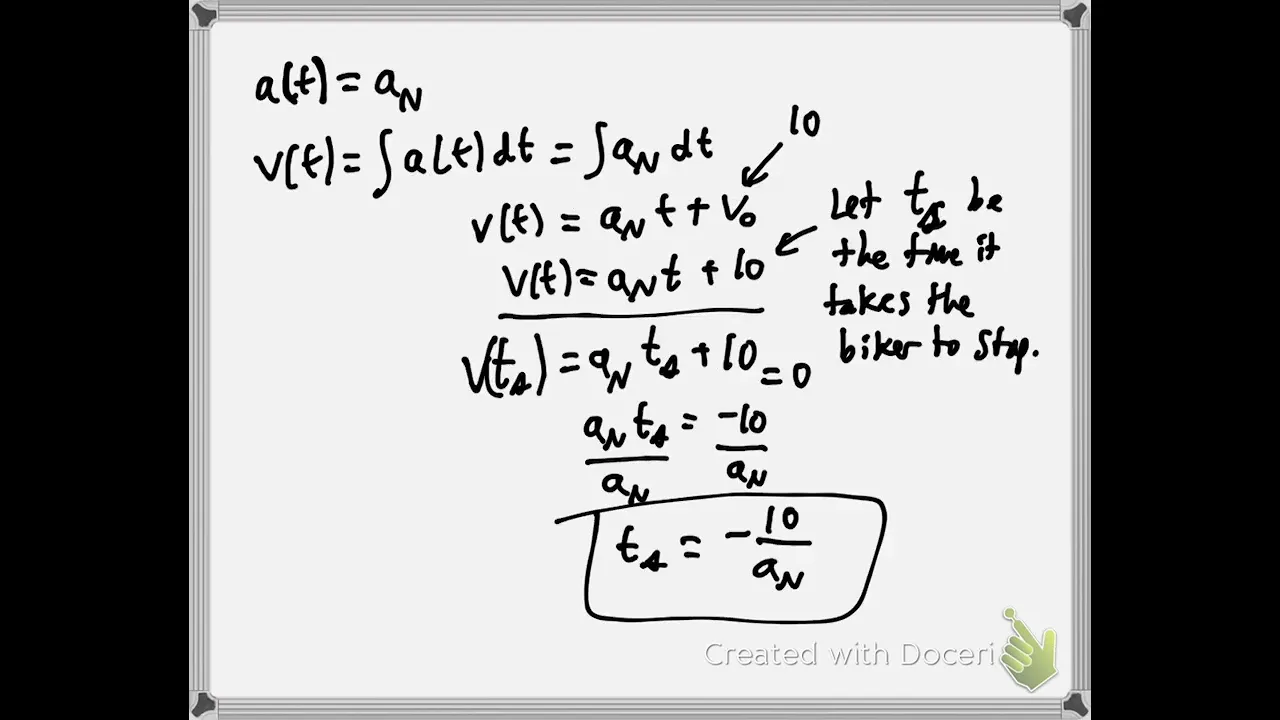
3 degrees so find a sub e so that biker comes to a stop at the top of the hill without breaking okay so we're going to define acceleration net is the acceleration e minus 9. 8 sine of 20. 3 degrees all right so the biker is going to undergo a net acceleration of a sub n all right so the acceleration function is a sub capital n and as we'll see in the integration section and the anti-differentiation the velocity is the antiderivative of acceleration so we're going to take the antiderivative of a sub n dt and that's going to be a sub nt plus the initial velocity which is going to be uh 10 meters per second there so the v of t is going to be a sub n t plus 10.
okay so with this set up let's t sub let's see we're gonna we're gonna call this quantity um t sub s be the time it takes the bike to stop for the biker to stop so what's going to happen here is v of t sub s cursive s there is going to be a sub n t sub s plus 10 and that's got to be zero so that means that a sub n t sub s is negative 10 you're going to divide by the a sub n and then t sub s is going to be negative 10 over a sub n okay so now that we've got that and go ahead and use this velocity here and get our position function for the biker up the hill the antiderivative of v of t dt is going to be the antiderivative of um a sub n t plus 10. with respect to t so it's going to be one half a sub n t squared plus 10 t plus the initial position now i'm going to calibrate this hill to be x equals 0 is going to be here and x equals 150 is going to be there so that's going to be x sub 0 is 0 so i'm going to wipe that term out okay now what happens with the 150 feet here x of t sub s has got to be 150 feet because by the time the biker comes to a stop they would have traveled 150 feet up the hill but on the other hand it's going to be one half a sub n t sub s squared plus 10 t sub s okay and as we saw already the t sub s is negative 10 over a sub n so one half a sub n minus 10 over a sub n quantity squared plus 10 times negative 10 over a sub n can be one half a sub n 100 over a sub n squared minus 100 over a sub n one of the a sub n's will cancel here 2 goes to 150 times so we've got a 50 over a sub n minus 100 over a sub n that's going to be negative 50 over a sub n and that distance has got to be 150 feet okay so negative 50 over a sub n is negative 150 uh cross multiply here minus 150 a sub n is negative 50 divided by 150 negative 150 so we have the acceleration positive acceleration going to be one-third 50 goes 150 three times so this is one third of a meter per second squared for the a sub n and that's the net acceleration okay so now let's go back and we had the uh a sub n was equal to set this up here we had the a sub e minus 9. 8 sine of 20.
3 degrees and this is one-third so one-third is a sub minus 9. 8 sine of 20. 3 degrees and add that to the other side let's get the calculator out take 9.
8 times 20. 3 on the sign of that equals about three point three nine nine nine six nine three eight five and then we're going to um let's see we're going to add to that of 0. 33 well the one divided by three so the acceleration effort needs to be about 3.
73 let's make it approximate there about 3. 73 meters per second squared okay and so with that acceleration then you ask the question what is the force of effort well and take the mass equal 120 kilograms and take the acceleration equals 3. 73 meters per second squared and the force due to effort is going to be 120 times 3.
73 kilogram meter per second squared's a newton so we take the 120 i'm 3. 73 so i have to exert a force of 447. 6 uh newtons of force now let's see it takes about uh about five newtons to get a pound i have to exert a force of about 90 pounds to be able to get up the hill so that by the time they've gone all 150 feet of the hill they naturally come to a stop at the top of the hill without having to apply their brakes because gravity is doing enough of the deceleration for them now one of the applications i see going on to calculus 2 how much work is done how much effort in work is expended in joules okay now if it's a force done by a if it's a work done by a constant force then you just take work is equal to force times the distance which we're going to take to be hang on a second here we have the 150 is in feet but we need to convert it to meters all right so let's see 150 feet let's see let's get the conversions here one foot is 12 inches then one inch is 2.
54 centimeters and then there's going to be um 100 centimeters and a foot i mean 100 centimeters of the feet already over here getting canceled out inches and centimeters we need a meter there so 100 we take 150 times 12 times 2. 54 divide by 100 that's going to be 45. 72 meters okay so the force expended was 447.
6 newtons and the distance was over 45. 72 meters okay 447. 6 times 45.
72 that's about 20 464 joules of work okay but for those of you going on to uh calculus 2 suppose they wanted to do the following so what if the acceleration effort would have been let's see here one third plus 9. 8 sine of 20. 3 but suppose they decide to decelerate and have a little bit less of an energy expenditure toward the top of the hill which might mean they might not make it all the way to the top maybe stopping at 100 feet or something like that so suppose i had something like um one-third i plus 9.
8 sine of 20. 3 degrees and then minus maybe 1 12 t so every 12 sec every second they're expending 1 12 of a meter per second squared less than their acceleration all right so so if that's the case then the force due to the effort is going to be the 120 kilometers times one third plus 9. 8 sine of 20.
3 degrees minus 1 12 t and then the work done the next the work done is going to be the integral from zero to the time that it stops now if they decelerate decelerate a little bit more with this one minus 1 12 t there's going to be a new t sub s prime t sub s prime is the new time when the box stops which one like was going to be short of the top of the hill is the integral of force of e dt so what happens is you get to integrate this linear function and it's going to be a quadratic function that you plug in the bounds of zero and t sub s prime and this will be an example of a work done by a variable force and this is a key application in calculus 2 for those of you going on to calculus 2.