so I've been trading for about eight years and I've been profitable for about six of these past few years and what I've learned is that the stuff that I see a lot of people doing just simply doesn't work the stuff that I see a lot of people saying simply doesn't work the a lot of the stuff that I see people giving you advice on what you should do doesn't work so I'm in the minority here in the fact that I say everything in this video is just my opinion only I do in fact make money
Trading even when I'm wrong I don't have any predictive Edge there is no type of speculatory power that my trading approach provides there's also no black and white rules it can seem complicated to people who do not have the experience to dictate and justify that what I'm doing is working because everybody trades in their own way nothing in this video is financial advice you're probably going to continue losing money trading trading is risky and most people do in fact lose money trading so you probably shouldn't even do it to begin with but if you're crazy
enough to continue trying to do trading I will show you you what's worked for me first let's look at not even a chart we're going to look at up and down lines now pretend that this is a market and you want to buy so you're going to buy and whenever you buy you have to decide where you're going to put a stop loss a takeprofit position sizing how much you're going to risk are you calculating it based on a lot size or based on how much you're going to risk you have to do all this
stuff if you strip away everything and you keep it simple and you just say I'm just going to buy with let's say a one standard lot size there is a 50% chance of price moving up and a 50% chance of price moving down so if you structure this into a trade you could say you could buy there at one standard lot and if price goes up we're just going to pretend you're going to make $100 and if price goes down you're going to lose $100 so with a one:1 risk reward ratio entering randomly on the
chart anywhere you will have about a 50% win rate and you'll have a break even system now the nature of price dictates that price does not typically go One Direction Forever price goes up and down and then sometimes you'll have quick aggressive sustained moves up with no pullbacks but eventually markets typically pull back now there are times where the market can run up for a very long period of time without pulling back but in general most of the time most markets are mean reverting meaning they extend one way then they pull back to their average
price then they extend another Direction and they pull back they send one way and they pull back and they just go back and forth up and down over and over and over so trading is a very interesting form of betting SL gambling in the sense that the further price Moves In One Direction from my experience the more likely it is to eventually have a pullback now the crazy part about the approach that I use is that you don't don't have to have any type of edge you don't have to have a reason for even entering
the trade you don't have to have any type of like specific reasoning you don't have to have any trading rules or anything with this system you could literally enter randomly on the chart and provided that your first position is sized small enough um it allows me to profit regardless of what happens now I win outcomes a large percentage of the time some weeks it's 90% some weeks it's 99% however every now and then I take a big loss and that loss blows whatever trading account I am trading now the way I get around this is
I fund an account that has a small percentage of my trading capital in it so for all the trading Capital that I've allocated specifically to trade FX with let's say it's 1.2 million I allocate if I put a 50k account and I start that account with a $50,000 starting deposit if I blow that account that's less than a 5% risk of my Capital allocated to just trade specifically FX so what this means is that the account is essentially my stop loss and if I know that a large percentage of the time I can get the
account to a certain growth Target in my case it's just doubling the account growing it from 50k to 100K or 100K to 200k or 150k to 300K if I can double it most of the time and then internal transfer the profits out and start again I know I can trade that one account really high risk with the intent to grow it and capitalize on the fact that markets do essentially pull back over and over and over and over I used to always say keep things simple and control risk but now none of that even really
applies all that really applies is just control risk because keeping things simple or making them complicated for it to begin with that's all subjective in the first place what's simple to me might not be simple to you and what's complicated to me might be very simple to you so that's all subjective to begin with one that cannot be looked away from though is the the concept of controlling risk you have to structure risk in some way if I took all the capital I've allocated to trade Forex with and risked on one trade with a 1
to1 risk reward ratio I would either double my trading capital or lose all of my trading capital is that a good way of structuring risk I don't think so however taking a percentage of my trading capital and putting it into a small account and then using that Capital to grow that account quickly and aggressively that works for me and this specific approach has worked for me for the past two years I made more money trading the year that I traded just this approach than any other trading approach where I've tried to get an edge to
predict where the Market's going to go essentially the past six years I've only been profitable because I've been good at controlling risk and that's it I I cannot predict where the Market's going to go more than half the time and often times I think even less than a 50% chance I'm going to be right the first entry now fortunately with this approach it doesn't matter when I'm right as long as I do happen to be right and I've controlled risk and size the position appropriately it allows me to make money even when I'm wrong I'll
give you a quick example here let's say price is in an uptrend and it goes up and it makes a higher high and I sell let's say the account is $50,000 and I use a one standard lot size that means the market would have to go very far against me for me to actually blow the account but if I know that the market typically pulls back and goes down at some point then if it bounces immediately and goes down I can close the trade and profit there make let's say like $500 if it goes against
me into a $500 draw down I can add again wherever I believe price is likely to reverse so typically I'll just let it run against me I'll watch the candlesticks and the price action to see when I think it's likely to start pulling back and for the momentum to kind of slow then I'll add a second position generally the same lot size now if it pulls back I'm break even on my first position and I'm profitable on my second position and I can generally close both positions right there at that area now if the market
stretches further against me generally I'll just let it run until the next area I think it will bounce you can use anything you want you don't even have to look at support and resistance but sometimes like let's say there's like a major support resistance Zone there you could say okay well I think it's going to bounce there so it's at a support resistance Zone s sell but you don't even have to do that you can just literally add a position anytime that you think it's likely to revert and start retracing generally after big spikes upwards
you generally see some sort of retrace and you don't even have to get a complete reversal to make money you just have to get some sort of a retrace and you can get out of most trades at either Break Even or profitable so that said if the market pulls back from here to here then I can close this position at a profit and then I break even on this position and since they're all the same position size I can just close that position at a loss the profit and the loss offset each other to break
even in the middle position was closed and break even so even though it's completely wrong I could still break at least break even on this and in some cases the market will continue to have a big bounce and then you can just keep holding it depending on whether or not you think it's going to keep going this all comes with experience there's no way to teach this it all just comes with black and white experience um all I'm sorry not black and white experience there's nothing black and white it all comes with experience and with
that being said all I can do is kind of help guide you as to like the best way to accumulate that experience and it's essentially just comes from testing and experimenting and optimizing and observing and seeing what works and what doesn't so in the cases where price goes up and it just never pulls back you can do this on any time frame you've added you've added you've added and you've added and you've added and you've kept adding and I'm trying to show I'm trying to like uh select this here let's just say you add like
like 20 times right eventually you will hit hit a market where it just runs away and it blows the account but most of the time the market will retrace and that will allow myself to get out of a trade at usually either a break even or a profitable scenario sometimes I'll take a loss it's like maybe 5 10% of the time but again the percentages can vary for weeks so don't take the percentages as a black and white number just understand that the point that I'm trying to illustrate here is that most of the time
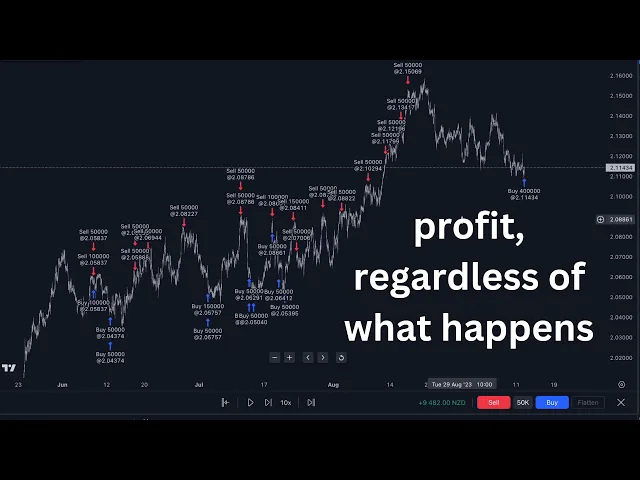
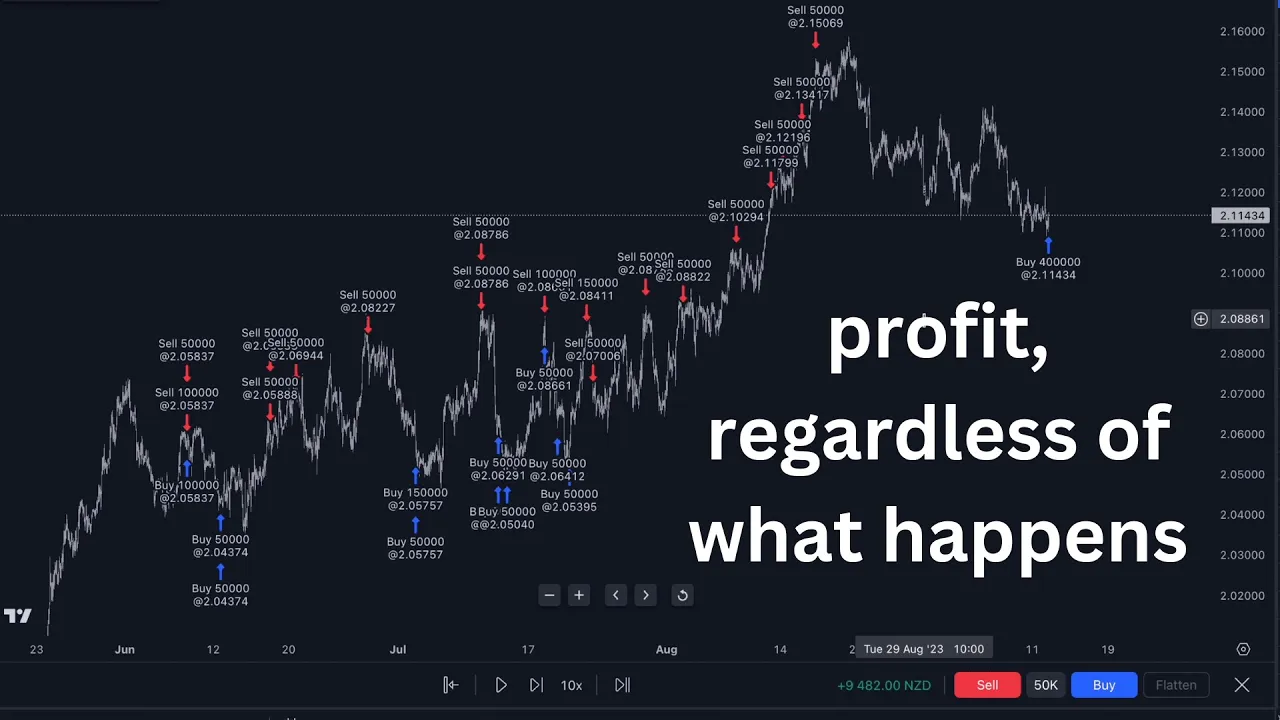
the market will not do this the market will have some sort of a retracement at some point and pull back so what I'm going to do is we're going to go to like a random back test scenario and I'm going to show you just doing this like on a chart in a back test scenario back testing has its limitations past performance cannot predict future results you know it is what it is we're going to simulate that we have a 100K sorry a 50k account and we're going to use one standard lot size and we're going
to take maybe like five outcomes of Trades and I'll show you so we're going to say let me just click so hard to see what the sizing is to see how much nzd okay so that's a little bit heavy sizing we're going to use a 50 so we'll be using um half of a standard lot 0. five Lots so here's what we'll do for our first entries we won't even do any analysis we won't look at Trend we won't look at support resistance we won't look at Market structure we won't look at fair value distribution
wagy beef Candlestick ICT smart money concept liquidity order Bank manipulation strategies to try to figure out where the Market's going to go we're not even going to really give a where the market goes we're just going to buy or sell so I'm going to just use um I'm me use a random number generator and if it's one we'll buy and if it's two we will sell fair enough it's two so we're going to sell now if the market goes against us let's say up here we'll be in a $2,000 draw down but we could then
sell again because when the market makes a higher high it's likely to retrace at some point also if the market goes up here to this previous High that'll be in a $600 draw down we could also add right there so what I'm going to do is I'm going to add if price goes up to that zone and I'm going to add if it makes a higher high so unfortunate we didn't get to add and draw down unfortunately it was a winning trade so we can close it there now we're at a support zone so that
might tell some people to buy but foolishly we're still going to do a random number and this happens to be one so we will in fact buy but even if it was wrong you know we would still have uh entered whatever the random number set so unfortunately we have another winning trade and this will happen roughly 50% of the time roughly 50% of the time the market will move into a profit and 50% of the time it will lose move into loss so every now and then you'll just get random win streaks and understand like
we're literally entering randomly with just a small position size relative to a 50k account a 0.5 lot with a 50k account is almost nothing from my experience so so so so far we've made a $1,400 this is nzd New Zealand dollars so now let's uh pick another random number so two so that means we'll sell and hopefully it goes into draw down so I can illustrate this so it does in fact go into draw down so we're here at the next resistance zone so let's just say we add there again you don't have to add
at a resistance Zone you don't have to add at a trend line you don't have to add anywhere specific it can just literally be the next spot where you think you know price might reverse here so I'm going to add another position here remember you're not trying to profit from predicting the direction you're just trying to capture the volatility you're trying to allow yourself to size accordingly so that way when the market does eventually reverse for one you don't blow the account and for two you end up coming out of the profit or break even
most of the time so it went into profit I didn't take profit I think it's might go higher and if it does go higher we'll add again and if it goes into profit maybe around the previous lows we'll just take profit so fortunately this went up higher and remember we've got 50k in the account to play with so it's a currently about a $2,000 draw down we're going to add another sell up there so now we're in three short positions we've added twice additionally to our first entry on this I'll take profit if it goes
to the previous lows so I think it'll bounce here at the support Zone but again I'm only right half the time and you're probably only going to be right half the time and nobody knows where the market will or won't bounce but the question is is is it a good idea to probably take profits now based on the risk structure yeah we're in three positions it's gone into profit it was a good trade that was our third outcome now let's just flip a coin again and it's one so we will buy so I hope it
goes into draw down if it goes to these previous lows down here then I'll buy again and if it goes around this previous High a little bit before it'll probably take profit so unfortunately it was another winning trade I'm sorry we'll take profit there we've made a 5k nzd so now we'll do another random number so two so we'll sell again we're just randomly entering buy or sell positions literally by flipping a coin there is zero technical analysis there's zero analysis at all there's no sort of fundamental analysis like there's nothing it is just literally
entering buy and sell positions randomly with the position size that is small risk relative to the account balance okay just want to throw that out there we're not speculating at all so I'm going to close here just because it's had a nice move in profit um this has been five outcomes but four of the outcomes resulted in an immediate profit only one of the outcomes did we have to essentially do like recovery trades where we're just adding and draw down and adding at the next zones so what I'm going to do is since we had
random again we're literally entering randomly this had an 80% win rate from the first entries um so what we're going to do now is we're just going to do like one or two more outcomes I want to get an outcome that really goes into draw down so that I can demonstrate this to a better degree so one so we're going to buy and again this is with just doing a small5 lot size buying and selling randomly and then just just adding if it's wrong and then waiting for it to pull back then taking profits or
or closing it in profit if the first position's right so a one that means we're going to buy so we'll buy hopefully it goes into draw down so it does go into draw down so we're going to buy again here at this support thinking you know maybe it'll bounce here and if not we'll buy again at this support down here so I'm sorry um this went into profit again my apologies now we've made 9,000 um I'm going to do it one or two more times hopefully we get something that really goes into a lot of
draw down here this is perfect I'm going to buy at a resistance that was the one so this goes into draw down so now what we're going to do is we're going to buy again some people would say wait for this support but just to stress test this and show you how it literally just doesn't matter we're just going to buy again here and this is just completely random if it goes further down we will buy at the support so we bought at the support now we're going to see if this can go into profit
so it goes around to the previous highs and me close now we made 11,000 nzd this sort of highlighted a little bit more we literally bought at resistance completely wrong bought again completely wrong bought a third time and then we were right so trading this way allows you to make money even if you're wrong a couple times you you can be wrong first but as long as you're right at some point and you're sizing appropriately um it's really difficult to blow the account unless you're sizing heavily now do I size the same way no I
size extremely more heavily because I know that 75% of outcomes are likely to be closed at a profit or break even after three trades every now and then I'll go into a four five six trade draw down and then I'll be in draw down of like 40 to 50% of the account just last week I I was in account that had $80,000 that was in a $40,000 Equity because I was in 50% draw down but I know the stats and the metrics and that eventually things generally do revert so it allows me to get to
my growth Target of doubling the account much more quickly sometimes as quickly as 4 to 6 weeks not all the time there's been times this has Tak me like 3 months to do there has been other times that has taken me only 3 weeks to do so it's important to just know that everybody's metrics are going to be the same this is just to give you sort of a proof of concept and a way that you can go about testing this to learn all the nuances through experience we'll do one more so that was a
two so we will sell We'll add in profit We'll add if it goes to the highs perfect so we'll add another position then if it makes a higher high we will add again let's be really risky let's add a third time around the same same price so we made a higher high going to add a fourth time we're in a $3,000 draw down add it again so we've went into draw again so we're going to add a fifth time we're we're still making a higher high I'm going to add a sixth time right here we're
in a $7,000 draw down so I'm glad this happened now I can show show you how stress test at an eighth time and we pretty much wiped out all of our profits in an open Draw down we're betting on the likelihood that price will eventually revert we're going to add an eighth time up here does take a lot of patience at times in my opinion it would not be a great time to add because it's already so low it could reverse back up and we'd be in too heavy at this point I'm just going to
attempt to get out of this at break even okay you get the point so I'm going to close there it's a round Break Even it was a little bit of a loss in this case um but essentially by just continuing to add we wiped out the open profit we didn't really dip too much below the original starting balance in this case but again this is a case where there was eight trades in total I believe seven or eight or nine this is a lot of Trades a lot of being wrong over and over but that's
why it's important to size your original position accordingly another thing to point out is look at how often this happens of all the trades we took you can rewind this video You Can Count here how many of them got into more than three total trades very few of them but even when that happens the account would have been over 60k that would have been a 10K draw down so the account still would have had 50k in equity in it um so that's like less than like a 20% draw down and that's like that happened once
out of it was almost 10 outcomes I believe it was like seven eight outcomes nine outcomes maybe that doesn't happen very often but even when it does we still wiggled out of that at a break even a note if you're going to go and test this make sure that whenever you're doing this you do this on a demo account first you're probably going to lose money trading live whenever you test this on demo use a reasonable starting balance on the demo account that you would actually be trading with if you were to trade it live
sometimes you only have $1,000 to trade with that's okay you're probably not going to become rich trading just $1,000 but it's a great place to start because most people are getting into trading because of the reason that they want to make extra money and they don't have a lot of money I completely understand you're just probably not going to make much with $1,000 full disclaimer just keeping it real however start a demo account with $1,000 if that's how much you have to trade you know or 10K or 50k whatever it happens to be and use
a very small position size literally like if you start a 1K account then just put like a 01 lot size you can literally start by just entering randomly half the time price will start moving into profit and you can close it wherever you feel you should close it there doesn't have to be any rules and whenever you're wrong figure out how to manage it where should you add at if you're wrong what would be a good place to add at as long as your position size is set appropriately it allows you to capture the volatility
regardless of where the market moves and it's very laid-back and chill if you can look during this whole back test we took a 50k account in a simulated Market environment from 50k to 60k and this is with me sizing like abysmally small we could have grown that account much much quicker and probably even doubled it had I used my normal position sizing which is generally about it's different for every trade but 2 to 3% is what I'll risk from the initial trade to the point at where I would add the second trade this allows me
to most of the time not get more than 10% draw down on an outcome and if I'm right I instantly make 3% and since I'm right most of the time in 75% of Trades I'm able to close in profit or break even after only three trades I I have like like 90 to 95% of the time the trade will end in an out in a profitable or break even outcome and then I'll have to manage the really bad losers like 5 10% of the time sometimes it doesn't even happen on an account sometimes it just
goes straight to the profit Target for most trades and I barely have any losses and I just grow it then I withdraw the account the fact that I withdraw slash internal transfer the profits from the account to another account and then restart with the original starting balance it allows me to double accounts over and over and over and most of the time I know I'll be able to do that but whenever I blow the account um it's just a small percentage of the profits that I made relatively right if I can take five accounts and
I can grow like let's say like four out of the five accounts to the growth Target right so I take say I start like a 50k account and then I grow it to 100K so out of those four accounts I'll I'll make $200,000 profit minus the one blown account it's minus 50k that leaves me with $150,000 profit and again this is without trading with a single edge this is just using proper risk management it's not predicting the market there's no speculation there's nothing if you approach tra this way I think it's a much more peaceful
way to trade I've traded so many different methods over the past couple years A lot of them the past four years have been based around just support resistance and trying to figure out like dynamic position sizing and how to get in adjusting stop losses using stop losses using hedging using DCA adding all sorts of different things what I found is what seems to work the best and what seems to work the easiest is just profiting from the market moving wherever it's going to go and simply controlling the risk in such a way way where you
know what the stats are so then you can bet on the stats and you let the stats play out without having to worry too much about getting things right because then that leads to a lot of emotions it leads to a lot of fear it sometimes leads to like Revenge trading because you were wrong and you're upset that you were wrong so you then risk more to try to recoup the losses from when you were wrong which typically results in a blown account anyway if you approach it this way I just think in my opinion
that it's a much more peaceful way to do things you do not have to be right to make money you can be looking literally be wrong like we saw in the last example on the chart he could be wrong s to 8 to 9 to 10 times in a row and still come out Break Even there's not many systems that offer that and even if you're using a system that uses stop losses where you're trying to predict where the Market's going to go you will still my friend take five to 10 trade losing streaks at
some point in your trading career and if that risk percentage is too high it's going to wipe out a lot of the profits you made or it's going to blow the account anyway and you're trying to predict where the Market's going to go and you think you might be doing things wrong and you think could be doing it better so you try to figure out how to get a higher win rate it's all of this stuff and it's all this nonsense and it's useless in my opinion CU I don't really see many profitable traders that
have more than around a 50% win rate I myself have a 50% win rate or less most weeks but I still make money why do I make money because I don't have to predict where the Market's going to be right it is because I can make money even when I'm wrong and the purpose of this V video was to illustrate that exact point hope it was useful see you