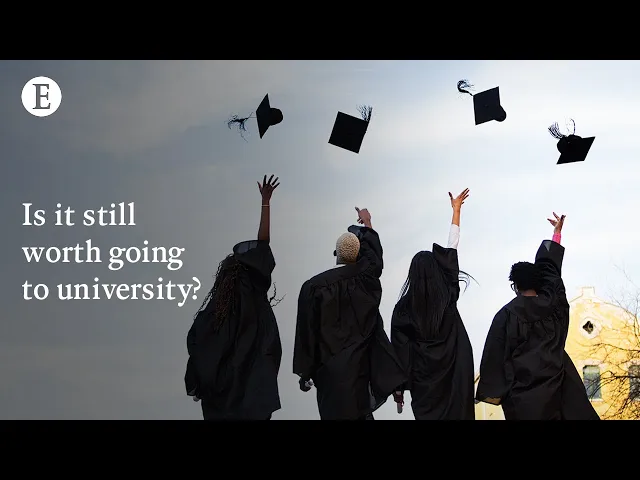
Earning a degree used to lead to a steady job with a good salary But today young graduates in the West are finding fewer employment opportunities So, is it still worth going to university? The unemployment rate of young graduates in America is now approaching the same rate for the age group as a whole In 2010 there was around a six percentage-point difference in unemployment between young people and young graduates But now there's just a one percentage-point difference between them It's not just in America In the European Union the unemployment rate of young people with tertiary education
is now approaching the overall rate for that age group One theory for this is that universities are accepting less-talented applicants, and then they aren't teaching them very well This could lead to employers not expecting much of a difference between the average graduate and then someone who didn't go to university Another theory is that fewer jobs need graduate-level qualifications For example, in the past you often needed to attend a university in order to understand how to use a computer On the frontiers of science the strange world of the computer But today almost everyone can use tech,
regardless of whether or not they went to university The number of jobs in graduate-friendly industries is also decreasing Across the EU the number of 15-to-24-year olds who are employed in finance and insurance fell by 16% from 2009-2024 And, since 2016, the number of British twentysomethings in law and finance has fallen by 10% It's tempting to blame AI for these waning opportunities Yet the decline in graduate jobs started long before ChatGPT What's more likely is that the industries that traditionally employed graduates have had a tough time lately Since the global financial crisis of 2007-2009, the golden
age of investment banking is over, so they're spending less money on hiring graduates In America all this is affecting young people's decision on whether or not to attend college The number of Americans enrolled in bachelor's programmes fell by 5% from 2013-2022, according to data from the OECD Yet in most rich countries, where education is cheaper because the state plays a larger role, young people are still applying to universities in droves Excluding America, enrolment across the OECD rose from 28m to 31m in the decade to 2022 Perhaps students simply aren't picking the right subjects Arts, humanities
and social sciences are still proving popular Even, inexplicably, journalism If these trends say anything about young people's ideas about the future of work, they truly are in trouble So, in the age of AI what should you study at university? As technology improves, the future of work is changing, too Many of the jobs that graduates will have don't even exist yet Some young people worry that certain skills they learn might become outdated as technology changes Coding, for example, is at risk of becoming obsolete within only a few years According to one study the percentage of American
and British IT professionals who worry that AI tools will make many of their day-to-day skills obsolete increased from 74% to 91% in just one year There are some subjects which are likely to stay relevant Robotics, for example, will help people maximise the benefits of technological change And practical jobs, like plumbing and carpentry, are less likely to be taken over by AI and will remain valued by society These professions often don't require a university qualification and can be learnt in other ways, like on apprenticeships But arguably what's more important for students than studying a specific subject
is to focus on learning soft skills instead Things like communication, critical thinking and reliability, as well as empathy and being able to build relationships All are transferable across multiple industries OECD findings from 2019 demonstrate that people will need to rely on their currently unique human skills to succeed Understanding how to learn will be key to developing new skills and adapting in changing times The research also suggests that jobs with complex social interactions, such as care, will still need humans so developing skills like negotiation and persuasion will be vital Currently AI isn't very good at these
soft skills I understand emotions have a deep meaning, but I can't experience them like you can So if workers can plug the gaps, while also being able to transition into emerging industries, then it will help humans to compete with machines Nearly all degrees will allow you to gain these skills through group projects, presentations and extra-curricular activities Ultimately it doesn't really matter which degree you choose to study Perhaps what's even more important is that a student gains work experience or an internship Research finds that those who graduated in 2022 and completed internships were 23% more likely
to start a full-time position within six months of graduation This gap increases further in certain fields, like oil, gas and mining, where it rose to 65% Although it's hard to predict how improving technology will change the world of work over the coming decades, one thing is for sure: a student with a variety of skills, a lifelong desire to learn and a good attitude will go far