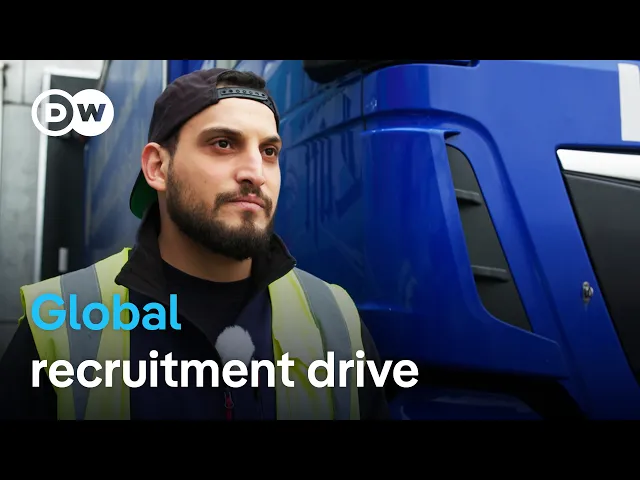
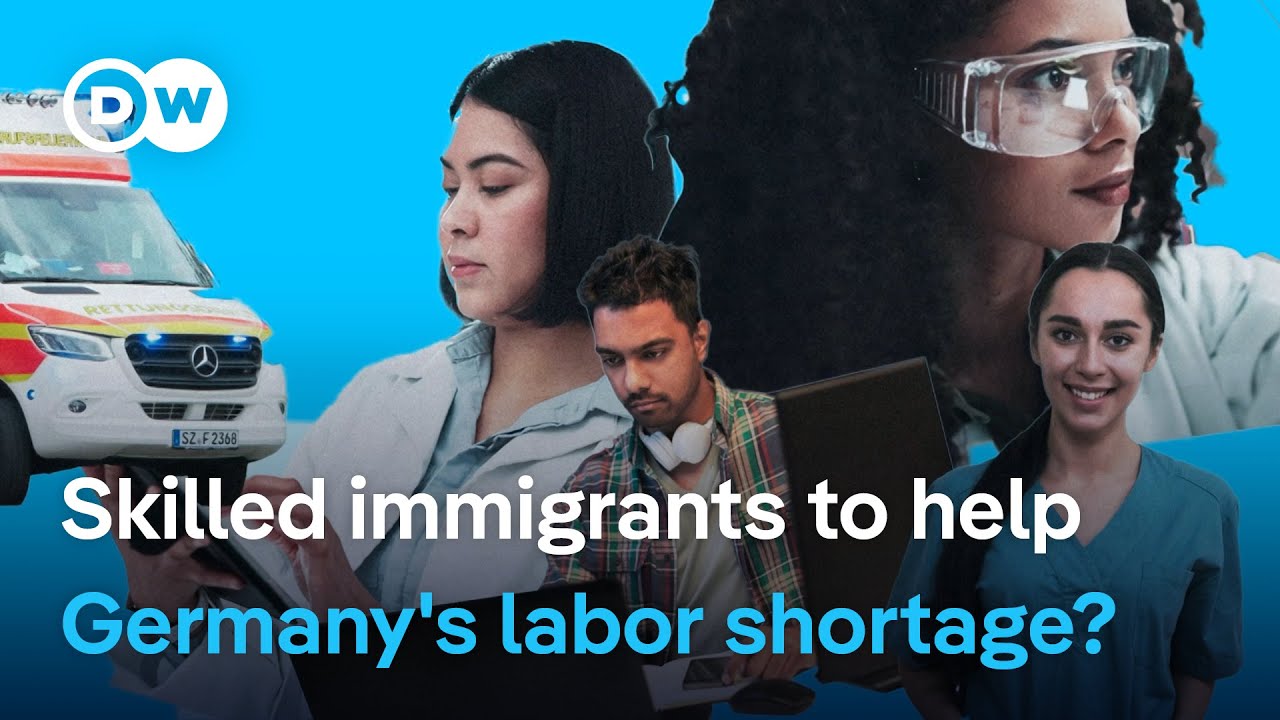
Yassine from Tunisia wants to be a professional truck driver in Germany. Elaine from Brazil also wants to work here as a nurse. In 2023, 570,000 jobs remained unfilled across the entire German economy.
There’s an urgent need for skilled workers from abroad. In Europe, things aren’t served up to you on a platter. You have to work, put in the effort.
In Brazil, Elaine managed an emergency room and was constantly problem-solving. Here, the problem to solve is communication. The German language is very difficult.
I know I have a lot to learn. For nine months, we accompany Elaine and Yassine as they make their way in Germany. Brazil, São Paulo, a metropolis of 23 million.
Elaine lives here with her husband and son. In two days, she’ll be leaving her home country to work as a nurse in Düsseldorf. She’s buying food for a farewell dinner with the family.
I’m a bit happy, a bit tired, and a bit scared. Her husband and son are staying here for the time being. She’s taken an intensive German course for a year in Brazil, but conversing fluently is still tricky.
I’d always dreamed of going abroad, to Europe. I thought of Italy, or Spain, because of the language. But the opportunity that came my way was to go to Germany as a caregiver.
Her husband is an IT specialist, mostly working from home. He and eight-year-old Hugo will join her later. That’s the plan.
My Mum and I promised each other that we’d chat every day, so that I see her, as long as we’re here and she’s there. Mixed emotions, for sure, I’m happy, but also worried because she’ll be far away and I don’t know what might happen to her. We’ve always looked after Hugo as a team, but now, that team won’t exist for a while.
The sportsground and the neighbourhood are under guard. Because of the high crime rate. That’s the main reason why the family wants to relocate to Germany.
We’re doing ok financially here in Brazil. For us, it’s about security and quality of life. For Hugo above all, we want him to have better opportunities than we had.
Her flight is scheduled for the following day. It’s November, Elaine just packs winter things. She’ll buy everything else later.
Her parents and brother come over for the farewell dinner. To get a work visa, Elaine had to finish a German course at the Goethe-Institut. After she had passed the exam, her mother accepted that her daughter was going to Germany.
I cried a lot, we both cried that day, but I was also really proud that she saw it through and achieved what she wanted. I won’t suffer for long, because I’ll soon be with her, by her side. I tell myself that, to reassure myself.
Because after all, deep inside, I’m very nervous. The next day, and she’s off to the airport to fly from the Brazilian summer, to the German winter. It’s a new beginning.
Like a rebirth. See you soon! In Germany, Elaine has gotten a job at a hospital in Düsseldorf.
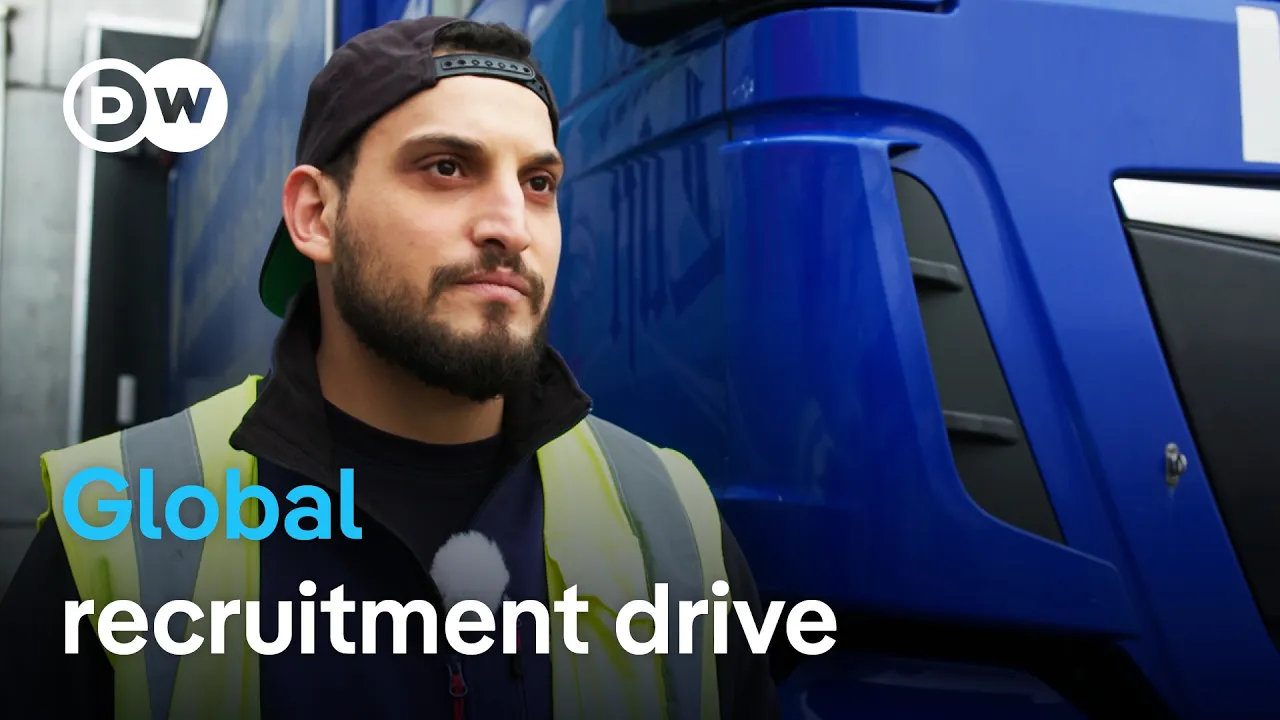
Gernsheim, south of Darmstadt. Yassine from Tunisia wants to be a truck driver. The training lasts three-and-a-half years.
His family lives in Sousse, a city on the Mediterranean. Yassine finished his schooling in Tunisia. His brother works for a haulage company this sparked his interest in truck driving, and he passed his driving test.
But if he wants to drive trucks in Germany, he’ll need a German driver’s license. I was a co-driver in Tunisia for the first three months, then I got a truck, then I drove on my own. That was a good experience.
But he’s not allowed to work as a driver here yet. Before Yassine can get his German driver’s license, he has to pass a car and truck driving test. And how fast are we allowed to drive?
Here it’s 60. Exactly, good. And did I pass?
That was an easy question. Yassine is one of six trainees. Three are German, the others come from Morocco and Tunisia.
He's doing well. He’s quick on the uptake and always motivated. I wish everyone were like that!
Many folks just want an office job, they don’t want to do a job like this any more. But Yassine enjoys driving a truck, he's already itching to get his driver’s licence. Am I right?
A detailed logistics study by the University of St. Gallen found that in 2023, 70,000 truck driving jobs went unfilled in Germany. The shortage is also affecting other sectors.
But sometimes, third-country applicants have to wait two years for a German visa. Haulage company boss Dieter Schaffner is struggling to find new recruits. We’re desperately looking for new trainees.
We try all sort of things to find them, we go to trade events, student fairs and colleges. Not very many are interested. There is simply too much red tape: for example looking for a parking space at motorway service stations, also for customers with waiting times, they get a beeper and have to wait until it’s their turn, which makes shift times unpredictable.
None of that stopped Yassine. He’s now been in Germany for more than 12 months and is in his second year of training. Some practical training at the haulage workshop.
Training manager Carlo Geßling wants to make sure Yassine can remember everything he’s learned. We're going to do a departure check on the truck today. The first thing is to check the torque wrench is set correctly, that it’s showing the right number of Newton meters.
Like that. Each time it makes that cracking sound, you know the wheel nut is tight. Germany’s dual training system, alternating between working and training, was Yassine’s main motivation.
In Tunisia, as a truck driver there’s no training, just work experience. It’s difficult to find a job. Yassine’s training manager is aware of the problems facing foreigners in Germany.
One of the biggest hurdles was for him to find an apartment. To get an apartment, he needs a bank account. And to open a bank account, he needs a fixed address.
It was a vicious circle. We had to try and pull a few strings. It wasn’t easy.
The haulage company boss came up with a solution to his trainees’ accommodation problem. Some time ago, he bought an old furniture showroom for additional storage space. The first floor was empty.
Hundreds of square meters that he wasn’t using. We’d’ve liked to have turned this space into accommodation for the trainees. We could’ve provided it more or less free of charge.
But the problem is, we needed to obtain official permission to utilize it for residential purposes, and our application was rejected. This is in a mixed commercial area and there’s no option to accommodate people here. Here for example, we’ve got perfectly good living space with a kitchen.
Everything you’d need to feel at home. With less red tape, this might have worked out. For Yassine, an apartment would be really welcome.
At the moment, he’s living in a 15-square-meter room without a kitchen. For 320 Euros a month. This is my first apartment and I’m not that happy with it.
To be able to receive visitors, I’d like to have a nice apartment so I can prepare everything well and take proper care of my guests. In Yassine’s family, it’s customary to roll out the red carpet for guests. Hospitality is very important in Tunisia.
And because he can’t respect that tradition at the moment, he’d rather we didn’t film in his room. Early December: Elaine’s first day at work at the Catholic Saint Mauritius hospital near Düsseldorf: Shift change on the neurological ward. Masks must be worn due to a recent coronavirus outbreak.
The morning routine on the ward: measuring temperature and blood pressure. Elaine first needs to familiarize herself with the procedures. She studied nursing for four years in Brazil, working in the emergency room and on the intensive care ward.
We’ll transfer you to a wheelchair now, OK? She has 14 years professional experience. Her most recent post: ward manager in Sao Paulo.
Here in Germany, I’m working less in administration and more with patients. I like that. The hospital is currently digitalizing patient files, which should make doctors’ and nurses’ jobs easier.
I think this is something new here, digitalizing patient data. In Brazil it’s all been digital for a while already. Nursing manager Barbara Beeg paid some 10,000 Euros to a German agency for Elaine Barbosa’s placement.
The foreign nursing staff are really important, because without them we would no longer be able to guarantee the day-to-day running of the hospital. From some countries, the whole process takes a lot of time. In the case of Mr.
Barboza, it was a year and nine months before she could actually enter the country. And in our experience, a lot of people end up going elsewhere rather than wait so long. Around a third of the employees at this hospital come from nations with a surplus of nursing staff, such as India or Brazil.
We manage very well. We understand each other and they’re all very nice, I must say, all the nurses. It’s end of her shift.
In Brazil, Elaine couldn’t travel to early or late shifts without a male chaperone. Alone, as a woman on the street early in the morning or at night, you could be raped or robbed. That’s why either my husband or my father always walked me to the bus stop.
Elaine has a one-hour commute to the nurses’ accommodation. She pays 280 Euros for the furnished room. The kitchen and toilet are out in the hallway.
She doesn’t do much in the evenings. She usually stays at the dormitory and practices vocabulary. The high point of the day.
It’s April, and it’s Yassine’s first time behind the wheel. Vehicle checks are imperative before every trip. He’s passed the theory exam in the meantime.
Yes, it was a bit difficult. With many more questions than back home, many more signs and laws, but I did it. It’s been over a year-and-a-half since he drove a truck in Tunisia.
And how are you feeling? I feel a bit nervous. That’s understandable.
So, we’re turning right here. . Check your mirror here just to make sure.
Tunisia has more rural roads than in Germany and there isn’t so much traffic. There are many motorways here, if you take the wrong exit you need half an hour to come back. His experience is apparent and he has a good feeling for the truck.
There’s no issue staying in lane, he reacts really well and slows down just as a truck driver should. After another six hours of lessons, Yassine can take the practical driving test. It’s 7am.
Yassine is on his way to trade school. It’s 80 kilometers away in Geisenheim. The company has loaned him a car.
On public transport, he’d never get to lessons on time. When he first arrived in Germany 18 months ago, he barely understood anything. Now, he can follow the lessons well.
The first day at the school was very difficult. I was a bit isolated, but now I’ve improved my German language skills. He was a bit shy at first, so I helped him a little.
Now, to be honest he’s better than me, not so much in terms of speaking, but he’s better than me at the school work. Yassine passed his school exams, that’s evident. He’s doing well.
It’s a wonderful surprise. Yassine is one of the best in his class. Back to the Catholic hospital near Düsseldorf.
Elaine is still getting to grips with basic care routines. The German language continues to be her biggest challenge. But the homesickness is even worse.
Now, down. Wait, I mean up! Every day, I want to go back to Brazil.
But I think that’s normal. My foreign colleagues say it’s the same for them, every day. I had the same problems.
From the beginning. It’s really hard. New life, new culture, new people.
But now, honestly, I’m very, very happy with Germany. I can say that with all honesty. After the shift, Elaine has an appointment with the hospital’s integration officer.
After three months, she needs to apply for a residence permit, which will then be valid for one year. I’ve already printed everything out, so we’ll complete it together now. Paola Scifo helps foreign nurses at the hospital battle their way through Germany’s bureaucratic jungle.
What are you going to live on? Wages. Were you ever in prison?
No. If the forms aren’t properly completed, the applications get stuck in a limbo, additional documents have to be submitted and the process drags on even longer. Yassine sometimes meets up with his friend Mehdi, who has a German mother and a Tunisian father.
Mehdi let Yassine stay with him in Darmstadt for his first four weeks in Germany. I didn’t know him at all. My Dad rang me and said that he was from our village in Tunisia.
I think we might be related in some way. But for me, it was a no-brainer. I’ve got space, I live in a big flatshare.
I think, without Mehdi or a contact in Germany, I’d probably have spent the first month on the street, I don’t know. Gernsheim is a small town in southern Hesse, with a population of 11,000. I was born in a pretty big city.
It’s called Sousse and it’s by the sea. There’s not much happening here in Gernsheim. Life’s completely different in Tunisia.
People are more sociable. If you go out on the street in the evenings, you always see children playing. There’s always something going on.
It’s loud, there’s a lot happening. And here, people are just a bit calmer, I’d say. That’s right, yes.
Elaine’s been in Düsseldorf for nearly six months. Tangible progress in German is still taking its time to materialize. And living in a dormitory with a toilet out in the corridor takes some getting used to.
It’s difficult in Germany at the moment. I feel like I’m on a rollercoaster. And at the moment, I’m not sure if I’ll hold out.
The simplest thing to do would be to return to Brazil. But it’s my dream to be here. I can’t just say I’m going back.
I can’t do that, it needs careful thought. For the first 10 months, two weeks in the classroom alternate with two weeks on the ward. Course participants are all from non-EU countries.
They must show their understanding of German medical terms for their qualifications to be recognized. And Mr. Barbosa will introduce the patient.
Mr Klein lives in a nursing home. She has incontinence and a grade one pressure ulcer. To finish, a test: drawing up a care plan.
Something they’ll need to do on the job as well. They all have a degree, nursing is a degree in all other countries, a higher qualification than in Germany, in Germany it’s a three-year training course. Elaine was very scared initially.
She came here full of fear, wondering what to expect. It’s understandable. She came to a foreign country as a young person, and didn’t know the culture.
And then started working at a hospital. And from the first day, it all has to work. But she’ll get there.
The exam lasts 60 minutes. In one week, Elaine will find out if she’s passed. It’s the end of April.
Yassine has his practical truck driving test in two days. If he passes, he’ll be allowed to drive trucks. The daily call to the family back home in Tunisia.
His father used to be an underwater welder. He’s no stranger to stressful situations. My family always supports me.
And I really miss them. I told him I’ve got an exam on Thursday. And he said, you must concentrate, without stress, without pressure.
Then you can do anything. And I hope you succeed. Exam day.
Morning, all ok? Yes, all good. Morning!
Morning, Yassine. Nervous? Very nervous.
It’ll be fine, don’t worry. Ok. Ready?
Ready, let’s go Now, it’s a question of remembering everything he’s learned. The driving test will last almost one-and-half-hours. Plenty of time to make a mistake.
On the way back, Yassine’s still at the wheel. A good sign. And Yassine, how did it go?
It went well. It was a bit tricky, but it went well. Did you pass?
I passed, finally. Düsseldorf in May. Things are improving for Elaine.
After a three-month online search, she found an apartment in central Düsseldorf. And she passed her last test; the final exam is coming up soon. Then she’ll receive the full salary for a qualified nurse, around 3 thousand 500 Euros before taxes.
The 80-square-meter apartment costs almost 1200 Euros: with three rooms, it’s ideal for her family. Her husband and son are due to join her in two months. I’m very happy.
Why? Because my family is coming. And I have an apartment.
I’ve got my own kitchen, my own bathroom, it’s very, very nice. The Federal Employment Agency says Germany needs around 400,000 workers from abroad every year to maintain the country's standard of living. But currently, immigration from the EU and third countries doesn’t even meet half of that demand.