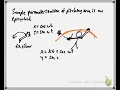
in this video we will look at an example of calculus in daily life in the baseball pitch now just a heads up this video is not so much to prepare you for content for any of the calculus assignments but rather for the discussion or discussions that are going to be taking place in this calculus course this is just to kind of open the eyes to you know the application of calculus to other areas so here's your basic idea all right so here's the see here we got someone over here the catcher's glove here and over
here is the pitching mound and you have someone about to throw the ball now there's there are two curves that apply here and the first curve is the arm motion of the pitcher if the pitcher does not release the ball you could anticipate that they start off maybe holding it close and then as they wind up the they drag their arm back and then they throw it like that and their arm comes back around like that so that might be the motion of the arm for the pitcher okay then the other one is the path
of the ball after it leaves the pitcher's hand and here's what that curve could look like all right here here's the here's where the calculus comes into play if we give um an implicit equation or a parametric curve if you go on to calculus 2 or 3 and you parameterize the arms path with an x of t and a y of t and if you want to be even more fancy a z of t for the third dimension then what would happen is there'd be some point at which we'd have a tangent line i'm going
to put the tangent line to the arm motion in orange i'm going to do the tangent line to the ball path in blue now ideally here these two tangent lines should be the same and so what happens is if you go one curve now and i'm going to put this uh combined curve i'm going to make a um a function here so it's going to start here at the moment that the pitcher has the ball furthest back the ball will be here okay so there's a ball there and now in purple i'm going to draw
first off it's going to follow the pitcher's arm okay then there will be this is piece number one and then piece number two will be the path of ball after the pitcher releases it and so if you have this combined curve here the slope from this side and the slope from that side agree with one another it would be like if we had an f of x equal g of x and h of x and let's go x less than or equal to a and x greater than a for instance all right so here's x
equals a and so g of x does some path we'll go and give it a green here and then on the red and the other side now earlier in this course we looked at piecewise functions having continuity but we really didn't look at piecewise functions having differentiability so if f of x is continuous then the limit as x approaches i of f of x is equal to f of a but if f of x is differentiable then the limit as x approaches a from the left of g prime of x is equal to the limit
as x approaches a from the right of h prime of x and this common value is f prime of x at x equals a and so going back to the curve over here all right so we've got the the ball is in the pitcher's arm where it's red the ball has left the pitcher's arm in green but the slope of this tangent line and the slope of that tangent line are agreeing they're the same with one another now this math gets a little bit complicated but i did some scenarios using some calculus three and like
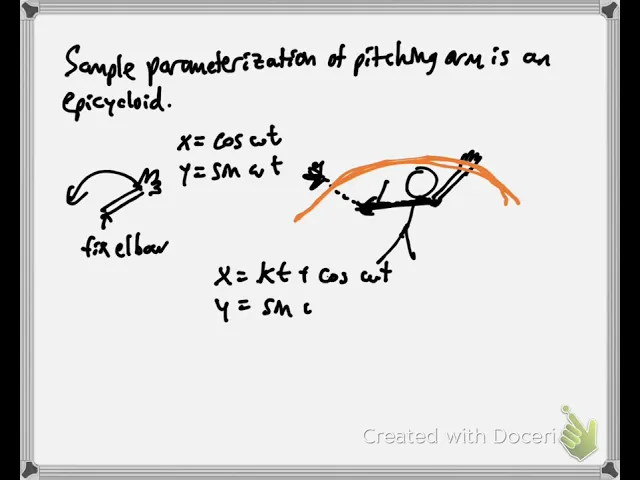
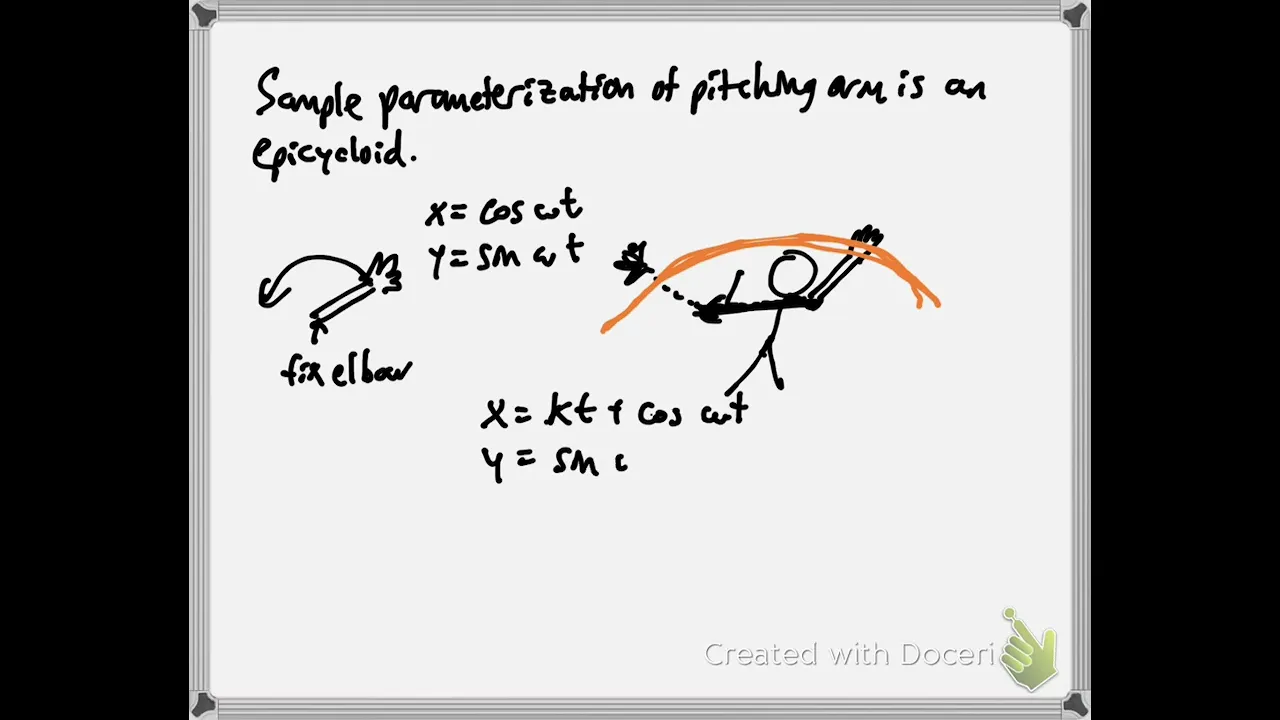
i say i wouldn't expect y'all to do anything like this on the assignments there but basically one of the ways that you can a sample parameterization of an arm in motion or a pitching arm is an epicycloid and the idea here is if i if i take my elbow and fix fixed elbow like your arm wrestling or whatever and you just make your arm just go like that okay then you can parameterize your x can be in terms of like a cosine of omega t and your y can be in terms of sine of omega
t okay but if you're actually throwing then your elbow starts off here and by the time your throwing motion is done and the arms over here there's a there's a horizontal motion for your base while the outer um follows a circular path well if you combine those two together it kind of gets a little stretched out not not like an oval but the parameterization would be something more like x is going to be kt plus cosine of omega t and y equals sine of omega t because you still say the elbow you know goes at
zero degrees here and then maybe here be it 90 degrees and then if you fully extend outward you'd be at 180 degrees over there so this parameterization right here x equals kt plus cosine omega t y equals sine omega t this greets you if you take a calculus 2 or 3 in a parameterization and what happens when you want to figure out at this velocity i want to go 90 miles per hour or 126 feet per second what you do in that what what you do is um it turns out that if x and y
are a position function position in terms of t then the speed of the ball is the square root of x prime of t squared plus the y prime of t squared and if you try to get this thing to equal 126 feet per second at at pi equals 2 over radians then the math can get a little bit complicated and you want to also assume maybe about three feet or so between where the elbow would start and the pitching motion and where the elbow would end in the pitching motion so you try to figure out
what parameters you have for k and omega to make out to make it work out you want to go through this point you want to go through that point and you'll go through that point and you want your velocity right you want your speed to be 126 feet per second so you solve a what might be a non-linear system of in terms of k and omega and you figure out exactly what your k is and what your omega is and once you do that no question can be what if the pitcher releases 1 1000 of
a second light okay so what happens here is suppose you've got the pitcher and they're well they're timing it well and pi over two radians in their arm motion they're getting the ball off toward a home plate by a model which would go something like f of f of t equals negative 1 16 t squared plus the height which is usually what you do is you add the height of the mound plus the height of the person at the neck level and then how long the arm is if you assume that when they're pitching the
ball their arms fully straight okay what happens though if they're light on the delivery though okay so suppose in their pitching motion they don't release the ball here but they release the ball there so now all of a sudden you might have something like an f of t equal minus 1 16 t minus um uh t sub k squared plus h sub k we're releasing at a different point instead of following this parabolic path and it hits the pitcher's glove one and a half feet above the um ground for a strike maybe releasing it a
little bit late the tent the again you want you know the red tangent line and then the green tangent line so what if at the point of release instead of going through this curve you create uh that curve and whoops now all of a sudden the catcher's got a lunge outboard and you got a high pitch for a ball that would happen if you're early on and if you go late then we'll more likely have maybe something like this parabola might go something like like this and all of a sudden it goes a little too
low and you might have the catcher might be digging it off the ground and it would be low for a ball so if you do the mathematics going into the parameterizations and saying you know what happens if you take x of the t that would happen at pi over two plus one one thousandth and you'd have y at the same t pi over two plus one one thousandth so at this point in the epicycloid instead of that point now in calculus 3 or calculus 2 it turns out that d y over dx is d y
over dt over dx over dt so if you take this ordinary derivative with respect to t and this ordinary derivative with respect to t you put your d y over dt on top and you put your dx over dt on the bottom and you can figure out if you release a second light this would be the slope of your tangent line and the parabola of the path of the ball let's go a different color here purple okay that's the point of releasing that that might be your parabola and then the ball would be low so
anyway that kind of gives you a rough um synthesis of some of the calculus and some of the mathematics that could come up if you wanted to go you know at a basic level just keep in mind that the uh if the unless the um pitcher pulls a muscle or whatever you would expect that the motion to be smooth and if the ball doesn't hit anything on the way like hitting a wall or whatever until it hits the pitcher's mount or hit or hit something along the way you would assume that motion smooth and what
i mean by smooth is the derivative exists everywhere and so again at the point of release you got the tangent line of arm's motion and the tangent line the ball's motion those tangent lines are the same and so the derivative would be the same and you can use that and say what happens if the picture releases too early or releases too late and just to marvel at the pitchers who are very good with their control who get like you know three strikeouts for every walk or four strikeouts for every walk they got a really good
command of exactly the millisecond that they've got to release the ball to make that ball always hitting the strike zone so hopefully this was a found this um interesting and eye-opening as far as mathematics and daily life