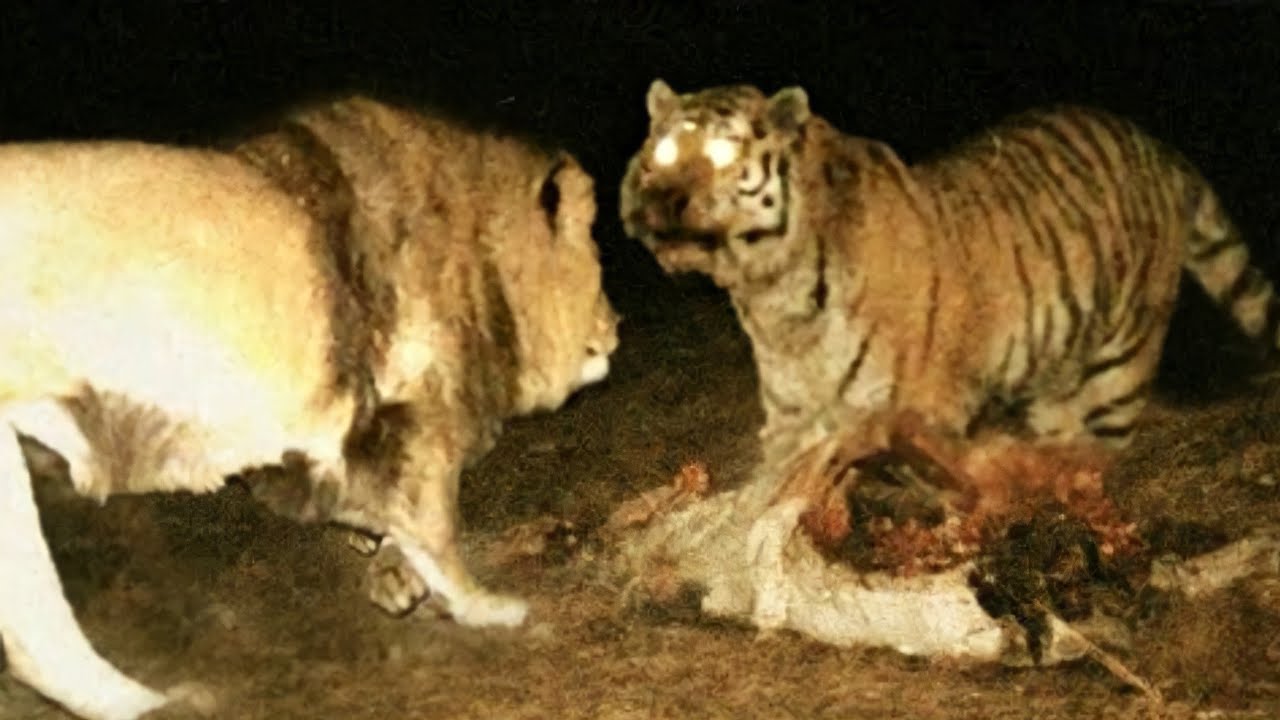
Two of the biggest cats to ever walk the Earth. On one side, the Ngandong Tiger, a colossal beast from the Indonesian forests, with strength and agility worthy of a legendary predator. On the other, the American Lion, a giant from the Americas, whose ability to dominate mega fauna made him the most powerful of his time.
Both have been extinct for thousands of years, but their stories, reconstructed through fossils and scientific studies, still make us wonder what would have happened if these two hunting machines had met face to face in a hypothetical confrontation. The question that hangs in the air is: After all, which of these two cats is really the strongest? The Ngandong Tiger or the American Lion?
So, click the like button, subscribe to the channel, and come find out which of these two predators would dominate a battle! HYPOTHETICAL OPPONENTS: The Ngandong Tiger is, to this day, considered the largest tiger ever recorded. Weighing up to an impressive 470 kilos, this giant could measure around 3.
60 meters in length, not counting its tail. His height at the shoulders varied between 1. 20 and 1.
40 meters, rivaling that of many herbivores he hunted. It is important to highlight that the iconic saber-toothed tiger is not a tiger, but a distinct species, which is why the Ngandong tiger is still the largest among tigers. Its coat was probably similar to that of modern tigers, with stripes that helped it camouflage itself in dense forests.
But what really made him stand out were his claws and teeth. Its thicker, larger claws allowed it to climb trees and grab prey with devastating strength. If today the modern tiger can do this with ease, imagine what the Ngandong tiger was not capable of?
He could cut splinters from trees with his claws like a hot butter knife. Their canines measuring up to 14 centimeters were even more deadly weapons, capable of piercing the defenses of the largest prey. This predator could jump up to 10 meters away, which made it a highly efficient hunter, even with its colossal size.
In its environment, where dense vegetation and uneven terrain predominated, the Ngandong Tiger developed a lethal combination of strength and agility. He was a true hunting machine, adapted to stalk, ambush and eliminate prey in a short space of time. Now, imagine the American Lion, a feline that dominated both the icy forests and plains of North and South America.
This predator was only slightly larger than the Ngandong Tiger, weighing up to 400 kilograms, but its body was incredibly robust and muscular. Its length could vary from 3. 50 to 3.
70 meters, directly rivaling that of the tiger. With a height of up to 1. 30 meters at the withers, the American Lion had an imposing appearance and was adapted to face gigantic megafauna prey, such as mammoths and giant sloths.
Its extremely resistant claws allowed it to hold large prey with ease, while its long, slightly curved canines made it easier to quickly kill its victims. The American Lion's coat was shorter and less dense than that of other felines from cold climates, but it compensated with a thick mane in males, which, in addition to providing protection during combat, served to intimidate opponents. While the Ngandong Tiger impresses with its strength and ability in ambushes, the American Lion stands out for its resistance and ability to attack larger prey in the open field.
WHERE DID THEY REIGN? The Ngandong tiger, a true wonder of nature, dominated the dense tropical forests of the island of Java, Indonesia, and possibly nearby regions during the Late Pleistocene period, between 126,000 and 11,500 years ago. These forests were filled with dense vegetation, tall trees, and uneven terrain that required unique skills to survive.
The environment not only challenged his agility, but also shaped his way of hunting, where surprise and accurate attacks were fundamental. In this densely forested territory, the Ngandong tiger's prey included large herbivores such as stegodon – a distant relative of modern elephants – and other robust mammals. Like a modern tiger, the Ngandong tiger used careful ambushes planned, camouflaging themselves among the shadows of the trees and waiting for the exact moment to attack.
In addition to its prowess on land, the Ngandong tiger was an exceptional swimmer. It crossed rivers, waterfalls and even small stretches of sea between islands, which expanded its territory and made it even more adaptable to the environment. Meanwhile, on the other side of the globe, the American lion reigned supreme over the vast plains, temperate forests, and mountains of North and South America.
From Alaska to Peru, it adapted to an impressive diversity of terrains, including icy tundra. , dense forests and open meadows. The wide geographic distribution showed its ability to adapt to different environments, which was a crucial advantage for its survival.
The American lion's diet reflected the rich diversity of its time. He hunted mammoths, giant sloths and even mastodons, in some regions, as well as smaller prey. This feline's strength was directed towards fierce clashes against huge prey, where it used its resistant claws and sharp teeth to attack vital points, such as the neck or abdomen, ensuring a quick and efficient kill.
BEHAVIOR AND EXTINCTION The Ngandong tiger was a solitary hunter, like modern tigers, and its territorial nature made it an absolute master of its area. However, its extinction is shrouded in mystery. Researchers believe that abrupt climate change, combined with tectonic events and the decline of prey due to increasing competition, led to the decline of this imposing species.
Geographical isolation on the islands may also have hampered their long-term survival. The American lion, despite its name, was not the typical social animal like modern African lions. It likely hunted alone or in small family groups, given the territorial nature of the giant prey animals that dominated its environment.
Their extinction was also the result of climate change at the end of the Pleistocene, which drastically reduced prey availability. Furthermore, the arrival of the first humans in the Americas brought excessive hunting, coupled with habitat loss, sealing the fate of this legendary predator. THE STRONGEST When we place the Ngandong tiger and the American lion side by side, the clash becomes a spectacle of epic proportions.
Both were apex predators, possessing the strength, skills and intelligence to dominate their environments. But, after all, which one is the strongest? Both felines are equal in size and weight, so brute strength here will not define the outcome of this battle.
The Ngandong tiger, with its larger and thicker claws, would allow it to climb trees and leap over the American lion with deadly precision, while its teeth, measuring up to 14 cm, would slaughter its opponent. On the other hand, the American lion could dodge and use its long canines and reinforced claws to disengage from an attack. If this clash were in the water, the tiger would win for the simple reason that it is familiar with hunting in that environment.
However, on land I believe that the American lion would win due to an issue that has been little explored: resistance. Due to the fact that the American lion can survive and thrive in many different environments, and the Ngandong tiger lives restricted to a single type of habitat, shows that this lion's resistance is superior. So stamina for this battle would count a lot, given that the strength and skills of both are very similar.
In my opinion, on land, the American lion would hold out for longer, giving the opportunity to finish off a tired tiger. Now tell me what you think about this hypothetical clash here in the comments. And please, leave your like and subscribe, it's free and it really helps our work here.
Thank you very much for watching until the end, I did!