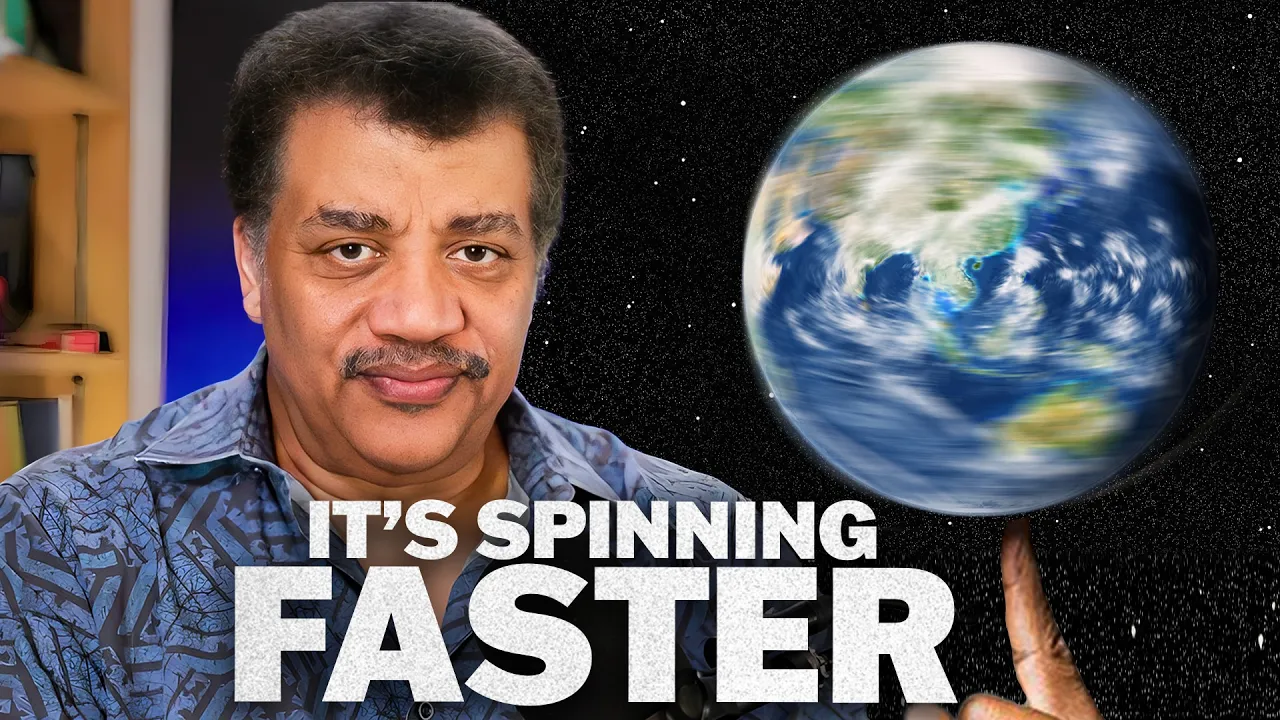
Earth's rotation rate is speeding up. What's up with that? [Music] Well, how long does it take Earth to rotate once on its axis?
We call that a day. We count up all the seconds and the minutes and the minutes and the hours and the 24 hours of the day and you get 86,400 seconds. If Earth were your only measure of the rotation of the Earth, how would you know if it was changing?
You need some other timekeeping device that's not only more accurate, but more precise than Earth itself to have any clue if anything is changing about Earth's rotation. That began in the 1950s where we introduced the atomic clock. Atomic clock keeps time just by vibrations within the atom and it's unrelated to the sun, the moon, the stars, the earth.
It's keeping its own time. And when we did that and we kept good records of the rate at which the atomic clock was passing time and the rate at which Earth's rotation was passing time, we found a difference. And beginning in the early 1970s, we started compensating for that difference.
The difference in almost all cases was that Earth was slowing down. So you accumulate a second in the slowing down of our rotation and then you throw in a leapsec to compensate for it. The alternative would be to change the definition of a second so that the 86,400 seconds still fills the day.
But that is a level of complication that modern society is not prepared to accept. The duration of a second is precisely defined and we'll just add and take them away as the earth deems necessary. When do we do this?
Well, just by decree. It's in one of two places on the calendar. Either in the last minute of December 31st of that year.
So the last minute would have 61 seconds in it or the last minute of June 30th midyear where that would be given a leapse second that last minute containing 61 seconds. So since 1972 when we had good enough atomic data we have accumulated last I checked 27 leapse seconds from the slowing of the rotation of the earth. This monitoring is done monthly, weekly, daily and you look at the accumulations in one direction or another.
Earth could also speed up. We have mechanisms in place for that as well. If we speed up by a full second, then we take out a leap second in one of those two spots in the year.
So the last minute would have 59 seconds instead of 61 seconds. All this is happening under the hood. Your computer will know about it, but you don't have to because milliseconds on a day, a second every now and then added or subtracted from a calendar really makes no difference to I I I'm betting you don't live your life time to the millisecond.
I'm just thinking just that's just me making assumptions about you. So, lots of things affect the rotation of the Earth. Foremost among them is the sloshing of oceanic tides on and off the continental shelves.
These tides are primarily raised by the moon. And so the earth and the moon do this kind of ballet where the moon raises the tides. The tidal bulge of the earth actually speeds the moon up in its orbit forcing it to ascend in its distance from us.
So the moon is actually spiraling away from us. Not by much, few centimeters a year. And how do we know that?
Well, you can calculate what it would be given this dual dance that's going on. Or you can stick mirrors on the moon, beam a laser to it, time the return trip, and calculate how far away the moon is, which is exactly what we did with Apollo 11. Back in 1969, Neil Armstrong and Buzz Aldrin laid down what are called corner reflectors.
Light coming in from any direction will reflect back exactly parallel to the direction the light came in. And so you come back to Earth, beam a laser out of your telescope, check the flash on its way back, time it, and there you have it. We confirmed that in fact the moon is spiraling away from Earth, as it's been doing for billions of years.
The moon used to be much closer and much bigger in the sky. All right. Well, that's one thing that slows down the rotation of the Earth.
Other things can slow it down or speed it up. For example, earthquakes. Continental drift shifts placement of mass on Earth's surface.
You say, "Well, so it's still just a sphere. " But no, you can picture an ice skater. They go into sort of a slow spin with their arms extended and then they slowly bring their hands in and they speed up.
What they've done is they've brought mass of their body closer to the rotation axis. When you do that, a fundamental law of physics kicks in. The conservation of angular momentum.
And so if you shrink an object, bringing your mass closer to the axis of rotation, you will speed up. Conversely, if you spread the mass farther out, you will slow down. Other things, the migration of animals can affect the rotation of the Earth.
Migrations typically occur north south. Well, if you're going south, you're taking mass that's otherwise on Earth's surface and moving it farther away from the rotation axis as you approach the equator. You'll come to the equator, Earth will slow down, and then you go into the southern hemisphere, Earth speeds up again.
Let's see other things that can affect Earth's rotation. Definitely the melting of polar ice, not only in Antarctica, but in Greenland. This is miles of ice that as it melts during our episodes of climate change, that water flows back into the ocean, creating a different distribution of mass on Earth's surface.
Anything that goes from the pole towards the equator will slow down Earth's rotation. So yes, climate change is another force that will slow down our rotation. And so too can our liquid core.
Earth has a heat source left over from its formation and from the decay of radioactive materials that has liquefied the core and you have movement in the core. That's what gives us our magnetic field. The movement of conducting metals within the core of the earth that changes where the mass is.
All of these phenomenon can either speed up the rotation of the earth and slow it down. We get asked by how much tiny amounts milliseconds millisecond is a thousandth of a second and often it's just fractions of a millisecond. Now some of the headlines I've seen are earth is speeding up and we don't know why and it's mysterious.
Really? I'd call that clickbait. It's possible to not know why something is happening yet have it not be mysterious at all.
For example, let's say you own three dogs and you go out for dinner with your loved one and you come back and you find pee in the kitchen floor. You don't know which dog did it. But it's not mysterious.
Not knowing something is not the same thing as something being mysterious. Not knowing what is the smoking gun that's speeding Earth up one day versus another does not make it mysterious. It means let's go to all of the factors that we know of.
Could there be a factor we haven't considered yet? Maybe, but unlikely because we've been in the business of doing this for 50 years. The universe brims with mysteries, don't get me wrong, but the forces that are altering Earth's rotation are not among them.
This is tracked daily. We compare the rotation of the Earth to the atomic clock daily. And we know these numbers and they're they're fractions of a millisecond.
Are they accumulating in one direction or another? Are they just canceling each other out from day to day? Of course, there's going to be a day in the year that has more of a shift than other days.
That's how data work. You're going to make a federal case out of it. You're gonna make a headline of it.
Biggest shift of the year. Yeah. Every year has a biggest shift in each direction.
There's a biggest shift. I think someone found out they can make clickbait out of it. And that's what we're in the middle of right now.
So rest calmly tonight or any other night because the daily changes in the rotation of the Earth. First, as I said, we only really care about it when it's accumulated a second and then we throw in or take out a leapse second. But I'm pretty sure there's nothing in your life as there's nothing in my life that requires that I keep track of time to the millisecond.
So just contemplate the fact that we are on a spinning planet in orbit around the sun like a pirouetting dancer in a cosmic ballet choreographed by the forces of gravity. Until next time, keep looking up. New findings may be shaking up everything we thought we knew.
Data suggests dark energy might be weakening, meaning the universe's expansion could actually be slowing down. If true, it would challenge one of the biggest assumptions in modern physics. But before we rewrite the textbooks, we need clarity.
That's exactly why Star continues to partner with Ground News. They built an app and website that helps us separate speculation from science. With one swipe, we can find original research and highly factual sources covering the most complex breakthroughs in cosmology.
They were actually founded by a former NASA engineer with the same level of precision you'd expect for space missions. But the best part, ground news isn't some new tool to learn. They're a smarter, better version of how you're already staying informed.
So follow every major development from dark energy to deep space with interest pages tailored to the topics you care about most. We're giving our viewers 40% off the same unlimited access vantage plan we use. Just go to ground news.
star talk or scan this QR code to bring the cost of context and clarity down to $5 a month.