[Music] Stanford University uh are there any other questions that I can answer in five minutes you mentioned last week that a person traveling near the speed of light would measure a longer wavelength well if he was depends on which way he's going uh if the light wav is going that way and you're moving with it then the wavelength looks longer than if you were Standing still if you're moving the other way it looks shorter um that's the Doppler Shi that's the Doppler shift and all right let me tell you how you can work it out
you can work it out just from geometry from the geometry of the lorence Transformations um here's what you do so all right first of All let's do the usual drawing of two coordinate frames one of them is at rest that's your frame and my frame is moving to the right and so my frame looks like [Applause] this uh let's draw in one more thing let's draw in the speed of light it's like that all right now imagine that there was a wave and think about here's the Wave and the wave is moving to the right
as it moves to the right we can follow the Peaks of the wave the high points of the wave uh and I'm going to draw them in in red they're also going to move with a speed of light so they're going to look like this notice that as you move up meaning as time goes forward as time goes forward the wave moves to the right so that's a Right Moving wave and what's The wavelength the wavelength in your frame of reference is this distance over here the distance between successive uh Maxima what's the wavelength in
my frame the wavelength in my frame is this distance but this distance as measured using relativity and using the lence transformations in other words this distance here is the distance Between the two Maxima at what you call an instant of time and the wavelength to me is the distance between the two Maxima at what I call an instant of time so if you work out the Loren Transformations and you look along here and ask what's the distance between these two points in your ref or my reference frame and compare it with the distance along here
you'll find it different and that would give you the Doppler shift you have the Tools to do that you can do that you know the Loren Transformations you can figure out what the co if let's say the wave well here's some wavelength some particular wavelength you can figure out what this point is you can figure out what this point is and you can ask what's the XP Prime distance between them X Prime is my coordinate X is your coordinate the X distance between these is Lambda and you can figure out what The X Prime distance
is and that's uh the way to calculate the Doppler shift so I recommend it as an exercise in um in uh in working with Loren Transformations yeah um is the next sequence next course in sequence going to be next fall yeah there's nothing to summ no no no and the yet we'll take a vote I'm not sure um I Think there possibly general relativity possibly more quantum mechanics um our coverage of quantum mechanics was reasonably deep but not very broad having not gotten to the harmonic oscillator that's a bad thing so I think before we
study Quantum field Theory we do have to study uh more quantum mechanics but um I'm not sure which way to go next quarter and I haven't decided yet can I make a small Request yeah whatever it is that you have could you cover infrared and UltraViolet connection not yet we have to we have to do general relativity first that's a gravitational issue we haven't studied gravity that's an issue of a combination of quantum mechanics and gravity uh we may know enough about quantum mechanics at this point but not enough about gravity the scales are not
the same on X And X Prime is that correct what do you mean the scales are not the same you can't just look at the black no no no you can't just look at the Blackboard you have to do the Lorent Transformations right um right okay how do you do it let's make this wavelength one just to simplify so this is zero this is one this is two and so forth all right now I Would like to locate what this point is it's clearly important for me to locate where that point is this point is
X Prime equal 0 that's the same as which is it x uh t equal VX do you remember that that um that the surface T Prime equal 0 is the same as tal VX let me remind you why the uh the Ln transformation involves T Prime is Equal to T minus VX over < TK 1 - v^2 right all right now supposing I want to know where T Prime equals 0 is T Prime equals 0 That's What I Call um an instant happens to be the instant T Prime equal Z but that's okay and that's
clearly tal VX so this is tals VX and what is this line over here or first of all what is this line X = t it's moving with a speed of light c = 1 that's xal T what is this one oh come on it's easy right x t + 1 right okay so we're at the intersection of x = t + 1 and T = VX let let's work it out uh let's see what that point is xals T which is VX + 1 or x * 1 - V = 1 or X is
= to 1/ 1 - V that's the x of this point and what about the T of this point well if we know the x of this point let's say if we know the x of this point we can read off the t t is equal to V over 1 minus V all right now we would like to find out what the simplest thing to do now is to figure out we know know T and we know x what I'd really like to know what would I really like to know about this Point over here
I'd like to know X Prime I would like to know the distance between successive Minima in my frame the primed frame so we go to the primed frame X Prime is equal to x minus VT over < TK 1 - V ^2 and now I just plug in for x and t what I have here do I really want to do this yes I Do X Prime equals x 1 over 1us V minus V * T so that's V * t - v^ 2 over 1 - V all divided by by square < TK of
1 - v^2 right did I do that right I think so okay so let's see if we can simplify it now we have 1 - V ^ 2 1 - V ^ 2 divided 1 minus V and also in the Denominator I also have square root of 1 - V ^ 2 okay 1 - V what sorry 1 - v s is the same as 1us V * 1 + V right that's 1 - V ^ 2 is 1 - V * 1 + V and so these cancel out what else can I do with
it well I can put this in the square root just by squaring it and then putting it in the square root and the whole thing becomes square Root of 1 + V * 1 + V that's 1 + v^ 2 divided by 1 - V ^ 2 which is 1 + V * 1 - V so the answer is square root of 1 + V over 1us V that's what x Prime is over here is it bigger than one or smaller than one it's bigger than one it's bigger than one so my Reckoning of this
distance gives me something bigger than One you said the wavelength was one I say the wavelength is square < TK of 1 + V over 1 minus V okay so that's the uh that's the calculation wow okay does that answer your question Warren good okay so it's all there in these pictures just draw the picture of the thing you're trying to figure out and then convert it into some simple um some simple Equations good now let's put this up this of course is the relativistic Doppler shift formula sare 1+ V over 1 minus V and
to really be correct about it this is V over C and this is V not correct it was correct but to put uh units in which is the same as Square < TK of C + V over C minus V what do you think happens if you're going in the other direction if I was going in the other Direction you would just change the sign of the Velocity from plus v to minus V that's just going in the other direction minus V and you would get square < TK of C minus oops oops C minus
V over C + V and now this is less than one so if you're shooting against the direction of the light Ray you see you see a shorter wavelength if you're moving along the light Ray you see a longer wavelength and what happens if your velocity gets up near the speed of Light if let's say this one over here if your velocity gets up near the speed of light then the wavelength gets bigger and bigger and bigger and eventually if you're moving with a light Ray if you could the wavelength would look infinite okay there's
another way to yeah no that's fine let's leave it that way okay uh good all right if there are no further questions we will start tonight's lecture 10 minutes Late fields and particles now in quantum mechanics fields and particles are the same thing thing but we're not doing Quantum Mechanics for us here fields are fields and particles are particles I won't say never the twain will meet because they will meet they will meet tonight but uh but they are not the same thing in particular we want to ask the question if a field affects a
particle in a Certain way for example by creating forces on it that accelerate it or whatever they do must it not also be the case that the particle affects the field well why do I say that why does it have to be the case why if a affects B does B necessarily have to affect a and that's built into the idea of action that's built into the action principle or into the L grangian principle we can see it in a very in a simple context it's also called action And reaction uh it's basic idea if
a affects B then B will affect a so a simple example of it is to suppose that you had two coordinates now you could have any number of coordinates but let's just suppose for the moment two coordinates and an action principle so let's call the coordinates X and Y and lran is going to depend on X and Y and X Dot and Y dot X and why do not Have to stand for the orthogonal coordinates cartisian coordinates of anything they're just two coordinates now uh and the lran depends on all of these now one possibility
is that the lran is simply a sum of two terms the lran for x and x dot plus a lran for Y and Y dot a different lran I'll just continue to call it l might be the same might be different if this is the case and you look at the Equation of motion for X let's write it down uh then that equation of motion will involve d by DT of partial of Val with respect to x dot is equal to partial of L with respect to X and Y won't get into all together likewise
if you write the equation of motion for y x doesn't get into it and so in this case X doesn't affect y y doesn't affect affect x what can you say if you know that y does affect X that tells you that the lran Must be more complicated and there must be things in it which somehow affect both X and Y for example here's a lran uh x do^ 2/ 2 + y do 2 over two so far they completely independent you could have a potential energy for x no minus and maybe another potential energy
V Prime for y so far it's just a sum of two terms an X term and a y term X and Y are not going to affect each other what do you Need to do if you want to see them affect each other put something in additional into the lanan which which involves both X and Y in a way that you can't unravel it for example just x * y if you have x * y then the equation of motion for X will involve Y and when the equation of motion for y will involve X
if you have them both in the lanan in a way which is coupled together in this way there's no way that it's possible that One can affect the other without the affect other affecting the one so that's as simple as that that is why if a affects b b affects a okay now let's come to the issue let's talk about particles and Fields we talked a little bit last time about how a field might affect the motion of a particle that was just a simple model but we'll we'll go back to it let's go back
to it talk about how the field affects the particle Motion and then come back and ask how the particle the presence of the particle affects the field this is very much the analog of electric and magnetic fields affecting the motion of charged particles and charged particles creating and modifying the electromagnetic field for example just by having a Charged particle creates a Kum field and so forth and those are not two independent things they come from the same Lran so let's uh work out this example all right so let's begin with let's suppose first of all
that there is some field Fi Fi depends on x and t for the moment we forget about how it got to have have the value that it has somebody solved some equations for fi and found out that f of x and t has a or measure f of x and t and it had some specific form f of x might be a wave or might not be a Wave uh how does that affect the motion of a particle and for that we're not going to ask about the Dynamics of fine now we're going to ask
for the lran for the particle this is the particle lran so let's remember what it is to begin with to begin with it contains minus M time the square < TK of 1 minus X do SAR what was this this was The terminal agian that corresponded to an action which just added up all the proper times along the little segments of a path multiplied by minus M uh the integral of this l and let's write it out let's write the integral DT that's the action that's the integral DT of this and this is the same
as minus M times the integral of the proper times from one end of the trajectory to another all right so that's a uh that's the ordinary L grangian for a particle But that doesn't have anything in it in which the field affects the uh the particle so let's put in something for the FI a simple thing the simplest thing we can think of simplest thing I can think of let me move this a little bit and let me put minus m+ 5 now f is a function of position and time in general so it's a
function of x and t but we're imagining for the moment that it's a known function of the coordinates of the particle times the Same thing again 1 - x do^ 2 that's the L grangian for a particle I could work out the oiler lrange equations and find out how fi affects the motion of the particle I'm going to do it but I'm going to do it in the simplified approximation where the particle moves very slowly just as an illustration I don't want to futz around with all the relativistic square roots of 1 minus V ^2
and so forth this of course is v^2 and we could be thinking about a particle on a line we don't need a y and z in this just X is enough to illustrate the point particle moving in one dimension let me put back the speeds of light all right it's useful to put back the speeds of light in order to see what the non-relativistic limit is the non-relativistic limit is basically the limit in which the speed of light goes to Infinity when the speed of light is Bigger than any other velocity in the problem that's
the non-relativistic limit uh the Newtonian limit lran has units of energy mass does not have units of energy unless the speed of light is one but if the speed of light is not one we put in minus m c^ 2 now it has units of energy F I'm just going to leave that way the field is defined oh let's put a constant in here let's put a g in Here this constant is a constant called a coupling constant it measures the strength by which the field affects the motion of the particle so let's put a
g in here G can be anything for the moment we don't know what it is it might have a c in it might not have a c in not important at the moment it's just G * 5 and F depends on x and t now let's oh and uh of course this is square < TK of 1 - x do^ 2 over c^ 2 that's the lran with all the speeds of light in place and now let's go to the non-relativistic Limit the non-relativistic limit when C gets very large we expand the square root we
expand the square root using the binomial expansion 1 minus a small number to the minus to the 1/2 power that just becomes well this thing becomes one - x do^ 2 over T c^ 2 the twice comes the 1/2 comes because this is something to the 1/2 power I'm using that 1 + Epsilon or 1us Epsilon in this case to the power 12 is just 1 -2 Epsilon plus things which are really very much smaller because they will involve Sol higher powers of the ratio of the Velocity to the velocity of light so this is
what we get plus tiny tiny things let's erase this and write 1 - x do^ 2 uh over 2 c^2 now we look at this and we try to find the biggest pieces the pieces which are most important when the speed of of light gets large the obvious first piece is mc^ 2 just mc^ 2 * 1 but mc^ 2 * 1 is just a number it doesn't do anything when you start different it's a lran we're talking about if you start differentiating it with respect to position or velocity it doesn't do anything it's just
a Number so that term is of no interest adding a constant in lran doesn't have any effect on the equation of motion so the mc^ 2 * 1 is of no interest the next [Music] term has the speed of light cancelling all together so it's part of the limit in which the speed of light goes to infinity and it survives it survives that limit so the next term is the product of mc^ 2 time x do^ 2 over 2 c^2 and that's familiar that's X do^ 2ar m/ 2 the C squares have canceled and that's
just the good old 1 12 mv^ s the nonrelativistic kinetic energy and what about this term G 5 * 1 that has no speeds of light in it so it clearly survives so we add minus there's a minus sign here minus g f of x and t and that's all that there is when the part is moving slowly and we just compare that with um you know the oldfashioned Non-relativistic L grangian the oldfashioned non-relativistic L grangian was kinetic energy minus potential energy this is clearly kinetic energy and that identifies for us G * fi as
the potential energy of the particle the potential energy of the particle in a field G is just a constant but in for example electromagnetism the strength of the Coupling of a field in a particle is just the electric charge the bigger the electric charge the bigger the force on a particle in a given field so it's natural that there be some constant multiplying something about the field we'll come back to this but if you like in this limit the nonrelativistic limit and the only reason I do the non-relativistic limit is so we don't have to
muck around with all these square roots of 1 minus V ^2 just to illustrate a point this is effect or this here represents the effect of the field on the particle okay now what about the effect of the particle on the field the important thing to understand is that there's only one action the total action all together and the total action includes an action for the field and the action for the Particle the physics problem we're trying to do could be we we we should draw a picture of what it is we're trying to do
we have a region of space and time time space and we have a field in it let's just draw the field as's a bunch of red mush there's the field and first of all we're trying to Find find out how the field behaves that involves knowing a l grangian for the field and minimizing L grangian for a field and in addition the mechanical system or the system that we're studying also happens to have a particle moving through it so what we're trying to do is study a combined system of a field and a particle moving
through the field and we're trying to minimize the action not just with respect to the Motion of the particle but with respect to the motion of the particle and the motion of the field or how the field behaves in there for that very simple we simply explore around changing the field letting it wiggle in different ways change the particle trajectory until we minimize the action and that will give us the trajectory and the field that correspond to the principle of least action okay so let's go and Write the whole action including the field and the
particle well first of all we need an action for the field we discussed this last time I'm just going to write down what we wrote down last time uh a simple case of it the lran for the field that we wrote elth stands for L grangian for the field that we wrote down last time or well the action the action itself the full action is the Integral time d4x d4x means DT and DX it's an integral over the whole space-time region X Y and Z and T and the thing we wrote down last time was
the integral of 12 partial ofi with respect to t^2 minus 12 partial ofi with respect to x^2 I'm finished with the speeds of light for the moment I don't care about them anymore I just wanted to keep track of them in this little exercise over Here but if we want it to keep track of the speed of light I think there would be a 1 over c^ squ here all right this is the lran for the field and it doesn't involve the particle at all but now we have to or the action this is the
action for the for the uh for the field but now let's also add to that the action for the particle here it is right over here I'm going to take a very special simple case you can work out the more Complicated case but I'm going to work out the case where the particle is at rest let's put the particle at rest Let's uh let's assume for the moment that there is a solution to the equations with a particle is just at rest after all there are situations where an electron might be at rest right uh
and ask what the additional term in the action is we could make the electron move it doesn't we but uh but for Simplicity let's just take the electron to be at rest not moving that's the trajectory and what is the action in that case here it is right over here x is zero this is just one mc^ s by itself is of no interest and so the lran for the particle or the contribution to the lran from this piece over here is just the integral of fi f of x and t but an integral along
where what kind of integral it's an Integral DT T right this is just a particle it's not a field it's an integral DT and it's an integral along the world line of the particle but it involves fi it involves fi the reason the particle responded to the field was because the lran for the particle involves fi the reason the field responds to the particle is because that same lran also has fi and the positions of The particles in it so what do we add how how can we add this term here I want to add
it in a way that corresponds to a integral over space and time how can I turn this into an integral over space and time oh sorry let's go back a step let's go back a step where should I put this particle for conven venience and simplicity let me just put it at xal 0 it's a particle at position xal 0 then what do we put in here well we put in The position of the particle X which is zero Pi of Z and T integral DT now this term here is just an integral over the
world line this term here is an integral of all space time in fact the way I wrote it space is only onedimensional so this would really be only a a two-dimensional integral but you know what I mean okay how can I write this so that it looks like an Integral over all space time just to put it into one term and the answer is simple the answer is you use the dra Delta function use the direct Delta function here's the way you do it this is what I want to get take fi at zero the
time is not important here and let me write it in the following way it's an integral over all space Of f ofx times the direct Delta function the time dependence is not important here it just goes along for the ride do you recognize this when you integrate the direct Delta function the direct Delta function is a very high Spike of a function it's a high Spike of a function it's zero everywhere except at x equals z and so when you integrate the field with a Delta function you just get the Field at the origin you
get the field at the origin or the field at the place where X where F where the Delta function has its big spike where does the dxb that's the integral over the volume if this was a one dimensional axis we would just write the X let's take the case of uh what this all right we I guess I really need to tell you what uh that Delta function really means what I've written is just Delta of X right let's uh let's be a little more precise let's call this Delta 3 of X d3x Delta 3
of X means the product of three Delta functions Delta of x Delta of Y Delta of Z where is this function nonzero it's non zero when all three of these Delta functions are nonzero there's only one place where all three of them are non zero it's at x Equal 0 y equal 0 or Z equal 0 okay so what is it it's a function of three coordinates Delta X Y and Z it's a function of the three coordinates of space but it only has a value at one point of space and at that point of
space it's enormously big when you integrate the field let's write it out let's write it out in bloody detail integral f of x y and Z I won't bother writing the time dependence Delta of X Delta of Y Delta of Z DX Dy d z that's what I've written here that's the meaning of the symbol here the triple Delta function and then integrating over all space all right how do you do this integral this is not a very hard integral to do remember whenever you integrate a function with a Delta function it gives you the
value of The function at the origin or at the place where the Delta function is Big where it has its Spike we're just using the equation integral F ofx Delta of xal f of 0 that's the defining property of the Delta function it picks out for you the value of the function at the place where the Delta function has its Spike all right so if I do the integral over X first this one tells me to set x equal to zero this integral tells me to Set y equals 0 and this integral tells me to
set Z equals 0 so the whole thing is just five of Z that's what I've written here notice I also in order to calculate the action I also have to integrated it over time the action was the integral of this F over over time so in the action we have the integral over all coordinates d4x that means D xdy dzdt 5 of x and T Delta cubed of X this Delta cubed of X is doing nothing but picking out the value of F at the spatial position of the particle that's all it's doing doing it's
a trick just to write this thing here it's a trick for writing the value of a field at a point as an integral why do I want to do it well I just want to do it because I would like to add here Plus I missed something I missed a g very likely because of this yeah minus G Delta cubed of x f of x and now the whole thing is just one big integral over all space and all time here it is and this thing inside the big square bracket is the Lran this is
this thing inside the big Square this action equals the action is now an integral over space and time like any good field L grangian it has the good old uh field action and this term over here represents the effect of the particle back on the field it's just this term over here for the special situation where the particle happens to be at rest we could Jazz it up so that the Particle moves this is 5X and T we could do that by making the Delta function uh move around with time that's possible to do but
it's not important right now okay now let's go take this lran and work out the equations of motion for it the thing inside the bracket is lunian and let's work out the equations of motion first of all we have the derivative of lran with respect to partial ofi with Respect to t d by DT what is that that's just equal what's the what is DL by d d DT it's just D DT right so this one is going to give us the second derivative of f with respect to t^2 sort of like an acceleration we
have a kinetic energy F do^ squar when we work out the equation of motion we have something that looks like an acceleration of F now there are the other terms coming from d by DX x^2 and they're exactly the same same sort of thing I'm going to erase this and I'm just going to put in minus DC F by dx^ 2 if that's all there was I would set that equal to zero and this would be a good oldfashioned wave equation onedimensional in this case if we wanted to add more Dimensions we would add minus
DC 5 by dy^ 2 - DC 5 by dz^2 And we would set that equal to zero that would be the wave equation describing waves of this thing fi but now we have more fi dependence here the lran depends on fi in another way what happens if we differentiate the L grangian with respect to fi remember what we're supposed to put here on the right hand uh on the right hand side is not zero we're supposed to put the derivative of lran with respect to fi that's the other side of lr's Equations or the other
side of the oil lrange equations and we can see from here the derivative of L with respect to fi at x and t is just G * the Delta function it's just G * Delta cubed of X so our equation is just that this is equal to G time Delta cubed of X do you recognize this as an equation you may have seen before Oh there's a minus sign I think was there a minus sign yes there's a minus Sign now this is an odd equation it's a wave equation except on the right hand side
at one point in only one point there's something different something's going on at that one point which is different than the rest of space what's going on is a particle there it's affecting the equation of motion but only at one point Let's uh just to try to make it a little bit familiar let's suppose that we're Looking for Solutions of the equation after all the particle is standing still at least in this example if the particle is standing still there might be a chance that there's a solution of the equation where the field itself doesn't
change with time just the effect of the standing still particle affecting the field is likely to make a field which also doesn't vary with time so we might look then for a solution to this equation in Which fi is time independent that means this is not there and we can change the sign of everything plus plus plus plus I don't know if you recognize this equation Pon equation this is the plusone equation for example for the electrostatic potential energy the electrostatic potential it would sometimes be written as d^2 f is equal to a source on
the right hand side a Charge density and in this case the charge density is just a Delta function in other words a high sharp Spike so you see now we're not really doing electrodynamics at the moment we're doing a sort of simplification involving a scalar field instead of electromagnetic fields but you see how it works the same term in the lran which tells the particle to move as if there was a potential Energy GF in other words which exerts forces on the particle also that same term when used for the equation of motion of the
F field tells us that the F field has a source these are not independent things the fact that the field affects the particle tells us that the particle affects the field and with a specific Simple example it even tells us exactly how same parameter G the parameter G determines how strong the effect of the particle on the field is and it also tells us how strong the effect of the field on the particle is so we have a nice uh little story there fields and particles affect each other through a common term in the lran
Okay I uh how might we all right let's uh let's just explore how we might Uh change this a little bit let's go back to the one-dimensional case just one space Dimension then it's not let's just make it one space and this just becomes then second derivative of f a very simple equation second derivative of f with respect to x^2 is equal to G * Delta of X simple equation supposing I wanted to put the particle someplace else I didn't want to put it at the origin I wanted to put it at x equal uh
A what would I do here how would I change it x - a Delta of x - a Delta of x - A has its Spike when X is equal to a now supposing the particle were moving that its position were a of T all you would do is Right Delta of x minus a of T here and what this would tell you is that there's a source of the field but the source of the field is moving and at any given time it's at position a of T so you see we can Accommodate a
moving particle we can accommodate a moving particle the only thing is if we did have the particle moving we wouldn't expect the field to be time independent if particle is moving around obviously the field will depend on time if the source of a particle is moving around and so we would have to put back the other term here minus DC 5 by DT ^ 2 there's no way we could get a solution with a Time independent fi but where the Right hand side does depend on time the only way to make it consistent is to
put back the time dependence here so a moving particle or an accelerating particle or a vibrating particle will uh affect the field give it a Time dependence and you know what it'll do it'll radiate waves but uh the moment we're not going to solve wave equations what we're going to do something else we're going to spend a little bit of Time um just talking about the notation of Relativity the notation I mean the mathematical notation that we use to make equations look simple and pretty and not have to write every damn time we write an
equation second derivative respect to X squ second der y squ blah blah blah but have a neat notation the notation was partly invented by mikowski partly invented by Einstein question yeah So this differs from classical in in that in the way that the time turns is that correct is this what differs from the CL non relativistic mechanics can we see that by looking at time derivatives par dtive with respect to time or is that actually notar well if we really wanted to do real non-relativistic we would want to keep the V overc you know we
we would not want to go to the relativistic Limit but even in non-relativistic limit the right hand side is time dependent and so it will create uh it will create waves but I'm not sure exactly what you're asking but uh I guess I say where's the relativity if I'm looking at that equation I guess it's the form right no it's in the form of the equ of the left hand side of the equation c^ s yeah it's in the form all right G g yeah yeah g * 5 has to be equal to energy well
let's see let's see if we can figure out the units I'll leave it to you you'll figure out the units the units of five happen to be units of energy and that means the units of G are dimensionless numbers um it depends on the dimension of space That's not always true but not for the moment this is not too important for us all right now we want to spend a little time just reviewing for some of you it'll be reviewing for some of you will'll be learning standard notation for relativistic vectors four vectors scalers how
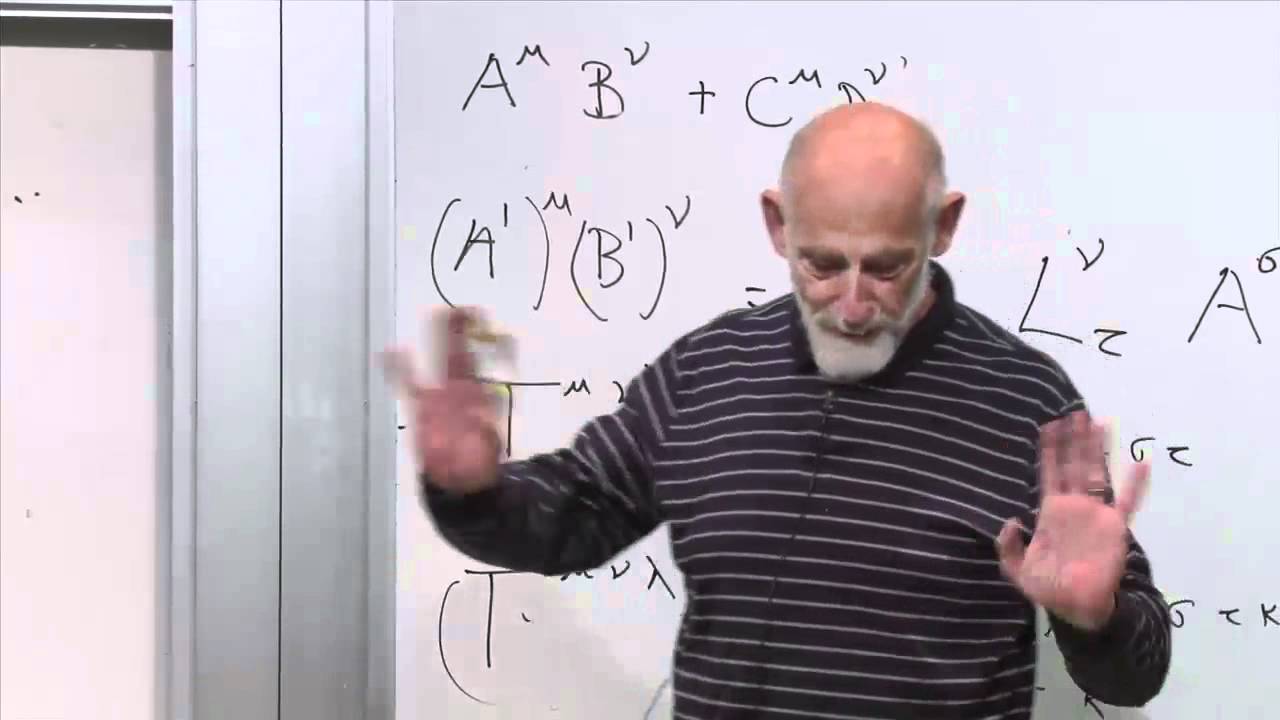
do you make we talked about this a little last time but I want to come back to it how you make scalers out Of how you make scalers out of vectors how you make vectors out of scalers and how you condense notation so that things are neat I'm sure that most of you know this but we're going to do it anyway all right X mu of course stands for the four coordinates of space time space time and it's TX Y and Z usually this is called one two and three and this one is called not
but That's not important mu runs over four values right notice now I'm going to pay attention now to where I put this index I've put the index up on top above that's going to mean something to us shortly at the moment it doesn't mean anything but this quantity if thought of as a displacement from the origin is a four Vector a four Vector is a statement about the way it transforms how it transforms under Lorent transformation anything that Transforms the same way under lorence transformation as x and t is called a four Vector I won't
write it down for the moment it's a four Vector has four components saying that three of the components are equal to zero for example that might be true that would uh that would mean that it was a uh displacement that uh only involved three of the coordinates and not the fourth coordinate but it's not an invariance Statement an observer one you may say uh that there was a displacement of an object which was purely Tim likee in other words it didn't move in space I will say it did move in space so the statement that
a four Vector has three components equal to zero may be true in some frame of reference but it's not an invariant statement that everybody will agree upon but the statement that all four components are zero that everybody will agree on because all it says is That that Vector is the zero Vector no displac at all and we'll all agree that a zero Vector is a zero Vector in fact zero transforms to itself under a loren transformation if all four coordinates are zero before transformation there zero after transformation so um that's the notion of a four
Vector there are many four vectors differences of four vectors are four vectors so differential displacements of four Vectors and so forth out of four Vector we can make a scaler a scaler meaning a thing which doesn't transform which is the same in every frame now I know we've done this before and I'm I'm I'm going over old material but nevertheless let's do it uh out of a displacement we can construct a proper time D squar and you know what that is that's the t^2 - D x^2 - d y^ 2us d z^ 2 and that
has the property that it is the same in every Reference frame it doesn't have components it only has one component one value and it's a scalar so let's call it a scalar this is a four Vector scalar now if a scalar is equal to zero in one frame of reference it's zero in every frame of reference why because a scalar is the same as a thing which is the same in every frame of reference so if in some frame of reference a scal whatever the it's practically the Definition of a scaler the thing which is
the same in every frame of reference if it's zero in one frame it's zero in any frame so it's an invariant statement to say that a scalar uh is equal to zero and here we have an example of how you make a scalar out of a four Vector that's very general if you have a four Vector of any kind let's call it a mu to say that it's a four Vector means it transform forms the same way under Loren Transformations then the difference of the square of the time components and the space components are a
scalar I won't bother writing it the difference a time squar minus a space squar are a scalar is a Scala and it's the same in every reference frame we want a nice way to write that I don't want to have to write a Time s - a x s - a y s - A z^ 2 okay for that we invent a matrix The Matrix Has a name it's called the metric in special relativity it's usually denoted Ada Ada is a Greek letter uh it's the Greek letter a e t a and it looks like
that ADA is a matrix Ada is a Greek letter it stands for a matrix and the Matrix has two indices mu and new but it's a very simple matrix it's practically the identity Matrix but not quite it has three elements which are equal to one on the Diagonal just like the unit Matrix but the fourth element is minus one the fourth element corresponds to time - 1 0 0 0 0 + 1 0 0 0 0 1 0 0 0 0 1 if I were to make this plus one it would just be the good
old unit Matrix but it's not okay now let's take this Matrix we're going to represent four vectors by column the column Vector for example a mu will Consist of four entries a Time component and the three space components X Y and Z and let's take the Matrix and multiply it by the vector we can either do it by matrix multiplication or we can say Let's uh let's call this a new let's use new here new run also from 1 to four right let's multiply the matrix by the vector we can represent that ADA mu new
a New summed over new that's one way to write it that's just this one you know it's just matrix multiplication but it can be represented by summing 8011 * A1 8012 A2 and so forth and this represents a new object which we'll call a with a lower index here let's see what it is let's see if we can figure out what it is what this a with a lower Index is it's not the original a if this really were the unit Matrix and you multiply a vector you would get back exactly the same thing but
not quite the minus one here means that when you multiply Ada by a what happens it changes the sign of the first term here leaves everything else the same and so we can write down immediately without any further work that A mu you or new it doesn't matter represents the column the Vector let's call it the vector minus a t ax a y a z in other words when I perform this operation I simply change the sign of the time component all right so that's one piece of um it's notation this is purely a notational
device there's no real content in it the second notational Device which no doubt you're also somewhat familiar with is the Einstein summation convention the Einstein summation convention says whenever you see a downstairs index and an upstairs index the same in this case new it's automatically the rule that you sum over it you don't need to write summation every time so whenever you see a repeated index as long as one of them is upstairs and one of them is downstairs don't bother writing the Summation sign it's implicit implicit in the conventions and in the notation all
right so this operation here just has the effect of changing the sign of the time [Music] component now I should warn you depending on who's writing the equations this can sometimes be + one -1 -1 - one or Min -1 +1 +1 + one there are different conventions I happen to like this one almost everybody else I know Likes the other one unless they're relativists relativists who study general relativity like the convention I use uh so it's one of these conventions that never quite set down and um you know it's it's it's it's it's like
Republicans and Democrats or Jews and uh Muslims they hate each other like all hell and there are those who use one convention and those who use the Other convention and uh when I'm with one group of people I use one when I'm with the other group of people I use the other and so far I haven't been killed about over it okay we'll use this one now question yeah you don't do you need the summation that normal matrix multiplication just gives you a mu lower mu if you multip Matrix multiplic multiplication really means multiply this
by this plus this by this plus this by this plus this by this now in this case it's just trivial but more generally if Ada was not the unit Matrix if it was something else if there was some other Matrix say some general Matrix it would be this times this plus this times this plus this times this plus this times that so yeah there would be a summation but Einstein simply got fed up Writing summation symbols he just realized every in every equation he was ever writing down whenever there was an index one upstairs and
one downstairs he was always summing over it he cleverly said I will invent the Einstein summation convention and that's it all right good incidentally an index like new here doesn't actually have a value it's a dummy index it's a thing you sum over this expression depends on mu but it Doesn't depend on new new is a summation index a summation index is something that the expression doesn't depend on it's just Su over me new over over new all right now let's go one step further and look at the quantity a mu a mu incidentally these
things have names the vector with the upper index here is called a contravariant index or the upper index is called a contravariant index And uh the thing with the lower lower index is called a covariant vector index upper it's contravariant lower it's covariant uh but I don't use that terminology because I always forget which is which I just call them upper and lower okay it's easier to remember all right so a with an upper index and a with a lower index and you go between them with this Matrix Ada you can also go back by
but I'll leave that to you to figure out how to Do that in fact you do it the same way okay now let's take am mu am mu this is summed over why is it summed over because by the Einstein convention a repeated index one upper and one lower is summed over so let's see what this means uh this is equal to a a t plus ax ax Plus the same thing for Y and Z I'll write the Y component but I won't bother writing the Z Component now the space components of the covariant and
contravariant vectors are the same so this is just ax SAR this is just ax SAR and it doesn't matter whether you put it upstairs or downstairs likewise this one is a y^2 no no not yet why doesn't it have a minus sign because when you plug in the fact that The lower index here gives you minus a this becomes minus a squared in other words this notation here says sum literally sum no minus signs in here but the minus sign comes in for the simple reason that when you lower the index it's called lowering the
index the operation of lowering the index changes the sign of the time component so a upper time a lower is Minus a^ 2 so you don't have to fact you you mustn't put any extra minus signs in here all you have to do is remember what the meaning of a upper and a lower are well this is exactly the quantity that we think is a scalar it's the difference of the square of the time component and the space components in other words it's this quantity here except with an overall Minus sign it starts out with
a minus sign here and a plus sign here but whatever it is it's clearly a scaler it's clearly a scaler and so we see an example of building scalers out of vectors and how do we do it we do it by soaking up all the index it's called Contracting the indices Contracting the indices meaning means when you see two indices which are the same an upper and a lower you sum over them this quantity With an upper and lower index summed is a scalar so so why don't we write as sub mu as a r
Matrix say it again so why don't we write a sub mu as a row Matrix to be consistent oh we could I think we could but uh yeah uh we probably want it doesn't you're right I think if we wanted to be purist we might but uh uh I think we would but this is what it is this is what its components are this is what its components Are okay and this thing is a scaler what's that mat that's true yeah yeah yeah you're right right okay right right okay I'm not gonna we know what
we did we know exactly what we yeah we could also write this in another way we could write this since a lower mu well let's let's uh let's change the summation index here let's call it a new I haven't changed the expression I've just changed the dummy index there but now let's look oh no I didn't oh I didn't want to change it I wanted to leave it me mu but now what I want to do is use for a mu it is Ada mu new a new a mu is equal to Ada mu new
a new so here's another way to write it you sum over mu and new with the Matrix Ada it's the same thing all it stands for is a time squ minus a space squar that's all it stands for but it's a neat way to write it where we don't have to keep rewriting x² y sare z square and so forth so that's the first notational device so is it true that when you use the Greek letters for subscript and superscript it always refers to the whole whenever you use the Greek index mu and new it
refers to all four uh Components if you want to refer just to the three components you usually use Latin indices sometimes I and J sometimes M and N depending on who's writing yeah right okay so this is a scaler now what about let's uh let's consider something else let's take two four vectors take two four vectors A and B A mu B mu that looks like it might be a Scaler it's got no indices the only indices are summed over question is it a scaler yes it is a scaler but let's prove it oh well
we need one thing to prove it to prove that it's a scaler all we really need uh is the statement that the sum of two scalers and the difference of two scalers is also a scalar if you have two things you and I agree upon what they are because we're in different frames but we agree we can Add them and subtract them and we'll still agree about the values of the sum and difference so sums and differences of scalers are scalers let's prove that this is a scalar that's easy all you do is you write
a plus b b mu time A + B mu oh sorry mu now this is a scal A plus b is a four vector and if you take any four vector and contract it with itself it's a Scalar so this is a scalar now subtract from this uh take a look what we have we have an AM mu we have the A's the a a terms and the BB terms are the same in both sides all that's different is the ab so we'll be left over when we do this with an AM mu B mu
oh incidentally here's something to prove this is the same thing as a mu B mu it doesn't matter you Can put the UPS downs and the Downs up you get the same thing the difference between these two things is just four * a mu B mu so here's a scaler here's another scaler the difference between them is basically just a * B a mu B mu so if I take any two four vectors and contract them in this way I get another scaler so it's a slight generalization of just saying that uh that a a
is a scaler take any four Vector with any other four Vector it's also a scal it's also a scaler is there any analogy one can go to like the do product of vectors what that the dot product of normal vectors and the cross yeah the dot products the dot products except with a funny minus sign it's the Lorent or the manowski version of the dot product right and the Ada facilitates the uh the change of sign that's all it's going on okay Now let's set take a scaler a scalar field let's take a scalar field
5 ofx x now stands for x T if I write a thing like this and I don't say otherwise it really means it's a function of all four coordinates and let's consider the difference of fi at two neighboring points if you if I is a scalar and we consider its difference at two neighboring points and we agree on the values of Five at each of those points we will agree on the difference between them and so the oh I need a theorem I need a theorem it's a theorem which I won't prove I will tell
you the statement it's something you can easily prove by yourself here's the theorem supposing you have let see how to say this yeah supposing you have a known for Vector to say it's a four Vector means that it transforms in a certain way it's not Just a statement that there are four components it means when you transform it under Lorent Transformations it transforms in a certain way supposing you have a four Vector number one and number two another quantity B mu such that then when you multiply a mu * B mu and Su over mu
you get something which is a scalar in other words you get something which doesn't depend on the frame of reference you know this is a Four vector and you don't know about this then it's possible to prove that if you know that this product is independent of reference frame that b is also a four Vector that it also transforms as a four Vector we'll use that in a moment it's sort of obvious if a is a four vector and a * B is a scalar then B is a four Vector not too hard to prove
okay now let's take the difference of fi at two neighboring points if we agree about the values of F we will agree about the values of the difference and so we will say the difference is something which we will agree about we'll call it for the moment a Scala all right what is the difference between F at two neighboring points infinitesimally separated the answer is you differentiate fi with respect to each of the coordinates multiply it this means derivative of f with respect To T * DT plus derivative of f with respect to x *
DX plus derivative of f with respect to Y and so forth this is the small change in fi in going from one point to another Well f is a scalar and so we will agree about the value of the difference of f DX itself is clearly a four Vector it was the the basic four Vector that we started with uh small differences small displacements this is a four vector and The whole thing is a scalar what does it tell you about this it tells you it's a four Vector the derivative of fi with respect to
coordinate it's a complex of four quantities it stands for derivative of f with respect to T derivative of I with respect to X and so forth so the upper u in the denominator is like a lower U yeah is that the notation yes that's what we're find that That's that's what I was going to say right right in order for this to make sense as a product as a uh as a product of this type this had better the the Dy by DX had better correspond to a covariant vector if the derivative corresponds to a
contravariant one so what we find out is that derivatives of fi with respect to X the complex of them the set of them form a Four Vector but they form the covariant components of a four Vector the covariant components like am mu all right so now we know something else we know that derivatives of a scalar with respect to X mu are a covariant vector and it's sometimes just written as d sub muf the index being a lower index here to indicate that it's a covariant thing good well now we can use a notational Device
to invent the mui what is the mui with the upper index here it's actually just exactly the same things here except the time component having the opposite sign okay so let's uh let's write out the the meaning of these symbols D mui stands for the complex of things D tii or D by DT and D by DX Y and Z what about this new symbol D mui with the index upstairs it's the same set of things except minus d by DT and D5 by DX all right so it's a bunch of notation but all it's
keeping track of is squares of time components minus squares of space components or squares of space components minus squares of time Components that's all it's doing uh but it's neat finally we can construct a new Scala I was a scalar the derivatives of five form a four Vector but now we can form a new scalar the new scalar is composed out of these two four or out of the four Vector what is it we just take the mu fun D muf and sum over mu what does it stand For it stands for something we wrote
down earlier DF by DT ^ 2 minus plus d by dx^ 2 sorry d by dx^ 2 plus the same thing for y and z in other words it's the thing we wrote down with a minus sign there's an extra minus sign here it's the thing that we wrote down for the lran for the Scala field okay what is this telling us it's Telling us that the Scala field L grangian is a scaler the LR in itself not the scal of field the scal of field was a Scala because we said it was a Scala
means it didn't transform when you lorence transformed it but this little exercise here in uh in um notation tells us that this quantity here is also a scalar why is that good why is it good that the lran is a Scaler and the reason l orian no no this is not the lassan this is the lran the Lan is composed out of second derivatives these are squares of first derivatives Lan okay in this language the Lan for the Scala field is equal to - 12 d muf d muf and it is just time derivative squared2
time derivative squar minus space derivatives of squar we could add things to the slan I Won't do it now but we could add other things to the slan but the rule is the Lan should be a scaler what's the value of saying the lran is a scaler it says the action is the same in every reference frame if you have a scaler quantity which doesn't depend on frame of reference and you integrated over all SpaceTime then the result doesn't depend on which frame of reference it's been evaluated in so if your principle of Physics is
the principle of least action and the action doesn't depend on which frame it's written in then the same action principle will give you equations of motion in each frame which have the same form in every reference frame in other words it'll give you equations which are invariant under Lorent Transformations so much of um studying field theory is really the construction of invariant lonians construction of Various kinds of fields scalers uh vectors other kinds of fields which we haven't discussed yet tensors Spinners constructing out of these objects lrin which are scalers why because you want to
build equations which are the same in every reference frame you want your equations to be Loren and variant that's the um and we'll use that we're going to use that over and over and over again in What follows the tricks of uh index manipulation but then when we actually come to write down real equations that we have to solve we of course have to know what this means we have to know that it means a time squ minus a space squ okay that's uh that's notation for you yeah when we were doing the in phys
physics report we didn't required to be invariant on different motions why it we Didn't talk much about it um right we didn't now uh we didn't talk about relativity very much but there is a non-relativistic version of Relativity yes there is uh the special theory of relativity entails two things it entails the rule that the laws of physics are the same in every reference frame and second that it's a law of physics that light moves with a certain velocity okay combine Them together light moves with same velocity in every frame uh if you leave out
the statement about light then ordinary Newtonian or Galilean physics uh FAL ma type physics does have a relativity associated with it it's not the relativity of Lorent Transformations it's the relativity of the limit of Lorent Transformations when the speed of light goes to Infinity let's talk about that for a minute we Didn't talk about it let's write down Lorent Transformations and take the limit X Prime is equal to xus VT ided sare < TK of 1 - V ^2 over c^2 T Prime is equal to to t - XV over s < TK of 1
- v^2 over c^2 but I'm not quite right I think I have to divide this by c^2 to get the units right this is the and of course we have two others y Prime is equal to Y and Z Prime is equal to Z all right we didn't we didn't speak much about this but we could take the limit of these transformation rules as the speed of light gets very very big what happens to them well the square root in the denominator here just becomes one so it's just X Prime is equal to xus VT
well that's familiar that's just the uh change of a coordinate in before anybody ever heard of the special theory of relativity this is what they would Have written down what about this one over here here again taking C to Infinity this becomes one but now we have x * V / c^ 2 when C goes to Infinity this goes to zero it's just T Prime equals T so yes there is a an invariance of non-relativistic Newtonian mechanics it's called Galilean invariance and requires the equations to be invariant under these Replacements this replacement is Trivial It
just says that all observers all frames of reference share the same time simultaneity is the same for everybody so that's easy and this is just the usual change of reference frame from one inertial frame to another so when people say that the equations of physics are the same same in every inertial reference frame it's a statement of Relativity it is a statement of Relativity and in fact when we write Down fals ma uh typically those equations are invariant under this we didn't discuss it but they are other questions the transformation Pro properties for covariant and
a contravariant the difference is just a change in V sign of v no no no no not quite let's do it okay Almost almost well let's work it out a prime t is equal to a t - v a x s 1 - v^ 2 and so forth and a prime X is of course a x minus v a t usual thing okay now we just write that um a prime T is the same as minus a Here a here is the same as minus a here a with an upper index T here is the
same as a with a lower index T here what about a superscript x that's the same as a lower superscript X only the time components change and so these just go downstairs okay so let's see so I think you're right I think that it justes just it seems to just change the sign yeah Yeah um I'm a little confused about when a SK what I think of as a scalar valued function in some coordinate system when that would not be a scale in other words Define any function there it might have no physical meaning whatsoever
and you just say well when you look at it in its other coordinate system that that function at this point transform transform anything no Energy density energy density energy density energy density of a um of a gas the energy of a g density of a gas in a frame of reference in which the gas is in a box and the box is at rest there's a certain energy density if you're at rest and you look at the energy density there's a certain energy density if you're moving fast relative to that box the energy density in
that box is a lot larger So energy density is something which we won't agree on so I guess what I would say then is that um what you mean is that a scalar function is some physical quantity that in every reference frame describe as something and that transforms according to okay right right when I say we agree about its value I mean if we measure it we agree about its value right yeah I don't just mean we agree because we're nice to each other I mean we agree Because we made the measurement and we compare
the measurements right um so energy density is a good example uh there are lots of them uh the uh components of the four velocity of a uh of a system time component of a four veloc vity is not the same in different reference frames other Questions okay if not we'll uh we'll um move on this this this is all very easy stuff it's very easy it's just notation but uh until you learn it it's a little bit unfamiliar let's talk about waves let's look at the wave equation let's look at the wave equation and solve
it let's solve the wave equation let's imagine we have some wave Field and it's satisfy oh let's let's even begin by writing down a lran let's write down a lran we've already written down a lran but I want to write a slight extension of it here it is the five by DT squared minus d by D now I'm going to write it out in detail because uh also Y and Z I'm not going to write Down the Y then they come in with the same sign as this we always put a 1/2 there in front
of the whole thing okay I'm going to add one more term the one more term is also a scalar it does not involve derivatives it's a function of fi and the simplest function of fi that I can think of well we could just add fi that would be a simple function of F but it's make a slightly more complicated one f^ squar okay so including the 1/2 we're going to Write with minus a parameter which I'm going to call MU ^ 2 5^ 2/ 2 oh no it's already got a two in it now this
is the field Theory analog of the harmonic oscillator that's all this is It's the field Theory analog of the harmonic oscillator if we were talking about a harmonic oscillator and we called the coordinate of the Oscillator fi we call the coordinate of the oscillator fi we would write down 5 do^ 2 over 2 for the kinetic energy and then for the potential energy minus a spring constant which I'm calling mu ^ 2us mu ^ 2 5^ 2 / 2 this would be the good old harmonic oscillator and the only difference is it now has some
space derivatives in the in the lran let's take this lran work out the equations and then Solve IT find its Solutions well it's first of all derivative of L with respect to time derivative that's just d by DT and we differentiate it with respect to time we get second derivative of Pi with respect to t^2 this of course is the analog of the acceleration term uh the acceleration and FAL ma but then we get minus DC 5 by D D x^2 minus same thing with Y minus same thing with z and that has to be
equal to DL by DF so that's equal to minus mu^ 2 F when you differentiate mu^ 2 5^ 2 with a factor of two you just get mu ^2 5 or if we want to put everything on the left side let's put everything on the left side plus mu ^2 = zero this is a nice simple equation it has a name anybody know what the name of this equation is No the uh uh kle Gordon equation yeah this is the Klein Gordon equation Klein Gordon Klein and Gordon I don't know if they were uh connected
with each other or not but uh I have a feeling Klein was a German and Gordon was probably a Brit so they probably were not collaborating but in any case in some combination or another they wrote down this equation uh this was their an attempt Before Schrodinger to write down the equation for a uh quantum mechanical particle um they made the mistake of trying to be relativistic had they not tried to be relativistic they would have written down the Schrodinger equation and been very very famous they wrote down the relativistic version of it and became
much less famous famous among physicists but not famous outside of the physics world only One person here knew that it was the Klein Gordon equation uh the shinger equation is somewhat similar but it only has a first derivative with respect to time and it has some I in it but this is called the Klein Gordon equation and its connection with quantum mechanics is not important right now we want to do a solve it there are lots of solutions to it Zillions of solutions but they're all built up out of plain waves the solution to this
kind of equations are sums of plain waves so let's write down a plane wave in exponential form it's useful when thinking about oscillating systems to pretend that the coordinate is complex and at the end just take the real part of it we do that for the harmonic oscillator we do it for all sorts of oscillating systems look for Solutions which we allow to be Complex complex functions and later take the real parts I'll give you an example as we go along all right what kind of solutions are we going to look for we're going to
look for Solutions which first of all oscillate I can't remember if I want plus or minus here minus for positive energy solutions e to the minus I Omega T that's an oscillation with time with frequency Omega and now we're going to look for Solutions which oscillate in space which means they're e to the I KX of some type e to the I and we can write here KX * X Plus KY * y plus k z * Z well these are three numbers KX and KY and KZ are just three numbers they're called the wave
numbers or the wave Vector uh KX KY and KZ and this is um this is the form of the uh of a solution that we'll look for we'll see maybe there is no solution like this we'll check all right uh first Of all we can rewrite this in a kind of neat way we could rewrite it as e to the i k mu X mu where does that come from from well if I take if I think of K as a four Vector with components minus Omega I want minus Omega I think so and KX
KY and KZ if we think of the four components of a complex of things involving Omega KX KY and KZ and I group Them together in this form here call them think of them for the moment uh they may not really be they are actually a four Vector but think of them as defining a four Vector then what's up in the exponent here is just K mu X mu time component Omega time t x component of K * X so it's a nice little notation but we won't I'm not going to use it now I'm
just going to just going to use it in this form here let's see what happens if We try to solve this equation what is the second derivative of f with respect to T ^2 well what happens when you differentiate an e to the I Omega t with respect to time twice that'll multiply what you have here by minus Omega squared so let's call this the this is this is our guess at five y all right what happens if we differentiate it twice with respect to T We get minus Omega 2 * 5 what happens if
we differentiate with respect to X we get kx^ S with respect to Y twice ky^ 2 so Al together we'll get minus Omega 2 plus kx2 plus k y^ 2 plus kz^ 2 but we're not finished we still have plus m^2 here so there's plus M squared f equals 0 well it's very easy now to find the Solution you simply say Omega must equal the Square t of kx2 + ky^ 2 plus kz^ 2+ m^2 in other words you just set what's in the bracket here equal to zero and you have a solution this is
just telling you what the frequency is in terms of the wave number frequency square otk of kx2 + k y^2 + kz^ 2 plus m^2 okay that's the solution of the Kang Gordon equation there are two possible solutions a square root like this can be plus or minus it'll solve the equation whether you put plus Omega or minus Omega here and of course for every KX KY and KZ there are two solutions with plus Omega and minus Omega or the plus or minus roots of the square root uh those are the solutions of the Klein
Gordon equation And um we're going to come back to it many many times this is the Quantum mechan or this is the classical field version of an equation which describes a quantum mechanical particle with mass m energy Omega and momentum K this is e = sare < TK of P ^2 + m^2 some uh plunks constants in there that I didn't tell you about but they're there all right so um these these equations aren't hard They're simple they're linear equations you add Solutions and at the end of the day after you've constructed Your solution in
this way you can take the real part of it and the real part of it if the field is supposed to be real then uh if it's supposed to be real number you just take the real part of it okay any questions we're getting uh you know we're moving along now and we're talking about uh real stuff yeah where did the C Gordon equation come from I mean what did you did you do something to the Lin to there's Lin I made up this lren if you look for okay good this is pretty much the
unique lran which would lead to linear equations a linear equation uh we'll come back to why we're looking for linear equations but uh but for the moment this is just an Example at the moment it's it's an example uh The Next Step going from gr into the Gordon equation you took the next derivative of each term with respect to the variable derivative of lran with respect to DDT that's just D DT and then you differentiate that with respect to time right yeah same thing add respect to yeah the remember remember what the Rules are okay
okay let's write down the oil lrange equation for a field d by D X mu all we now write them in a neat form d by DX mu of partial of L with respect to DF by DX mu and that means sum over mu equals or Min uh minus partial of L with respect to fi is equal to Zero d by DX mu this is a con a covariant index a downstairs index in the denominator here you have a D5 by DX mu that makes this an upstairs index and uh but this this is of
the form of a lower index times an upper index uh and you can see that this equation has some nice uh relativistic structure upper indices and lower Indices contracted and uh everything is a Scala yeah um what in nature obeys the K Gordon equation scal of particles the higb on the higs ball on let's go back uh let's go back to something else let's go back to uh uh the uh action for a particle we wrote I made this up of Course I made this up but I I was using some rules the rules are
that it should be relativistically invariant and fairly simple so we generalized this thing time the square < TK of 1 - V ^2 we generalized then put in Min - M + 5 that was just that's a guess I mean that's something you can write down can you think of anything else yeah you can think of lots of other things but this is one thing you could write Down now notice that this has an interesting property if for some reason or another fi was not equal to zero for some reason or another you had a
region of space in which F was not equal to zero but was equal to some fixed value for some reason for whatever reason then effectively this particle will move with a mass m+ 5 for all practical purposes if Y is a constant it just shifts the mass of the Particle well it's even possible that you might have a massless particle with no term at all and the entire mass is due to uh is due to some field not being equal to zero in some region of space for some reason there's an environment in which five
is not equal to zero it can not only shift the mass it can create a Mass for a particle that didn't even have one to begin with that's the nature of the Higs boson it creates mass that in this sense in roughly this sense um and because it creates masses for particles such as quarks and other particles because it creates masses the presence of those particles will where are we will react back on the field and create field particles create field field affects particles higsbo on is a particular case when you said you take the
real Part of the solution does that mean the imaginary part ends up to zero is throw no no it just means you it just means you write it as sum of a real part and imaginary part let's write it let's take a solution all right so where was our solution I lost it well it was of the form e to the I Omega T minus K do K mu K k.x let's call it minus k.x uh the I multiplies Everything [Music] um okay so this is equal the cosine of Omega t - KX plus I
sin Omega t - KX both the real and imaginary Parts if something is equal to zero you know we went through an exercise said all of this equal to zero if all of this is equal to zero it means both its real and imaginary part are equal to zero so both the real and Imaginary part are solutions of the equations a construction like this gives you two solutions two real solutions cosine Omega T and S cosine and S you can add them together you can add them together with real coefficients too and there're still Solutions
but uh you know exponentials are a neat trick for facilitating taking derivatives that's the reason we used exponentials not because the field is imaginary or complex but because it just Helps us do the algebra of taking derivatives uh but once we have a solution like this the real and imaginary parts are both separately Solutions they're both plain waves they're waves and and what are they they're 90° out of phase if this is a wave that moves down the axis like this such that at time T equals z the uh uh the wave is Peak is
Loc ated here that's the cosine then the S is just Another wave that's displaced like that you can add them together you can subtract them and they're still Solutions okay any other questions yes C can you explain the superconductor case what what [Music] where did that come from uh from the uh the giv particles Mass particles acquire Mass uh when a uh field appears well I mean yeah can I can I explain yeah I can explain superconductor but uh not yet we haven't done any electricity any magnetism um the superconducting case is a situation where
the electromagnetic field gets a mass and it gets a mass from a similar thing like this but not at this point no I don't think you want me to uh no no no yeah it's certainly a connected Phenomenon but we haven't gotten into F it's what the the answer is that it is an effect where a scalar field where the presence of a Scala sorry well the presence of a scalar field affects the photon and gives it a mass but uh not not yet yeah yeah so what you said about the about the Hig bone
has these have been mathematical conclusions is there any way that it's possible to visualize how a HG B on Creates Mass there it is here it is here it is here it is I mean a physical a physical way do we think of a particle flying through through space somewhere and spitting out masses as it goes along or what no no it's just this is what F does to it it shifts its mass that's it there's no other there is nothing else that's it so different mass is different c yeah that's right I didn't put
the G here did I so right so different coupling constants could lead to different masses right and in fact they do the strength the strength the strength with which a particle couples to the higs field will determine its mass when you compute it momentum Pi is the master yeah that's right but in every respect it functions as a m Ter uh no and if the higs field were zero all particles would be massless not all particles no no no um quirks would be z bosons w bosons would be massless uh the higs boson wouldn't be
and uh protons and neutrons wouldn't be massless protons and neutrons do not get their Mass from uh from the higs phenomenon and uh electrons neutrinos would be massless Electrons and neutrinos would be massless um protons and neutrons not quirks in some sense yes but the but protons and neutrons not if the higs field went away one day electrons would become massless that would be a disaster for atoms because uh the size of an atom is governed by the inverse of the mass of the electron and if the mass of the electron were to go to
zero the atom would become infinitely big and that would not be Good for you uh but protons and neutrons would be virtually unaffected very very weakly affected not very much um right yeah well I mean it is it is true that a world without a higs bosan would be a bad world for your survival the uh many many things would go wrong and um as I said not the least of which would be the Electron would become massless and when it did so uh atoms would just uh have no no Co no um the electron
would become completely unlocalized okay for more please visit us at stanford.edu