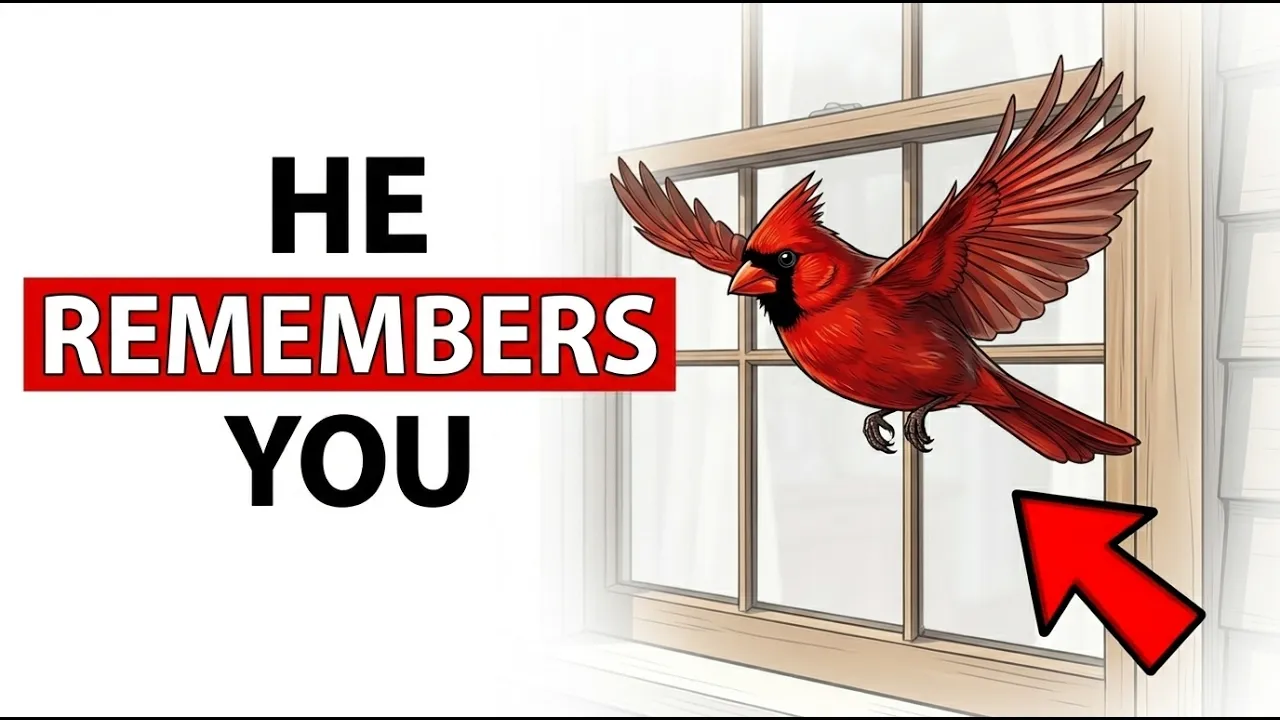
There is a bird in your yard right now that knows exactly who you are. Not in the vague instinctive way that animals sense a presence, not just the outline of a human near their food. It knows your face.
It has been watching you, specifically you, every single time you've walked outside. It has filed away details about you that most people would never believe a bird could process. And depending on what it has concluded about you, it may be doing something about it right now.
Welcome back to Backyard Birdmind. If you're new here, make sure you subscribe because what you're about to learn will change the way you look at every bird that visits your yard. Today we're going to talk about something that most people find genuinely difficult to believe the first time they hear it.
Birds are watching you. Not randomly, not passively, but with real recognition, real memory, and real intention. We're going to walk through eight signs that the birds in your yard have been studying you, what they've decided, and what that means for the relationship quietly forming between you and the wildlife just outside your door.
And we're going to end with something that I think a lot of you will find deeply moving because it touches not just on what birds can remember, but on what they may be trying to say. Stay with me from beginning to end because sign number six is something researchers didn't think was possible until very recently. And the final sign, number eight, is the one that changes everything.
Sign number one, the birds arrive before you've done anything. You know the feeling. You haven't refilled the feeder yet.
You haven't opened the back door. You haven't made a sound, and yet you glance out the window and there they are. A pair of chickadees waiting on the branch closest to where you always stand.
A cardinal perched at the edge of the yard facing the house. People tend to assume this is coincidence. It is not.
Research coming out of the University of Cambridge and supported by studies at Cornell's Lab of Ornithology has shown that many common backyard birds, particularly corvids like jays and crows, but also smaller species like chickadees, develop what scientists call anticipatory behavior toward specific humans. That means they learn your schedule. They track the pattern of when you appear, what you do when you come out, and how that correlates with food, safety, or threat.
In one long-term field study, crows near a suburban feeding site were found to anticipate a particular caretaker's arrival up to 12 minutes before she appeared, adjusting their position in the yard and calling to one another in a pattern researchers came to recognize as distinct from their other vocalizations. This wasn't happening with any other person who occasionally passed through the area. It was specific to her.
What this means for you, if birds are already oriented toward your yard when you step outside, if they seem to be expecting you, that is not accident. That is memory. That is recognition.
They have placed you inside their daily model of how the world works, and your arrival has meaning to them. The warmth of that, if you let it land, is remarkable. Sign number two, they respond differently to you than to strangers.
Let's say someone else comes into your yard. A neighbor, a delivery person, a grandchild visiting for the first time. Watch what happens to the birds.
In almost every case, they will pull back. They'll go quiet. The feeder will empty out, and then they'll wait, sometimes for several minutes after the stranger has left before returning.
When you go out, if you've been consistent and calm in your yard, the birds often stay. Some will keep eating. Some will move to a slightly farther branch, but won't flush.
The response is categorically different. This is not about smell or sound, though both may play a role. This is primarily visual, and the science behind it is more rigorous than most people realize.
A landmark study published in the Proceedings of the National Academy of Sciences used researchers wearing masks to test whether American crows could distinguish between a face they'd learn to associate with threat versus a neutral face. Not only could they identify the dangerous face consistently, even when the people wearing it changed their clothing, their gait, their hats, but crows who had never personally been exposed to the threatening researcher began avoiding it, too. They had learned from other crows.
The memory of a specific human face had spread through a local crow population. For your backyard birds, you are a face in their database. The question is only what category you've been filed under.
And the fact that they stay near you when others cause them to flee tells you everything you need to know about what they've decided. Sign number three, they make eye contact. This one is subtle.
It's easy to miss, but once you start noticing it, you won't be able to stop. Watch a bird at your feeder sometime when you're standing still nearby. A chickadee, a nuthatch, a house finch.
At some point, it will stop what it's doing, turn its head, and look directly at you. Not a sweeping scan of the yard, a direct deliberate focus on your face. It may hold that for two or three seconds before going back to the seed.
In birds with eyes on the sides of their heads, looking at something directly requires turning the head to bring one eye forward. That is an intentional act. It takes a moment of conscious attention in an animal that has predators and can never fully afford to stop scanning.
When a bird chooses to give you that attention, and especially when it does it repeatedly, it is registering you specifically. Ornithologists have noted that birds who are highly familiar with a person often engage in what's called investigative orientation, positioning themselves to get a clear monocular view of that individual, particularly when the person is doing something new or different. If you are wearing a new color, carrying something unfamiliar, or moving differently than usual, watch for this.
They notice. There's something about being truly seen, even by a creature the size of your fist, that touches something deep. If a bird at your feeder looks directly into your face, it is not random.
It is checking on you. Sign number four, they track you as you move around the yard. This one takes a little patience to observe, but it is unmistakable once you do.
Go outside and walk a path through your yard. Go from the back door to the garden bed, then over to the feeder, then to the far corner. If the birds in your yard know you, really know you, many of them will reorient as you move.
A cardinal that was facing east will turn to face you. A jay will shift its position on the branch to keep you in view without flying away. What you're witnessing is called subject tracking, and it's part of how birds monitor the individuals in their environment that matter to them.
Predators are always tracked, obviously. But birds also track individuals they've classified as safe because the behavior of a safe individual is still important information. If you suddenly start acting strange, moving erratically, reaching toward the feeder in an unexpected way, the bird wants to know immediately.
The fascinating implication is this. You are on a mental watch list. Not a dangerous one, a meaningful one.
You are a known quantity in the bird's model of its world, and that model updates every time you appear. In crows, this tracking behavior has been documented with remarkable precision. Individual crows have been observed maintaining awareness of up to three or four specific humans simultaneously within a complex urban environment, tracking their positions, their movements, and updating their predictions about what those humans were likely to do next.
That level of social monitoring applied to humans requires genuine cognitive sophistication. But what comes next is something even most bird enthusiasts don't know. Sign number five, they've told other birds about you.
Stay with me here because this one is going to feel remarkable. If a single bird in your yard has learned to recognize you and has classified you as safe or as generous with food, there is strong evidence to suggest that information has been shared with other birds, including birds who have never personally interacted with you. This was first rigorously documented in crows, where researchers observed something they began calling social learning of human identity.
Young crows, juveniles who had never encountered a specific person, began displaying the same avoidance behavior toward that person as adults who had because they had watched the adults' reactions. The identification had been culturally transmitted. But the sharing happens in other ways, too.
The alarm calls of small songbirds are deeply specific. Chickadees, for that example, produce calls that embed information about the type of predator, its size, and its behavioral urgency in the structure of the call itself. Other species, nuthatches, titmice, vireos, eavesdrop on those calls and adjust their behavior accordingly.
If a chickadee sees you approach and doesn't call at all, or calls in a way that signals calm, every other bird nearby receives that information. Your reputation in your yard is not held by one bird. It is distributed across a network of animals who communicate with each other constantly.
The quiet way the birds continue eating when you come outside is not just individual comfort. It is a collective endorsement. They have vouched for you.
Sign number six, they've started bringing you things. This is the one that researchers did not expect to find. Most people know that crows and jays are capable of extraordinary problem solving.
They use tools. They plan for the future. They hide food and remember thousands of individual cash sites across multiple seasons.
But what began emerging from long-term observations of wild crows in suburban areas was something no one had formally predicted. Some individual crows began leaving objects at or near feeding stations associated with specific people. The objects varied.
Small stones, bits of shiny material, a piece of bark, a button. In one documented case, widely cited in discussions of corvid social behavior, a crow that had been regularly fed by a family began leaving objects, small trinkets in effect, at the precise location where the woman of the household typically filled the feeder. Not [snorts] randomly scattered, placed.
Whether this is a form of gift-giving in the human sense of the word, an exchange, an offering, is something researchers are still working through. What is not in question is that it is intentional, it is specific to a person, and it is reciprocal in nature. The bird appears to be responding to receiving something with a gesture of returning something.
If you have ever found an oddly placed object near your feeder, a pebble, a piece of glass, a small twig set apart from others, and dismissed it as random, I want you to reconsider. You may have been given a gift. Sign number seven, their alarm calls around you have changed.
This one you can test right now if you pay attention. Birds in your yard produce two kinds of sounds around humans, alarm calls, which are sharp, urgent, and designed to warn, and contact calls, softer sounds that essentially mean everything is fine, I'm here, carry on. The ratio of these two categories of sound in your yard, specifically when you are outside, is one of the clearest indicators of how you've been categorized.
In a yard where the human is unknown or classified as potentially threatening, alarm calling goes up whenever a person appears. Short, punchy chips, the distinctive high-pitched seat that many small birds produce, a thin ventriloquistic sound that is very difficult for predators to locate, a sharp from a cardinal, all of these signal elevated threat. In a yard where the human is deeply familiar and safe, those calls diminish in your presence.
Birds may still produce contact calls, the soft conversational chips that songbirds use to maintain flock cohesion, but the urgent warning notes quiet down. Some birds go so far as to produce what researchers call appeasement vocalizations, sounds they use primarily toward members of their own species to signal non-aggression. Interpreting those sounds as directed specifically at humans remains an active area of study, but the shift in the acoustic landscape around a trusted person versus an unfamiliar one is dramatic and measurable.
Pay attention to what you hear when you step outside tomorrow morning. Are the birds going quiet and pulling back, or are they carrying on chirping softly, moving normally, going about their morning as if your presence is simply part of the world they live in? That sonic landscape is their verdict on you.
Sign number eight, a bird came to you in grief. I've saved this one for last because it belongs last. Everything we've talked about today has been about recognition, memory, behavior, the science of what birds know and how they know it.
And that science is real, and it is profound. But for many of you watching this, the moment you find most difficult to explain and most impossible to forget has nothing to do with a study. It happened when someone you loved was gone.
Maybe it was recent, maybe it was years ago, but you know the moment I'm talking about. You were in your yard, or on your porch, or standing at a window in a quiet house, and a bird came. A cardinal, most often, though it might have been a robin, a dove, a small wren appearing somewhere unexpected.
And something about that arrival was different. Not threatening, not random feeling, deliberate. It stayed longer than birds usually stay.
It looked at you, and you felt, not thought, felt that something was being communicated. I want to be very clear. I am not going to tell you that this is impossible.
The belief that certain birds, especially the red cardinal, carry the presence or the message of someone who has passed, is one of the oldest and most widely held spiritual beliefs in American culture. It crosses denominational lines, regional lines, generational lines. It is not fringe.
It is part of how millions of people process grief, find comfort, and feel connected to those they can no longer reach any other way. What I can tell you from the science is this, the birds in your yard have a capacity for awareness, for recognition, for memory, and for intentional communication that most people have never been told about. The idea that their behavior might be shaped by energies, presences, or forces that we don't yet have instruments to measure is not something science has ruled out.
It is something science simply hasn't finished asking about. What I can tell you from the hundreds of comments and messages and stories this community has shared is something simpler. When a bird came to you in that moment, you weren't wrong to pay attention.
The instinct that told you this was different was not foolish, and whatever you believe about what it meant, you are not alone in it. The red cardinal in particular carries a weight of association in American spiritual life that is unlike almost any other creature. The striking red of the male, vivid even on the darkest winter day, the first color to catch the eye at a gray feeder, has made it a symbol of vitality persisting beyond death across cultures and across centuries.
The Cherokee held it sacred. Christian tradition associated red birds with the blood and resurrection. The popular modern belief that a cardinal is a loved one saying hello is not a superstition that was invented.
It is a feeling so common and so consistent that it generated its own tradition organically because people kept having the same experience and reaching for the same words to describe it. If you have felt it, you know what I'm talking about. If you haven't, I hope you hold on to this.
The next time a bird comes and something in you goes still, pay attention. Don't explain it away. Let it be what it is.
Because everything we've covered today tells you one undeniable thing, the bird knows you're there. Before I go, I want to ask you something, and I genuinely want you to answer in the comments below because this community has shared some of the most moving stories I've ever read, and every one of them matters. Has a bird ever visited you in a way that felt like more than coincidence?
A moment that stopped you, that you've thought about since. Tell me about it. What bird was it?
What was happening in your life at the time? And if you found something in this video that you didn't expect, something that made you think of someone, share this with them. Or share it for them because sometimes the right words at the right moment are exactly the thing.
Thank you for being here at Backyard BirdMind. I'll see you in the next one.