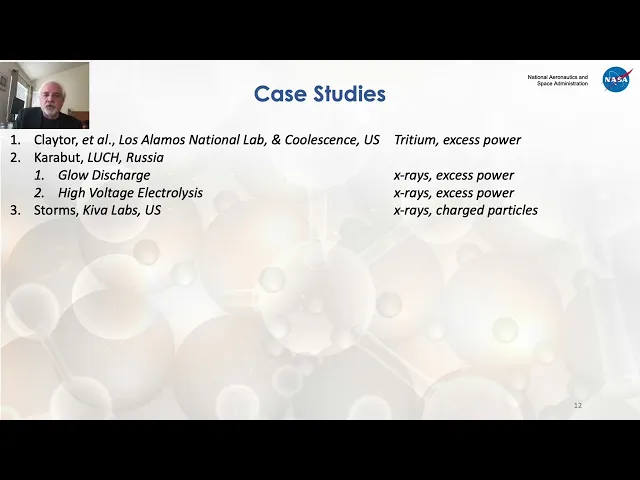
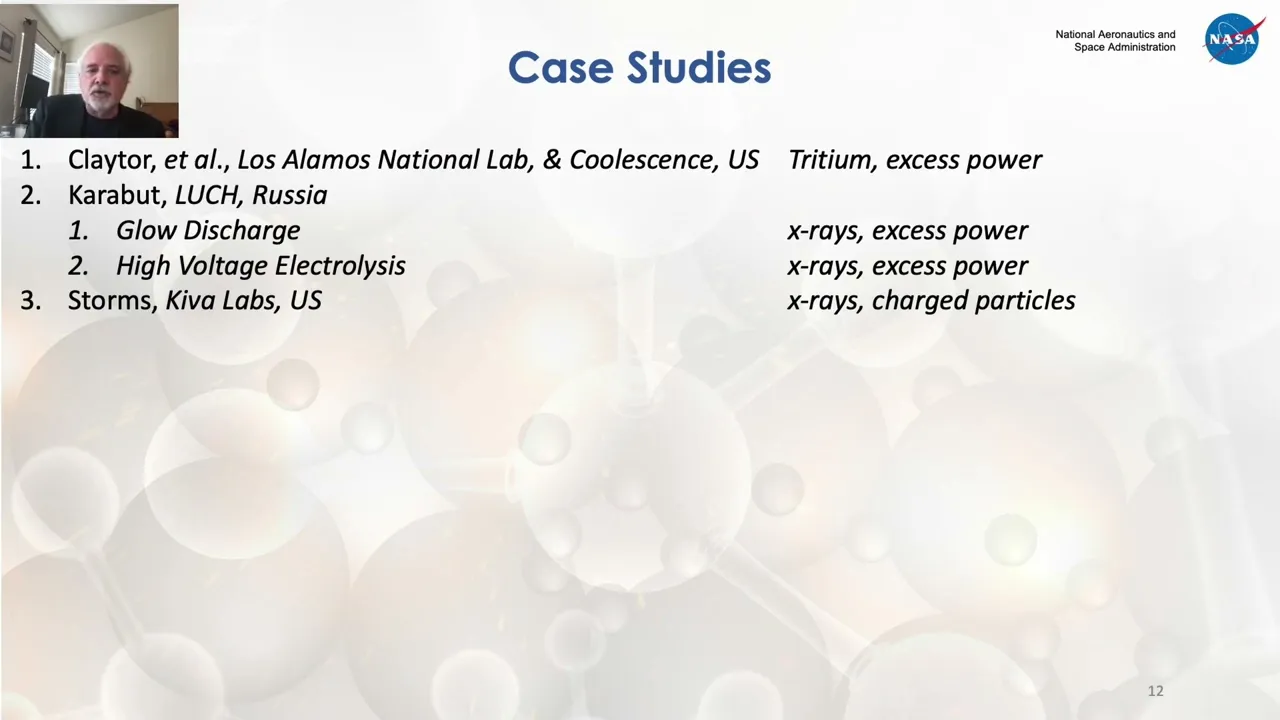
I'm Lawrence forsley giving a talk as part of the iccf 24 workshop on plasma loading and nuclear reactions and condensed matter the outline for the talk context overcoming the coulomb barrier plasma loading current Generations case studies some common characteristics and measurement difficulties electron screening a summary and a conclusion and I note that this talk isn't exhausted but it is representative of plasma loading research analysis and considerations so first the context there is a distinction between a neutronic linear reactions and hot Fusion either may occur within or near a lattice and both may occur in a given system both of these have been seen and are seen in plasma loaded and triggered liner and plasma loading is an experimental way to load hydrogen Isotopes into a metal lattice and potentially trigger these reactions helium-4 and tritium are indicative of largely a neutronic linear reactions whereas fast neutrons and protons helium-4 or alpha particles and tritium are indicative of hot Fusion and the chart on the right hand side paired by Ed storms indicates a log scale on the x-axis and counts of papers on the y-axis hot Fusion predominantly has a ratio of tritium to Neutron production one to one whereas in Leonard it's about 10 to the six or a million times uh favoring tritium over neutrons and fission reactions in liner are also observed with non-actinites no uranium and as Julian schroyer noted unlike the near vacuum of hot Fusion the ambient environment of cold fusion is a lattice which is a dynamical system capable of storing and exchanging energy Dave Nagle put together a set of slides that kind of characterizes all the different ways that hydrogen isotope is loaded electrochemical hot gas and what I'll be concentrating on which is plasma so first we have to overcome the coulomb barrier where light charges repel one another and these prevent nuclear reactions from occurring one way of doing this is electron screening and there are two forms here lattice screening which is from the electrons within the lattice itself which is measured as a factor called U sub e and what it does is it enhances the gamma factor of the fusion probability deep screening is where additional electrons are brought in such as in glow discharge or plasma ion sources or with X-ray and Gamma Photon sources arguably a Quantum cold plasma exists within the lattice with these hydrated metal conduction bands are for me degenerate a supporting a clove plasma and the second thing is we can create special microstructures which allow for super density around clusters within the lattice other theories have looked at neutral nuclei where we force mediated electron capture leads to Quark conversion these would be the P electron P such as occurs in the Sun or the P electron D reactions so can s-matternuclear reaction we have a lattice with electrons and deuterons or hydrogen and fusion related nuclear reactions that occur at low Energies these rates are enhanced by having essentially a near or greater than solid state fuel density on the order of 10 to the 21 to 10 to the 23rd atoms per cubic centimeter again the presence of a metal lattice for electron screening the cold plasma from Fermi degenerate electrons the presence of a nuclear active environment potentially nanovoids a flux of energetic electrons hydrogen or deuteron ions potentially the existence of electron and magnetic fields and then reaction multiplication or scaling through a variety of things including kinetic heating nuclear Cascades nuclear phonon coupling and microstructures in order to measure these we have a series of what we would call orthogonal Diagnostics so first of all after the experiment we can measure the hydrogen Isotopes and noble gases that they've been produced during the experiment we can do calorimetry or thermometry during the experiment we can use high Purity germanium and sodium iodide gamma-ray detectors Geiger Mueller tubes residual gas analyzers Neutron and charged particle spectroscopy Optical spectroscopy Neutron Counting and after the experiment we can subject to the materials both the gases liquids if present and the cathodes to again High Purity germanium and sodium iodide gamma detection liquid scintillator spectroscopy and we can also use solid-state nuclear tract detectors like cr-39 so some of the considerations for plasma loading are first plasma is the fourth state of matter with ions and electrons forming a neutral gas over on the right hand side we have a passion curve for five gases showing the relationship between pressure and voltage and you'll notice that as the pressure goes up the voltage goes up considerably in order to get breakdown and what this does is result in a highly non-equilibrium system but it increases the hydrogen isotope concentration it increases the number of Resident electrons it certainly increases localized Heating and it induces flux of both electrons and hydrogen however there are secondary resonant effects which have time varying capacitance and inductance these can be both good and bad but they can give you short time scale lattice and fuel interactions they can also induce defects through scattering of the either gas or lattice elements themselves which then become sites for nuclear reactions so some of the modeling approaches for this are the following from first principles and analytics we can one can use Matlab or Mathematica and spice this gives you zeroth the first order behavior these incorporate the observed power supply characteristics and circuit interactions if one wants to look at the detailed physics one of the commercial packages for doing this is comsol and so on the right hand side up at the top we see an anode and a cathode and a simulation of a DC glow discharge below that we show a different type of setup we have alternating conductive and dielectric gaps which are filled with gas between these dielectric plates and then the voltage is applied free electrons will then be accelerated and cause ionization again this was both of these are produced with comsol so plasma discharge the experiments span a range of possible discharges glow discharge which is in a region in the center circle in red and there's a normal and an abnormal glow discharge abnormal where it begins to break down we then have a region of dielectric barriers this is something we've practiced at Nasa where there are streamers as well as continuous flow of electrons then you go to even higher currents and you get arcs and Sparks now one of the things that has to be remembered is that in modeling this the source and the circuit interactions all have to be modeled in the discharge chamber itself is part of the overall circuit one of the problems here especially as you go into the arc and Spark region is the system capacitance and inductance can give rise to residences and with the pulse power to cause a high power discharges and radiated noise this is the electromagnetic interference and it can be disastrous for all of your Diagnostics so now I'll go into some case studies I'll look at Tom clater from the Los Alamos National Lab in conjunction with colescence they observe treating the Nexus power Caribou in Russia looking at both glow discharge and high voltage electrolysis and seeing x-rays in excess power Ed storms from Kiva Labs seeing X-rays and charged particles or ions savitamova and gavitanova from Russia also x-rays transmutation Excess power Andre Lipson from The Academy of Science in Russia Fusion protons alphas and x-rays Bob gods and friend enzella from brione and SRI Excess power enhancement of the nickel 64 isotope and tritium Thomas Shankle from the Lawrenceburg the National Lab observing Fusion neutrons and finally some work done in the NASA Glenn Research Center with two of the plasma reactors one of which we observe tritium so looking at claater's work glow discharge helium and tritium being observed on the left hand side of the top you see a glow discharge apparatus approximately 15 centimeters long operating some of the successful materials he's used are nickel and nickel Alloys Palladium and its Alloys Platinum where he's observed electron screening of anywhere from nickel at 380 EV to Palladium 800 EV this is very significant because one EV is the equivalent of 11 000 degrees K this is an Evidence of a cold plasma and operate this device he would run from 150 to 250 torr both deuterium and hydrogen operating at 900 to 1300 volts 5 to 10 amps and 5 to 20 microsecond pulses at a 50 to 100 Hertz rate running in constant power again because one wants to make sure you sample sufficiently often he's sampling at 100 Mega samples per second 14-bit resolution and what he's observed using a thumbtack looking at the low discharge gas is coming off with initially 20 percent deuterium producing 0. 2 to 1 Pico Curie per hour of tritium he observed Excess power with nickel alloy of one and a half percent over the input power and using the Finnegan 270 observed helium again four times or more the background of healing gas and this is in a hydrogen deuterium mixture similarly helium-3 200 times background so in conclusion nickel alloy is reproducible tritium can be several Sigma above background the effect can be obtained in one to two days and excess heat is small but it is consistent with the helium-4 data an inherent electron shielding or screening significantly changes the reaction rates Caribou in Russia also had a glow discharge apparatus on the left hand side is the diagram and you notice first of all one is the vacuum discharge chamber this had a flow calorimeter associated with it there's a cathode holder unit and a cathode sampler labeled two and three the anode is for and again the input and output of the water cooling system five six seven and eight have to do with x-rays and the shielding to allow them to be seen without having other light from the low discharge interfering a heat insulation cover and windows in the heat insulation cover and for what is able to observe from the slow discharge input to Output power looking at three different regions regions one and two are taking the deuterium pre-charged plate in cathode and then running in gases of deuterium Xenon or Krypton with a current of 50 to 100 milliamps the optimum voltage is number one and you can see this is where it's above in terms of output the ratio of output to input and the optimal region was 1100 to 1300 volts which is the gold discharge voltage two is not optimal it's too low a voltage and as a result the points are below one and three without pre-loading the Palladium cathode and with a Krypton discharge driving it basically seeing no Excess power so in conclusion he found that excess heat power from 10 to 15 watts with an efficiency on the order of 150 percent and the Palladium cathode was pre-charged with the deuterium and then run in Xenon and Krypton and in addition he'd seen helium-4 and other impurity nucleides in the cathode now he's also compared the runs with and without deuterium preloading so on the left hand side we have plots of excess heat power versus input electrical power and you can see in the case of electrolysis without it being pre-treated it increases but if it's been pre-treated and pre-loaded it works much better so in conclusion pre-loading of the cathode with deuterium enhances the Excess power arguably the value of preloading the cathode may be introducing defects in other words giving rise to the sites where the reactions can occur to summarize caribou using a post deuterium glow discharge on a titanium cathode and observing the DD reaction and tracking protons in the PT access Channel he found that the voltage range from 0. 8 to two and a half kilovolts and a current from 300 600 milliamps per square centimeter he estimated from the proton yield a u sub e screening potential of 610 plus or minus 150 EV this is comparable to what we've seen in accelerator experiments where they would see used to be of 800 EV but what's significant is he is actually putting out a thousand times more flux on the cathode than you see with an accelerator experiment and this gives you a much more efficient way of measuring the gannet the gamma Factor enhancement measure at low kinetic Energies also observe soft x-ray photons now the reason for doing this was to try to induce non-equilibrium States in temperatures of one to three Kev in order that long-lived learner excited States might be formed in a Palladium or titanium cathode and there are a variety of primary and secondary optic phonons and these would result in compound excited Palladium nucleus which would either de-excite by shedding a helium particle or splitting the two nuclei but note that experiments have shown that the kinetic energy is not given to the fragments and this has a low Neutron yield or it may lose its excitation by fissioning moving on to Ed Storm's work at cable labs using low discharge and observing energetic particles including x-rays the setup on the left hand side includes a vacuum chamber with Diagnostics and feed throughs but what's most interesting is he's seen with a silicon barrier detector a Spectra coming off where energy goes from the left to higher energy on the right and sees a lineage linear energy transfer ion loss as shown on the right hand side which is very similar to the energetic ions observed also by Caribou who also use cr-39 now Caribou has signed alpha particles to this whereas storms indicates a novel hydrogen isotope H4 which is three neutrons of one proton one more than tritium it then decays by Beta emission into alpha particles Robert Gods also has positive this same intermediary it would also be a beta Decay and he's observed tritium these conjectures are based upon the need to overcome the coulomb barrier and the absence of fast neutrons but there are observed products savatamova also did glow discharge and saw transmutations operating in the region of 300 to 850 volts in deuterium and saw a variety of potential Fusion fission products including by this case looking at isotopic ratios of boron carbon nickel calcium zirconium and changes in the ratios of silver from one to one to as much as three to one and in some cases even nine to one the alpha particles produced hence the helium by a factor of 10 to 100 times in the Palladium cathode and as she notes in the paper The observed effects can be explained by Fusion fission reaction on the cathode that is by an interaction of Palladium with deuterium and by the subsequent Decay into more Light Elements Andre Lipson did similar work using low discharge on titanium deuteride and observing Fusion protons so we have highlighted in red on the left the voltage is running from 805 to 20 2450 volts and highlighted in red the number of tracks seen in cr-39 and I should note that the 5.
2 Micron track was measured Against The cyclotron Accelerated proton and corresponds to three Mev protons he also measured these using silicon battery detectors in other cases but what we find is the yield of protons to coulombs increases as the voltage goes up but it turns out it is dependent on the voltage but less so on the current or the power he also observed Fusion protons in long-range Alphas these are Counts from cr-39 looking at the track diameters and as noted before the tracks have been calibrated for the protons larger tracks indicate slower or more heavily charged particles and he notes in other papers that these particles here long-range Alpha candidates might be from titanium fission Robert gods and tanzela from brain energy using the quantum pulse plasma observed Excess power he has a complex patented technique where he runs in three to ten bar of hydrogen much higher than others with an inner tube and an outer tube also heated to 200 to 600 degrees C the pulse frequency and amplitude are variable that depend upon the catalyst and on the left hand side you can see a complicated scheme of what happens when you plot out everything from the power in the power out but you notice that we've got a variety of voltages and a variety of currents but overall he finds an increasing cop power out over power in that eventually reaches 2. 7 and he's also observed tritium Thomas shankel at Lawrence Berkeley National Lab under Google research program also studied low discharge of deuterium on Palladium and observe Fusion neutrons on the left hand side is a picture of his schematic where he was able to detect neutrons but because of the electromagnetic interference the proton detector was inoperable he operated with a one to five kilovolt square wave and the glow discharge regime current was 0. 1 to several amps per square centimeter with DT pressures of 0.
1 to 2 torr but as I say he observed DD Fusion neutrons and he found that the neutron yield as a function of Palladium cathode voltage and the fusion rate was 100 times higher than that for Bare nuclei which attributes to an electron screening potential used to be on the order of 1000 plus or minus 200 EV this is despite the deuterons having less than 2 Kev Center of mass energy NASA also conducted plasma discharges as shown in this slide on the left hand side we have plasma discharge rig a it's also runs with a calorimeter and we note that it was difficult to accurately know the input power hence the excess thermal power is questionable despite having accurate calorie retreat room temperature fluctuations can compromise in otherwise accurate calorimeter and in addition there can also be RF emission losses a second plasma discharge rig B was produced this one consisted also of a series of Foams and silica spacers so we found ourselves in a variety of discharge regimes it was also with a calorimeter and again it was difficult to accurately know the input power partly because of resonances capacitance and changes in the inductance as it ran some of the observations are we're running at 10 kilovolts to start with typically 1. 8 to 2.