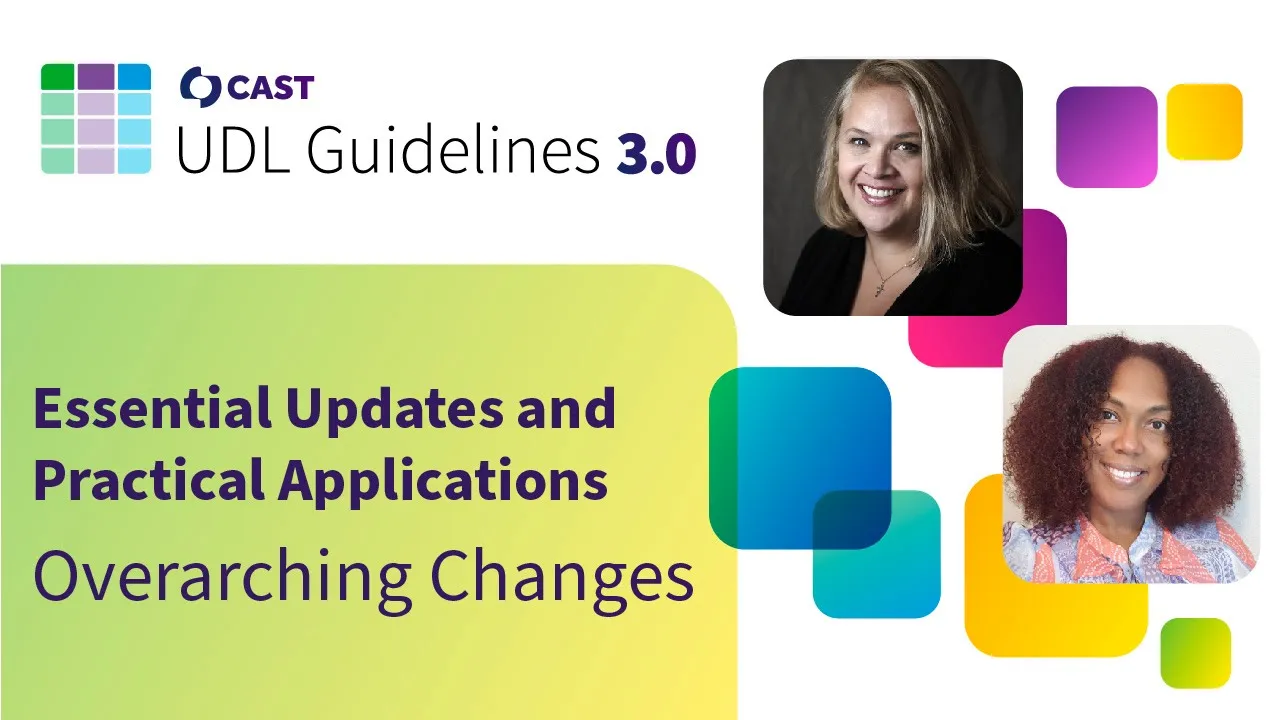
but welcome to udale guidelines 3.0 essential updates and practical applications the overarching changes so this is going to be a four four webinar series and this four webinar series is going to be on the I the research behind the changes and the 3.0 and the expansions as we like to say and 3.0 so this first one's going to be the Big Ideas then we're going to go into each of the principles engagement representation and action and expression and we're going to have some time um at the end we're going to ask you to populate our
chat with some questions you might have after you kind of hear from Shante some of the big big ideas in the research that um that has led to these expansions and the guidelines and we'll have you'll have an opportunity to ask us some questions about principal by principle that we can use to then make sure you're getting what you need in the next webinars um because you have signed up for all all of them so welcome everybody yeah welcome uh so chat box feel free to anytime introduce yourself in the chat box let us know
who's here where you're coming from ask a question you can share an idea you can quote something you heard or you could um share a link with your colleagues and how you do that is you type um you go to the chat box and there's a drop- down menu and you're going to want to click all panelists and attendees that way not only Shante and Patricia I see your chat but everybody sees your chat so go on in there and let us know who's here introduce yourself we'd love to hear from you um and if
you hear somebody if you if you hear something in the chat or you see something in the chat you read something in the chat that you want to respond to you can use that little app button at and then use that person's name and respond directly to them in that chat box so you can say oh I really like that idea or wasn't that great so um welcome everybody we got some chats coming through already I see love it our um accessibility commitment so we've taken steps to ensure that this deck is accessible so how
we've done that is we used a tool to perform an automated check using M Microsoft Office we've checked manually to ensure clear reading order for screen reader users we are going to provide the deck to you once we get that solved um and that means you can personalize the the experience and we welcome any feedback on uh improving this experience as we go along so my name is Melissa Sanjay I am an implementation specialist at cast so I work with teachers and um School leaders District leaders sometimes State leaders uh County Office of Education leaders
Regional Regional um office leaders and on the implementation of udl not only in their classrooms but schoolwide districtwide Statewide thinking about how do we make all those places and spaces accessible to all of our students and a place where they can have agency in their learning um and I am based mostly in Boston again like I said about the last webinar I'm not in Boston right now but I am based mostly in Boston so I'm glad to meet you all um and that's my email if you have anything you want to tell me or questions
or anything feel free to email me I have with me shantee yes and I love presenting with Melissa because she has such a vast array of experiences and is always um with us from a different destination we're in the world in the world that's what I always say we're in the world Melissa um so uh U my name is shant singer and I to sit on the professional learning um team at Cass where I do many of my things online virtually but do support school districts and um similar a similar group to Melissa as on
you implementation but I also have the privilege of sitting in the research and development um department at cast where we do all things research right so help with design and do all the grants do all grants and not all but some of them um but I get to have my field in the literature which is i i i geek out right on the reading on the literature and we'll talk a lot about that today so super excited to be here with y'all to to continue our conversation on our enhancements of uh udl guidelines in the
in the chat shant tell we got Mississippi we got Ohio we got Canada we got North Carolina we got Brazil Baltimore Yukon Ontario UK and Houston I see and I did forget to say that I am based in uh Brian Texas so my fellow folks in Houston at Region 4 where I used to be a part of their nice Arizona Pennsylvania shout out oh I see a Boston Boston College yay awesome Austin welcome everyone so great to see everyone here so just a little bit about cast the organization that is uh leading these webinars and
cast is the author of The Universal Design for Learning guidelines and our mission is cast leads inspires and convenes a global Community to design Equitable inclusive learning experiences through our Universal Design for Learning framework so that's uh the mission that guides all of our work as we use these uh udl guidelines so before we uh really dig into the webinar we wanted to set our intentions for a second so we're going to talk about some of the changes the overarching changes that um the udl guidelines are changes or expansions I like to say expansions because
not they didn't really go away nothing really went away we just added but some of the overarch ing expansions of our our guidelines I want us to set our intentions and think about what is it you want to lean into today when you um when you think about these these changes so our agenda is we're going to talk about the changes from 2.2 to 3.0 kind of broadly we're going to talk about some structural changes so the document itself has some changes um so we want to help you navigate that a little bit we're going
to talk about those big ideas that um that the research team that was involved in expanding the guidelines that shantee was a part of that they the big buckets that they found new research to enhance those guidelines in identity in bias and collective learning and using learner centered language so I go into each of those buckets um as we as we go into thinking about that's what we're intending to do today as we move forward I want to take let you take a minute and think about which of these ideas do you want to sort
of lean into and so um if you could put in the chat since right now we don't have um the slides Patrice if you could put in the chat the udlg guidelines. cast.org and then the key changes document so people can at least check that out if that's something they're interested in looking at as they set their intention um but I'll read to you some of these uh big changes in each of our our buckets so engagement our first principle engagement centering affirming and sustaining Learners interest and identity emphasizing the role of belonging in teaching
and learning and addressing bias threats and distractions so think about is that something either one of those any one of those something you want to lean into and think about you can put it in the chat you can write it on a notebook you can uh talk to a neighbor if you're if you're watching this with someone else under representation authentically res representing A diversity of idea identities perspectives and narrative address bias in the use of language and symbol valuing multiple ways of knowing and making meaning cultivate understanding and respect across languages and dialects anything
you want to lean into and representation feel free to put that in the chat or hold it in mind action and expression honoring and valuing a wide variety of forms of communication centering and valuing forms of expression that have been historically silenced or ignored by addressing bias and challenging exclusionary practices to build more access ible inclusive spaces and systems so just take a second set your intention where you want to where you want to focus your your thoughts today where you want to focus what you dig into you can put that as I said put
that in the chat write in a notebook hold it in mind tell it to someone next to you so as we talk about a Universal Design for Learning a universal I'll tell you what the definition of Universal Design for Learning is and I'll read it directly from the slide um for accessibility purposes Universal Design for Learning udl is an educational framework based on research and learning sciences that guides the development of flexible and accessible methods materials and environments that Embrace variability minimize barriers and develop ex develop learner Agency for all so as we use that
framework the the sort of Cornerstone of that framework that we're talking talking about is our udl guidelines so we have enhanced these guidelines we've expanded these guidelines and Shante is going to tell us a little bit about that the changes from 2.2 to 3.0 as we get into the overarching changes yes I am so the enhancements were actually released um to the public at uh udl Con on July 30th of this year and so it's still hot off the press if you will we're a few months in um and and we want to we've had
several webinars um and also a few sessions at medon regarding um some of the updates Melissa you can go to the next slide um so in addition to the enhancements that we'll talk on throughout this series um I want to remind us as a community that the udl guidelines still provide provide common instructional language for design and you'll see kind of throughout today that there we have been more intentional about really highlighting the need for design um we also uh use the guidelines to really uh bring together or compile a summary of learner variability so
we're still addressing variability uh one of the enhancements that we'll talk through explicitly today is now variability includes identity and that's something that is a shift this is also still a summary of the research what makes it great is that we've expanded This research base we've expanded the types of research so in methodologies we've looked at um both International and Global perspectives we have um Incorporated many excuse me identities of varied identities of researchers themselves we have varied the participants of the research and we've also expanded the terminologies that we've used and so it still
includes you know our Neuroscience our cognitive science our learning science That's the basis that will always be the foundations of foundation of the udl guidelines but as we keep saying we have enhanced we've expanded and we hope to continue to expand the research base that supports um the the development and the ongoing iterations of the guidelines we still want to look at the guidelines as a tool for um anticipating barriers and like I said again it's the guidance it's guidance for design of learning you could go ahead Melissa um some of this this is this
is a uh 30 foot view if you will or just a summarization of the specifics uh within the structural changes of the graphic ordinance or of the guidelines and so for each of these bullet points we will uh I'll show you what each of these how each of these have been um how each of these look like on the guidelin so you can go to the first one so before we used to have provide multiple means of Engagement and excuse me what we as a team as a community decided was you know what when we
say provide it's very teacher Centric is very um it's having the teacher at the focus and being able to present this opportunity for students with students and so we wanted to in use uh change this word to design to um amplify the uh co-design nature of the guidelines so it's not just things that teachers or educators are providing it's more of the creation of multiple means of Engagement representation and acts and expression and co-design it with the Learners who are in our in our um in our settings the other thing we've done is we have
uh changed the word it used to be checkpoints those bullet points that you see to considerations so we thought maybe and the community said not just us right it's not just cast thoughts but it's really um just to remember all of this is based on focus groups and advisory boards that we have had but they said when we say checkpoints sometimes that can be um miscommunicated or construed to mean um check a checklist or check marks and so we wanted to pull away from the idea that these things are in a hierarchial order or that
if you can just check them and so we thought that the word considerations would be um would be a better way to emphasize what we're hoping Learners and educators will be able to do in their design or input in their design next one uh the next thing that we'll that you'll see here is that our roles have changed and the uh previous rule used to be internalized I've already forgotten I have to look um but what we've done here is we've uh labeled this executive exe executive function because we recognize that it doesn't just it's
not just construed to a box actually the all of the guidelines was specific specifically the ones at the bottom really do Encompass what exective function is and so they've been labeled that's what it's been labeled um for that row and uh the goal of udl so the goal of udl used to be expert learning and so now we want to focus on learner agency which can be look as an um as an umbrella to expert learning it still involves expert learning but the word expert learning we found um from our from our audience or from
our Advisory Group that sometimes it's very contextualized sometimes in our International or Global Community found it very difficult to explain what that is and it could be looked at as a very eurocentric approach and so what we uh what we have determined the goal of udl to be is learner agency which is purposeful reflective resourceful and authentic and strategic and action oriented which there is a webinar um that will be solely focused on learner agency and so in addition like I just mentioned to the structural changes of the guidelines there are some enhancements conceptually that
have also been a part of the overarching enhancements to the guid guidelines uh Melissa mentioned some as you saw in the checkpoints but those big themes really uh are that we want to include Center affirm and sustain Learners interests and big identities so variability we talk about we've always talked about since the conception of udl um variability exists and so we want to make sure that we're including identity as part of variability so before if you remember we had the how of learning the what of learning the why of learning that's still there right but
now we're including the who of learning and so that's the importance of identity being a part of the guidelines enhancements we also wanted to acknowledge um in uh individual institutional and those systemic barriers that or systemic bias that present themselves as barriers so oftentimes we looked at barriers in our methods our materials our assessments but now we recognize a one and want to acknowledge that there are also systemic barriers that prevent students and our Learners from engaging in in in overall learning the other emphasis is on interdependence and collective learning so we'll talk a little
bit about more about that later on in this session but there is this focus on valuing not just Independence but interdependence right um and so we heard that loud and clear a lot from our Advisory Group the other thing is Shifting our language from um it from it being T teacher centered like that provide U terminology to being more L learner centered and really making sure that we're incorporating learning into uh the learner into um our choices our design into our considerations and like I mentioned before um the the overarching goal of udl has been
expanded to include learner agency and not just expert and I'd take a minute here Shante to um to uh identify that we are we had we're having a webinar on identity we're having a we had an webinar on bias we're having a webinar on learner agency so we're take we're coming at this from different angles so you can kind of choose the angle that works best for you what's going to um make this webinar different so you might see some of this similar things when we're talk about bias but what makes this webinar different and
the webinars in this series different as we're trying to really dig into some of that research and kind of me as a practitioner the practitioner's questions for the researchers uh like Shante so that's kind of where we're coming at coming at it from um this time through yes and I also want to bring your attention to the resources that are at the bottom of this slide so one of the things that we prided ourselves on honestly is really the transparency of the process of of the enhancements and so there are several resources that get into
the thoughts and mind the wise the house um of the um enhancements and so we wanted to provide that that uh information or resources to you and then we talked about this but there's the words are bigger on the screen for you um when we talk about learner agency we are saying uh learning that is purposeful and reflective resourceful and authentic and strategic and action oriented so because the goal of udm is learner agency we wanted to first uh dig into that first big bucket of new research that was looked at in order to expand
the guidelines identity so identity is key to learner agency and if you watched our um if you watched our webinar um our Cil webinar which is one of our projects you might have heard uh some of this before uh but we're as I said we're going to really dig into the to the research so when we're talking about identity we're talking about our sense of self and What Makes Us unique and has continuity over time some of that includes family cultural and background physical features values morals beliefs and ethics and to sort of bring that
home um my PR prior to cast I was a first a social worker then a teacher and then a principal in alternative high schools in Boston so those are the high schools for who um for the students for who had be either dropped out or been pushed out of their homeschools for a variety of reasons one of my students was a immigrant from Africa and she had immigrated from one part of Africa to another part of Africa to go to a refugee camp and then came to Boston um from that refugee camp so as you
can imagine she had a lot of interruptions in her schooling um sort of lost her herself um and her identity as a learner as she went through that process and then she came to Boston and her homeschool um told her that couldn't continue um they couldn't continue serving her because she had missed too many days and she missed a lot of days because she had um many younger brothers and sisters and her parents had to work two jobs each to make ends meet in Boston um so she came to us kind of a little bit
uh disenchanted was the schooling process trying to figure out what it was in school for her what what was there for her and she um how we gave her some flexibility around how she could manage both her home responsibilities and her school responsibilities but one thing that I feel like really made a difference for her was when she did a personal narrative project and she was able to tell her own story of her immigration and her own story from her own perspective um it was in her English class and her English language arts class and
um because so many stories were being told about her right the people were Mak were thinking about you know why is this this young lady never in school etc etc so she was able to tell her own story and through that process by bringing her whole identity to the learning she was sort of able to reclaim her identity not only um as a person as an African as a as an older sister as a woman but also as a learner and a writer in that process so that's one way that um identity in my experience
has really enhance the learning for a young person what's the research behind that Shante great and so one thing that I um mentioned before but I want to reiterate is that when we had um our focus groups and uh advisory boards there were many or several themes that emerged and so what we did was as themes emerged we also looked at the research base behind several of those themes and so there were sever uh there was several literature pieces right so not just not just articles I should say citations not just articles but but websites
and white papers and uh you know a variety of of literature a variety of texts podcasts right that uh supported many of the themes that resulted from our conversations and so the slides that I'll be presenting to you are are really a representation of of those citations that supported those themes so when we look at a welcoming interest and identities we found that uh Gonzalez and Maul's research of uh funds of knowledge really did support the development of our consider of of this uh principle so welcoming interest identities we had folks saying you know we
want ourselves to be representative and so funds of knowledge if you will are cultural practices that look at um how families actually pres um work through their day-to-day what are their day-to-day activities and how really when you bring those activities those thoughts those values into the classroom the impact that it has on uh on student achievement on student engagement and so we found that that was an important part of our research the other thing uh and the enhancements the other thing that popped up a lot is on being respon being culturally um responsive and so
we a included um um a citation or citations really from Gloria Latson Billings work where she looked at how being culturally responsive and using uh asset-based culturally responsive pedagogy really does address student achievement and so we found that this critical perspective and having that asset based approach really did um Foster or support many much of what the um uh much of what we think is important to consider as we implement the guidelines or as we design learning experiences and then of course um in in that same vein cultural responsive pedagogies uh Paris and the Lam's
work really talked about perpetuating students both cultural and linguistic repertoire if you will so what they value what they emphasize and how how important that is in in learning and overarching um their overarching learning experiences um the other thing I wanted to mention to you is that all of this can be found on our on the udl guidelines so if you if you uh go to udl guidelines which I believe uh has been put in the chat but Patrice if you could put that back in in the chat you'll see that each of our uh
checkpoints and considerations have a research page and so you'll be able to see much of the research that has been used to enhance the update that has been used to enhance the guidelines and those things will be denoted with the asri at the following the citations So based on the that research these are some of the strategies that you can find when you when you click another place you can click in those those udl guidelines is Click on each guideline it'll give you a little bit of a a narrative and some bullet points around uh
what that might look like so some strategies to bring help students bring identity to to the U Learning might be a counternarrative project similar to what my young person did um self-reflection to content and activities so self-reflecting on what's going on in the classroom creating space for Learners to find Joy through connections to their identity sense of communities maybe some art projects some um sharing uh dancing other things and allowing multiple ways for students to engage based on their culture so those are some ideas there is um I believe we now have the slide deck
so there's a video that we probably won't have time to show you in the slide deck that you can watch um by Karen Pitman about letting students lead with their identity but we wanted to set for a minute let you process and um use the chat to let us know either what you're encouraging how you encourage students to bring their identity to learning what are some ideas you want to share with your colleagues or some questions that you might have for us so take a minute drop anything in the [Music] chat um Peg I don't
know the answer to the question Patrice might know about the closed webinars see what else any other ideas you might have Shante for identity strategies or how the the research links up um the other thing that is important to note uh is the interest or to mention exactly is the intersectionality of identities so sometimes we tend to be very monolithic in in how we uh you know how we support identity and just remembering that there is no one identity of a of of anyone right and so the importance of like I said the intersectionality of
how uh individuals identify will also be U something that we want to support So asking questions too is always going to be like my answer to everything we so want to make sure that we're giving students and Learners uh voice and choice in um in everything that they do like as it relates to their learning as it relates to their processing and so uh where there's doubt where we don't know question first and listen I do see in the chat some people are modeling sharing their own pronouns ethnic background choosing topics so using that choice
to support people bringing in their own identities um another choice on Heroes uh uh let's see it's popping now so I'm trying to cat sure is Right sharing our privilege or information about our privilege um moving past surface identity thank you for sharing that Shante um where can we ask questions Iona you can ask it in the chat just feel free to drop a question in there um and we'll do our best to answer it either now or later we'll have a we'll have a record of the chat all right should we move on Shante
where we have Michelle and I will make note that just like many of you I am experiencing technical difficulties as well so I've been popped out uh twice so if you don't see me and just know that I will be right back oh my goodness I didn't even notice believe me Shante all right so our next one is talking about bias so we must address bias to Foster learner agency um we have to address you know the biases that we bring uh we talked in our bias webinar if you want to go back to that
about how it's just part of our natural natural makeup as humans it's just something that happens and uh it's the way our brains are wired and so in order to in order to address the impacts of bias we have to notice when it happens interrupt it stop it and then um make make a choice make a different choice so uh it's it's in our it's in our DNA it's in our makeup so one way that that happened for one of my students um was they were late to school every day and so they were asked
to leave the school and come to a different School come to our school because they were late to school every day and they asked them questions like do you have an alarm clock can we get you an alarm clock uh do you want somebody to call you in the morning do you want somebody to to do you need like to set an alarm to make sure you go to bed on time are you staying up watching Tik toks Are you standing on watching playing video games um and they were trying to help him solve the
problem through that process um he came to us and uh we were able to give him first period free so that he could catch up on his studies uh second through 7eventh period And as we built a relationship with him what we found was the reason he was coming to school late was um because he had um violence in his home and he was staying home to protect protect somebody and wanted the person who was violent to leave before uh before he did and uh that's we made all these assumptions other people made all these
assumptions about why he was late to school based on bias based on those shortcuts based on our experiences with other students that start to develop those shortcuts and this must be why this young person is uh late to school so that's why it's important to really stop interrupt your bias and really think about um asking questions questions as Shante said let's ask some questions Let's uh let the students lead um and as Melissa has alluded to um you know bias is natural right and I think sometimes we have this we say bias and it's a
catchall phrase and so one of the things that we really wanted to do and I I'll say this 100 times one of one of the things my mentor has suggested is that we be really specific so what does bias mean bias truly is just an inclination or our tendency or preference uh towards how we think or how we act towards a given person a group an idea you know sometimes words can conjure up you know emotions positive or negative that initial inclination that you have is our bias uh we have excuse me a different types
of biases and one thing that we at least here have been talking about it are our cognitive biases and so in the previous uh webinar we talked about what biases we talked about several different bias that exist um in as it relates to learning but we could spend years if you will uh talking about talking about what bias is and how it shows up in learning in in in a classroom and so uh when you think about a cognitive bias it's that era so I don't know if if you guys remember that crave with the
with the is this the is this a blue dress or is it a gray dress right it's how our minds perceive something and when we're trying to understand it we make a decision almost instantly right but sometimes it's really an error in how we see it right do you see a picture of a woman or do you see a picture of a old lady you remember those o optical illusions are what they called and so it's our brain's way of making sense of of something of our perceptions that we take of those things that we're
taking in and so it does allow us to make choices really quickly um but that's the thing it's a quick decision and so we don't have excuse me uh the time to take in to be con to deliberate or to reflect on those things um the research talks about there being over 175 biases cognitive biases and there's even more when you step outside of cognitive biases so one of the first things we do I say is to slow down right and also knowing how being aware of our bias and how we are operating within those
bias and or assumptions all right mosa and so what does the research say y'all we could again talk about talk forever about the research on bias um and so I want to make sure that we um are acknowledging the fact that the research that we've included again the enhancements may not speak specifically towards bias although there are a lot that does but some of the Articles or citations or websites really do uh support what happens when bias is present so um in this um uh Loretta Ross talks about how we can address bias in the
classroom so in her particular um articles speaking up without tearing down it's really her as um an author talking about how educators might be able to support students when bias comes into play so for example if you have a student who says something that um involves bias says something that is Prejudice says something that is stereotype what do you do how do you help students work through calling in and calling out and so that article is um really on how to protect students and their own identities in the classroom if they're truly if they're being
attacked or if they feel like that attack or threat is becoming a distraction to their uh to their learning the next one um uh C's work Angela cre talks about um one of the and this is this is one of the things that came up um in our in our groups this whole shift or mindset shift around our multilingual learners so there have been many instances where multilingual Learners have um have uh been looked at through deficit a deficit L and so we want to adjust the language the perceptions the thoughts around thinking of multilingual
Learners from a deficit approach and so um C talks about and actually looks at how social social Linguistics look in language and language being only a part of identity but not equal to excuse me and so one thing for me I'm always amazed um and quite fond of maybe a little selfishly jealous that's my own bias with how multilingual Learners are able to take in what they see process it and express it sometimes in multiple language simultaneously like just the sentences that are like half in one language and half in another but just how much
at least you know from my perspective that takes right to be able to process and understandable what an asset it is to be able to have that skill where you can bring in multiple perspectives and also give multiple perspectives through through language and the last piece is or one of the um citations I just want to highlight it is highlight is actually one of our considerations um addressing bias and modes of communication and expression so we know that there uh there uh is and we talked about this in our bias webinar um a propensity to
want to do things as we learn we hold value to things that we experience and hold true and believe to be quote unquote right and so um nld the national Center Center for learning disability has an article where they talk about um the bias that exists in our education system and this is specifically um disproportionality within special education but one result of the bias and how we assess how we ask for students to express themselves how we ask for students to demonstrate what they know has led to disproportionality of black and brown students within special
education so this is um a way or a demonstration evidence of how bias and um how biased in the form of modes of communication communication and expression um can be seen or can become an outcome in our education system and so we want to make sure that we address this and our guidelines are helping us to do that so when we want when we're thinking about addressing it we want to really consider all those decisions we make all these decisions as Educators um throughout the day we make decisions about materials methods assessments environments so we
want to stop and ask ourselves sometimes we call it an equity pause you just want to stop and ask ourselves are the materials representative of all the Learners and all their perspectives do the methods consider various ways of interacting does the assessment involve choice of expression relevant to all cultures similar to that piece that um Shante was saying towards the end there around interrupting that disproportionality by giving different modes of expression and think about who is represented and comfortable and feels like they belong in the environment so you can stop and ask yourself those questions
as you're trying to address bias and some things to think about when we think about bias and in modes of expression sometimes our schooling sit our schooling system here in the US believes that learning by reading a physical book is greater than using text to speech software on a digital texts we might give off the impression that we think Mental Math calculations is greater than johning or drawing visuals that writing to demonstrate understanding is greater than speaking drawing or using digital media to demonstrate understanding Arts made with paints greater than Digital Arts working solo is
harder more important than working with others or working with others is harder more important than working solo and that working without scaffolds is better than working with scaffolds so another way to sort of um think about when you're designing your lessons and you're designing um think about how do I interrupt or address bias think about those those ideas and am I unintentionally giving off these ideas that I think the one is better than the other and so how do we address um and really disrupt the bias that comes with with us being humans right um
or what are some anti-bias strategies first and foremost practicing mindfulness can make you less bias so Jill suudi has um a um a um article if you will um and it's there and that link is linked there about how mindfulness can really reduce the bias it that we have and so it allows us to put ourselves um to empathize with others from different walks of life with different perspectives and so once we're able to stop that quick reaction those quick thoughts and really take time to slow down and deliberate how our thoughts are impacting our
our actions and our decisions then we can really truly honestly reduce our bias it's also important and I think that's probably all three of the next uh bullets we recognizing that we all have personal bias and it's not a bad thing but it's it's what we do as a result of our bias um and the stereotypes that we we create for ourselves and how we walk within those thoughts that does impact and can negatively impact our Learners and learning and so we want to we want to recognize it we want to acknowledge it we want
to get specific and we want to be mindful to help reduce it the other things that we want to be open to is hearing others perspectives so not thinking that our thoughts our values our uh preferences are the right way right or the only way and and and allowing opportunity for differences to really um drive and really help support us as we design learning and learning opportunities um also practicing responding or asking rather re reacting and I have to admit I you know I I I I I need to do some work in this area
because um we have to sometimes when we hear something or we see something again that bias our first inclination is to react as opposed to listen to ask questions to try to get a deeper in get deeper insight into that other person's uh why behind what they said behind what they did and then looking for barriers in the environment right and so we know from being in in the udl space that we often time that we we we want to look at the environment and how that's impacting our learner and not just look and not
looking at barriers specifically within the Learners themselves so our question to you is um how do you address bias in learning how do you address bias in designing learning experiences for the Learners uh that you um support so we'd love for you to incorporate or give us some of those things in the chat um and we'll move forward W as we uh as the chat starts to populate Shante I'm um it is my understanding and maybe you can let me know uh how close I am in terms of the research okay that the more that
you start to ask questions and you start to hear other people's opinions and you start to to um spend time thinking about things from different people's perspective the more it is going to route your neurop Pathways that that knee-jerk reaction is not going to be as prevalent that's right and so we even have uh one of the considerations that talks about cultivating empathy right and so that allows us to um see see those see those different perspectives but like you said develop those thoughts develop those um spaces and start to think about yes how we
how we can um align ourselves to or appreciate if you will other perspectives cool I drop those things in the chat let's see I got one new message here um conversation is greater than thank you Dan he's using our he's using our sentence stem conversation is greater than outing shaming and correcting absolutely love it nice uh we got some comments about ESL or ethnicity when discussing culture disability is also a culture and community of people with unique perspectives thank you for calling that out a hope thank you nice thank you for all your comments so
feel free to keep responding to each other in the chat I'm going to move us on so that we uh can get through all three of these in time and so we're moving on to collective learning shant all right and so one of our um uh the highlights conceptual changes enhancements has been on uh collective learning and I remember uh back when I was in the classroom and I was I'm a special educator and so at the time I was pushing in and pushing out if you will um pushing in and pushing out and I
had a student who was in one of my resources resource classes who was an avid illustrator I mean any everything every thought that he had would was perpetuated if you will through his art so um and I'm dating myself I was telling Melissa this earlier that he used to use a etes sketch which just in that and of itself amazed me that he was able to uh Express himself so clearly in his illustration and uh in talking with him and talking to his teacher uh we talked about uh the fact that he was having a
difficult time with group work in the sense that he he didn't feel like he belonged when when group when collaboration or group work was happening the teacher often complained or his general education teacher often complained about his involvement with group with the group work and so I asked her because I do this so well asking questions right um what type of what type of things are you asking him to do and so she said well I assign roles and um you know everyone knows what they're supposed to do and so we looked at the roles
and it was things like you know um write in fill in the graphic organizer or write your summary or you know be the timekeeper and so what we found as you could imagine was that wasn't his preference right that wasn't his preference that what what that was not what he felt like he was good at that was not the way to Excel and so what we did was um we looked at the roles and we did things like you know summarizing and you did options you had options for being able to express yourself we had
illustrator oftentimes and then we provided a a agency piece in there what which was having students actually be able to choose which role they wanted to play Within the group work and so as you can imagine not only did he excel in participation but he actually um began to learn those harder Concepts because he had the opportunity to communicate with his student to to communicate with his peers and to learn within a more Community um Community Rich uh environment and I hear in that story shantea interdependence that is part of the new the new guidelines
not just you know protocols for group work and collaboration but this interdependence we're counting on this this individual to get us our illustrations we're counting on each other to a better product that's right there's a level of shared accountability in that model and so some of the examples and themes that popped up uh within our research and this is actually a quote from one of our Advisory Board was we want students to be learning and building together right we want them to have the opportunity to share their stories and so um you know not only
did we have the research but we have quotes right from our from our community so one of the um some of the the citations or some of the literature that I wanted to highlight for collective learning was uh first and foremost the need to fully Embrace as Melissa said interdependence not just Independence um and this was an amazing article um around the um yunti style pedagogy which is a um a pedagogy from a southern African country of nimbia where they uh had a very of diverse very very diverse um culture in the sense of uh
their the country was SE separated and then once they got their dependence they were able to brought back together so just a rich tapestry of cultures that they wanted to make sure um was really represented in their educational system and so they developed a a pedagogy that supported Community Learning and being culturally responsive in their education approach so this um uh this this article is amazing amazing to give you a very Global or International perspective on what it means to be culturally irresponsive um another citation that I wanted to highlight was that of Espinosa at
all which looked at um meaningful participation and what they titled educational dignity and how important interdependence within a community is in enhancing learning so that involvement in learning the right to learn and the importance of autonomy when you're learning to Foster true involvement in participation and learning and the last one um that I wanted to highlight was uh you know there was this uh a few a lot actually um individuals who were amongst our advisory and focus groups who self-identified as having disability dis abilities and intersectionalities with one of those identities being disability and talking
about this overemphasis of think in the western culture of Independence and so what they were saying was that I I solely am not my disability first and foremost that's a part of who I am but also when I learn in isolation I don't have the um the bread or the depth of learning that I do when I'm in a community if I am isolated if I am separated if I am excluded from True learning when I get back into the environment where my peers are then I don't have that same agency right or sometimes I
I feel like the opportunity is not there for me to say have that same agency and so um we want to focus on that interdependence with that importance of Community Learning um some of the benefits of collective learning as you probably could glean from our conversation is that the shared responsibility of being able to work together and seeing each others um capitalizing on each other's strengths and interests and varying perspectives uh again we just come to the world and everything we do with our own experiences and that's great but that can only carry us but
so so far like it's important to make sure that we are open and that we have an understanding of multiple points of views and expertise because that's going to make us um that's going to expand even our own perspectives and thoughts communication skills so when we are working with other people we learn how to communicate with others right because someone will say I don't understand what you're saying and so we can develop those communication skills as we're working towards a common goal the other piece is that critical thinking and so we want to make sure
again that we are um having opportunities to gain insight and discuss and ask questions as it relates to a particular issue but it helps us uh look through multiple lenses of problem solving again if you if it's just you you only have those lenses that you bring when you need to uh solve a problem so having being in a collective learning environment allows us to have multiple approaches to solving um issues or concerns that we may be presented with so for our collective learning strategies we have collaborative group workk thank PA share jigsaw problem soling
Gallery walks interactive digital platforms and we want to ask you what's strategies you use um we only have a few minutes left but go ahead and populate the chat with that and we have a video that you can also watch we also have some um resources to support you so there's graphic organizers and six different languages research Pages FAQs the changes there's a changes document where you can kind of follow along what what change from 2.2 to 3.0 um there's a rationale document to describe each update and we're going to dig more into that into
each of the the principles as we go forward um so please feel free to to put in the chat all the uh all the ideas and questions you have that you want us to address in the next four um there's a slide here if you want to know about professional learning services at Cass you can email PL at cast.org we also have a schoolwide implementation leadership Workshop series coming up um it's going to be I think about nine sessions um from October 3rd to June 5th so that's something you can find on our website and
uh lastly we just wanted to give you an opportunity to reflect on today what affirmed your thinking what pushed your thinking and what might your learners need you to do next and before we close in the last like 30 seconds I did get a private chat that um with concern that the story about the young man um who had violence in his home there was a the picture of a young man of color as representing that and we I did not intend to reinforce stereotypes I was looking for a picture that represented the community of
Learners that I serve so I apologize and I'm publicly um holding myself accountable for the impact that that may have had on people and I too want to uh note that uh correction was made in my language as as well I said a eurocentric approach as opposed to a western um way of thinking and so I do want to acknowledge that um yes that could be that a western approach would be more appropriate for that that um that statement and again one of our biases right first acknowledgement awareness but also uh recognize intent was not
our intent However the fact that it impacted others is important for us to be able to stop and call it out and um you know to really listen to How it impacted and affected others so thank you for that and we appreciate you all feeling comfortable um for uh presenting that information to us that's what the 3.0 is all about right we went to the field we got feedback and uh we're going to continue to grow um I also wanted to make it uh to acknowledge I know we're we're at time uh is the fact
that a lot of the grp group work uh neglected or we should have flexible options for for students where group work May pose um as barriers so thank you for that all right we'll see you next time at our uh changes to the engagements thank you all we appreciate thank you everybody hope to see you back thank you




![Upbeat Lofi - Deep Focus & Energy for Work [R&B, Neo Soul, Lofi Hiphop]](https://img.youtube.com/vi/THh4fT0O7IY/maxresdefault.jpg)