What if I told you that there was a single habit that you could do every day that would make you smarter, more successful, and more in control of your mind? Well, not only does neuroscience tell us that this is 100% possible, so does the Bible. And so, after hundreds of hours of research into both of these, I'm going to share what this habit is, how I've used it to drastically change my own life, and how you can do it correctly yourself.
But first, let's look at what makes this habit so powerful in the first place. So, real quick, I want you to imagine that you are working as the assistant to the CEO of a multi-million dollar company. Now, imagine one day suddenly that the CEO actually passes away, and you've been voted by the shareholders to be the next CEO of the company.
Now, normally, that'd be good news, right? But here's the problem. Last month, your company decided to launch a massive project that's going to take 20 years to complete, and they've already invested, you know, tens of millions of dollars into it, and they expect you to be the one to make sure that the project succeeds.
Now, imagine that all of a sudden, God, the creator of the universe, suddenly appeared to you in this moment and said to you or gave you advice on what to do. What do you think he would say? Well, what if I told you that the answer was, "Make sure that you meditate every day.
" Well, this is actually exactly what happened to Joshua in the Bible. So, for those of you who don't know the story, right, this happens right after Moses had just led millions of God's people through the wilderness, out of Egypt, out of slavery, and of course, their goal was to enter this place called the promised land and take over the enemies and take over the land that God had promised them. Now, the only problem was that, you know, Moses kind of messed up and died.
And so, instead of Moses leading God's people into the promised land, that job now went to Joshua, and he was the one that was going to take over the lands and lead his people and go from an assistant to basically the leader of God's people. And when this transition happens, here is what God said to Joshua in the book of Joshua chapter 1, verse 7 to 8. It says, "Above all, be strong and very courageous to observe carefully the whole instruction my servant Moses commanded you.
Do not turn from it to the right or the left, so that you will have success wherever you go. This book of instruction must not depart from your mouth. You are to meditate on it day and night, so that you may carefully observe everything written in it.
For then, you will prosper and succeed in whatever you do. Now, being strong and courageous, you know, I think most of us can understand. But, why would God tell Joshua to meditate on the scripture, which was, you know, only around five books at the time, when he's about to walk into a land of giants and kill a bunch of his enemies?
Well, here's where the science comes in. So, if you ever watch videos on things like behavior change or learning or just making your brain do different things, there's a good chance you've heard of a concept called neuroplasticity. So, basically, neuroplasticity is a really important concept in neuroscience that tells us that our brain is not just a static machine that just adds layers on top of each other over time and nothing ever changes inside of it.
Rather, it's constantly rewiring itself by breaking down old neural pathways, which are based on old behaviors and thought patterns, and then building new neural pathways based on our current or new behaviors and thought patterns. And you can think of neural pathways like, you know, highways or roads or set programs in our minds that tell us, you know, when this behavior happens, go trigger this other set of behaviors and triggers that are linked to, you know, based on what we've done in the past, right? And the more we engage in some of these patterns, the stronger and thicker those neural pathways get or those highways get, which make our behaviors and thoughts more automatic over time.
So, this tells us something extremely important about behavior change and how rewiring your brain works. You're actually not stuck with your old patterns. In fact, it's the exact opposite, which is your brain is literally always trying to remove old patterns to make room for new ones based on what you are making it focus on.
Now, what does this have to do with our friend Joshua from the Bible? Well, when we look at the word meditate in the Bible, we actually see that biblical meditation is very different from your typical mindfulness meditation or other forms of modern meditation that we see today. The word meditate is in Hebrew the word haga, which means to imagine, to ponder, um to mutter, uh to study, to deeply reflect on something.
And so, this tells us that God actually wanted Joshua to completely fill his mind with the word of God, right? To rehearse on it, to study it, to um think about it deeply every day and night, to even speak it out loud if he wanted to succeed and prosper in everything that he did. Or from a scientific perspective, right?
God wanted Joshua to build new neural pathways in his brain by constantly deeply thinking about the same thoughts, even speaking them out loud over and over until they became a natural part of his thought process. But here's where things start going wrong for many people, which is if our goal is to rewire our brain as fast as possible and not over, you know, several years and you know, just taking our time, we actually want to change now, then just meditating or thinking about the same thing over and over again isn't enough to actually create the change in our lives that we want, which is actually also reflected in the Bible, which we'll look at in a second. But to understand why this is the case, we first have to look at another key concept in neuroscience, which is closely tied to neuroplasticity.
And that is something called neuroplasticity windows. So, to help you understand this, imagine you have a blacksmith, right? This is the guy who, you know, takes the hammer um to make the metal to forge like swords and shields out of metal, right?
Imagine a blacksmith is trying to forge a sword out of a block of iron. So, at room temperature, when you have a block of iron, the the iron is hard, right? It's rigid, it's not you can't really bend it, you can't really do much with a block of iron, it's just a heavy piece of metal.
But the moment that you heat or when you actually start heating up the metal in the fire, which is what blacksmiths do, that's when the iron becomes malleable, right? It becomes bendable, you can start shaping it, hammering it, when the blacksmith starts shaping it into the shape of a sword. And once that sword cools, right?
And you let it harden, that's when the iron kind of keeps its form and you now have a solid piece of, well, you have a solid sword, right? Well, this is basically how neuroplasticity windows work. When your brain enters a heightened state of change, right?
Which is triggered by things like novelty, uh strong emotions, or some sort of emergency or some important events, then it enters a state of or it enters what's called a neuroplasticity window, which is where neuroplasticity happens much faster. Now, why is this important? Well, the reason many people don't see changes when they try to, you know, repeat the same thoughts over and over again when they're doing like affirmations or reading the same Bible verses or speaking them out loud, is because they're not operating within neuroplasticity windows.
Or another way to put it is, right, if you are trying to if there's no novelty, if there's no emotion, or there's no urgency when you're trying to rewire your brain, your brain isn't going to register that activity as something important and it's just going to take its sweet time in implementing the change and building new neural pathways. Now, going back to Joshua, right, he was also in the middle of an extreme and urgent transition in his life, right? The previous leader of Israel, Moses, just died and now Joshua was in charge of leading millions of people into this land of 12-ft tall giants to conquer all of it and, you know, it doesn't really get more stressful than that.
And that is why, right, right in the middle of one of the most stressful moments of his life, God told Joshua to start rewiring his brain through meditation. Now, that being said, if you go back and carefully reread these same verses from Joshua one more time, you're going to see that there's actually one more key ingredients to making all of this work as effectively as possible. So, we're going to go back to Joshua chapter 1 verse 7 to 8.
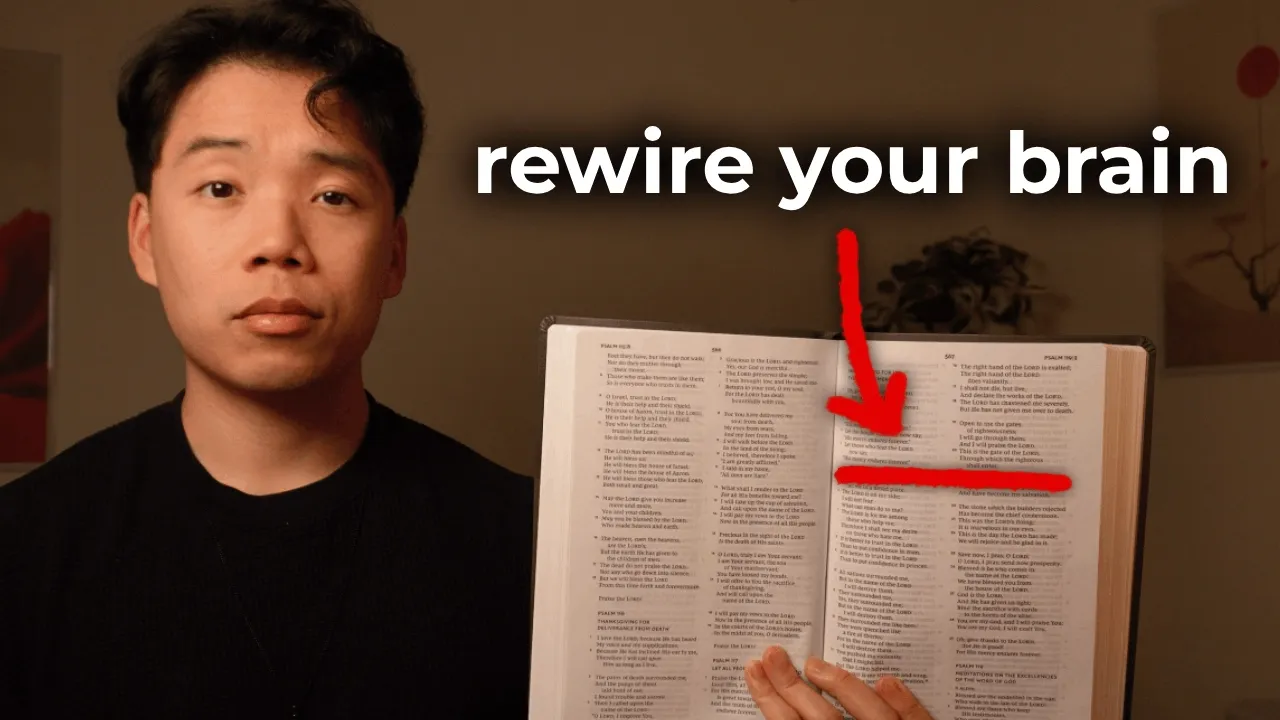
Uh and this time I'm going to highlight a couple of words so that we can really emphasize or highlight what we're trying to look at here. So, it says, "Only be strong and very courageous, that you may observe to do according to all the law which Moses my servant commanded you. Do not turn from it to the right hand or to the left, that you may prosper wherever you go.
This book of the law shall not depart from your mouth, but you shall meditate in it day and night, that you may observe to do according to all that is written in it. For then you'll make your way prosperous and you will have good success. " So, if you notice, right, there are actually five distinct commands that God gives Joshua to prepare for the promised land, right?
Number one is to be strong and very courageous. Number two is to observe to do what is written in the word. Number three is to do not turn to the right or left.
Four is do not let the word depart from your mouth. and then number five is meditate in the word day and night. Now, here's where things get interesting because when you look at the scientific implications of every single one of these commands, you actually realize that every single one of them map perfectly into the activation of neuroplasticity and building new neural pathways in the brain.
For example, right? Being strong and courageous in the face of an extreme challenge is one of the most powerful ways to open a neuroplasticity window because of the heightened emotions and stress and the emotional commitment that you make to go against that stress. Um in the case of observing what to do, right?
So, the word observe in Hebrew is shamar, which means to guard or protect to or to attend to. So, neuroplasticity is also dependent on our focus, right? So, when we intentionally focus not just our intention but also our actions on an objective and we do so very carefully, we do so very intentionally, we drastically increase the brain's resources spent on building that new pathway.
And also, right? Physical actions give us real feedback, real-life feedback that tell us what kind of effects our thoughts and behaviors are having on our lives and the world around us, which builds new pathways even faster because we're actually learning in real time based on what we're doing. Now, when it comes to not turning to the right or to the left, right?
As you can probably imagine, when we try to do different things at the same time, it creates these competing or alternate pathways or neural pathways in our brain. And this isn't necessarily bad, but if your goal is to focus on a certain thing, like let's say you want to build a business one day and then the next day you're like, "Oh, I want to learn this new hobby as well. " You're going to start building um different pathways in the brain, which is not necessarily a bad thing if you want to do both.
But if your goal is to build a business as fast as possible, then you're just basically wasting your time and energy on building pathways that don't actually align or strengthen the pathway that you want to focus on the most the most most most most. And so, staying focused on only what we want to do is going to focus our resources on just building the neural pathway, strengthening the neural pathway that we want to strengthen. Now, the fourth command is, right?
Do not let the word depart from your mouth. So, speaking is obviously neurologically much more demanding and stronger than thinking alone, right? Because it activates several parts of your brain at once.
Things like your language centers, your hearing centers, um the motor movements like your mouth and your your your lungs or whatever, right? So, you actually have to engage your body, which as we know, right, the more resources and parts of your brain that you activate or engage in creating a new neural pathway, a new thought or behavior, the stronger and faster it becomes entrenched in your brain. Now, just to show you how powerful this really is, right?
In one meta-analysis, which included over 27 studies, researchers found that when people used physical practice, uh and not just mental practice, they learned two to three times faster than the group that just did mental practice. But, here's the crazy part, which is most of those studies only used about one to two out of the five commands we just looked at in the book of Joshua. So, imagine the results you could get if you actually followed all five of these commands at the same time.
Now, what does all this look like practically in your life? Right, like how do we actually implement all of this as a habit? So, step one is to find or create your Joshua moment.
So, like Joshua in the Bible, right? A Joshua moment is a situation where you were basically forced into a big transition, and there's really no turning back, and you have to make that thing work. Now, of course, the purpose of this is to open up a neuroplasticity window.
Now, that being said, you don't want to just go make stupid financial decisions, you don't just quit your job, and you know, say and have no plan to to make money, right? Um you want to actually do you want to be smart about it. But, there must be a moment, you know, of drawing a line and actually being willing to lay down something as a sacrifice to move in a direction that you will not turn back from.
So, one example for me was about half a year ago, I decided to do a 21-day water fast, which was, you know, no food, no juice, no nothing, just water. And I was basically like, "Hey, I don't know what's going to happen on the other side of this fast, but God, I expect you to do something, right? " And that fast forever changed my life, which I will talk about in another video.
So, once you find that, you know, Joshua moment, you have to then equip yourself with truth and wisdom, or essentially principles that you know that if you follow this way, if you follow these principles, if you live and think and act by these principles, you will succeed in whatever endeavor you are currently on. Now, obviously the number one source of that in my case is the Bible, right? It's how I overcame a bunch of my old addictions, um self-sabotage, fears, limiting beliefs.
And you know, for example, one of the verse that really changed my life when I started meditating on it and actually living it out was the verse Romans chapter 8 verse 28, which says, "And we know that all things work out together for good to those who love God and to those who are called according to his purpose. " And so, I realized when I really meditated on this verse was that there's literally nothing I can do that can permanently screw up my calling in God. And even if I do make a mistake, God is still going to make it benefit my life.
And so, when I realized that it was not only impossible for me to fail permanently, but also impossible for my life to not keep getting better, that's when I just decided to go all in on God and you know, my life is pretty cool right now. And so, after that, step three is to start practicing and actually living out the new um truths and principles in your life. So, for example, right?
If you want to be more disciplined, exercise discipline in every single part of your life. And the reason for that is because I found it's actually easier to be disciplined at everything instead of just some parts because it's you're making every part of your life aligned with your identity and your new belief system and not just parts of it, right? When you have only parts of it, you have incongruence and you're going to have to choose your brain is going to have to choose which identity is going to pick.
Is it the old one or the new one? Um another example, right? If you want to rewrite your fear of rejection or your fear of being judged, you have to start living like a person who is not afraid of those things.
Now, this doesn't necessarily mean that you have to go out to the mall and talk to 100 people like a weirdo, but you know, at the very least, you can go start saying hi to people when you walk by them, right? Or just look up and smile at people, look them in the eye instead of constantly keeping your head down and being afraid of interaction. So, going back to my example with Romans chapter 8 verse 28, right?
Every time I was then encountered with a situation or a decision where I had to do something comfortable, where I knew I had to obey God, where I knew the right thing was not the thing that I wanted to do, I always asked myself, "What's the worst that could happen? " And well, the answer was always, right? Based on the verse that I'd meditated on, the answer was always my life's just going to keep getting better because God's going to make it better.
And that's what's happened so far. Now, if you get to the point where you've actually implemented everything in this video, you know, you've tried meditating on your verse, you've tried speaking it, you've tried acting on it, but you're still struggling to actually live out those behaviors and new thought patterns consistently, then there's a good chance that you're struggling with something which is called strongholds in the Bible, which is basically mental and emotional programs that are entrenched in your brain and your nervous system that prevent you from adopting new habits or new programs that you actually want. Now, if that's you, I have a free community where every week I do deep dives and Bible studies on exactly how to deal with these types of problems, and you can find the link to that in the description below.
Otherwise, if you want to hear my full story on how I personally rewire my brain with God's help, of course, on dealing with my addictions, um getting rid of self-sabotaging limiting beliefs, and fears, all in the course of really just 12 months, then you can go watch that next video here.