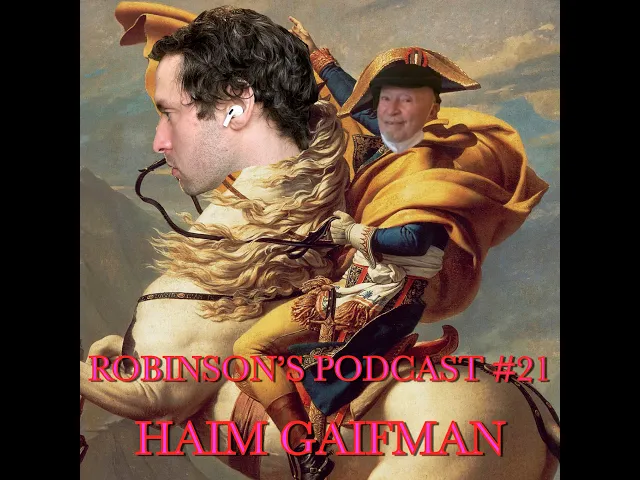
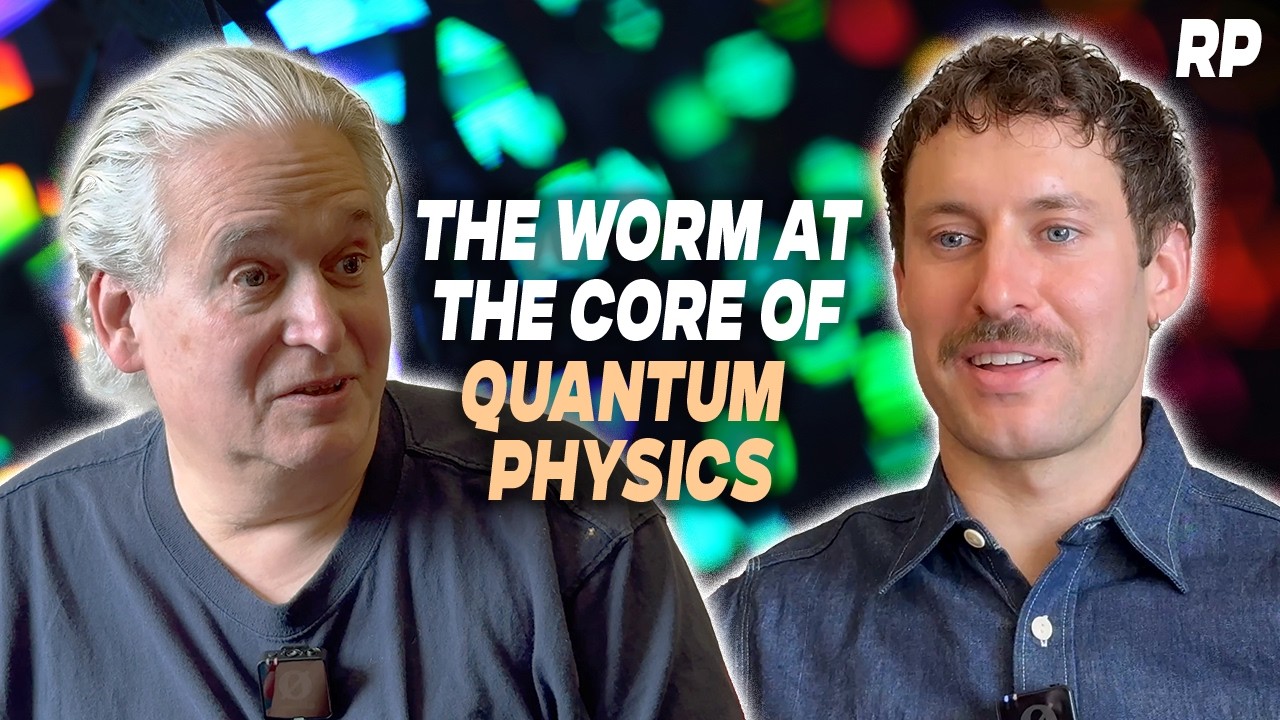
Hello my geese links this is Robinson Earhart the Mother Goose again introducing another episode with heimgaffman this should be the third episode I am recording this introduction with the intention that it will be episode 21 but it might end up being episode 22 or who knows what episode it'll end up being because Heim likes to look at these before I put Them up to make sure that I haven't caught him making a mistake or saying something wrong and in case that is the case uh right now on the the video at least I will be
typing some sort of uh subscript uh clarifying whatever error was made and he'll probably ask me to point out that I gave him no time to repair anyway Heim is super important to me as you know if you have listened to any other episodes He's a computer science scientist a mathematician a probability theorist a philosopher at Columbia University he's also taught at the Hebrew University of Jerusalem and got his PhD at Berkeley from Alfred tarsky and in this episode it's it's more of a well it's a meta episode but not uh meta in the terms
of in terms of the podcast it's not about the podcast but it's meta philosophical and that we start off by talking about what Philosophy is and having talked about this plenty with Heim he's really changed my ideas of of what philosophy is and then for the for the most part of the podcast we talk about what is mathematics and he has a very idiosyncratic way of answering this question and one that has taken me a lot of time to understand but just listening to this podcast episode again yesterday in preparation for releasing It and recording
this introduction it has made it makes more sense to me now now that I've heard it a bunch of times and he's actually teaching a course with Justin Clark Doan on what is mathematics in the philosophy department at Columbia right now that I'm sitting in on and his thesis basically is that to answer the question what is mathematics you shouldn't be seeking to answer questions like what are mathematical objects or How do we know about them but the answer to the question is really really concerns mathematics historically speaking and how it was developed how it
was used who used it the technical developments over the thousands of years since the Greeks those sorts of things and as you listen to the episode you'll get a a better understanding of how he views this whole issue Anyway this was a wonderful conversation I have one more that we recorded back in May this one was recorded in may even though it should be released sometime in October and then hopefully even though I'm across the world in Stanford and he's in New York we will continue to record some virtually all right I hope you enjoy
this episode I really did I learned a lot from recording it with Heim And let me know what you think now we're going to begin okay see already that you've got um books out here yeah this is a this is the most difficult subjects of all the subjects you answered you asked me before well we'll get to we'll get to that subject later I see you have Euclid's elements but the first thing that I wanted to talk about today is when I came to Columbia to study Philosophy I had an idea of what philosophy was
and it wasn't fully formed but I thought it was a way of answering questions yes and you told me when I asked you what philosophy was that it was not at all about answering questions and I found that very surprising you told me instead that philosophy is about gaining insight And I'm wondering if we can talk a little bit about that yes right now so why why do you see philosophy that way because the question presupposes already by posing a question you have a lot of presuppositions there and by answering the questions it is somewhat
a legalistic point that if you answer a certain question in a certain way you are already committing yourself to to something for this video Did you where you when did you stop smoking you cannot answer this question without agreeing that you smoked okay so they they are presuppositions to every question some sometimes the very posing of the questions uses a terminology which commits you to something so philosophy then can't just be about answering questions because it also has to be about uh phrasing them properly that is correct but here we are already a Presupposing that
you die you do a brand of analytic philosophy no no there is a so there are other I I mean I know the answer to this but there are other types of philosophies in analytics yes there are philosophies that come and tell you what the world is and they're like a religious philosophy maybe uh yes or mostly if you you look at philosophy Philosophies you have a Greek philosophy which is our guideline guideline but there are also Hindu philosophy and it is simply a general reflection which expresses an attitudes towards the world and the philosophy
is a kind of an inquiry which is supposed to give you a taste of what the world is that's what the Greek and Hindu philosophies are like the In a sense it's any philosophy it takes it and you can start simply by declaring boldly that this is what you what you will do and you start speaking your language now it might be if it's interesting enough it is it it may be worthwhile for The Listener to learn your language because if you The Listener learns your language The Listener might gain certain important insights into life
into reality into What's called the big words Okay other kind of philosophy starts from so to speak a minimalist basis it doesn't legislate it doesn't give you a terminal energy that compels you to follow the intuitions or to understand what somebody is saying one philosophy that comes to mind that might be of this sort is phenomenology yes but phenomenology already is within a tradition of culture philosophy is a Certain basic attitude to what has been produced by the human race in the in the in the in the area of thinking that's all I can say
or the area of thinking of presenting something it sums up the intellectual history of the human race of part of human race that is philosophy I mean philosophy the raw materials for philosophy is the history of the human thinking of the Human race of how we we talk how we think this is a basic inquiry and not everything can be a subject of philosophy although there have been attempts to do a philosophy of anything some areas are more naturally given to philosophical analysis ah the other than other areas something that Varsity Aquila ivarzi of philosopher
Colombia was telling me today we had at lunch he told me that he just gave a talk on the philosophy of Finance in Which he was talking about the sorts of objects that derivatives are and he derivatives being options Futures these sorts of financial instruments and he told me this sort of stems for maybe concerns about what a twenty dollar bill is because on the one hand a twenty dollar bill is just a piece of matter like uh like a star or a rock or something but in specific contexts it means something very Particular and
in other contexts it doesn't and so I just found it fascinating that there's a philosophy of Finance which had never occurred to me I I don't know to tell you the truth I don't know exactly what he meant I mean philosophy of Finance would be part of economics and economics itself struggles to become its own subject so to speak out of the out of their financial history or the the way human exchange certain items with other items Giving them a value so the raw material of economics of yes economic theory would be the practices of
the human race when it comes to exchange of goods to exchange exchange of certain objects to exchange of certain legal commitments like IO sending an IOU and all kinds of legal documents which commits you to produce or to compensate or to pay or to get paid and so on so so this is Again this is a summing up uh The Brute facts which underlied comments which are facts which go very back to the to very ancient civilization I suppose when it comes to gather hunters or previous there would be no economics right when you say
that philosophy has as its raw materials the history of human thinking would that brings to mind for me is how I tend to answer questions from my friends or family about what philosophy is and what I'm doing in particular with regard to philosophy of math which what we'll we'll get to in a bit but I think of philosophy as I'm interested in it is looking at sort of the assumptions and the principles and the larger questions around Pre-existing bodies of human knowledge so mathematicians go about their work tending not to think during their work week
about what the number two is or what a function is or how we know about these purported objects and it's one task of philosophy to go into subjects like mathematics and then look at what really is going on the Epistem the epistemological questions the metaphysical questions if there are any to look at mathematical practice and it's in this sense that I've come to understand what you meant by philosophy being a way of giving us insight as opposed to trying to answer questions I don't think that every subject is equally as it can be a subject
of philosophy I I doubt that you can make Uh speak about philosophy of baseball for instance you can describe the game and so on but philosophy will be very thin or artificial right but there are there are certainly philosophy of games in general well it depends again there is a theory of games uh yeah you can you can speak about games in the sense of that Wittgenstein has spoken about the language games and things like that But uh games just in general I don't know but some something else that you told me to substantiate your
point that philosophy is not about answering questions is that all philosophical programs have failed again it's a very wide declaration some of them had partial results I don't know in what sense you can say that phenomenalism failed okay there's positive philosophy they've they Themselves came to acknowledge that there are certain questions in which they couldn't carry out the program also so it it has become a fact that certain attempts were recognized as not leading to anything but this was a very valuable lesson and in a sense the fact that a school can say well this
this presupposition and so on we could we couldn't make it it gives you a ground to treat that school more Seriously or give it bigger honors if you can in quotes then other philosophy who by who always argues that they were successful because and then they bring all kinds of arguments why this is this so an attempt which Ends by an agreed failure is an important Enterprise which reveals something that means in philosophy the goal is not to succeed but to gain insight and some philosophies that want to to Show you that no matter what
they succeeded and so on and are by giving Twisted arguments in which to legalize their status so one addition I would say philosophy um of any subject should be related to subjects which have a definitive cognitive dimension what do you mean by and for instance if You take a football it's a game you have to have good Mass you have to give good instincts and so on but the Cog as against as against philosophy of size for science by definition is a matter of cognition of of thinking of something perhaps which is truth of certain
claims in which success means success in having the new scientific results neutral Results and so on I wouldn't say that a physical game which is extremely enjoyable and important and so on is by itself a subject which has a strong cognitive element because it is a subject in which you have a more a lot of training to do a lot of bodily feeling and so on so you cannot speak every philosophy of the body or something like that unless you use philosophy in a very wide sense in which you say My Philosophy of Life is
you know that kind of thing right so that brings us then to a topic very dear to your heart and which is mathematics and one of the questions that I've found burning in my mind for some time is what is mathematics and that's a big question yes a huge question yes but and it encompasses many sub questions such as what are the objects of mathematics If there are objects what unifies mathematical practice how do we tend to or how do we acquire mathematical knowledge but when when you hear the question what is mathematics where do
you start I start by mathematics as a discipline which has an historical place which started at the certain year in which we developed and changed during this year's The body the whole big body of mathematics as it developed during the years as part of the history of the human race okay so you first and foremost when confronted with the question what is math look at its development over time yes look how it was used look where you encounter math let's see that seems like a very common sense cool answer yes I mean you must give
your what is math I don't want to give you an I pray or I answer or to Give you some clever trick also with some formulation what it is or if it is a formulation it should be rooted in pointing to okay you you look at what Euclid did you look at what this did then you can see here is math now in some areas we would say the mass is faulty or has to be corrected and things like that but definitely I think Euclid is a good point to start okay because uh these were
mathematicians who were aware Of the need to give an account or some explanation what they are doing when I think of the history of mathematics the first thing I think of isn't even humans but pre-humans or even today they do experiments on dogs or crows or yes monkeys and that seems to be a good place to think about where well I would say I don't know if you'll if you will have a philosophy of it but you will have a Certain abilities which you will connect to mathematical abilities I don't think there is a philosophy
of math as it is conceived by chimpanzees right I'm not suggesting that that there should be a philosophy of chimpanzee mathematics but they're numerical abilities suggest how ours originated well or why no it's a it's a useful point to Ask what are the mathematical patterns of recognitions because knowing certain math or being able practically to distinguish a nine pieces of cake from 12 pieces of cake very important for me yes is is important for the animal that likes cakes in that sense or as can make choices and I think I mean it's probably important originally
to keep track of your children or the eggs in your nest or any number of other things yeah it Will children you would say if you don't know how many children you have you either must be a very king or leader who doesn't know or how many wives he has because yes thousands or hundreds or something like that yes but uh simply if you say if you give it two hips one hips of which contains more pieces of food or more grains and so on and the animal is given the choice going to this one
or that one you can see what Are the mathematical abilities of animals which are not necessarily the more advanced I mean you can do it there well I don't know about belt whether they are or not are not Advanced now there are all kinds of claims being about the intelligence of birds but in any case you can you can actually conduct experiments in which to you see what the counting comparison by by way of accounting a collection of discrete Units which are each one of them is more or less valued in the same way um
but so then going on to humans presumably and obviously this is conjecture because I'm not an archaeologist or a yeah a psychologist but I imagine that numerical literacy or numeracy arose one for for Commerce and trade uh yeah that's how it was initially used actually I think it was this this for Sure but it was used in engineering in construction and in the need to count how many stones are needed for this and this how many how much raw material and also about the value when you have to change one for the other and so
on and so forth endlessly and these are all uh practices in which you have as some sort of scale of quantity with respect to a certain kind of Certain kind of maybe yeah no but a certain kind of uh material objects like tiles like number of stones and things like that and then presumably I mean mathematics became an abstract practice after that no it the the method the abstraction might have come even without people noticing it uh There's an ancient mathematics which deals with natural numbers which consists of producing abacai and Abacus to come to
Simply to enable a shopkeeper to make very fast calculations to know whether he lost how much he lost how much he gained and things like that and people with abakal with knowledge how to manipulate an abacai are now rare because you don't need it but in the past there were people who could do it just like almost like in computational Speed you might say and why do you consider that abstraction just because because avakai by themselves they don't represent they themselves have no value their value is that you are unable to calculate how much you
will gain or lose if you agree to a certain trade and it's independent of the objects that the little Stones represent right whether suppose you will you sell for This and you get for this and every one of these costs three coins and every one of this you have to produce costume like that and so on so you are a small shopkeeper and you have to at the end of the day to to make a very fast calculation how much you ex what way you're expanded and how much you got and how much you got
you have for the records of uh this was sold by me at that price this I bought at that price bookkeeping so it seems like at least Initially based on the sort of story you're telling or way of presenting how mathematics was first used that it's at least on a very primitive level a way of organizing things a way of Performing calculations a way of bookkeeping to use your word a way of taking measurements yeah okay so I can't think how many uh packages of sand will be needed in order to construct this structure in
which sand is a component or you have health and sand or whatever they use To to produce the pyramid I mean this was a huge engineering job so all kinds of ancient engineerings involve math Okay so this is the initial story before mathematics I think really became a discipline but what so what's the next step uh in in this sort of history that we're constructing look uh if we if we go from every in Greek a great established not only Math it established philosophy I mean at least in the western tradition philosophy as a general
subject begins there and it might be natural that they regarded their mathematical activity as part of a general view of the world so it was very natural for them to give a certain view of the world which is very much related to mathematical activity I'm I'm not sure I Totally understand what you mean okay you know that there has been Pythagorean and there's been and there's been Pythagoras yes but there was a school of potia pythagoreanism yes and they developed the technique of making a lot of calculations and estimates and what we would call now
arithmetic or for instance summation of an arithmetic series Uh summations of cubic cell one to this Cube plus two to the cube plus four to the Q Plus weight of the cube and so on and there's and they did it using geometrical models okay and using geometrical argument how to do that and multiplication is very easy to do because the multiplication is a product and you can which gives you a essentially not the area but the number of squares In a rectangle in a discrete rectangle and then it is obvious if you just rotate the
rectangle that a times B is equals to B times a because it's simply the same thing but just rotate it like that so you had it from geometry and so they had the commutative law for additional multiplication and the distributive law for a multiplication over addition right there from geometry but you said that you said something About with them viewing mathematics as as part of the world it was part of their philosophy it wasn't part of the world it was yeah it was they took mathematics to give the basic form of physical reality in as
much as physical reality can be captured in this way well isn't that also I think how Euclid viewed his geometry it wasn't Necessarily it was he viewed it almost more as physics than as well I wouldn't say you wouldn't say that definitely but I thought that he viewed the geometry that he was developing as his geometry was the geometry of the world that is true it's the geometry was supposed to reflect to give the basic properties of physical space right yes it doesn't mean that physics right this would be true of uh committees in which
kind of realize That you can have the same kind of axiomatic method can be applied also to theoretical physics and he used and developed a lot of models which were based on physics and he was a genius engineer at the same time that he was a mathematician but anyway going back to the the broader question what does this tell us then about what mathematics is well yes mathematics for your for the pythagoreans of the Greeks in general what does talking about this Tell us about what mathematics is okay so for them mathematics gave the bestie
the basic properties of physical space because they their mathematics was geometry and it was Ellen a very a very explicit idealization that means you get the forms of the Physical Space by considering a certain idealization and is the Euclid or the pythagoreans as well I think this we don't have Pythagorean big mathematical tracts like we have Euclid okay but they had their tradition and there are stories about them but the story of a really huge discipline geometry two-dimensional and three-dimensional geometry Is given in the three volumes of Euclid's elements and if you look at what
Euclid does you can see that they are defining the mathematical the mathematical entities as a kind of a limit case of an idealization of the actual physical objects and you can see it from the definition so Euclid starts by definitions there's a whole lot of definition what is the point what is a What is a sec what is a line and what is a geometric figure and so on and you can see that they do it by idealizing the properties of a point and so on so that's why I brought it and it gives a
lot of a long list of definitions okay so for those who the point is that for those who aren't uh watching Heim has taken out a flashlight and it's now reading through Euclid's elements for me okay so a point is that which has no path Right okay and that's obviously an idealization because there are no such things yes so but they treated them they didn't get whether there is or there is not they gave you straight away the idealization so you're saying you're saying they're not asking philosophical questions yet asking oh what is the point
well I don't know that for them this was not also a philosophical questions okay but these definitions is not The reason that Euclid is like such a big classic book of mathematics you can teach Euclid without having these definitions this is not what gives what Euclid is known Euclid is known by developing a very sophisticated and difficult mathematics proving theorems and providing constructions using a straight edge and a ruler this was their standard way of constructing this was so to speak the rules of the game that for them a Construction meant that you can draw
a circle with a given Center and a given radius okay so you have this and then you have a straight edge am I clear yes yes yes we do that in uh high school in the United States yes you take this protractor protractor yeah that's what it's called this is the this is a English term I knew I know the Hebrew one the Israel What is it in Hebrew hoga something which makes circles oh that's a nice word you know but you you know you have two legs and you put one leg here and then
and then you spin it around yes and so you can construct a circle and you have a straight edge so this is the way they did it and a Euclid the propositions what what we call Pro what is called propositions Consists of claims which is theorems but our propositions that this and this can be done which shows you how to make a certain Construction this is also proposition so Euclid the the body of Euclid the way white it is so impressive is the list of propositions and the way it derives it from the axioms so
two things now have come up for me that we've mentioned or two things that I've gotten out of what We've discussed so far is that mathematics originated as a way very roughly of organizing information and then organizing the world organizing the world yes okay by organizing the world um certain aspects of the tiles or or money exchanges packages of information very Loosely and then the second thing that comes to mind is now with Euclid this is becoming more formal and also more abstract yeah that's that's true but the the Actual engineering consists pails of water
pills How many pairs of sand and so on how many many cubic cubic measures of this material of this material they were engineers those who constructed the pyramids so do you want to re is there more to say about Euclid right now oh yeah well I know that there's plenty more to say about Euclid in general but in the context of this question what is mathematics is there more to talk about Euclid right now a great example you can you know the I think what I'm claiming now is an actual fact I can I verified
it once I don't know that I have the the souls there but uh in Britain at the beginning of the 20th century Euclid was used as a textbook for geometry and I think I gave you this example you cannot imagine that any physical size any natural science could Have used at the beginning of the 20th century a textbook that was written at the time of Aristotle right well that that brings into light that doesn't kill your quality of mathematics yes which you've talked to you to quote you yes uh there is no flagistone or flagistan
in mathematics so the Natural Sciences go through Revolutions in which pull swaths of information are or theories are abandoned whereas mathematics does go through sort of fads And Trends and areas of inquiry are sort of abandoned but once something is proven it's proven well that's not completely precise well yeah I'm not I'm not going for a completely no no I want to make it precise okay because from our point of view and I think we are Justified the proofs in euclids some of them are defective that means they omit they use various reasonings which is
not given in the axioms And they assume that you can for instance move a triangle until it comes to a certain place they give all kinds of arguments which are not guaranteed in the action well I'm not saying that people can't have made mistakes that will be corrected but once something is proven in mathematics yes then it can't be unproven so to speak because that is correct that means I don't know I don't I don't know look this is an empirical claim Uh there is no published textbook in mathematics which would simply will be thrown
and say this is all nonsense right okay I know there are certain counter examples and I wonder if you realize what is a good counter example to that you're asking me if I can come up with a good cancer example the author of a book in geometry which is nowadays completely valueless because the whole all the proofs are Incorrect huh her name is Hobbs oh no I wouldn't have guessed that yes so hops was a very smart guy and he was a very uh his first name is John right John Thomas Oh Thomas John Locke
okay John Locke Thomas Hobbs okay Thomas Hopps so Thomas Hopps was a very Elegant writer and he had a leviathan yes and and one of the establishers of political philosophy okay what is less known is that he wrote books in in geometry hubs came late in a rather late in life the other after he studied other things and so on he happened to come upon Euclid and then he opened it and they Saw the proofs and says this is marvelous this is incredible it was so you can do and then he started working and said
well I have a theorem which how to trisect the hang and angle the you know an angle and and so on and so forth they have been the well-known problems of Antiquities the doubling of the cube and the trisection of the angle and there was uh another I forgot the the three classical problems of Of geometry and [Music] the section of the angle doubling of the cube this was I can look it up look at that what was the the third one it is three classical problem oh no no no uh the circle producing squaring
the circle squaring the circle producing the square hose area is the Same as the area of a given Circle doubling the volume of a cube yes this is all your suppose you have to uh two Altos you sacrifice two Alters yes two altars you sacrifice on them and then you want to build an altar whose volume is doubled the sum of the volumes of the two Alters this was a kind of the story of that but it's yes the doubling of the cube that means find the cube whose volume is Double of the volume of
the cube find the construct this this was supposed to be geometrical constructions so you give me the lengths of the side of a cube and using a straight edge and the protractor you have to construct another another Cube which whose area is double the area of this Cube okay so you what you are giving you are given a segment and you have to construct another segment The segment will be the size of the cube and the same goes for squaring the circle and the same going for dividing an angle to three equal angles and so
the your point was just that Thomas Hobbes thought he might have solved some of these he was sure that if salt but he didn't so it all had to be gotten rid of it's an interesting because I looked into what he did and it's very very it's Not it's not at all clear well he was dumb he wasn't dumb he was a sharp guy and he thought that he could do you do it like that no no the there's an involved construction there but it's some somehow it is not correct and it's difficult to see
because it is a little bit vague what exactly how exactly it works eventually it became a kind of a game almost between Thomas Hobbes and another mathematician whose Name Escapes Me was a serious mathematician British mathematician you say this is nonsense you didn't do it and then they asked for the French Academy to judge it wasn't whether and after a long debate and so on they came and judged and the verdict went against stops but the hubs was also a very ambitious person and his goal was really to become famous by that time the house
this story was Not very interesting to him because he published his writings on political philosophy and Leviathan and made himself a worldwide name so he got his uh his own satisfaction from becoming famous and well known from his political writings and for the nice style I mean he style is incredible all right I'm gonna have to pull you back to Euclid again okay or maybe are we moving on from Euclid no no no so now in Euclid thou defects But it was recognized that this was the right thing way to do it and this Final
Solution came of the final uh crowning of this work came in the work of Hilbert from 1891 when he gave a complete axiomatization not only of this geometry but all kinds of other geometry hyperbolic he gave he gave examples that these axioms gave counter examples to the showing that these axioms do not imply this and a lot of other meta claims About the system but essentially he gave a way of accommodization of Euclid since that there are other axiomatizations of you but again so so what this tells me though again is that we're moving from
just organiz organizing the world to giving various ways of organizing abstract information which is completely precise which admits of no vagueness or not clearness which goes with empirical signs because it is not an empirical Science even though it began it began look they thought the pythagoreans thought that the world was rational this is a they discovered the when you say that they thought the world was rational what do you mean it the world is something that is given uh they had the notion of rationality and according to them a rational quantity was other and natural
numbers which is a discrete Collection of discrete items if you wanted or fractions So when you say that the world is rational or they believe that the world is ready all quantities could be expressed as a ratio of two natural numbers that is correct okay but then they discovered that uh that the diagonal of uh Square was not rational it was not Russia so it could not be expressed as a ratio and that Brought a big crisis and there are all kinds of Legends and stories about it most of them probably dubious that one story
goes that they killed the one who first published it because it shows that there was something wrong with their whole conception of the world but as a matter of fact this irrationality and that is very much is well treated in the volumes of euclids by and your doctors your dogs your Doctor says so the part the field which is impressive is that at extremely high sophisticated mathematics and very difficult proof okay no question about it ingenious difficult proof that is what gives it the aura of being the classic work in mathematics but what does it
tell us about what mathematics is then in a phrase it is uh It's as a system basing based on the certain idealization which admits of incontroversial proofs secure proofs which gives you a certain way of organizing the space to me while I'm sympathetic to a lot of that well they thought the big the big Point came in when they started looking into it and found and asked if there are other ways of organizing the same Material which is not euclidean geometry and this brings you to the discovery of non-euclidean geometry so the point that they
can't made that these are up priori they are synthetic because they involve the certain geometrical view they are not purely logical and I think Kant was right you need axioms which are not logical axioms but can't was wrong in thinking that this was the only way of doing it so the Other way of doing it mathematics consists of extending this method which is completely precise which has no vagueness in its empirical Sciences doesn't depend on experiment extending it to cover more and more domains and more and more possibilities so you have numbers which are commutative
and then you use the algebra Rings of fields which are not commutative and then sometimes you go to even very very abstract systems and all of them can be treated as a piece of mathematics so it is so what is it that unifies the fields and the Rings and what Euclid did and the method of the point is that they share certain properties for instance there is a commutative field of what you used to be Called the skew field which is not commutative multiple a commute I feel this by definition some uh where there is
a definition of a field this is a collection of a domains a domain we stop with two uh with two operations plus and and multiplication identity element yeah and the yes identity elements for both of them so like a group you have this group in this group and and so on this is a kind of structure of this form and there are Axioms and you derive other from these axioms using this axioms of the derivative now this can become very very abstract but still the method persists that means logic itself can be treated in this
way as a mathematical system and in logic there are different Logics and and you might have debates about what logic is whether it should be intuitionistic or non-usualistic or finite in the Hillbilled incense only actual infinity and so on but when you go and see how the debates go on and what the people are doing all of them are doing mathematics I can be a non-intuitionist or somebody who is completely a and committed as whether one should be or not be an intuition an intuitionist is what intuition is a logic in which well intuitionistic logic
is a logic but intuitionism itself Is a foundational philosophy of mathematics well that you use the logic which is intuitionistic logic in the proof right but what they they think of mathematics as being something that's in the mind roughly it is in the mind no matter what mathematics is no many people think that mathematics well so you're making the assumption that mathematics is a is a practice but other people might say that mathematics is what's existing in some Other Universe a platonic realm and you're dismissing that immediately no I mean this this is just a
gross look right put it like that first of all the Greek didn't consider the possibility that there will be non-euclidean geometry right okay so from that point of view it is if you want you can say they they consider that there are platonic uh platonism is a kind of it goes nicely with this because it is it it is A realm which is obtained by idealization and which gives you in this idealization certain [Music] properties which you might want to say are the essence of the the essence of a line it it is a length
which has no breadth and no depth okay some essential Properties or some and you can from this you can use platonic forms as your philosophy of mathematics and you might want to say that the Euclid the straight lines were part of a platonic fall or platonic entities okay some enter entities in which everything is precise and which is which is what we call platonistic platonic form but there is no commitment to viewing it in there should be out there should be no commitment to viewing mathematics in this way and every and those who think That
there is a big problem with mathematic objects simply don't realize that mathematics doesn't the object the platonists mathematics is not the mathematics of mathematicians today so what I'm learning from you right now or realizing based on what you're telling me is that when I'm asking the question what is mathematics the way that you're answering it is by explaining to me the nature of the practice yes whereas when I was Initially asking the question when I when I initially asked the question what is mathematics the it's an it's what is done by mathematicians right that's not
what I had loaded into the question what I had loaded into the question is what are the objects how do we know about them and I sort of expected your answer to I I this is a bad question right I I think it's a bad question look suppose so tell me Tell me why it's a bad question to ask what numbers are because the numbers or what sets up okay or what triangles are okay uh imagine an abacus okay okay symbols you know they are they are the the stones or beads or whatever the beads
you use beads and the beads has various colors and so on and you you might as well say that there are numbers written on the on the beads and so on sure and the whole Function of these beads is like having uh what do you call it in when you in the casino you get chips with this and you ask what is the chips and they say you you now start worrying what kind of entities this is a g I think that's a worthwhile question to ask no what is a chip a chip is a
physical item and so on but let's go back to what varsie and I were talking about earlier in that a chip is not just a physical object I mean on some level it is but in certain Contexts the chip like a casino it means something it has it has value whereas on Mars if we discovered a chip there I mean it wouldn't have the same meaning that is correct that is certainly correct so are natural numbers natural numbers are the same gets their meaning in the way they are being used this is what gives them
their meaning it's not that some sort of entities like a piece of stone that you rev that on Mars it is not what it is on Earth right well that is what some people think is that there are objects that are numbers but yes but but the whole question is ridiculous because numbers if by up objects they mean some physical object their ontology is a completely different ontology from the ontology of mathematics in which the numbers themselves gets their whole meaning and their whole status in the way that they figure out and they are used
in the system It is like in a casino that the chip is much more than the physical object because the chip has a value and you can move the chip from here to here and push it there and bet on it and so on when you phrase it that way though you strike me as a structuralist about mathematics in which mathematical objects are sort of the idealizations of their properties so the number two isn't an object just whatever is second in a progression but I don't that might be also but this is Not the only
way in which you can do it you can do it in many ways the natural numbers come out yes if you want to speak it in the context of a progression yes in the context of a community group or an all that grew in a commutative group or in other group you have another so these same numbers appear in commutative Fields non-commutative fields and so on so the structure itself should be addressed from this wide point of view The trouble with philosophers particular philosophers or mathematics said oh no the whole thing is just structure now
let us give what is a structure and they start getting into the same old difficulty as before right says they want to give some sort of some sort of they can handle it right this is Stone Age ontology you know so you know about the Johnson said I I told you the story Something about kicking a rock yes I mean Sam Johnson the one who wrote the English dictionary the great guy 18th century 17 18th century and the he had about Bishop Bartley and he said Bishop Barkley an idealist thinks there's no physical reality it's
all ideas in the in the brains of people or in the minds of people and since we must have Something which is there even people are not they are all uh ideas in the brain of God of God so that Berkeley and philosophy okay and so Sam Johnson was was a told about it and they said I refute him thus and he gave a kick to his Stone so for as an object is something that you can kick her out And and and initially it is the same intuition an object is something that you must
have causal relation must be able to grab it it must be able to hit another object how can you know about such things they have no causal relations right there are no causal relations well that goes to my next question is how do you answer epistemic challenges about math yes because we know because we know we know That uh if we take this book and we take that book they make two books from experience but then how are we able to prove or say that we know that such claims hold generally and then how are
we able to make such claims as uh the Continuum because it's larger than the size of that is a that is a different style of the natural numbers that is a different step my dear this is a difference well the Idea is that these these can be verified empirically in theory at least uh questions about the books that one plus one equals two or we have two objects if we hit but we can't do the same thing but this is not what one plus one really means so what does it really mean then and how
do we know that how do we really know that one plus one equals two if it's not insight into some abstract realm and obviously I'm playing devil's advocate here yes obviously and and I Have to answer you and that is that uh you I I'll give the fragrance although I don't agree with it because in principle that there might be an arithmetic which is completely different had the empirical world big radically different okay but uh when you teach children mathematics you teach them using physical models you give them the practice of counting okay But the
meaning of three plus five equals eight it's not there is not it doesn't mean that if you have three marbles here and five marbles here and you take the both of them and put them into a box and then you open the box there will be eight marbles this is not the meaning of that the meaning is an abstract meaning the meaning is if these numbers are you are Objects apps they're there that is true that they are abstract objects but they are abstract objects that are used in the organization of the world so their
meaning comes from the meaning of the way they function in the system like the meaning of a chip in a casino comes from the way it functions in a casino it's not just the the the the physical symbols which is used so then how do we learn about these abstract objects we learn because these are the rules of our Language these are the rules of our thinking you learn it the way you learn a native language that's where you know it and this is this again you don't need to have a causal relation the relation
is much deeper than that this is the way we think so it's closer in a sense to learning how we ride a bike than it is learning that it's raining I mean we Learn about numbers sort of by doing mathematics and by thinking in a certain way we don't learn about mathematics the analogy there is not riding a bicycle but speaking a native language how do you learn this the how do you know that uh Tom is good and ugly is equivalent to Tom is good and Tom is ugly this is an experience by interacting
With other human beings the world that's part of the world oh by five if you want to have that that I do want to have that no because it's a Human Institution but there's a there's a a disenology between these two cases that's very important which is there isn't something objective in a sense about the human language it's still something that is arbitrary and up to uh evolutionary accident but two plus two equals four is is not like that there's something objective about it That is true so how do you address this analogy okay since
you know you you recognize the idealization that involves in using natural numbers okay you can see that this is you recognize them there you recognize the validity of such statements just by thinking of them or by deriving them from other statements which whose Validity has been established before eventually you will need the proof so either they are self-evident almost an axial or you need a proof that's all okay that I that I I can accept and so we've gotten a couple of things out of this conversation so far one we've we've described the practice of
mathematics using history a bit as something that Relies on proofs comes from or builds theorems based on initial assumptions it's a way of organizing material in the world this is axiomatic method right and we've also then talked a bit about what mathematics isn't what its objects aren't yeah and how we know about it what were some of my other questions the last thing that I'd like to ask about today is in discussing this question in the past You've liked to use these the example of tiling problems to explain what mathematics is and I explained the
beauty of mathematics okay so you don't you don't uh view them as a good example for describing what mathematics is mathematics can be beautiful or not beautiful okay well let's let's I guess the last few minutes then talk about one tiling or a tiling problem and how it shows what mathematical beauty is okay So look so what's this problem okay so I I cannot well okay you can describe it okay you have uh okay so this would be come to the presentation at corner yeah okay so imagine a bold of 10 times 10. so it's
a square ball a square board divided into 100 little squares yes the size this the sizes of the board are squares segments of length each segment is divided into 10 equals well we can just Imagine a chessboard sort of no I want 10 times 10. okay but ten times ten ten times like a chess board by 10 times 10 a mode of ten by ten and no coloring or coloring no nothing nothing at this point just 100 squares you give away the whole thing yeah nobody has any idea you are a spoiler nobody has any
idea no no no no no keep going okay now the point is now you have dominoes every Domino consists of two squares arranged in a rectangle but the size the Length is twice as much as the breath right so it's divided and the tiling is a covered it's a covering of the board in which every tile covers two squares of the board there's no overlap between tiles and tiles don't go beyond the boundaries of the boat okay sure now it's very easy to tile a board of 10 by 10 by tiling first of all say
the first row Five tiles five tiles five times five times and so on and you get the tiling of the ball right or you get another one the the columns five tiles five stars a column and you get the tiling of them because five five tiles times two equals ten spaces ten Spade ten squares right that's all now suppose I mutilate the boat by omitting by cutting out one of the squares the square that is being cut can be in any place of the boat So in the picture it will appear like white space so
there are 99 squares now obviously they cannot be tiled because every tile covers two squares and therefore there must be an even number of squares and here there's odd number of squares you this cannot be tiled this is Trivial yes now suppose I mutilate the board by taking out two tiles now you have 98 and the question so the argument from uh From the being that requires an even number of squares doesn't the previous argument trivial doesn't work here because the number of square is still is the the number of them is an even number
a number of this but you can't just easily go down anymore yes okay that is correct and the question is can in general this be also it's an even number can it in general be tiled right that's the question provided It's not a complete board right okay and we already know that if it's an odd number of tiles yes it can't be titled okay and not number okay so the the standard example which you give is you take a corner one corner of the boat out and then you cut out the the diagonal corner at
the other end and and you can this board be tiled yes and you do it's very difficult question to to answer to prove in pure mathematics yes in pure Mathematics you have to prove how to prove or to even to find an answer the right answer okay because it's 98. now there's an ingenious idea you color the board like a chessboard but here it is a board of 10 or 10 times 10. okay and the you'd cover you you suppose you color it red and black or something like that because the white will be used
for the blank squares for the mutilated Square Which is emitting so you have two colors now if you look at the diagonal you see that you will have the same color in both ends at both ends if it's like a chess board you know just about it's obvious but it's true for any board which has an even number side even number that it will be the same color every tile on the other hand must cover adjacent squares which will have different colors in this case then You have 48 red squares and 50 blacks yes and
then you cannot therefore you can so this is this is a this is a conclusive argument now this is an ingenious trick and the Ingenuity comes from the fact that first of all the question by original question didn't refer to colors I added another dimension to the whole setup and induce another Factor here and this factor helps to solve a problem In whose statement this Factor did not exist and this is a very known technique in mathematics you take a certain mathematical entity you modify it by adding an additional parameters or additionals and you answer
a problem which relates to the original entity without the additional machinery you impose on its additional maturity and you solve it and you don't need actually the additional machinery for Stating the problem the problem and the answer makes sense without the additional Machinery the additional Machinery shows that you cannot do it that something is not doable this is the beauty of it and the beauty comes from a high satisfaction which is epistemic satisfaction as if you have here something which is blood some would bled and you don't know what it is going what is going
there and how It is and so on and so forth and all of a sudden you say okay now look shift a little bit your head go like this and you put lights on it you see the whole thing that's beautiful so Beauty in mathematics with this is epistemic is it is a Simplicity ingenious epistemic trick which gives you an epistemic satisfaction so it's something it has to do with encountering the unexpected yes It has to do with uh but it is Simplicity and elegance elegance but the point is that what the goal is epistemic
clarity so it's all operates in the epistemic clarity domain and that is why it's beautiful we are satisfied that it is so satisfying we are amazing it we see it is amazing ingenious and so on we have a nice feeling about it are there other aspects to mathematical beauty that don't figure Into this particular problem I don't think so okay so it all reduces to this epistemic beauty yeah no something sometimes though the establishment of an additional way of looking or you establish a very complicated additional organization which can take years in but then this
additional organization helps you to solve scores of problems which were opaque before so it is here It is a little trick in a game and you see it in five minutes these five minutes can be translated into five years into developing an additional structure which you can be imposed on the additional Pro I'm sorry it's okay which which you can impose on the additional on the original problem so that you can save uh give an account which solves a whole list of problems which are otherwise difficult this is what Category Theory does so this actually
I think brings us back to my first question of the evening so we talked about what mathematics is as a practice and we've now done a little bit of philosophy of mathematics okay which is if philosophy is about bringing insights to aspects of human cognitive activity we've just described what is beautiful about mathematics so that's sort of what One one thing that philosophy can contribute to mathematics no not every problem in mathematics can be solved in a beautiful way even in category Theory and the hardest problem in mathematics uh we thought in what let's say
classical mathematics which is mainly mathematics in which algebra calculus geometry and things like that not logic not set Theory set theory is a different area altogether right but traditional mathematics like the Riemann conjecture or heart problems in the calculus of differential equations and so on might require the use of computers to solve the problem or to in some sort of organization in which you will rely on other results that you take for granted okay probably there are all kinds of Tricks probabilistic methods and things like that that that essentially it you you obtain as given
some brute facts which you don't go into and these are ugly Solutions but ugly Solutions have solved many problems with no other Solutions like apple is proof right yes and then the and this was a proof that one over three to the one over three plus one over three Squared plus one over three to the five uh wait a minute let me no no no I'm sorry I'm sorry I thought 1 over 1 plus 1 over 2 to the third plus one over n three to the third the the reverse third powers of one over
n squared where n goes from one to Infinity this is an irrational number yeah that sounds difficult no and the proof is The pro for this is a big achievement of Euler it gave the example and they gave a proof which was defective but his answer was correct and that from this answer it follows immediately that it is irrational and there are other problems like that and these are up to this very day is not solved by any of the other elegant methods it's only solved by a brute method no aperi is not it's an
ugly Story right that's why I said it's not it's not a group method no I said brute brute yes it takes it's it's ramanujan if you have if you know the name add intuitions into this kind of problems this is a kind of uh results in mathematics which was done by how the a littlewood in the British school and so on very complicated infinite products infinite Psalms all kinds of ratios involving the number pi and all kinds of Things tricks integration and so on very hard problem very hard Solutions and they are not they are
not beautiful that's all this is a class but but the computers which are now being used to solve problems like the focala problem and Tom Hales problem they are even uglier than that because you you you you give part of the solution to a computer which you take without understanding You have no conceptual access to the problem itself except you of course you know how the computer works right so if somebody has intuitions about huge epistemic problem yes but look it depends if you are the programmer of the computer then you might get a big
satisfaction because you have your own intuitive access right to and then you say oh that's a beautiful program it's a beautiful code it's like A goat which is written I don't know 200 lines of codes and says it's a beautiful code I wouldn't be able to say that's a beautiful code but somebody who is a programmer who has his own aesthetic criteria and what is a beautiful code and what is not a beautiful code can say it because you say it has a he the programmer has a kind of intuitions which gives him epistemic access
to Areas for which I don't have epistemic access so he already operates in a different domain than the mathematician who wants a solution to the problem right okay Professor it's time for me to take uh the dog out okay so um before you take those off though thanks again so much these events okay sure this is the fourth one we've done and they've all been so fun to do so thank you so much yeah it was fun for me Okay I have recorded this about 10 times because I'm just so bad at asking for help
but if you could like subscribe comment on whatever Medium you're consuming this nascent fledgling podcast on that would be so helpful because the best thing for helping me grow this podcast at this point is making it at least appear that I have an audience so thank you for listening and thank you for supporting Me