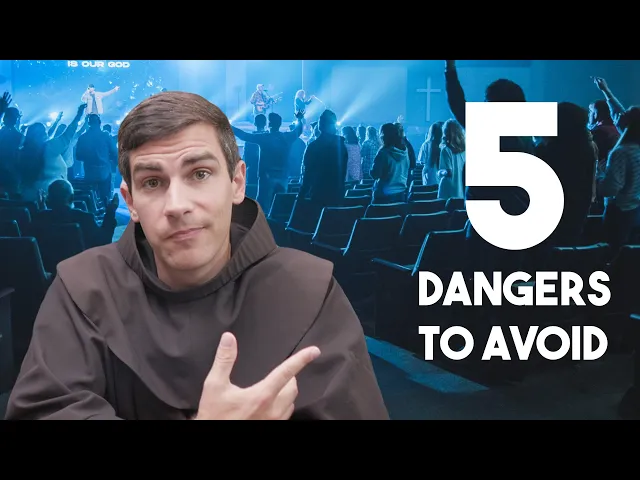
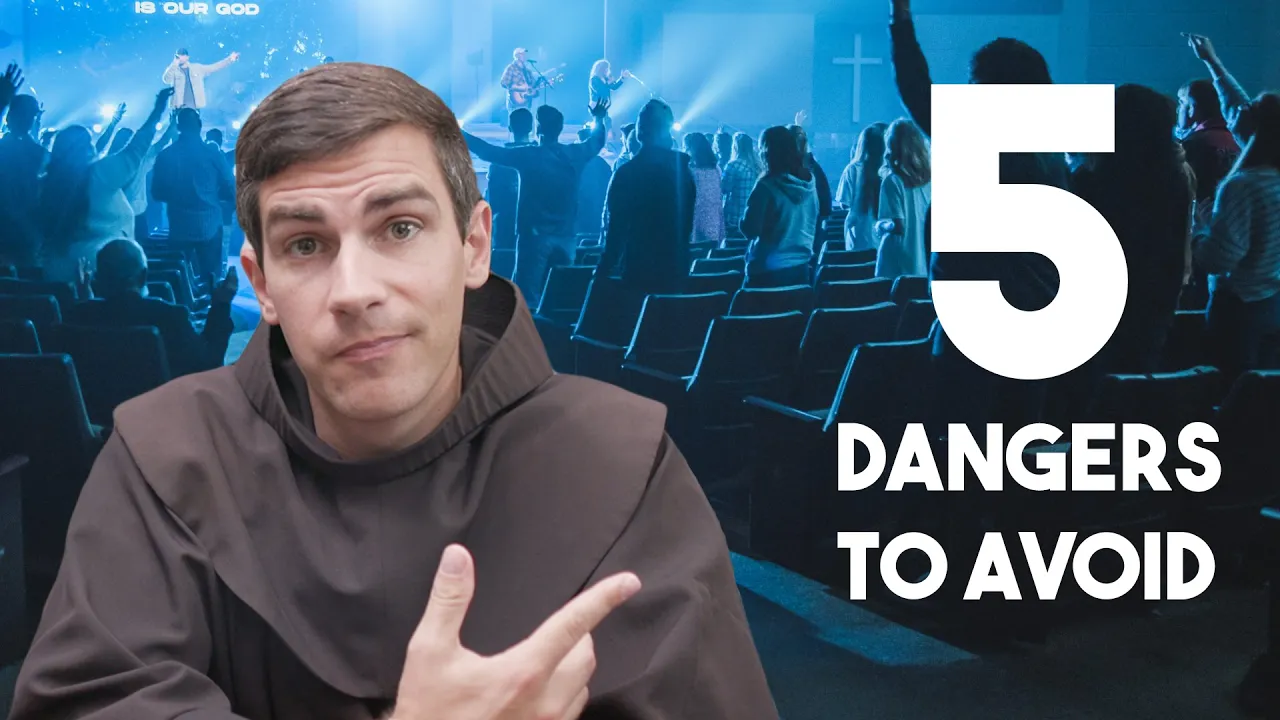
Easter is the time to celebrate Jesus’ resurrection over the death of this world, to joyfully praise the God who saves us and transforms our lives. There can be no higher or more solemn act of worship. I wonder how megachurches celebrate this feast… [clip] Well, singing Benson Boone wasn’t exactly on my bingo card.
I bring this up, not to hate on this specific church or comment on this specific choice of songs, but as background for a fascinating video that I saw on TikTok last week reacting to just this. It’s from a former megachurch music leader who was disappointed in the poor choice of the church, but also completely unsurprised by it. For her, it is not just a matter of a singular bad apple or a minor lapse in judgment, but a problem with the very nature of megachurches themselves.
In her video she outlines five points, five fundamental flaws with the megachurch model that I want to share here—not because I want to comment megachurches directly—I have no idea if what she’s saying is true or not—but because I think the flaws she finds in her own experience… have a lot to warn us as Catholics. Even though the Catholic Church may appear completely different from most megachurches, the temptation to make the church into a human institution, an earthly kingdom all about us and worldly things, is all too present in every church. Let see what she has to say.
1. mega churches are not biblical—small groups took care of each other like a family rather than a light show and TedTalk I think it’s helpful from the start to remind ourselves what the word “church” originally meant. As much as we use the word to refer to the specific building where worship takes place, the original meaning of this word referred to the people that occupied the building.
When Scripture speaks of “the Church” it’s using the word “ekklesia,” the greek word for assembly. Especially in a time when the Church was the extreme minority, persecuted by both Jews and Romans, fixed buildings were hard to come by. They gathered, as this creator rightly says, in houses, but they also worshipped in caves, catacombs, the temple, synagogues, and even rented rooms.
What mattered to them, what MADE the church was not the special ornamentation or dedication of a building; it was the body of Christ that was celebrated by the people who inhabited it. Don’t get me wrong: I love big beautiful cathedrals. I think that we should give God our first fruits and do the best that we can to make the place where we worship him a wonderful place.
But the place doesn’t make the worship, the people that inhabit it do. God would much more prefer a mass in the sewer with saints than in a cathedral mass filled with hard-hearted hypocrites. And so would I.
As Catholics, we may not have the temptation to turn our worship space into a concert hall, decked out with the biggest screens and nicest sound systems, but we are definitely guilty at times of caring more about the space than the people, getting all bent out of shape about candles and altar linens and statues, while neglecting the poor at the door and the broken hearted in the pews. Forget about the people, and what we’ve left with is not the church, just a big, beautiful, meaningless building. 2.
power and money corrupt ministry; ministry stops being about people and more about protecting a brand At first, this may sound completely irrelevant to Catholics. Our priests don’t make six figures. Most churches are not bringing in millions of dollars.
We’re not selling coffee or merch in our vestibules, putting out a brand for people to buy. And yet, think again about what’s at the heart of this point: caring more about maintaining influence than caring for people. Not relevant to the Catholic Church?
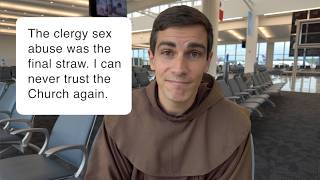
I wish this was true. This is the very problem that led to the scandal of the priest abuse crisis. Not the abuse itself, but the cowardly act of covering it up.
People knew it was wrong, otherwise they wouldn’t have moved the priests. They knew it was wrong, otherwise they wouldn’t have tried to keep it quiet. What mattered most to the leaders of the 1960s, 70s, and 80s was not the safety and welfare of the people, it wasn’t living in humble virtue, it was maintaining financial and cultural authority, protecting the image and assets of the Church.
To admit fault would risk losing donors, risk losing political clout, risk smearing the reputation of God’s Church. It was more important to hold onto those things than act justly. And we all saw what happened eventually.
Eventually, the truth came out, and gone was our integrity. When the Church is more concerned with earthly power and influence than people, with building our own kingdom than serving Christ’s Kingdom, things are going to fall apart. 3.
Ego over humility. Power leads to entitlement and blind to flaws. When pastors start acting like celebrities; system favors charisma over character.
Of all the points she makes this is definitely the one we are most shielded by, simply by the nature of the mass. Our services are not built around a sermon or the personality of the preacher but the lectionary and eucharistic prayer. The vestments limit individuality, the liturgy reigns in person agendas.
From place to place, the Catholic Church has much less variance than other denominations. But not “no variance. ” There is still room for the personality of the priest to come out and even take over.
We know that people shop around parishes to attend the mass of the priest they like. It is not unheard of for father to have his posse, his favorites, his in-crowd that get special attention. Add this to the fact that priests in the Catholic Church are already treated with more deference and respect than their Protestant counterparts, given canonical rights over parishes that afford the near absolute authority, and it is very easy to imagine a Catholic pastor as the prince or king of his small domain.
Which is not to suggest that priests are bad people or that they enter seminary with any sort of Machiavellian ambitions. I think most enter this life for good and holy reasons. What she’s saying, and what I agree with, is that unchecked power corrupts.
When all you ever hear is yes, when you’re told over and over that you’re special, that you’re in charge, that you’ve been given a unique gift from God that no one else in the parish has… it is really, really difficult to remain humble. This is not uncommon in parishes. In many places, it is the norm.
In my opinion, this is a structural flaw that leads to messes. The best parishes are the ones where the pastor works collaboratively with the laity—not democratically or denying his responsibilities—but listening to his people, walking among them, sharing in decision-making, and welcoming criticism. Priests may act in persona christi in the liturgy, but that doesn’t mean we’re saviors.
When we forget our common baptism with the faithful and the need to model Christ’s humility, the Church becomes more about the priest than Jesus, and that is a problem. 4. trains people to be consumers not disciples; experience over sacrifice.
This. This right here is when I paused the video and realized that I wanted to share this with everyone. What a profound statement: “When church becomes a production people stop asking how can I be transformed by this and start asking was the worship good today.
It’s not about sacrifice it’s about experience. ” Of all the points she makes, this is the one that hit me right between the eyes as a Catholic. I have experienced this soooo many times.
Think about what people argue about online. Look at what gets so much attention and ire from certain types of Catholics. So often the discussion is about vestments and music styles and architecture.
What so many people claim they want most, what draws them in, is the style of worship, a sense of reverence, solemnity and order. None of which are necessarily bad in themselves—priests should follow the rubrics and we should want our liturgies to be as wonderfully put together as we can make them—but putting these things as the ultimate values has everything backwards. It makes us, as she says, into consumers, not disciples, interested in experiences not sacrifices.
What matters most in worship is not how it is performed but what it effects in us, the conversion that it invokes. We go to worship not to witness a show but to be transformed. It’s why the liturgy was reformed by Vatican II.
The Church did not want people showing up to watch and pray privately, liturgy shouldn’t be about being a passive receiver of God’s grace. We are called to full, conscious, and active participation. The priest has a critical role, obviously, but he can’t do it all.
The people have responses, they have gestures, they have a responsibility to actively engage with the readings and mysteries so to offer themselves as a spiritual act of worship. If we show up to church and expect to do nothing but receive, we are consumers not disciples. We may praise God by our attendance, but worship, by it’s very nature, requires sacrifice and conversion.
5. inward looking rather than missionary Again, don’t get distracted by the examples she gives—drummers, merch, venues. What bothers her, and what should bother us, is a church that is only concerned with making itself bigger.
Which is not to be confused with evangelization. Evangelization is great and important and the exact opposite of what this is. What’s she’s talking about is a church that is inward looking, that brings people into the church to support the church… Rather than what a church should be, which is outward looking, building people up so that they will go out into the world.
The problem with so many megachurches, and not a few Catholic Churches, is that they are entirely self-serving. I see this all of the time—you look on their websites and everything is about building up the church itself—musicians, ushers, parking lot ministry, daycare, food—there isn’t a single mention of the outside world. There is nothing about serving the poor, nothing about going out.
It’s all about bringing people in. And since the liturgy in these situations is about creating consumers and not disciples, this means bringing them in not for any sense of mission, just bringing them in to make the church bigger. There are definitely Catholic churches that are just like this, parishes that are their own self-perpetuating machine.
They do so much and are filled with good, welcoming, genuine people, but for what? I look in the bulletin and I see that every ministry is about serving parishioners. Altar servers, fish fries, faith formation, music, greeters, nursery.
Everything they do is about serving within, nothing at all about going out. A Church without a mission, a church that ignores Jesus’ call to go out into the world to make disciples, to care for the poor, to bring peace… is not the church that Jesus founded. It is, as she says, corporate machinery dressed up in scripture.
Which… may not be true of your church. It’s probably not true of the majority of churches, in fact. But that doesn’t mean there can’t be elements of truth, reasons to give us caution.
In my video about whether the Catholic Church is a cult I obviously said that we are not a cult, but I said that we shouldn’t be so quick to dismiss the question. It is not as simple as a black and white, yes or no answer. When we look at the qualities that make up a cult, we have to admit that we can be tempted by them, that at our worst we can begin to inch closer to them.
And I think it’s the same with megachurches. At our best, we could not be any more different in worship, theology, or mission, and there is never a worry that we will ever actually become one. But that doesn’t mean we can’t learn from their mistakes, that we can’t recognize in ourselves the same temptations to build an earthly kingdom, as so many of them have.
Is the church you attend focused more on people, or a building? Are decisions based on the Gospel, or on power and wealth? Does your pastor serve Christ’s kingdom or is he out to build his own?
Are people transformed by worship, or simply entertained by spectacle? Is the Church more concerned with those in need, or just itself? Five important questions to keep us focused on what matters.
Five important reminders of what the Church is and what we should be about. May we always be a people pointing to the Kingdom of God, and not concerned with any kingdom here on earth.