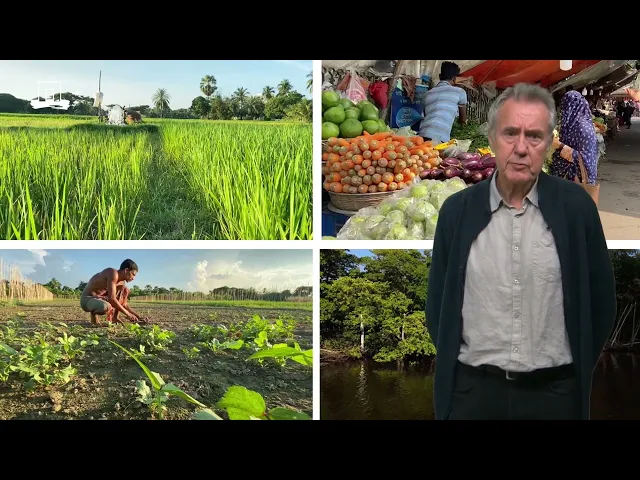
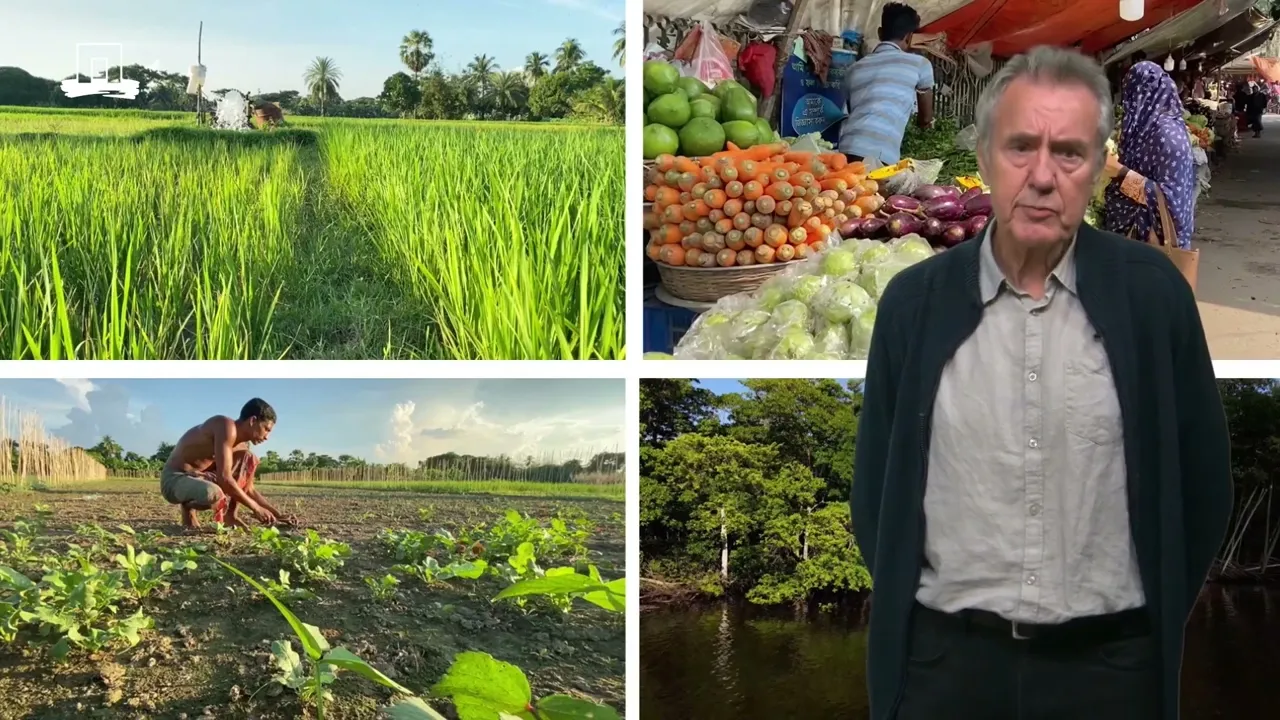
To achieve sustainable agriculture. . .
in food systems poses an enormous challenge. To realize this, we need to address the four. .
. objectives of the food system approach. .
. which can be seen here. Sustainability requires new agricultural production processes.
It also requires a change in behavior and practices. . .
from stakeholders in agrifood production and consumption change. These stakeholders include farmers, food industries. .
. wholesalers, retailers, and last but not least, consumers. Such an encompassing change process we call a transition.
Related to this, we also speak of a transition pathway. The transition pathway is defined. .
. as the required development path along which a sustainable. .
. future develops from the present system. The transition is so complex and encompassing.
. . that it cannot be planned and realized from a central point.
It will have to result from a broad variety of initiatives, each of which addresses only parts of the agrifood system. There is a risk, however, that the changes that result from. .
. all these parts of initiatives are poorly tuned to one another. And cannot be connected to change the system as a whole.
. . in a more sustainable direction.
To address that problem, Wageningen University & Research. . .
has developed a method. . .
that seeks to coordinate the activities. . .
of various stakeholders for sustainable development. The method uses six steps, each of which. .
. strongly engages various stakeholders. .
. to ensure that they are committed. .
. to the various outcomes of the process. And aspire to work on specific topics.
The method acknowledges that stakeholders. . .
have different interests and that there. . .
will be differences of opinion. Meanwhile, it seeks to identify the common cause of action. .
. that serves the interests of the key stakeholders. Necessary to realize a transition.
Starting at the top middle and moving clockwise. . .
the first step is the analysis of the present system. What is at stake. .
. and what are the main sustainability challenges? In the second step, we moved onto food system mapping.
. . to identify the main characteristics.
. . of the present agrifood system.
The next step is prioritization, setting the key targets. . .
for what needs to change. Then, in the design step, the future is explored. There, stakeholders jointly develop.
. . visions of a sustainable future and explore.
. . the transition pathways that could lead to such a future.
In the fifth step, stakeholders plan for action. They translate the transition pathways. .
. into activities for the near term. The final step is acting.
Here, stakeholders take concrete initiatives. . .
to realize the transition. Such an exploration of transition pathways. .
. does not provide a blueprint approach. In which the transition can simply.
. . be realized according to plan.
It can be expected that, in the course of time. . .
various developments will start drifting away. . .
from the initial vision. Furthermore, the desired future system is not a set situation. In time, stakeholders will change.
. . the future they work towards.
That is why continuous adjustments. . .
to the pathways and the intervention points are needed. For that reason, it is important to assess occasionally. .
. how things are developing and related. .
. to the initial planning. That is why a process of monitoring, evaluation.
. . and learning is at the heart of the method.
Related to all steps in the transition process. Following on a next round of monitoring, evaluation. .
. and learning, adaptations will have to be made where needed. It can then either be decided to adapt the initial vision a bit.
Or to change the plan of action. By using this method to explore transition pathways. .
. stakeholders are supported by researchers. .
. to jointly engage in the process of learning. .
. by doing to move in the direction of more. .
. sustainable agrifood systems.