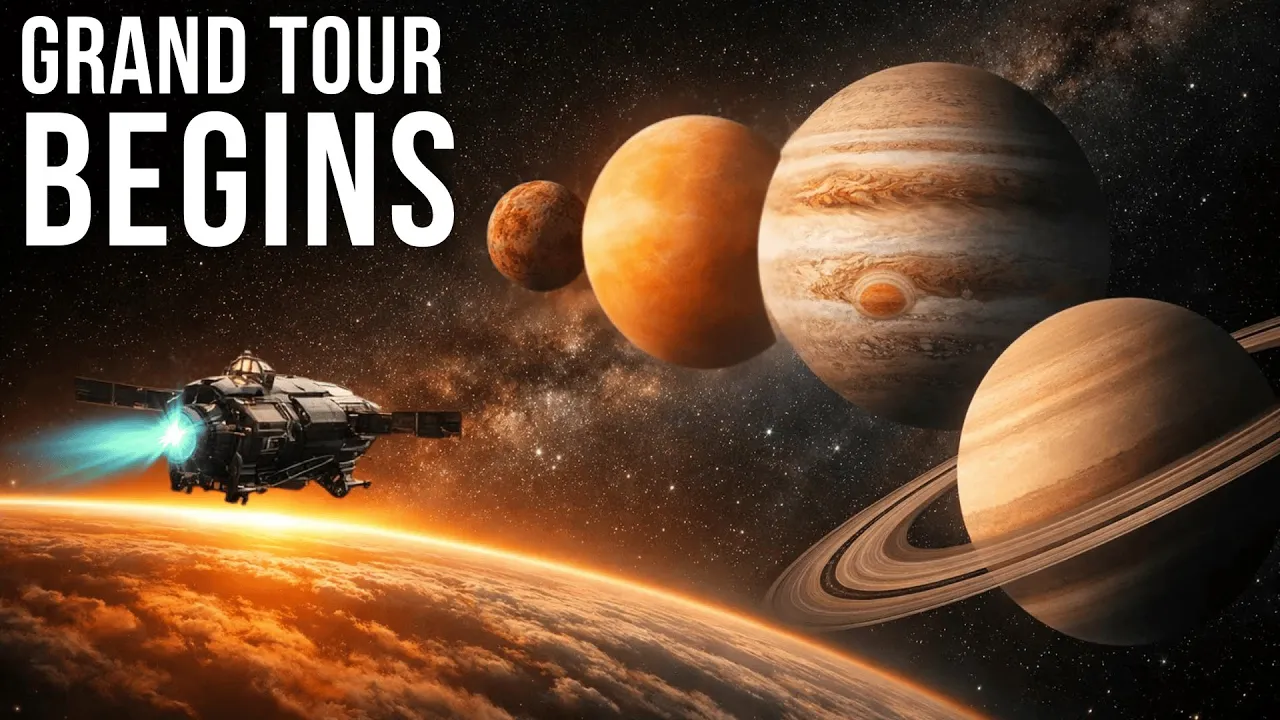
Down to hell: travelling through the atmosphere of Venus The popular science fiction of the early 20th century depicted Venus as a kind of wonderland; with pleasantly warm temperatures, forests, swamps, and even dinosaurs. A kind of Jurassic Park where someone already wanted to bring one-day rich tourists looking for emotions. Today, Venus is unlikely to be perceived as a dream destination for would-be space tourists. As revealed by numerous missions in recent decades, rather than being a paradise, Venus is a hell. Roughly the size of Earth, its surface is plagued by temperatures that would melt lead, pressures 90
times greater than Earth's, and clouds of sulfuric acid suspended in an atmosphere of carbon dioxide and nitrogen driven by winds of up to 350 km per hour. Under the dazzling blanket of clouds that perpetually covers the planet comes little light to illuminate the high volcanic mountains and huge plateaus. It's all true... this planet is a hellish world of hellish temperatures, surrounded by a toxic, corrosive, and frighteningly "heavy" atmosphere... Despite this, today, March 14, 2047, I find myself here, aboard a HAVOC-type airship, which stands for High Altitude Venus Operational Concept. This is not the first aerostat
to float in the atmosphere of Venus. It is in fact since 2037 that NASA and ESA have started the exploration program of this planet. The plan is to use airships that can stay in the Venusian atmosphere for long periods. The aerostats are filled with oxygen and nitrogen, which are lighter than the elements that make up the Venusian atmosphere and therefore allow them to float while providing a large supply of breathable air for the crews. Strange as it may seem, Venus' upper atmosphere, the one I'm in now, is as close to Earth's environment as there can
be in the solar system. The atmospheric pressure at 55 km altitude is about half that at sea level on Earth, and the temperature varies between +20°C and +30°C. Incredible or not, under these conditions, I could even go outside wearing a respirator and a simple, non-pressurized, chemical-resistant suit! Almost a paradise... not to mention that the layers of clouds give us good protection from radiation coming from space... there is plenty of sunlight to generate energy with photovoltaic systems and gravity is 90% of Earth's. The airship that is hosting me is not the only one to navigate in
these parts, but it will be the first to bring down to the surface a pressurized probe, able to withstand the pressure and the heat of that hell that is 100 km below our feet. If all goes well I will be the first man to step on the ground of this absurd world; otherwise, I will simply be the first to die on it. The bathyscaphe to which we will entrust our lives has been very appropriately named Trieste... like the one that in 1960 took Jacques Piccard to explore the bottom of the Mariana Trench, at a depth
of 11 thousand meters. Descending into the atmosphere of Venus will be very similar, in fact, to a very Long dive into the depths of the ocean. In this will accompany me the pilot and friend Don Walsh, who will have the task of managing all the parameters of the mission. The probe basically consists of a two-seat, spherical-shaped cabin measuring 2.54 meters in diameter. It is constructed entirely of tungsten carbide, which is basically a light alloy of high resistance to wear, corrosion, and heat. The heat from the outside is absorbed by a lithium nitrate trihydrate thermal accumulator
and heat exchanger. Two onboard cameras face outward through 2-inch-thick quartz portholes. The sphere is attached to a carbon fiber balloon covered with twelve centimeters of honeycomb insulation. The balloon, 25 meters in diameter, is filled with gases lighter than Venus' atmosphere at the time of ascent. And that should allow us to make our way back to the mother blimp that awaits us 50 kilometers higher up... Before that, however, there will be the most dangerous part of the entire mission. In a special pressurized suit, I will have to pass through the small compensation area located just behind
the seats, open a hatch and with all the caution of this world try to make a few steps on the surface ... just enough time to collect some pebbles and some data on the ability of the suit to keep me alive. March 15, 2042. We are already aboard the Trieste and free of all ties with the mother airship. We are ready to descend by progressively releasing a certain amount of the gas contained in the balloon. The on-board computer calculates the ideal descent speed and the amount of gas to be released. T= 0 - We are
at an altitude of 100 km. For the next 10 km, we will cross a very thin layer of the atmosphere, practically undetectable. The temperature is -114°C. The sky above us is absolutely black, a sign that we are immersed in an impalpable atmosphere. Despite this, the anemometer indicates that the wind is blowing at a speed of 349 km per hour! An oddity that we still cannot understand. Venus rotates very slowly, taking a good 243 Earth days to complete a full revolution around its axis. Yes, you heard me right: one day on Venus is as long as
243 days on Earth. It is even longer than a year, which on Venus is only 224 Earth days. Even so, Venus' atmosphere rotates 60 times faster, so that the thick clouds that surround the planet take only four Earth days to complete a full circle. The fast-moving atmosphere transports heat from the side lit by day, to the side where it is night, mitigating temperature differences between the two hemispheres. There is still no certainty as to the real cause of this super-rotation. The fact is that in an uncontrolled descent like ours it is necessary to calculate well
the effect that the force of the wind will have on our final destination, which should be Navka Planitia, the place where Venera 7 landed on December 15, 1970, the first probe to touch the ground of Venus. T= 37 minutes - We leave the highest layer and plunge into a layer of haze, at times clearly visible, formed by tiny drops of sulfuric acid. The temperature Is -73°C and the winds are blowing at 322 km per hour. T=1h 53m - We proceeded to descend about twenty kilometers until at an altitude of 70 km the fog began to
thicken and take on an amber yellow color. This is the sign that we are entering the main layer of Venus' cloud system, where the clouds that we can only see from Earth in the ultraviolet are formed. From where we are now, that is inside the clouds, however, the clouds can be seen very well. And they are scary. Driven by winds of around 250 km per hour, these giant clusters of sulfur dioxide saturated with large drops of sulfuric acid jolt the probe in a very unpleasant way. At times we are also hit by violent bursts of
corrosive rain, which is most likely putting a strain on our materials. However, this rain soon dissolves and - dissolved by the heat - only falls for a few kilometers. At around 55 km altitude, the pressure is the same as it would be on Earth in the high mountains, and the temperature even becomes Spring-like. We have reached the altitude where our mother airship floats, along with many others. The wind, held back by the ever-increasing pressure, gets weaker and weaker. Lightning? If there were any it would be trouble for us, but fortunately, the fear of dangerous electrical
activity on Venus, widespread until twenty years ago, has since proved unfounded. Since the beginning of the HAVOC airship exploration program ten years ago, only on three occasions has the sighting of an electric discharge between cloud and cloud been certified. Besides their composition, Venusian clouds differ from terrestrial ones for the mechanism of their formation. On our planet, they are formed as a result of the cooling of rising air that causes the condensation of water vapor. The clouds of Venus instead resemble smog, as they are the product of chemical reactions between sulfur dioxide and water that are
triggered by sunlight. T = 2h33m - Below 50 km altitude we come out of the clouds and the temperature begins to rise sharply, reaching 110°C at 45 km, with the pressure already twice that of the Earth. The temperature is so high that the sulfuric acid particles dissociate again in sulfur dioxide and water vapor, thus preventing the formation of clouds. From here on, up to 30 km, we descend much more quietly through a layer of fairly thin mist, composed of very dilute sulfur dioxide. For the first time, we can see the surface, while the winds decrease
in intensity and slightly exceed 100 km per hour. At this moment we are the first human beings to see Venus as a rocky planet with a walkable surface, and not as a whitish ball of gas. Seen from here, the general coloration of the planet is gray-ochre, with an orography more similar to that of Titan than that of Mars. The impression is that of a once-thriving world, where then something must have gone wrong... Venus was perhaps a habitable world for most of its history, then destroyed by the greenhouse effect in an uncontrolled process. At some point
in its history, the dense CO2 atmosphere spewed out by explosive volcanic Activity must have heated the planet; causing the oceans to boil and also all the residual water vapor, condemning the planet to death with all that inhabited it... T = 3h33m - At an altitude of 30 km, even the very light haze that had accompanied us after leaving the clouds disappears, and the atmosphere appears completely clear. The external pressure is 22 times higher than the Earth's and winds are blowing at 90 km per hour. But the most worrying thing is the temperature... we are already
at 300°C, and Don tells me that the lithium thermal accumulator is starting to show some discomfort. We decide to proceed anyway. T = 4h14m - At an altitude of 10 km, Don again informs me that we are quite far from the planned landing point and that we will probably miss the meeting with Venera 7 by at least 40 km. It doesn't matter, that would have been the icing on the cake, but it was certainly not the main target of the mission. The important thing is to land on safe ground. The temperature is at 392°C! The
wind speed drops dramatically: only 25 km per hour. We prepare for landing. T = 5h43m - Don has reduced his descent speed. We are at 100 meters and we are approaching the ground one meter per second. Tension is through the roof. We are enchanted by the landscape that is welcoming us, but we are also busy checking the efficiency of the accumulator which is now at full scale. The temperature at 424°C. T = 5h45m - We have touched down. There is no time to waste, yet Don and I, without saying a word, allow ourselves a couple
of minutes of incredulous satisfaction in front of the monitors. We are on Venus. Outside the calm is absolute, the wind seems not to be there. We missed the Venera 7 site by only 32 km... Not bad. T = 5h47m - As planned, we now have only 15 minutes before we Have to leave this seemingly peaceful hell. Don helps me adjust the pressurized suit and screws on my helmet. I close the airlock door behind me and open the one to the outside. Am I going or not? In any case, I am connected to the probe by
a 15-meter cable that prevents the wind from carrying me away. In fact, although on the ground the wind blows at 3 or 4 km per hour, because of the pressure it can exert an enormous thrust on the obstacles it encounters. Could this be the reason why the ground seems to have been leveled and tiled? I put one foot on the ground. I lean against the hatch and try to figure out how I feel. I'm fine, even feeling cold. I get out, finally, and look around. The sunlight manages to filter through the thick blanket of clouds
quite effectively, illuminating the surface of the planet in much the same way as it does on Earth on a day when the sky is overcast. I am surrounded by debris and flat stones of various sizes. I am not a geologist, but I understand that they are basalts, Typical magmatic effusive rocks, produced by the solidification of lava. Among the rocks, there is also some sandy soil of a very dark color. I don't feel the heat, but I feel the pressure exerted by the wind, like that of a large hand trying to push me forward... with force,
but very slowly. With effort, I fill the front pocket of my suit with small rocks and stones. I look up and all around me there is only this endless extension of rocks, all the same until the horizon. A desolate, desert landscape. I look towards a camera and greet Don, who is obviously watching me inside. I give him a nod that means "all is well", but inside I am suddenly afraid. I'm becoming aware of my situation: Me, standing on the surface of another planet. A killer planet, at that. The viewer tells me I've been out for
four minutes. I turn around and go back. I step into the chamber and turn around for one last look. Goodbye Venus, I already know I'm going to Miss you in a minute, and I'm going to miss you for the rest of my life. Come on, let's get out of here Don, let's go back up! How Will We Journey to Mars? Mars, Mars, Mars… All everyone has been talking about recently. Humans do always have a deep desire to explore and seek adventure… from our youngest to our eldest. And when they set their minds to something, they
become unstoppable. Throughout history, we've traveled across continents, sailed ships, flown airplanes, and even launched rockets to discover new lands and push the boundaries of what's possible. And until now, no challenge has been too impossible to overcome. But there's one adventure that we haven't fully tackled yet, and it's a big one: a journey from Earth to Mars. Can you imagine being part of a crew that lands on the Red Planet and takes the first steps on its surface? That would be wild! You might have heard of a show called The Expanse and many more that have
gained a massive following In recent years. It follows a crew of characters in a futuristic world where humans have colonized parts of our Solar System, from Earth to Mars to the asteroid belt. They explore new worlds, uncover conspiracies, and fight for survival in a universe full of danger. And while we're not quite at the level of interplanetary travel just yet, the thrilling glimpse into what the future of space exploration could look like gives us the motivation to keep going. Can you imagine building territory and expanding to Mars? It would be incredible to be part of
that journey and make history! Who knows what we might discover on our way to the fourth planet from the Sun. Let’s see together what this trip would look like… Previous Missions So what have we sent so far to Mars? Mars is an interesting world that is covered in dust and has a very thin atmosphere. Despite its harsh conditions, Mars is a dynamic planet that experiences seasons, has polar ice caps, and features canyons and extinct volcanoes, all of which we are a little familiar with On Earth. Scientists have even found evidence that Mars was even more
active in the past, which is exciting to explore, and actually makes it the most explored planet so far! We have sent a few different types of robotic explorers to Mars in order to learn more about it. The most advanced of these robots is called Perseverance, which just landed on Mars in February of 2021. It's the largest rover ever sent to another planet and has the ability to take samples of the alien soil and rocks. There's also a helicopter named Ingenuity that came along with Perseverance. Perseverance isn't the only spacecraft currently on Mars. In fact, there
are quite a few! Recently, China even became the second country ever to successfully land a rover on Mars. There are also orbiters that study Mars by flying around it and taking images, like the Hope mission launched by the United Arab Emirates and a few others. The Hope probe is actually helping us map Mars fully. Check it out! All of this exploration has taught scientists a lot about Mars' past. They've found lots Of evidence that it used to be much warmer and wetter, with a thicker atmosphere. Do you think studying Mars will help us better understand
our own planet and how it fits into the larger scheme of our solar system? How will we get there? Artemis Missions To get to Mars, we first need to set up a permanent station on the moon. Why? Well, going from the moon to Mars is much easier than going straight from Earth to Mars. Earth's gravity and thick atmosphere make it tough to launch things into space all at once. It sure is nice to live on Earth, but it makes space travel tricky. On the moon, though, we don't have those problems. Living on the moon will
be tough, but if we can make it work, the moon would be the perfect place to launch missions to other planets. NASA's Artemis program has a long-term goal to use the moon as a spaceport and gateway to the solar system. Missions 4 through 10 of the Artemis program will focus on learning how to live on the moon. We'll find ways to use the resources that are already there, like rocks and metals, To build new infrastructure. We'll also try to find water and oxygen. Meanwhile, NASA and its partners will keep exploring Mars with robots. They'll even
deploy a drone called Ingenuity to fly around Mars and take pictures. NASA's next big project is to build a space station that orbits Mars. The space station won't just be a stopping point for trips to Mars; it will also be a place where astronauts can live for longer periods of time. One of the goals of exploring Mars is to bring back samples of Mars rock and soil. This will mark the end of one-way trips to Mars and help us learn even more about the Red Planet. NASA never fails to come up with the best of
plans to realize humanity’s wildest dreams… They're working on multiple missions and getting everything ready right now. The first real step will be the Artemis 10 mission, which will bring cargo to the moon in preparation for the Mars mission. Then, there will be the Artemis 11 mission which will deploy more cargo to the moon. Both missions will include a trip to the lunar surface. But the real excitement begins with Artemis 12! This mission will bring the Mars one human Lander to the Gateway station near the moon, which will have a crew of four people staying there
for 134 days. NASA plans to use Gateway as the starting point to send humans to Mars! The astronauts will take off on a special ship with the Mars one human Lander and travel to Mars. They'll stay in a pressurized vehicle that will be their home for 30 days on Mars. This vehicle will also be their Rover, so they can explore the planet. It's important that the vehicle does double duty because even in the reduced gravity of Mars, it takes time to adjust from space travel especially from spending a long time in zero gravity environments. Who
knows what amazing discoveries the astronauts will make on their mission to Mars. We can't wait to find out! Space Travel So how do you think we would be getting people from Earth to Mars? To be able to do this, they're developing something called a Transit Habitat which will use a mix of chemical and electric propulsion Stages to power the journey. This habitat will be able to support a crew of four people and take them all the way to Mars and back again. Once they get to Mars, landing is a bit of a tricky process. The
most recent perseverance Rover actually landed using a special capsule that's similar to how people return to Earth from space. The capsule had a huge parachute to slow its descent, but since the atmosphere on Mars is too thin for the parachute alone to provide a soft landing, the Rover had to use a jet pack to slow down via rockets. Fun fact: two of the crew members will stay in orbit during the entire mission while the other two go down to the surface. Did you know that there are two ways you can go to Mars? One way
is a short stay mission, which lasts 30 days on Mars, but involves a long and grueling 403 day return trip through deep space. During the trip to Mars, the spacecraft uses a gravitational boost around Venus to get there in only 217 days. The other way to go to Mars is a long stay mission. This involves a direct course to Mars that takes 210 days to reach the red planet. Once there, the mission lasts a whopping 496 days, requiring extensive planning and preparation before deployment. The return trip is then only 210 days, which is shortened thanks
to an ideal transfer window. Of course, the current technology we have limits our abilities to make these journeys faster and smoother. However, NASA is always working on improving propulsion systems and technology, so we may see faster and more comfortable trips to Mars in the future! Future Spacecrafts NASA and DARPA are teaming up to create a super cool spacecraft that will be powered by a nuclear thermal rocket engine! It's called the demonstration rocket for Agile CIS Lunar Operations, or Draco for short. This spacecraft will be able to travel faster, carry more stuff, go further distances, and
maneuver through space much more easily than any other vehicle we've ever used before! One major benefit of this new engine is that it will increase science payload capacity and Provide higher power for instrumentation and communication. The engine works by using a fission reactor to generate high temperatures, which heats up a liquid propellant that is then used to propel the spacecraft.. This new nuclear engine is going to be three to five times more efficient than traditional rocket engines, meaning it will take a lot less time to get to places like Mars. Instead of 8 months, it
could take as little as 45 days! The Draco project is set to come online in less than five years, expected to be integrated with an experimental spacecraft by 2027 and will help establish a space transportation capability for an Earth-Moon economy. And who knows, maybe within the next decade, astronauts could travel to Mars on a ship powered by the nuclear engine! Of course, there could be some delays along the way, but we humans are optimistic and love a good challenge. We refuse to stay in one place for too long and going to Mars is just the
next step in our interstellar journey. Recap-Outro To recap, Our journey to Mars is a daunting task, but humanity has never backed down from a challenge. NASA's Artemis program is working hard to establish a permanent station on the moon, which will serve as a gateway to the rest of the solar system. The journey to Mars will involve a Transit Habitat, a special spacecraft that will use a mix of chemical and electric propulsion stages to power the journey. Landing on Mars is a tricky process, but NASA has shown that it's possible with the recent successful landing of
the Perseverance Rover. The future of space exploration looks bright, with the development of the nuclear thermal rocket engine and the demonstration rocket for Agile CIS Lunar Operations. We're excited to see what discoveries await us on our journey to the red planet, and we hope you are too! Journey (without return) in the hellish atmosphere of Jupiter Mysterious, imposing and austere, Jupiter is the largest and most massive planet in the entire Solar System. It is so large (140 thousand kilometers in diameter) that if we Put together all the other planets, including Saturn, we would be able to
equal only half of its mass. It is difficult to describe in words the fascination that this cosmic giant has exerted over the centuries on entire generations of astronomers, enthusiasts and simply curious. On Jupiter everything is out of scale, starting from its best known feature, the Great Red Spot, a huge cyclone that rages in the atmosphere of the planet for at least 350 years. Like Saturn, Uranus and Neptune, Jupiter is mostly composed of gas - especially hydrogen and helium - and therefore has no defined surface on which to land. A hypothetical descent into its atmosphere would
look very much like a very long dive into the depths of the ocean. Although we do not know all the secrets of Jupiter yet, we know just enough to imagine the wonderful and terrible spectacle that a hypothetical astronaut would see if he tried to venture into its turbulent atmosphere... Alien colors, clouds as big as mountains, immense columns of gas in continuous movement, lightning so powerful That an entire ocean evaporates in the space of an instant: on Jupiter every atmospheric phenomenon is taken to the extreme, to characterize one of the most hostile environments of the Solar
System. An environment that - few remember - we began to explore a quarter of a century ago. So much time has in fact passed since the day the Galileo probe arrived on Jupiter after a six-year journey. Among the main objectives of that mission, in addition to the study of the Medicean satellites and the Jovian magnetic field, there was also the analysis of the atmosphere, for which was designed a small probe (called "atmospheric") that would measure pressure, temperature and chemical composition. Galileo released the atmospheric probe five months before meeting Jupiter, in July 1995, and on December
7, 1995 the two ships reached the gas giant together. The "mother probe" entered into orbit around the planet, while the little one penetrated its atmosphere at a speed of 48 kilometers per second, after which, in little more than two minutes it was slowed down to subsonic speed by the density of the air. The descent lasted a total of 58 minutes, and the connection was interrupted when the probe, arrived at 150 km of "depth", reached conditions of temperature and pressure so high that it dissolved in the atmosphere of the planet. The data collected along the way
proved to be of fundamental importance to understand the dynamics and chemical composition of the upper layers of the Jovian atmosphere, but did not provide any clue as to what lies deeper. However, nothing prevents us from putting together what little we know with a bit of imagination, and fantasize about what we might see as we descend towards the core, obviously protected by a super pressurized suit. A dive that will allow us to discover the secrets of one of the most extreme environments of the Solar System. Are you ready? En route to Jupiter! We are half a
million kilometers away from Jupiter, aboard our ship, and the approach phase is much longer than expected: we are navigating at the maximum speed allowed by our propulsion system, yet it seems that the planet is not approaching one meter! The outermost layers of its atmosphere begin to occupy the entire field of view only after several hours of travel, when we are still 200,000 kilometers away from the apparent surface of the planet, that is, from the top of its highest clouds. Now the entire disc of the planet extends into the sky for about 40 degrees of apparent
diameter. Finally we see in detail the dense clouds of ammonia and hydrogen that rotate in parallel around the equator forming the characteristic white, red and orange bands. Jupiter, as well as the Sun and Saturn, is in fact subject to a differential rotation phenomenon. Because of its high speed of rotation (9.9 hours), the gases that make up the upper layers of the atmosphere - mainly hydrogen, helium and ammonia - move at different speeds depending on their position with respect to the equator, creating the characteristic horizontal bands of different color. Usually, the red ones, called "zones", correspond
to atmospheric depressions caused by descending cold air, while the lighter ones, the "bands", are cloudy reliefs formed by rising hot air. The Great Red Spot, so clean and geometric if seen from a distance, slowly begins to transform, so that after a few hours we find it hard to distinguish the contours. The enormous vortex, which from space seemed to us a single structure, now appears as a chaotic set of smaller vortexes, whose circumvolutions reveal new and unexpected details about the extreme turbulence of the atmosphere. The mighty columns of gas emerging from the deepest layers of the
planet make Jupiter resemble a huge pot full of bubbling water. Arrived at 100 thousand kilometers from the surface the electromagnetic bombardment caused by the Jovian magnetosphere is so intense that we are forced to activate the special protections of our ship. If we did not, we would die of radiation poisoning within minutes. Jupiter is in fact like a giant dynamo: because of its fast rotation period the speed with which the metallic hydrogen "slides" on the inner core of the planet generates strong electric currents that give rise to a magnetosphere 20 thousand times more powerful than the
Earth. The magnetosphere then traps solar Emissions in huge bands of radiation, generating a radioactive environment that is a deadly risk both for probes, whose instrumentation must be adequately shielded, and for astronauts. 0 km. The descent begins! Continuing our journey we finally reach the edge of the troposphere, the zero limit from which we begin to measure the descent, as we would do with the depths of an oceanic trench. The long descent to the innermost layers of the gas giant begins here: we disengage from the spacecraft, protected by our magical spacesuit, and let gravity drag us towards
the core. Because of its enormous mass, at this height Jupiter generates a gravitational acceleration 2.6 times higher than the Earth, so if we want to avoid burning like a meteor we have to open a parachute to slow the fall. We do it, and in a few minutes our speed goes from 3200 to 360 kilometers per hour, with a deceleration that allows us to avoid any risk of supersonic compression or overheating due to friction. -10 km. Among the mists of the Great Red Spot. Looking around we notice an unusual landscape: The colors vary from bright red
to brown and there is a thick layer of mist that prevents us from pushing our gaze further than a few hundred meters. But if we could do it we would see a spectacle without equal: the clouds that surround us, up to 45 km high and composed mainly of hydrocarbons, hydrogen, methane and ammonia crystals, would look like huge mountains. We would immediately notice that ammonia covers the upper surface of the clouds like an oil film on the water, adding a hue of white to the dominant red color. Pushing our eyes even further in the direction of
the Great Red Spot, we would see a huge column of turbulent gas soaring over the surrounding clouds, almost as if it were floating above the troposphere. -50 km. Lightning and turbulence. At the height at which we are now, about -50 km from the beginning of the troposphere, the conditions of pressure and temperature are similar to those detectable on the surface of the Earth, but the winds raging around us are dragging us at a speed of Over 560 kilometers per hour and the intensity of radiation generated by the Jovian magnetic field could still kill us in
a few minutes, in the absence of protection. The noise generated by the turbulence is deafening, because here the speed of sound is four times higher than we are used to. The sky is continuously crossed by violent lightning tens of kilometers long, thousands of times more powerful than those generated on Earth. The lightning is mainly caused by rains of water, sulfuric acid and ammonia, which due to the gravitational attraction of Jupiter fall at a speed three times faster than the Earth's rains, creating a huge difference in potential. -100 km. Goodbye to the light. After another five
minutes of descent the atmospheric pressure rises to 2 bar and we begin to cross a new layer of clouds, this time composed of ammonium sulphite and ammonium hydrosulphide. The conditions of the environment around us are quite extreme, but at this moment we do not need any additional protection other than good radiation shielding. Although the weight of the air above us starts to grow following an exponential curve, The relatively low fall rate allows the cavities of our body to equalize their internal pressure without generating undesirable effects. Another 10 minutes pass and the pressure reaches 4 bar,
a value corresponding to what we would experience on Earth by diving into water at a depth of 30 meters, while the temperature drops to -40 degrees. We begin to encounter the first clouds of frozen water and in the meantime the ambient brightness continues to decrease. The speed of the winds rises to 720 kilometers per hour but we barely notice it, because the level of turbulence in the atmosphere gradually decreases. Another 15 minutes of fall and the pressure rises to 10 bar. At this point, in order to avoid harmful effects on the body we have to
modify the air mixture supplied by the suit's respirator: if we do not do it in a few minutes we would encounter an oxygen poisoning, or a nitrogen narcosis, because under pressure the two gases become toxic. Let's take a last look above us, just in time to see the weak disk of the Sun disappearing in the orange fog. Another 25 minutes pass and the situation begins To get complicated. The special protective suit with which we are equipped must withstand a temperature above 100 degrees Celsius, continuously and constantly increasing, accompanied by enough atmospheric pressure to crumple a
car. We find ourselves suddenly immersed in darkness and we can no longer distinguish anything. The absence of light is due to the density and chemical composition of air: around us now there are only hydrogen, helium, ammonium sulfide and traces of water vapor, compressed to the point of absorbing all the electromagnetic radiation coming from the Sun. Our journey has turned into a slow fall into darkness. -20,000 km. Gases become liquid. We continue to slow down due to the increasing atmospheric density, while incandescent helium is raining around us. The gases compress more and more, starting to behave
like liquids: if we had to leave our protective suit we would be crushed and vaporized in a split second. Now we are no longer even able to determine where we are in relation to Jupiter's core, because the transition between gas and liquid is so Gradual that we can not realize the change in density. Below us, at an unspecified distance, we notice a faint luminescence caused by the energy radiating from the nucleus. Atmosphere is now almost completely formed by liquid hydrogen that boils at thousands of degrees centigrade, as on the surface of the Sun. The pressure
rises rapidly from one thousand to two million bar and the atmospheric density has exceeded the water density by a while, reaching even one thousand kilograms per cubic centimeter. At this point the fall stops, because our body, being less dense than the matter around it, once exhausted the kinetic energy of the fall can no longer sink. If we want to continue we need a push, so we turn on the propellers of the suit and start to descend slowly again. - 30,000 km. An ocean of liquid metal. From here on, and for several hours, the journey is
particularly boring: darkness and silence dominate, and the monotony is interrupted only by the imperceptible flashes that emanate from the deepest regions of the planet. Continuing on becomes more and more Difficult. After a time that seems endless, however, something unexpected happens: the darkness is torn by a web of lightning that vaguely resembles a spider's web. This network of lightning branches out following a very particular geometry, which closely resembles the way electricity propagates in the water. We are sailing in a vast ocean of metallic liquid hydrogen! Under normal conditions of pressure and temperature hydrogen is a gas,
but if its density exceeds a certain critical point it turns into something different, a substance that flows like a viscous liquid and conducts electricity like a metal. The lightning we saw in the troposphere are nothing compared to those that cross this boundless ocean. Where we are now, pressure and temperature have reached such high levels that they escape any attempt at understanding. -60,000 km. The core! No matter how hard we try, we can't go any further. Below us now is the core of Jupiter, an extremely dense and warm core with a mass between 12 and 45
times the Earth's one: astronomers believe that it is mostly solid and contains most of The heaviest elements of the planet, such as ice, rock, iron and other heavy components, with a considerable amount of hydrogen. To be able to walk on its surface we should be able to survive pressures four million times higher than the Earth's surface and temperatures of over 35 thousand degrees: a bit too much even for our imagination! After all, it is only thanks to the latter that we can bear the idea of being forced to stay here forever, held as we are
by a gravity force equal to 130 times that of the Earth. A well from which no means of propulsion, no matter how powerful, would ever be able to pull us out... Is Saturn a real planet? I'm off to find out for myself! Some weird rumors are going around about certain planets in the solar system. After Pluto got the boot, some folks raised an eyebrow and started saying that if we can make distinctions about what features a "real" planet should have, then gas giants should be put "out of the game" too. Yeah, because there's no shortage
of scientists who are convinced that, To be called a planet, you should have a solid, walkable surface. From this perspective, Pluto would be more of a planet than Jupiter, Saturn, Uranus, and Neptune. Those gas giants, you see, are celestial bodies formed from a massive amount of gas gathered around small solid cores, at most deserving the label of "failed stars." What do you think? Do you agree that gas giants should be in a category of their own, just like poor Pluto? While you ponder that - planet or failed star - we'll take this chance to give
you a rundown of what an aspiring daredevil might see if they wanted to dive into the deep atmosphere of Saturn, free-falling all the way to its solid core. enjoy this one-way trip into the heart of the ringed planet! Beyond Mars and Jupiter, after nearly one and a half billion kilometers from Earth, emerges in all its glory one of the most iconic planets in the solar system: Saturn, with its unmistakable ring system. Like Jupiter, Uranus, and Neptune, Saturn Is mostly composed of gas - specifically, hydrogen and helium - and therefore lacks a defined surface for a
potential landing. An imaginary descent into its atmosphere would closely resemble an extraordinarily long dive into the depths of an ocean. While we don't know all its secrets yet, we know enough to envision the marvelous and awe-inspiring spectacle an astronaut would witness if they dared to venture into Saturn's turbulent atmosphere. Alien colors, clouds as large as mountains, immense columns of gas in constant motion, lightning so powerful it could evaporate an entire ocean in an instant: on Saturn, every atmospheric phenomenon is pushed to the extreme, defining one of the harshest environments in the solar system. The "Lord
of the Rings," after all, is perhaps the planet that, more than any other, has ignited our imagination and curiosity about space. It has inspired many children to dream of owning a telescope to see if such a cosmic work of art truly exists up close. And of course, astronomers, motivated by dreams and passions similar to those of children, have Gone to great lengths to observe this gas giant up close, even sending automated probes into its vicinity. In 1997, a probe named Cassini departed from Cape Canaveral, and after seven long years of travel, it began orbiting Saturn
in 2004. Over the years, it sent us thousands of breathtaking images along with an incredible amount of data, unveiling many secrets of the planet. On September 15, 2017, Cassini met its inevitable fate: its mission was over, and scientists decided to plunge it into Saturn's atmosphere. The reason was simple: to prevent it, if left on its own, from crashing into one of Saturn's moons - some of which might potentially harbor life - thus avoiding contamination. Before being launched into space, probes are sterilized to eliminate any terrestrial contamination, but there's no foolproof sterilization method. Poor Cassini didn't
last long as it began its descent into Saturn's atmosphere and didn't manage to send any images of its final dive. It likely disintegrated shortly after entering Saturn's clouds. Cassini is the second human-made object to break apart in the atmosphere of a gas giant; The Galileo probe met a similar fate, destroyed within Jupiter in 2003 for a similar reason. And what if we sent a person into Saturn? Well, likely, they wouldn't have survived long enough to tell the tale, but guided by scientific knowledge and fueled by imagination, we're about to narrate an extraordinary story. Firstly, you
need to know that Saturn is vastly different from our beautiful blue planet. It's a gas giant, ten times farther from the Sun than Earth, ten times larger, and nearly a hundred times more massive. Even compared to its big brother Jupiter, Saturn has distinct differences, especially in its more subdued appearance. There are several reasons why Saturn's colors are muted compared to Jupiter's. One reason is that Saturn is twice as far from the Sun, receiving only a quarter of the solar light. This results in significantly lower temperatures in the upper layers and a much less dynamic atmosphere.
Additionally, Saturn's atmosphere contains more haze and fewer clouds than Jupiter's, further reducing the amount of sunlight reaching the planet's surface. Saturn's density is incredibly low, less than that of water, so if you could place it in a large enough basin, it would float! Its atmosphere is radically different from ours, consisting of 96% hydrogen, the rest being helium, and traces of other elements like ammonia or methane. Naturally, pressure and temperature behave differently as you descend into the planet, with the vast amount of gas generating immense pressure and a tremendous increase in temperature. But we don't want
to spoil the journey ahead, so buckle up; you'll need it. You find yourself half a million kilometers away from Saturn aboard your spacecraft, and the approach phase is proving to be much longer than expected. You're cruising at the maximum speed allowed by our propulsion system, yet it seems the planet's apparent size remains unchanged! The outer layers of Saturn's atmosphere fully occupy your field of view after several hours of travel, even though you're still 200,000 kilometers away from the top of its highest clouds. The entire planet's disk now spans about 30 degrees in apparent diameter in
the sky, And the entire ring system extends over 50 degrees. It's a truly fantastic sight. Lower down, you can already discern in detail the dense clouds of ammonia and hydrogen rotating in parallel around the equator, albeit much fainter and less distinct than those of Jupiter. The moment has arrived. Your spacecraft hovers at an altitude of 9,000 km above the atmosphere - a challenging position to maintain. After your adventure companions make a final attempt to dissuade you from the suicidal mission, the hatch of the pressure chamber opens, and you find yourself propelled outside. The descent begins,
but not before canceling your remaining orbital speed with the suit's thrusters. Only then can the irreversible plunge towards the planet's center commence. The initial panorama is a waking dream. In the first kilometers of descent, visibility is excellent. Above you, against a dark blue sky, the magnificent rings stand out in all their majesty, brilliantly lit by the sunlight. You realize they extend tens of thousands of kilometers and, despite being only a few Dozen meters thick, occupy a significant portion of your field of view. Below you, you begin to see more clearly the imposing clouds of ammonia
crystals, with a whitish-yellow hue. It's cold, very cold, with temperatures hovering around -190 degrees Celsius. Your journey could tragically end here if not for the superhero-like space suit they've equipped you with. So, you continue to enjoy the fall without succumbing to the cold. Since gravity is not much higher than on Earth (about seven percent more), the falling speed won't be much different from a free fall on our planet. A few more minutes, and you find yourself inside the thick clouds of ammonia crystals. Pressure and temperature start to rise, and the light becomes dimmer. As you
descend, the atmosphere becomes denser, and your falling speed decreases due to friction. After another hundred kilometers in free fall, you exit the first layer of clouds, and what seemed like an inhospitable environment begins to seem like paradise compared to what is coming. You plunge into a layer of ammonium Hydrosulfide clouds, and everything around you gets much darker and darker due to the color of the clouds and the sunlight struggling to filter through. The pressure increases to values four times higher than on Earth, and temperatures rise to a "comfortable" 100 degrees Celsius below zero. After three
hours of descent, you've penetrated hundreds of kilometers into Saturn's atmosphere, but this is nothing compared to the almost 60,000 kilometers of the planet's radius. You keep falling; it's so dark that you can't even see your hands, and your speed has now reduced to a few hundred kilometers per hour. Without protection, you would already be covered in sores caused by the ammonia and hydrosulfide clouds, but your suit is so magical that it allows you to persist. After another half-hour, you find yourself immersed in an eerie darkness, facing another problem: you're about to exit the ammonia layer,
but, perhaps we forgot to mention it, Saturn experiences some of the most powerful winds in the entire solar system - hurricanes that can reach speeds of 1,800 kilometers per hour, over four times the fastest wind ever recorded on Earth. In other words, you'll likely be whipped by a supersonic hailstorm of ammonia crystals and swept away like dry leaves during Hurricane Katrina. Oddities are just beginning. After falling for another 300 kilometers or so, you have reached the end of this hellish layer of clouds, and an unexpectedly almost familiar panorama unfolds before you: massive clouds of water
vapor, similar to terrestrial thunderstorms! The pressure is now ten times that on Earth's surface, and the temperature has reached 0 degrees Celsius. Darkness is torn in every direction by enormous and terrifying lightning bolts that brighten the night, illuminating the fearsome storm towers. Two hours have passed. Provided your suit has shielded you from the lightning (no one likes to be instantly fried), brace yourself because if what you've faced so far seemed bizarre and lethal, well, you were wrong. You've just left behind clouds that are kilometers high, and apocalyptic lightning when immersed in darkness after about 400-500
kilometers, the temperature dramatically rises, First to 20 degrees, then a hundred, and finally a thousand. What seemed strange before now becomes truly extreme. The pressure keeps increasing; you can't see anything, but you realize that whatever is around you is getting denser, while your descent slows down drastically. Total darkness, extremely high pressure, insane temperatures: you're immersed in a mix of hydrogen and helium that is becoming so dense that it turns into liquids due to extreme environmental conditions. You start to see something again, and everything around you takes on a reddish hue due to the gas's incandescence.
The density is so extreme that unless your suit has an explosive propulsion system, you'll be condemned to float for eternity in a sea of scorching hydrogen, at over 5000 degrees and subjected to pressures thousands of times greater than Earth's. Needless to say, you would die horribly (we'll spare you the details) unless your suit is truly magical. If it is, the prospects become even more interesting, and all you need to do is activate the thrusters to overcome friction and continue descending. As you continue to plunge deeper into the abyss of liquid hydrogen, pressure, and temperature reach
values increasingly inconceivable for us. At around 32,000 kilometers deep, at pressures over two million times that of Earth, temperatures soar to much higher values than those found on the solar surface: over 10,000 degrees! In such extreme conditions, matter can become truly strange, and scientists still struggle to comprehend its properties. The deeper we go, the more extraordinary they become. At approximately 32,000 kilometers deep, at pressures over two million times that of Earth, temperatures soar to much higher values than those found on the solar surface: over 10,000 degrees! In such extreme conditions, matter can become truly strange,
and scientists still struggle to comprehend its properties. The deeper we go, the more extraordinary they become. At such depths, hydrogen behaves like a liquid metal: you're literally floating in a sea of "metallic hydrogen," incandescent and radiant! The atoms have been compressed so much that they've started to share electrons, Just like a liquid metal and not a gas. This bizarre material is, among other things, responsible for Saturn's powerful magnetic field and, in general, for gas giants. It's also an extraordinary conductor of electricity: electric discharges envelop everything inside. At this point, you have plenty of options: you
could die by liquefaction, frying, corrosion, or being torn apart by immense pressure. But by now, we know your suit can withstand anything and allows you to continue for another 15,000 kilometers. Even with the thrusters at full power, it would probably take years (by the way, where did you hide the provisions?) to traverse the immense ocean of metallic hydrogen because what surrounds you is truly dense. After almost 50,000 kilometers, your feet finally touch something solid: you've reached Saturn's planetary core and the end of your journey. It's an immense sphere, almost twice the size of Earth, composed
of rock, exotic ices, metals, and a combination of other materials we might never imagine because we've never seen them, not even in a laboratory. You find yourself "walking" (figuratively speaking) on what could be considered the "surface" of a gas giant, with a temperature of over 12,000 degrees and a pressure ten million times higher than Earth's. This is the hard core of the planet Saturn - the mass of dust and ice that, 4.5 billion years ago, began to attract frightful amounts of gas it encountered along its orbital path. So, the last conscious thought that gleams in
your mind before falling forever into total and eternal darkness is in full agreement with those who say that gas giants have no right to be called "planets." At most, submerged planets.

![Everything Discovered from Year 2 of JWST. From Closest to Farthest [4K]](https://img.youtube.com/vi/wh4G1Wh79Ck/maxresdefault.jpg)