since we're going to be talking about how enzymes increase reaction rates let's try to get a better idea of the factors that influence these rates let's consider a simple reaction where reactants a and B combine to form product P we can describe the rate at which this occurs as the rate at which either of our reactants disappears or the rate at which our product appears since reactants are being used up those rates would be the negative change in the concentration of one or the other over time the rate of product formation is simply the positive
change in product concentration over time note that concentrations are typically in molar units that is moles per liter because of the stoichiometry of the reaction the rate of the disappearance of a is the same as the rate of the disappearance of B and these are equal to the rate of product formation we can therefore express our rate as proportional to the product of the concentrations of a and B however the rate of the reaction depends not only on the concentrations of our reactants but also on the speed with which the reaction occurs representative by the
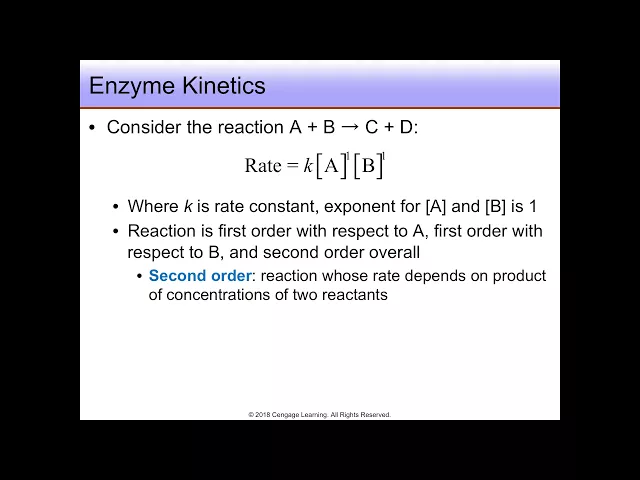
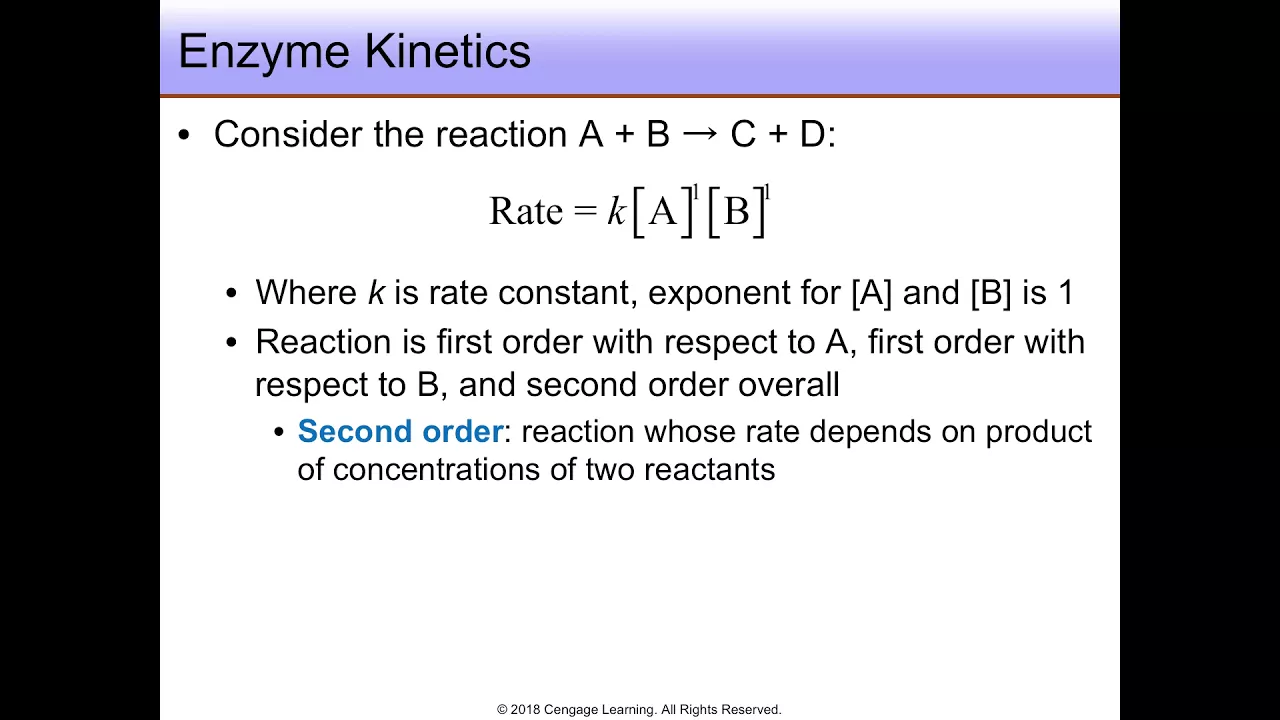
lowercase K the rate war proportionality constant now notice the exponents F and G these are typically whole integers and represent the number of these molecules that must interact over the course of the reaction most often these values are equal to the coefficients of the balanced reaction the overall order of the reaction is simply the sum of all the exponents consider the simplest reaction where reactant a is converted to product P our read expression includes the rate constant times the concentration of a to the first power we say that the reaction is first order with respect
to a and first order overall since there is only the one exponent first order rate constants are those that depend on the first power of the concentration of a single reactant now let's consider a more complex reaction involving two reactants and two products our reaction rate will depend on the concentrations of our two reactants in this case we say that the reaction is first order with respect to a first order with respect to B and therefore second order overall this would therefore be a second order rate constant because product formation depends on the concentration of
two reactants an example of a second order reaction would be the reaction of the polymer glycogen with inorganic phosphate or P I the products of this reaction include one glucose molecule released from the glycogen chain as glucose one phosphate and the glycogen chain minus one residue our reaction rate depends on the concentrations of both reactants the reaction is first order with respect to glycogen first order with respect to phosphate and second order overall in some cases a reaction proceeds at a constant rate regardless of reactant concentration our reaction rate is equal to the rate constant
times the concentration of reactant raised to the zero power which simply means the reaction rate is equivalent to the value of the rate constant itself these are known as zero order reactions and we will see this apply in some cases enzyme catalyzed reactions exhibit zero order kinetics if the concentration of reactant is much higher than that of the enzyme in other words the population of enzyme molecules is saturated with reactant molecules the reaction proceeds at the same rate no matter how much more reactant is added understanding the principles of reaction rates will be key to
helping you understand more about enzyme kinetics