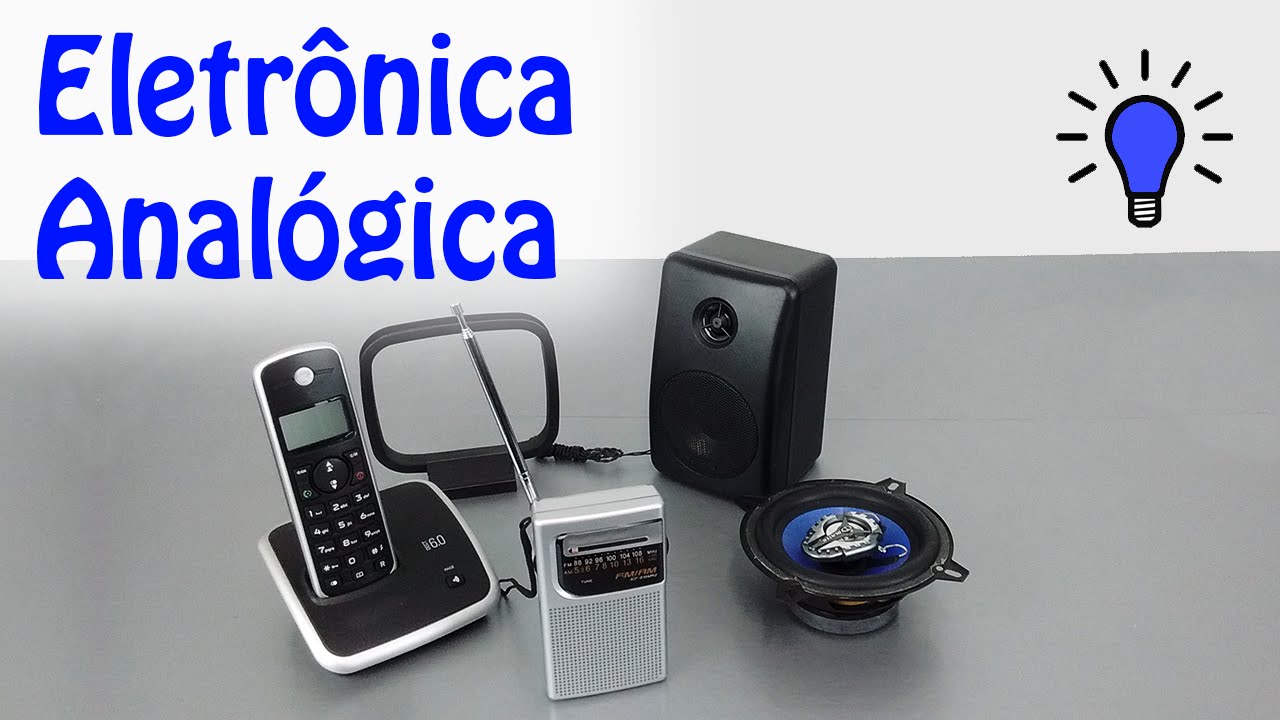
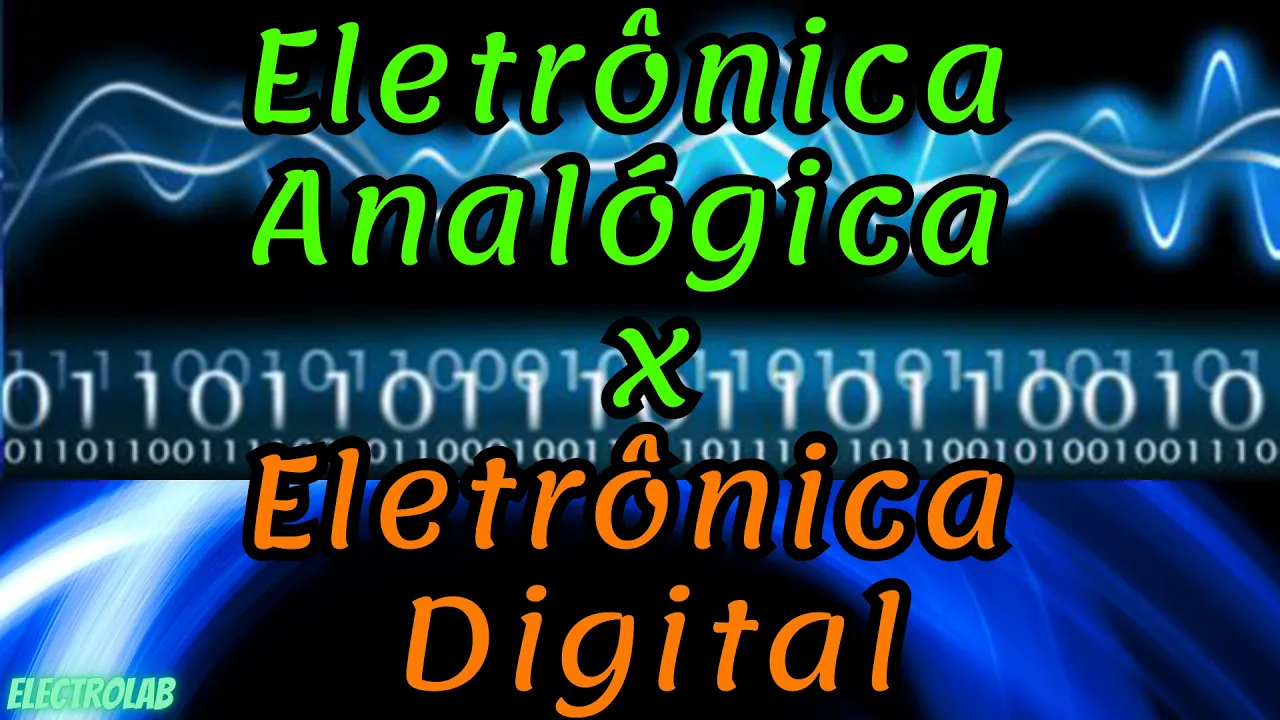
Hello everyone, welcome to another video on the channel ElectroLab. Today we are going to deal with a basic but very relevant are the differences between analog electronics and digital electronics, comment on some important aspects about the two major areas of electronics. Well, first just remembering that digital electronics is actually a derivation from analog electronics.
After all, we live in the analog world. All our greatnesses are analogue, the world digital actually converts these quantities by digitizing these signals that are analog to digital signals, for what? So that it is easy to process, OK?
So, in true, the study of electronics as a whole, necessarily passes through analog electronics, which you need to have a broad knowledge needs to know all phenomena physical and electrical events that occur in analog electronics and studying digital electronics, which is a derivation of it, you applies these concepts to digital electronics adding some other new concepts to address the signals after they are digitized, OK? Then, some classic examples here that we have. We have today Nowadays, many of the signals that travel here by our media in general is a digital signal.
Obviously, when I when I watch television, when I listen to a radio, when I I listen to a recording on a CD or in a stream, wherever it may be, the signal at some point it was digitized, it was processed and then it was transformed, converted to analog again, so that I could receive this information, since I can't read binary, nor listen to music in binary. I need to listen to songs in the original signal, which is the signal analog. I need to watch an image in a visual format, analog.
The digital part is the only internal part of the processing, OK? So basically the electronics Digital isn’t new, okay? We can, so to speak, return back in the thirties, around the forties, when the first computers appeared and computers digital, because there were analog computers before, but it was seen that it was impractical for you to do any kind of work with signals would have infinite values, variation of infinite values, would be called analog signals.
You digital signals, so to speak, greatly restricted that, so so that it could do much more calculations, in a much easier and that you could store that information in memories in a much simpler way, if you digitize the signal, OK? I will now comment on the digitization process. So, at that time, thirties and forties, digital computers, which were gigantic pieces, were able to work with circuits valve that assembled small flip-flop circuits, the flip-flop acts as if was a memory and would store data there, digital data.
Which Is it digital data that I have? These are tension levels. O called high level and low level.
We know well, remember that calmly, I have a level here low, which would be zero volts or zero level and here I have X volts for example, at the level we call TTL, it is a level standard five volts, but it could be another voltage today Nowadays, other voltages are used here as well. This here is the high level also called a. One and zero is the encoding that I have of the binary system.
There's a video here channel where I explain the binary system in detail. Or In other words, this is the low level. This is the high level this is low level.
High, high, high, low and so on and these levels refer to this type of signal here, which is a square wave. OK? Or rectangular.
She will indicate low, low, high, high and so on. This type of signal translates the one there that translates into binary. Well, this is one digital signal.
The analog signal is one that has infinite values. He not only has a high level and a low level. So, for example, if I have here a sinusoidal signal, which is a very standard signal here, for example, It could be a musical note or something like that, I have it here values here for voltage and here is time.
Same thing there. Here I could have values here that if here is five volts maximum and here it is zero, there could be two here volts, two and a half, three, four and a half and infinite values that will vary and to map this all from here, I would need to have gigantic memories, so it's much more It's easy for me to translate these levels into digital levels. How is it I do this?
With signal digitization. He goes through a circuit known as an analog-to-digital converter, Or ADC (Analog to Digital Converter). Analog to digital converter and this circuit will convert my analog signal may be by example a song, it could be a recording of a voice or it could be an image or it could be a level that comes from some type of sensor any type of information that has fluid variation, or be permanent, for variations that are categorized as zeros or ones doing the scanning.
Digitization nothing more than reading several points here in this analog curve, OK? From time to time he will do readings and at that moment it takes a reading and records a digital value for that point. As I have infinite points on an analog curve, I will limit that reading to a given sampling rate.
This sample rate, it will be in Hertz. So how many times per second do I sample that sign. So, for example, the ideal is you sample at least twice the frequency that is twice the maximum frequency of the signal you are reading to say this way you can capture as much information as possible, otherwise you will have loss of information.
Let's go with this sinusoid here, I did a sampling here from this point, I'm going to improve here like this. Here, I would do another one later sampling here, then another here, notice, I'm doing few samples, another here, another here, another here, do so, very extended. Just these points here.
Then I go read this point, I will measure the voltage here and transform it into a digital signal or rather a binary number, right? Here the same thing that is the same thing and such. If I'm going to translate this from here to a straight line, because then I will read these points, I will read from here to here, it will be like this, from here to here, it will be like this, from here to here, it will stay like this, from here to here like this, he It's going to be a bit square here, because I I'm not going to have this entire path here that the sinusoid makes In fact, I'm going to have something like this.
I will have So the deal is kind of square. It will be like this, the sinusoid It won't be perfect, of course because I'm sampling it some of the points. So the first, the first thing is, there is great difficulty in converting analog signals in digital with high quality.
Nowadays, of course, much less than in the past. But the big question of difference between the signs is that you effectively don't catch the infinite points you have, you take the ideal which is at least the double the maximum frequency of that analog signal. Then for example, in audio you have in theory a maximum signal twenty kilohertz twenty kilohertz.
It would be the biggest frequency of the audio signal. So you sample at least the forty kilohertz. Typically a CD for example sample forty-four kilohertz which is a lot.
It means I'm going to do sampling, this is the rate sampling, I'll do forty-four thousand samples per second, in every second I will read forty-four thousand points of my analog waveform, quite a lot, right? Apparently quite a lot, but if the signal has much greater information, a much greater frequency, this may be insufficient, depending on how often you are sampling. Another important factor.
. . .
this one would be then the sampling rate. Another factor would be the resolution of this sampling, which is the number of bits. The number of bits is as follows, the higher the number of bits the better.
Clear, your converter circuit will be much more complex digital analog and much more expensive, which is why circuits high quality for example in audio, high quality circuits audio fidelity they are expensive because they work with digital signal. It needs high frequency sampling and high number of bits and this makes the circuit extremely complex. Then the difficulty.
For example, in part of electronic instrumentation, an oscilloscope Good digital, what do we measure on the oscilloscope? Signals analogues, we can even measure digital signals. We can do a logic analyzer and such, but every signal will pass by an analog-to-digital converter and when it does this conversion I need an ADC converter with high resolution and high sampling rate to be able to have more faithful as possible to my original sign.
Then on the oscilloscope, very expensive oscilloscopes, they have ADCs with a very high resolution and a very high sampling rate. To begin, among others, among other factors, of course, I'm talking only referring to the ADC. The ADC makes all the difference.
Those ones tiny, portable models that cost fifty, sixty dollars or a little more, they use an ADC extremely simple, because he can't use a complex ADC there with a high resolution, which will greatly increase the cost of the device. So it works, it does the analog conversion to digital, but with losses, obviously, right? All proportional to type of circuit you chose.
So big difficulty due to these factors that end up making the more complex and more expensive conversion circuit. Then the number of bits is exactly the number it reads in each sampling. Here I put one, two, three, four, five, six, seven.
Normally you have it on the CD for example you have sixteen bits or In other words, there are sixteen bits so it is a number that varies from zero to sixty-five thousand and something that are number sixteen which is two to the power of sixteen, okay? So it's a number with if if you go down here to eight bits you will go down to zero to two hundred and fifty-six positions. You're going to share this one of yours reading here only between zero and two hundred and fifty-six (255) positions.
This is very little in the way of variation. Then, normally a greater variation with the larger number allows you get a more accurate reading every time you do a sampling of the digital signal. So, in short, This is the big question that involves the transformation of analog signal into digital signal.
Because of this all the difficulty, you will have products with great conversion for digital, the treatment there is much easier then with the advent of digital electronics, it facilitated not only these areas that I mentioned, but for example in the area of communications we have digital radio transmissions of TV data transmissions and you can with these transmissions, which are transmissions that obviously go on a carrier analogue, a lot of people get confused, is the radio digital? Is it analog? No, the radio, the radio signal is a wave carrier, it is always analog.
Now the content that is modulated inside it, this can be digital. So, it is modulated within an analog signal carries that sign over there. He ends up becoming much more immune to noise, variations because it has error bits, it has a control series that allows transmission at high speed and get to the other side, even with difficulty in transmission o the circuit that is receiving what will it do the opposite, right?
Analog digital conversion that would be the famous DAC, which is what is at the other end, it will treat this signal, it will identify if there is an error, ask them to send new data, everything this done at a very high speed, makes your signal is normally of very high quality on the other side, very better than in purely analogue transmission. Of course if Did you manage to convert your analog signal well to digital. For example, as we were talking about sound, music, you don't have much difficulty there, because frequency maximum 20kHz, you set a very high sampling rate, set a reasonable number here, above sixteen bits obviously or plus, depending on the situation, twenty-four bits and you can a very quality only audiophile purists will say that obviously there is a difference between that digital sound and a analog sound that comes, for example, on a vinyl record, this then obviously it's a private personal opinion and I even I think it makes sense.
'Cause you'll surely end up losing certain nuances (harmonics) that the trained ear can capture, but for general use for those who are not audiophiles he will not notice any difference and will think that the sound It's fantastic because there's no noise, there's no hiss, etc. And it has good bass fidelity. and treble.
Another issue of sound, music, etc. is more easy. Now transmit signals that have a very high frequency higher can get a little more complex, video now a little more complex.
You already work with frequencies higher levels and other types of signals can also be complicated, but it is certainly the best way to convert from analog signal to digital, its transmission and then the reconversion so we can act. The electronics there will be specific components to work with digital electronics, whether the converters or example circuits that work with digital logic, which would be, for example, logic gates, in which you will work directly with high and low signals, zero and a TTL ports, C-MOS ports and a host of other circuits that you can, Flip-Flops and all, that you can develop a logic and work on that or not wanting to be so discreet so you can move on to more sophisticated work which is working with microcontrollers, where you work with digital signals at inputs and outputs, sometimes even with analog signals because some of these Components may have internal ADC conversion ports, such as for example Arduino and you make a program that will deal with that the logic of that and there will be an answer at the output. So there you are already in another area, in a another segment that involves programmable circuits, OK?
Like microcontrollers, for example, that will work with the digital electronics, OK? Analog electronics will always be there surrounding the digital, be it the moment of conversion, i. e.
at the time of one of the conversions. Both in input and output, either in the power supply or in the control of digital signals, which in turn also depending on the will often have critical behavior and may it is necessary to use analog circuits to treat those signs there in a way that they are well conducted within the circuit and so on, folks. Then basically analog electronics and digital electronics are part of a large group that is our study which is general electronics, we have to go through all the steps to be able to master the complete area and be able to carry out projects that can bring the benefits from one to the other, OK?
And I will show here, for example, There is no practical question for us to feel the difference here of analog signals and digital signals. In electronics a very classic view that we can see on the bench is a measurement made on a digital instrument and a measurement made on the analog instrument. So we have an AC voltmeter here analog and here a digital AC voltmeter.
That here, for example, there is a bargraph here so you can see the analog variation. I'm going to vary the signal here at the entrance with the variac and we'll see how this meter here behaves that he will quickly be able to understand the variations of the signal and we can see here the very classic fluctuation and there the fluctuation of digital, in which we cannot see well except for the bar that appears below, when the signal varies a lot, OK? We need the signal stop so we can take a measurement, we can't see fluctuations or very rapid variations, because this one depends on a sample rate and it will not can you show us this so quickly.
So I will call here. So, for example, here, I'll put one, if I put a fixed value here, close to fifty volts, ok there, fifty volts here, fifty volts there, here is the bargraph, now if I start floating here. I can see that I I'm varying here, from sixty to eighty volts more or less and here the bar variation is interesting, I I can follow it, but the reading there is of values several.
Here I can't more or less I can even see why I'm not changing very quickly here, but normally we don't have this notion in a variation with You can save yourself from this by this little bar here. In analogue We can see the variation, look, I'm going to increase more, less, very slowly here, look how well it follows, he even has it here a very quick read answer there in the bargraph, arriving here at one hundred almost one hundred and fifty went from one hundred and fifty decreasing is instantaneous. And we see the fluctuation clearly what income he is working on.
Hence in some situations up to measurements made with analog instruments can be useful especially when you have this fluctuation which is not a constant value. I stopped, it is measuring a value there constant both here and there. Obviously, it's not possible nowadays you replace a digital multimeter because it has a number of other features, it has more precision and has countless other advantages, but analog has still its application especially when you have signals that vary.
At least so you can see the variation in order of magnitude of the signal being measured, often a digital multimeter, even the simplest ones, is even worse that then you will see a barbaric fluctuation of numbers you won't be able to understand anything in analogue you see in which range it is varying. But the goal here It's not about comparing instruments. Just show here.
In analog you have the fluid variation of the signal and in digital you have it in steps, in steps, they go rising and falling because they depend on the sampling rate, OK? That's the big question, OK guys? So basically it is That's what I wanted to compare here between analog electronics and digital electronics, electronics basically work with these analog signals and digital signals, this is the big difference, but in practice it's just one thing, one goes work with signs that have fluidity of values and values infinite which is analog and the other will work with values limited to high and low levels and proportional to the rate of sampling and resolution during the scanning process.
So that's it folks, there are two major areas, we need be careful to study both with the same dedication, one is not better than the other, especially nowadays when they are closely linked in various aspects of the equipment that we we work so much on the electronics instrumental as well as the equipment we work on repairs in projects, whatever, OK? I hope you enjoyed. It's a basic video, OK guys?
Many people still have doubts regarding these differences between both the electronics as well as digital analog signals, then I wanted to make these points a little more clear. important, OK? If you like the video, click on like, don't forget to subscribe to the channel and hit the bell notifications and until the next video, a big hug.

![Pop Rock Radio [ 24/7 LIVE ] Best of Pop Rock Songs! Best Rock Music Hits Mix](https://img.youtube.com/vi/CBfAjXne-H8/maxresdefault.jpg)