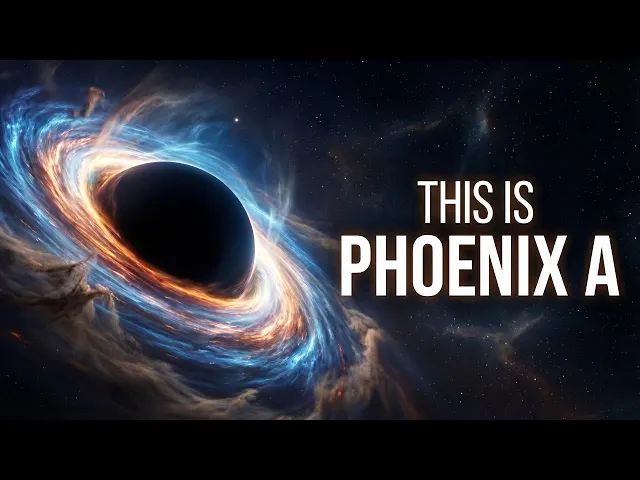
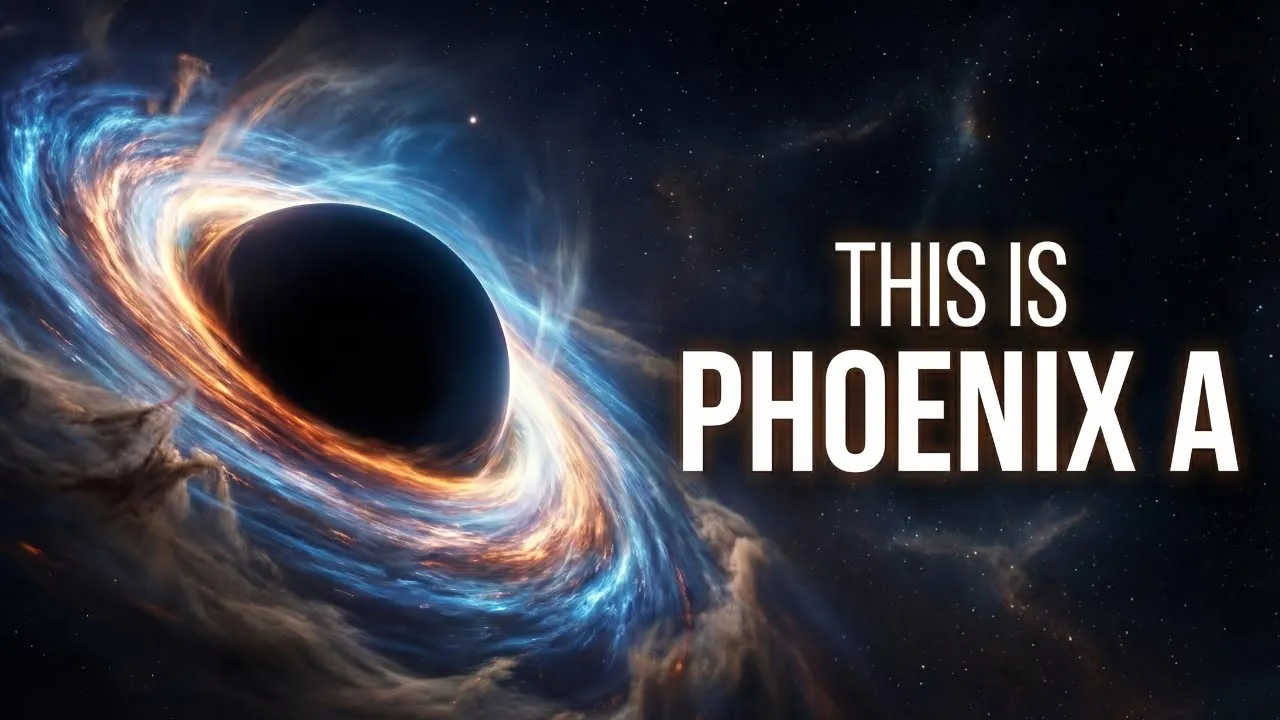
[music] This black hole should not exist. It is so massive that even the laws of physics say it had no time to form. And yet it does.
5. 8 billion lightyears from Earth, hidden within a massive galaxy cluster, lies a black hole that weighs 100 billion times more than our sun. To understand how impossible this is, consider that even Ton 618, previously the largest known black hole, weighs only 66 billion solar masses.
Phoenix A is 50% more massive than that cosmic giant. But according to our understanding [music] of black hole growth, it simply should not exist. Yet there it is, immense, relentless, defying the rules we thought governed the universe.
In 2010, the South Pole Telescope detected [music] an unusually massive galaxy cluster in the southern sky. What astronomers found at its [music] center would challenge decades of astrophysical theory. The Phoenix cluster harbored a central black hole of [music] staggering proportions.
It is also one of the brightest galaxy clusters ever observed in X-ray light, glowing intensely as superheated gas floods its core. In cosmic terms, it shines like a beacon, revealing just how extreme its environment truly is. Initial measurements suggested a mass approaching 100 billion solar masses, roughly 24,000 times heavier than the super massive black hole at our galaxy's center.
If our sun were a marble, Phoenix A would be the size of Mount Everest itself. But size is not the real problem here. The real problem is time.
The universe is 13. 8 billion years old. Black holes grow by consuming matter, but there is a natural speed limit to this process.
As matter spirals into a black hole, it heats up. It radiates enormous amounts of energy. That radiation pushes away incoming material, creating what physicists call the Edington limit.
Even if Phoenix A began as a million solar mass seed at the very beginning of cosmic time and fed continuously at the maximum [music] possible rate, it should weigh only about 10 billion solar masses today. Phoenix A is 10 times heavier than physics allows. It broke the cosmic speed limit.
One possibility lies in the cosmic dark ages. Perhaps Phoenix A did not begin as a stellar remnant at all. It may have formed as a direct collapse black hole when enormous clouds of primordial gas collapsed straight into million solar mass objects from the start.
But there is a third, more unsettling option. What if Phoenix A found a way to exceed the Edington limit itself? Recent observations suggest that some black holes can temporarily exceed this limit.
If [music] Phoenix A fed this way for billions of years, its forbidden mass might finally make sense. This [music] is where Phoenix A becomes truly puzzling. Its host galaxy cluster is forming nearly 1,000 new stars every year.
By comparison, the Milky Way creates roughly one new star annually. This explosive star formation should be impossible in Fenix A's presence at all. Super massive black holes typically heat surrounding gas, [music] preventing stars from forming.
Yet in the Phoenix cluster, gas has cooled dramatically, [music] triggering a stellar baby boom. The most massive black hole ever observed appears to have lost control of its environment. It is like finding a wildfire that somehow stopped burning, allowing a forest to grow in its path.
Phoenix A forces astronomers to reconsider how the early universe evolved. Black holes [music] of this scale would have influenced galaxy formation across enormous regions of space. They would have shaped where stars could form and how matter distributed itself on cosmic scales.
Yet, current simulations cannot produce objects like this so early in cosmic history. Phoenix A lies 5. 8 billion lightyear away.
Its mass [music] can only be estimated indirectly, leaving room for uncertainty. But even conservative measurements place it among the most massive objects ever discovered. Phoenix A represents the extreme edge of what is possible in our universe.
It is a gravitational monster that should not exist according to our current understanding of physics. Whether it [music] weighs exactly 100 billion solar masses or somewhat less, its existence alone changes the rules. It proves that the early universe was far [music] more violent, efficient, and extreme than we imagined.
Somewhere in the depths of space, this cosmic giant continues its ancient dance with hundreds of galaxies. [music] A reminder that the universe still holds secrets capable of rewriting everything we know.