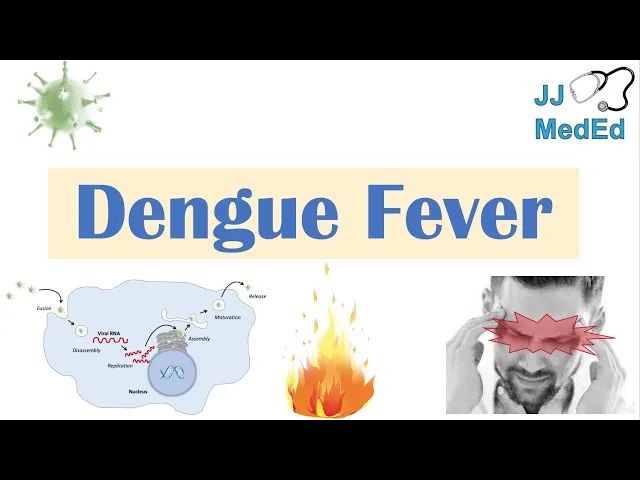
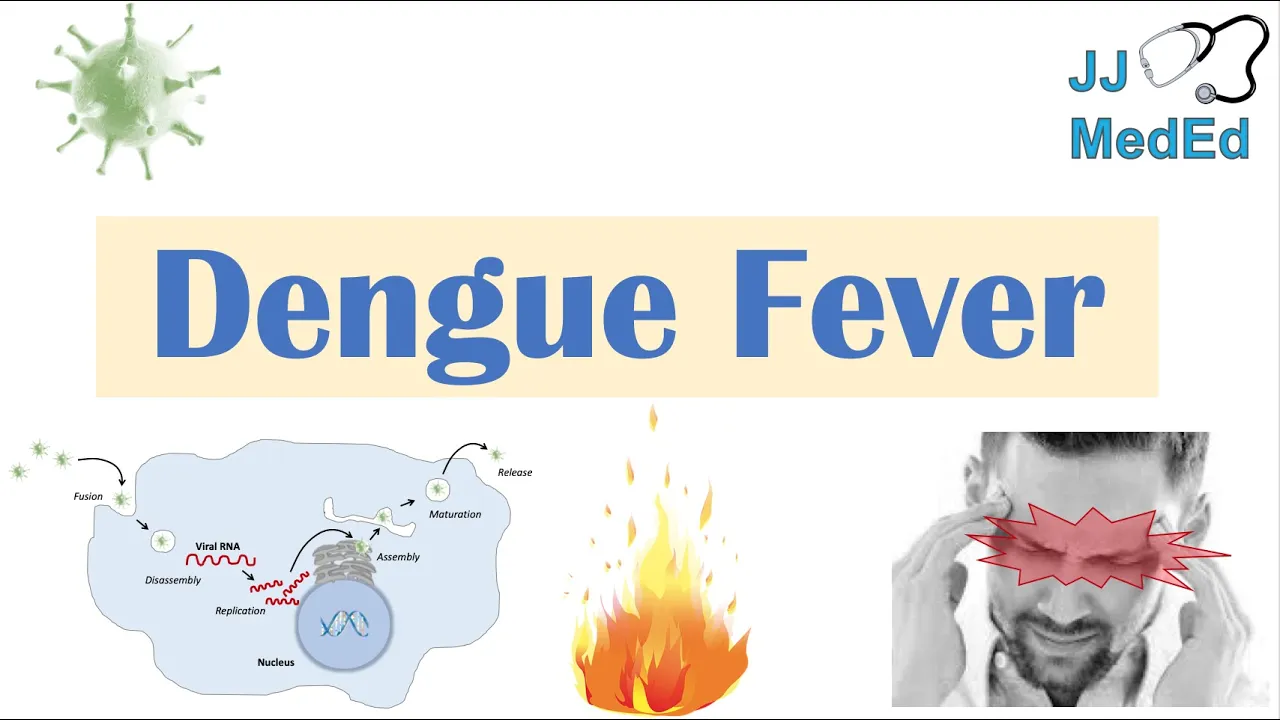
hey everyone welcome to another lesson this lesson is on dengue fever so we're gonna talk about how we become infected with dengue fever what are some of the signs and symptoms are also going to talk about how we diagnose it and how we can treat it so dengue fever is an illness due to an infection with a virus of the family flaaaav e'r'day and there are a subset of five of e'r'day viruses known as the dengue viruses so there are actually four dengue viruses and we name them the env1 to be envied for so then
v1 that then v4 they are all enveloped viruses we're going to talk about why this is important a little later and they're all positive single-stranded RNA viruses now dengue fever is an important cause of what we call a fever or in a returned traveler so what that means is that if there is a traveler to a perhaps exotic locale and they come back to their home country and they have a fever dengue fever actually accounts for about 5% of those cases so where are some of those exotic locales so most of them are in tropical
and subtropical climates and a couple in particular that I want you to think about are the Caribbean and Southeast Asia so how do we get infected with this virus we actually get it from our lovely friends the mosquitoes once again and the mosquitoes in particular are the species 80s Egypt I which is actually the same mosquito that can infect us with yellow fever and the related species 80s el Bob pictus so what is the pathogenesis of dengue fever once we actually become infected once a mosquito bites us in our skin the viruses can actually fuse
with a host cell now there are some theories as to what some of the host cells might be some theories are that they are the Langerhans cells in our skin which is an immune cell whatever that host cell might be the dengue virus fuses with that cell and enters the cell so how does it fuse with the cell it's actually mediated by the viral envelope a glycoprotein which is important for infectivity so that is actually how the dengue virus can attach to a host cell and enter that host cell what are some of the viral
receptors that it attaches to well some of these receptors include heparin sulfate that is located on the host cell there's some other ones as well but we won't talk about them here once the virus enters the cell it gets packaged into an endosome and acidified vacuole and it eventually becomes disassembled into its viral RNA once that viral RNA has been exposed it can become replicated inside the cell and once we have enough of viral replication the virus actually assembles and we can think about it assembling in the ER or the endoplasmic reticulum once the virus
has assemble that can mature into a variety into plasmic reticulum and Golgi apparatus and can get packaged again and it can be released to be able to infect other cells so that is actually the basic process as to how the dengue virus and many other viruses infect host cells once that virus leaves that host cell it can move on to infecting local lymph nodes and in lead to very Mia or virus in the blood so what are some of the signs and symptoms of dengue fever so thingy fever actually leads to a variable clinical presentation
can anywhere from asymptomatic to life-threatening what we find is that bengi fever is more likely to be a somatic in children now when we do become infected with the virus the incubation period for that virus is on average anywhere from 3 to 14 days and there are actually three phases of infection I'm going to talk about here in the next few slides the first phase is the febrile phase the second is the critical phase the critical phase doesn't necessarily have to occur in every infection but we'll talk about what are some of the risk factors
for getting this critical phase and then the third phase is the recovery phase so each of these phases has different signs and symptoms and different clinical outcomes so we'll start with the febrile phase the febrile phase is where this infection begins to become symptomatic and the symptoms usually begin at a four today seven and when we do begin to have symptoms of the febrile face the febrile phase lasts for three to seven days and as its name suggests it has a fever and the fever is a fever of sudden onset it rapidly and suddenly occurs
and it is a high grade fever greater than 38 point five degrees Celsius again it is a very important cause of fever in the return traveler other common symptoms include headache and we can also get retro orbital eye pain so pain in behind the eyes and this is something that will be almost like a key phrase for you if you hear fever headache return traveler and retro orbital pain you are thinking dengue fever so retro orbital pain Clues you into this being dengue fever patients can also have myalgias or muscle pain and arthralgias or joint
pain and some other symptoms that might not necessarily occur include some gastrointestinal symptoms like nausea and vomiting diarrhea and abdominal pain if a patient is having persistent vomiting and abdominal pain we consider this a worrisome find which means it could be a more severe presentation some other signs and symptoms of the febrile phase include lymph adenopathy so swollen tender lymph nodes how paddle megali so an enlarged liver and this is actually another warning sign that may indicate a severe presentation of NJ fever we can also see a maculopapular rash so maculopapular rash like here in
this image so we can see this reddened flat or perhaps slightly raised rash and it occurs in approximately 50% of cases and it's more common in the first dengue infection so if someone gets dengue fever for the first time they're more likely to have the maculopapular rash compared to if they were to be infected with dengue fever a second or a third time and the maculopapular rash generally erupts about two to five days after fever has started and dengue fever can have some other symptoms that are less common including respiratory symptoms like cough nasal congestion
and sore throat and some of the more worrisome things that can happen in the febrile phase in dengue fever are the findings of leukopenia or low white blood cell count thrombocytopenia or low platelet count and Trans Am and itis or elevated liver enzymes like alt and ast so these only happen in a small subset of febrile faced patients but if they do they are again well worrisome sign that this is a severe dengue fever so what is the critical phase so the critical phase occurs again in a small subset of patients most patients have the
febrile phase and they recover fine but some get this more severe presentation and the critical phase of dengue fever is more likely to occur in the following cases having a secondary infection of dengue fever and when I mean by secondary infection is that they've had a previous dengue fever infection before they recovered they were fine and then they get it again and a lot of times it's with another and gay serotype remember we said there are four different named gay viruses if they were to be infected with one of those and then they're infected again
with a second different dengue serotype then they are more at risk for having the critical phase in particular if they've had that first infection within 18 months of the second infection so again if they had a primary infection and within 18 months they get another infection with a different dengue virus they're more likely to enter the critical phase of dengue fever infection in critical phase of infection is also more common or occurs more often in patients with other medical comorbidities if the critical phase does occur it occurs about 3 to 7 days into the infection
after d4 vessels which means that it's after the fever has resolved and the critical phase lasts for about 24 to 48 hours and what we see in the critical phase is thrombocytopenia so low platelet count and can be very severe even less than a count of 20 and because of the low platelet count we see increased risk of bleeding so we can see hematochezia so red blood in the stool melina or black tarry stool hematemesis so vomiting up of blood epistaxis so nosebleeds and even menorrhagia or heavy menstrual periods so all of these can occur
due to that very low platelet count and these symptoms are often what we call dengue hemorrhagic fever now this term is not often used anymore we can still hear it but a lot of times now we describe dengue fever as mild or severe so we may still hear dengue hemorrhagic fever this is essentially what this means you get very severe thrombocytopenia and increased risk of bleeding so again we may see the beginning of the thrombocytopenia in the febrile phase not always but we can but if it does occur in the febrile phase it's not as
severe as it would be in the critical phase and in the critical phase we may also see vascular leakage so there's so much inflammatory cytokines that it can lead to leakage out of the intravascular space we can lose intravascular volume leading to hypotension or shock and this can lead to a variety of organizations leverage and central nervous system involvement so these signs and symptoms are what we call in gay shock syndrome but like dengue hemorrhagic fever the term engage shock syndrome is not being used as often we actually prefer to use newer criteria that describes
dengue fever without warning symptoms with warning symptoms or severe dengue fever so these would be considered part of severe dengue fever but you may still hear the term dengue hemorrhagic fever so think about thrombocytopenia in the bleeding or dengue shock syndrome where we can think of vascular leakage leading to hypertension and shock and organ impairment so again older terms that are still being used but we may use other types of terminology nowadays and the third phase is the recovery phase so recovery phase as its name suggests is essentially a resolution of all those problems we
talked about resolution of vascular permeability and the hemorrhagic risk the vital signs also stabilize but you may also see an eruption of a new rash similar to the first rash so again it looks exactly the same it's a maculopapular rash and it may be pure attic so maybe itchy and it usually lasts about 1 to 5 days and what often happens is that even though these patients may recover they may experience chronic fatigue which can be debilitating for them and this can last for weeks to months so how do we make the diagnosis and how
do we treat engei fever so the diagnosis is through generally serology we can look for anti dengue IgM so immunoglobulin M antibodies against dengue virus and these can be detected by about day four of infection before that we may have to use PCR to detect viral genomes or viral genetics and the treatment of dengue fever is often supportive a lot of times patients recover on their own and there is spontaneous resolution we can use acetaminophen for symptom relief but we want to avoid using ie Pro fin or Advil due to its anti coagulation properties because
we've talked about before we have decreased thrombocytes or decreased platelet count so we don't want to decrease platelet functioning by using ibuprofen or Advil so we avoid using this and we can try to prevent getting dengue fever in the first place and we can use a dengue vaccination but unfortunately even if you get the dengue vaccine you may not be fully protected against dengue infections but the good news is that having a dengue vaccination reduces the symptoms and the length of infection so again diagnosis of dengue fever is by looking for anti dengue IgM antibody
that is usually present by day four of infection treatment is often supportive this is a viral infection so we don't have the right tools to fight this infection we can use acetaminophen for symptom relief for helping with headaches and retro orbital pain but we want to avoid Advil due to the bleeding risk and we can try to prevent the dengue fever in the first place by using a dengue vaccination so if you want to learn more about other infectious diseases please check out my infectious disease playlist if you haven't already please consider liking subscribing and
click in the notification model that helps for the channel and say up-to-date on future lessons so live laugh and continue to always learn and thank you so much for watching and I hope to see it next time