What if I told you that Jesus didn't just fulfill individual prophecies throughout His life, but entire story arcs of the Old Testament? We usually look at five Bible stories and get into some deeper meanings on this channel, but the stories we've chosen today are so incredibly deep that we had to select only three. I promise you that you will appreciate Christ more than ever after watching this video.
Today, we're focusing on Jesus' baptism and temptation, His walking on water, and His discussion with the Canaanite woman. These stories seem simple on the surface, but it turns out they serve a much bigger purpose to fulfill entire chapters and story arcs of the Old Testament. Prepare to understand the greatest man who ever lived as you've never understood before.
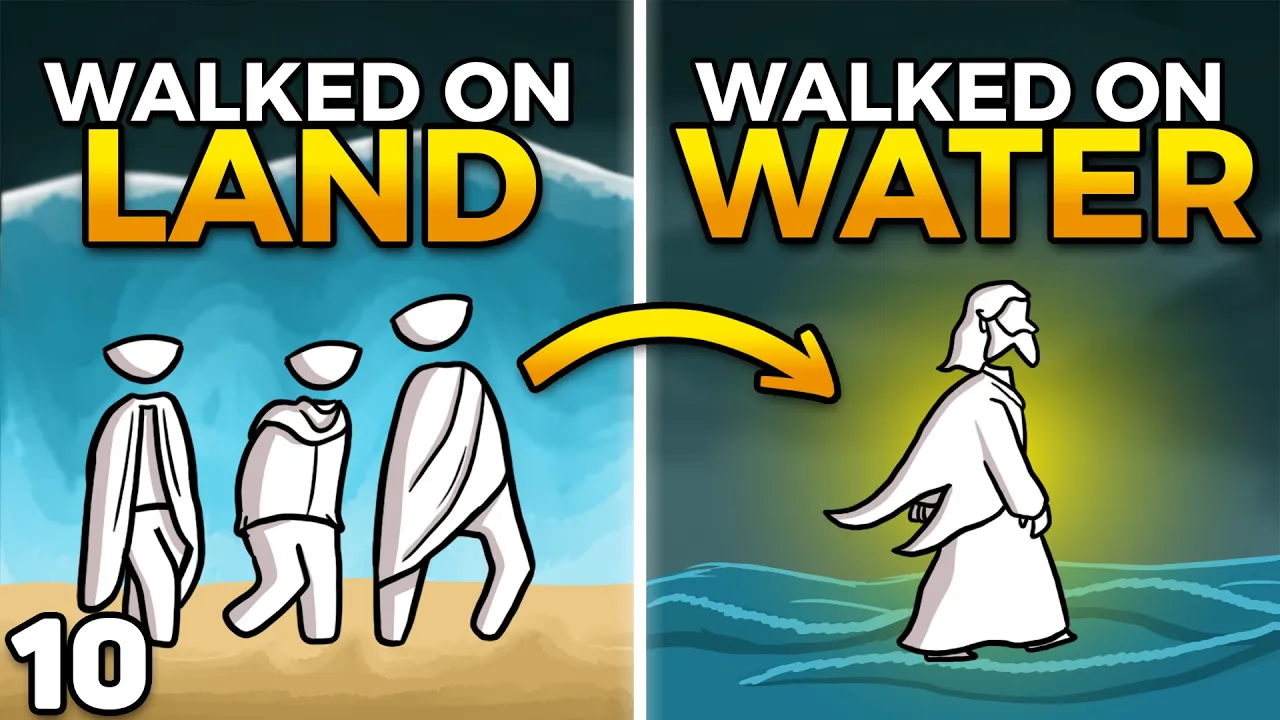
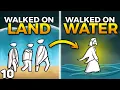
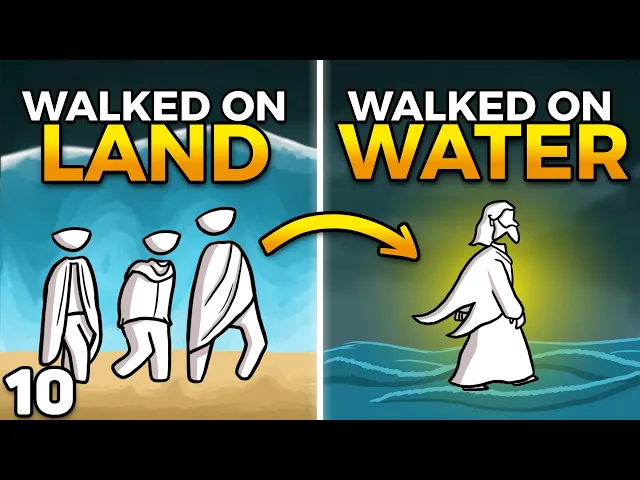
Jesus never used His godly powers to get attention or to show off. We know that all of His miracles pointed to something deeper than the physical. So why do we have a record of Jesus walking on water, a very flashy superhuman ability that generations of kids have tried and failed to replicate at their local swimming pools?
At first glance, this miracle doesn't seem to reveal any profound spiritual truth, but it turns out that we've been missing a crucial Old Testament connection for all these years that hides the reason why Jesus performed such a flashy sign: that is the famous story of Moses parting the Red Sea. Once connected, something incredible is revealed about the subject we thought we knew but perhaps misunderstood. So, in order to connect these two stories, let's take a look at these two verses first.
Both are addressing God, the Great I Am. That name is going to be very important later on, so keep that in mind. The Greek translation of this verse in Job is as follows: He walks upon the sea as upon firm ground.
The exact same Greek words are used to describe Jesus walking on the water—an interesting parallel. But that's only the beginning. Have a close look at the end of verse 11; it describes God passing by, and in Mark's account, it said Jesus wished to pass by them while walking on the lake.
But this isn't the first time the phrase is used; it's actually used twice in the Old Testament. The first was Moses, where the Lord passed by him on Mount Sinai. The phrase "passed by" is used twice here and matches the phrase in Mark perfectly.
The second is Elijah, where this divine encounter is repeated; the phrase is yet again used, and all this happens on the very mountain where it occurred previously. So when I look now at the Gospels, we see Jesus treading on the waves as spoken of by Job, passing by His disciples in the same manner that God passed by Moses and Elijah. But this, although awesome, isn't the connection we're looking for.
We want to know how Jesus walking on water is connected to Moses parting the Red Sea and what lies at the core of their connection. Well, prepare yourselves because what I'm about to tell you is near impossible to ignore. Both the parting of the Red Sea and the walking on water events took place at night, and the exact time they took place will be important in just a moment.
The disciples on the boat reacted to their teacher walking on water as you and I probably would: they were afraid and cried out. But Jesus responded with the words, "It is I; do not be afraid. " Here we have three statements exchanged in the story.
These two statements also appear in the parting of the Red Sea. When the Israelites saw the Egyptians pursuing them, they feared and cried out, but Moses assured them, "Do not be afraid. " This phrase is literally translated to "I Am," the name God gave Himself in Exodus 3.
But the real point of all this is that the Israelites feared for their lives because they had an obstacle blocking their escape: the Red Sea. In the Gospels, we read that Jesus stretched out His hand to rescue Peter. This action is very prominent in the Red Sea account, appearing twice when the waters were parted and joined back together again by Moses.
Though we find out the truth later on that it was actually God who stretched out His hand to open and close the Red Sea. Remember when I said the time was important? Well, the Gospel events took place in the Fourth Watch of the night; the Red Sea story, however, took place during the morning watch.
But here's what's interesting: there are only four watches of the night, meaning that the Fourth Watch contained the sunrise, also known as the morning watch. In other words, these two events happened within hours of each other, likely just before sunrise. But here's where the stories take different paths.
The conclusion of the Gospel story sees Jesus calm the storm and immediately transport the disciples to their promised location, but in the Red Sea account, the Israelites are set to roam the wilderness for 40 years. This comparison says something about Jesus: how the wait for God's people is finished in the coming of Christ. So now that the connections have been made, we can finally discover the secret these stories reveal together, and I wonder if you guys can guess it.
The Red Sea depicts death on one hand and life on the other. The Israelites leave their life of slavery and are released into a new life through God's power, and the motif of water in all this can lead us to no other conclusion but the Christian practice of baptism. Many passages represent deep water as a symbol of death, connecting them with forces of evil and chaos.
To walk on water, then, signifies having dominion over the power. Of death, which Jesus demonstrates, we see Peter here desiring to walk on water with Jesus. But digging deeper, we see a man's desire to overcome death itself.
Peter represents us all; he figuratively goes down under the water, symbolizing death in a very real and dangerous environment. And like in the Red Sea account, God stretches out His hand and rescues Peter as He did with the Israelites fleeing from the Egyptians. As the Egyptians died in the Red Sea, so our old nature of sin needs to die also.
It is this connection that adds incredible depth to the command to all believers to be baptized in Christ's name, dying to sin and living for Christ in Christ. This brings us to another baptism that is very important in the Bible, and of all the deeper meanings I've ever covered on this channel, I believe this story you're about to hear is the most unbelievable connection of them all. It's about the baptism and testing of Jesus, of which the baptism holds significant importance.
But before we can talk about the baptism part, we need to understand a deeper meaning in the temptation of Jesus. We're told in Scripture that Jesus was led by the Spirit into the wilderness to be tempted by the devil. We're also told that He fasted for 40 days and 40 nights during this period of time.
It's an interesting story, but what if I told you that something incredibly similar to this had happened before, and it was right in front of our eyes? In Numbers 13, we're told 12 scouts were sent into the land of Canaan, but they weren't willing to enter it due to some fearsome giants that lived there. Thanks to their lack of faith, God said that He would punish Israel by sending them into the wilderness for 40 years—one year for each day that they scouted the land.
But the purpose of this was twofold. The first was to punish them for their lack of faith, of course, but the second was to test them, to see what was in their hearts. Who else was tested in the wilderness?
It seems like God is disciplining Israel here as He would His own son. In fact, the Bible calls Israel God's firstborn son, so the spiritual Son of God was tested for 40 years in the wilderness. Jesus, the actual Son of God, was tested for 40 days in the wilderness.
The parallels are striking. But wait, because there’s something strange going on during Jesus' temptation. When Satan tempts Jesus, we know that Christ quotes three scripture verses to resist the challenge, but all three verses happen to be in the same few chapters of the book of Deuteronomy, and it seems too close to be a coincidence.
Satan first tempts Jesus to turn stones into bread, but Jesus quotes a very specific verse in Deuteronomy that, in context, is talking about the Israelites' failure to resist this very temptation in the wilderness, where the Israelites grumbled about their lack of food in the desert. Jesus resists the temptation under even harder circumstances. In the second temptation, Satan quotes scripture of his own, but Jesus again responds with a verse from Deuteronomy: "Do not put the Lord your God to the test.
" Again, this verse is an explicit reference to the time recorded in Exodus 17, where the Israelites are described as having tested the Lord. In the third temptation, Satan tempts Christ to worship him, something I've discussed in previous videos. But what's important to illustrate here is that Jesus rebukes Satan, referencing Deuteronomy for a third time.
This time it reminds us of the golden calf, one of the lowest moments in Israel's journey through the desert. In Matthew, the order of the temptations makes this impossible to ignore. First, Jesus was tempted by Satan with hunger, just like the testing of Israel in Exodus 16.
Then he was challenged to put the Lord to the test, just like in Exodus 17. Finally, he was tempted with idolatry, just like Israel was tempted in Exodus 32. But where Israel, God's spiritual son, failed, Jesus, God's Divine Son, succeeded at every point.
Where God's people failed, Jesus succeeded, cementing that Jesus overcame all the temptations that caused Israel and ultimately mankind to fall. Now that we understand all that, we can finally unlock the secret to this baptism. When the Israelites left Egypt via the Red Sea, they're described as having been baptized into Moses in the cloud and in the sea.
The word "wind" is used in the sea's parting; "ruach" is the Hebrew word, but it's also the word for Spirit. Isaiah seems to support this idea that the Holy Spirit was an important presence at the parting of the sea and the escape from Egypt. When Jesus was baptized, the Spirit came down upon him in the form of a dove.
Is it any coincidence that after Israel's baptism through the Red Sea, the Spirit led them into the wilderness, where they were tempted for 40 years? And when Jesus was given the Spirit after his baptism, he was led into the wilderness, where he was tempted for 40 days? To make matters even cooler, the Exodus narrative features the Jordan River prominently at the end—the very river that Jesus was baptized into.
To me, these connections prove God had Jesus planned from the very beginning, and the signs in Scripture that all point towards him are too incredible to ignore. Let me take you to one of the most misunderstood passages in the whole Bible, a place where Jesus is rude and racist to a woman. This passage has caused problems for a long time, but in order to truly understand it, we need to look at this woman's famous ancestor.
In the time of Joshua, God's people ran into a problem. . .
The problem was called Jericho, a fortified city that served as a barrier between God's people and their conquest of the promised land. To scout this city, Joshua sent two spies, and a Canaanite woman named Rahab accepted them into her home. In return for hiding and protecting them, she requested protection for herself, proclaiming faith in the God of Israel.
This Canaanite prostitute would be spared when the Israelites destroyed Jericho, and eventually, she would be integrated into the nation of Israel, becoming an ancestor of Jesus himself. That's the first connection, but it won't make sense until we look at First Kings, where Elijah has some bad news for the king of Israel. King Ahab was incredibly evil, and Elijah told him that there would be no rain in the land except at his word, declaring the start of a severe famine.
Following directions from the Lord, Elijah eventually made his way to Zarephath. It was here that he met a Gentile woman preparing to eat her last meal before death; the devastating famine had all but destroyed her. Elijah assures her that if she makes him a meal first, her meager supply of flour and oil would not run out.
Despite her miserable circumstance, she believed that God would provide for her, and she made Elijah his meal, and it was just as Elijah said: the jar of flour never fully depleted, and the jug of oil never ran out. The woman had another problem: we're told that her son fell ill and grew worse and worse until he eventually died. Elijah intervenes, and his prophetic word brings the boy back to life.
So how are these stories connected, and what does it reveal about the most controversial phrase Jesus ever said? The passage in question is Mark 7. We're told that Jesus is laying low when a Gentile woman manages to find him and persistently begs him to help her.
After begging Jesus to heal her daughter, he tells her that he was sent only to the lost sheep of Israel. She pleads with him some more, and Jesus said it is not right to take the children's bread and toss it to the dogs. Where is Jesus' compassion, and why is he calling her a dog of all things?
After reading through these two stories, I think we can find some clarity. Firstly, it's good to know what Jesus meant by "dog. " The Greek word "kuna" means rabid wild dog, commonly used as an insult, but in this example, Jesus uses the word "kairion," which was more like a house pet or puppy.
Secondly, she shared its geographical region with Zarephath, the location Elijah met the impoverished woman at. Thirdly, Mark refers to the woman as Syrophoenician since she was living in the region of Syrophoenicia, but Matthew calls her a Canaanite, which is notably the only use of the word "Canaanite" in the entire New Testament. With this information in mind, the Old Testament connections become clear.
Like Rahab, this woman was a Canaanite; she would have been considered an enemy of Israel to be wiped out. But, like Rahab, she had faith in the true God, and God's mercy was shown to her, resulting in her salvation. With Rahab, she was spared in the sacking of Jericho and was made part of God's people; with the Syrophoenician woman, she was told the same thing, since as a pet resides in the house of its master, she wasn't being insulted by Jesus.
She was actually being told she's in the house of God already, and like the widow in Elijah's story, she believed in the providence of God. Her statement, saying even the dogs eat the crumbs that fall from the master's table, showed she believed that there was more than enough of God's provision to go around. And just like that widow, she had a child that was healed through a powerful prophetic word, an indication that Jesus had come as the culmination of the prophets.
So tying this story into these two shows God's heart towards the Gentile nations. He had always planned to integrate them into his kingdom from the very beginning. Rahab, the widow, and the Syrophoenician were outsiders, but they were outsiders God always planned to bring into relationship with Him.
Thanks to Jesus, that was made crystal clear to the Jews and the rest of the world.





![Deeper Meanings in Biblical Stories! [6]](https://img.youtube.com/vi/DOexHEnTHSk/maxresdefault.jpg)