The B series, Honda's gift that just keeps on giving. While engines from the established car manufacturer shared some of its excellent traits, Honda always had a trick up its sleeve, and it was called VTEC. [Music] It gave the B series the best of both worlds.
A smooth idle and efficiency and when activated, it used a cam profile similar to a race prepped engine, allowing it to rev to astronomical levels and make power unlike any other economybased engine before it. And best of all, it was the every man's engine. Anybody could afford it.
It wasn't too complicated to build. And combined with the turbocharger, it can make all the power you could ever dream of. This is the story of arguably the greatest inline four-cylinder of all time.
an engine that helped transition Honda from being known as just an economy car manufacturer with some cool motorcycles to a preferred platform to build, to race, to break, and then to rebuild again. This is the story of the mighty Honda B series. [Music] 100 horsepower per liter for a naturally aspirated engine.
That is the measuring stick to consider an engine, regardless of configuration and displacement, as a true performer. By today's standards, this number and beyond is fairly common place amongst exotics and even Ford Mustangs like the GT 350. But in the late 80s, to achieve such power density meant you had to prioritize ungodly revolutions over [Music] [Applause] rationality.
In 1987, Honda had a humble little sport bike called the CBR250R. It was an exercise in how high a production engine could rev and still stay in one piece. [Music] With its 250 cc dual overhead cam inline four-cylinder engine that used a gear driven valve train, it could rev to a red line of 17,000 RPM from the factory.
[Applause] [Music] That is 283 revolutions per second. From a power density perspective, it was pushing the equivalent to 180 horsepower per liter naturally aspirated in 1987. A true marvel of Japanese engineering for the time, especially for what many would consider an entry-level sport bike.
That high RPM mantra was prevalent in their sport bikes, but not in their passenger cars. That was until the engineer Ikuo Kajatani working for Honda's Tochigi Research and Development Center proposed the idea of making 100 horsepower per liter engines available across Honda's passenger car lineup. And to achieve this, a project was proposed to look into variable valve timing as a way to solve a century old problem of internal combustion engines only being correct in one area.
The size of the valves, the cam shaft duration and lift, intake port design and length all come together in harmony at one point in the RPM range where peak torque is made, which is also where the engine is most volutrically efficient. Kajatani's idea was to make the engine efficient in two spots by changing the cam shaft profile on demand to create low RPM and high RPM efficiency zones. Therefore, giving it a broader range that was not possible with a single cam shaft profile.
The mechanism to actuate the switching of cam shaft profiles proposed by Kajatani used a set of three cam lobes and rocker arms. Two for efficiency and one with a race profile cam lobe. At low engine speeds, the two outer cams were used to open and close the valves with the center cam inactive.
However, as RPMs increased, the engine computer signaled the spool valve to direct oil pressure to activate a pin. This forced the two outer arms to act upon the center arm which used a racing cam profile optimized for high-end horsepower. It was absolutely genius and it was no easy task to engineer.
Kajitani in his own words said, "I thought we might not be able to achieve it because the goal was too high, but in the end it was a success. " A task of this magnitude like bringing racing technology into compact economy cars or even task of just making it through the daily grind can create immense pressure on an individual. And our upbringing and generational beliefs can stop us from seeking help with our internal struggles.
Mental health isn't discussed in every home and sometimes you are just told to just get over it or just bottle it up. Well, you don't have to thanks to our sponsor, BetterHelp. Therapists listen.
They ask questions and they help you see things from a different viewpoint, which can make a world of difference for your mental health. If you think you can benefit from speaking with a licensed therapist, click the link in the description and go to betterhelp. com/37speed to match with a therapist.
And using my link also gets you 10% off your first months of therapy. You don't have to do this alone. And regardless of our upbringing, we can all use a little bit of therapy.
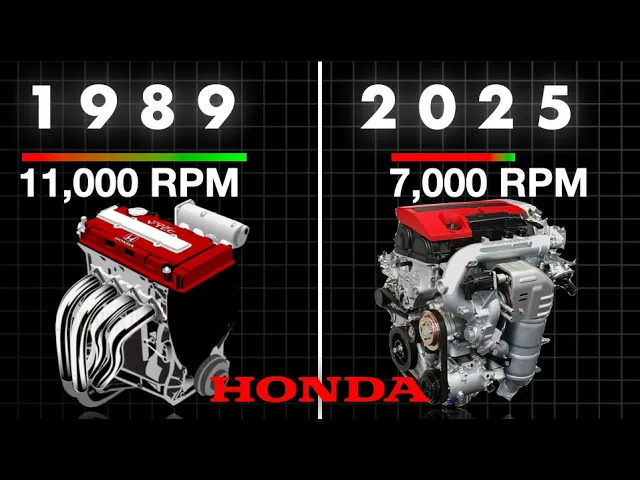
This revolutionary form of variable valve timing was called VTEC, short for variable valve timing and lift engine control. The B16A launched in the 1989 Honda Integra XSI in the Civic and the CRX. It was instantly a hit amongst enthusiasts and eventually started an arms race for other manufacturers to develop their own proprietary variable valve timing systems.
Most notably Mitsubishi with their MVC or Mitsubishi innovative valve timing engine control system. Mivec used an arguably more complicated method using a T- lever that in the low-speed operation struck nothing but air. But as oil pressure increased with RPM, the piston inside the rocker arm would move upward and the T- lever would contact the pistons in the rocker arm, allowing for more lift.
It was just as genius as VTEC, but four years later than the B16A. And it was obvious what inspired it. The B series came in an assortment of flavors with five different displacements.
The original B16A and A1 through 6, the power dense B16B found in the JDM EK9 Civic Type R. The B17 A1 found in the Integra GSR, the B18A and B found in nonVTEC Integras, the record holding power per liter B18C and C5 found in the Integra Type R that was capable of 9,000 RPM out of the box, and the torquy B20 engines found in CRVS. They all were in large part interchangeable.
So, taking a cheaper nonVTEC B18B short block from Integra LS that only originally supported 6,800 RPM power and transplanting it with a B16A VTEC cylinder head that flowed more CFM of air flow created a torquier version of the B16A with the same high RPM power band. Quickly, the B series would become one of the most revered engines to [Music] modify. Companies like Spoon Sports took the B16B from the EK9 Civic Type R and stroked it from 1.
6 L to 1. 8 L, added more aggressive cam shafts and stiffer valve springs, individual throttle bodies, and ECU tweaks to make 260 horsepower out of a 1. 8 L naturally aspirated engine.
and it revved to 11,000 [Music] RPM. The B series was a powerhouse when turbocharging was applied. Since the VTEC system already had a race cam profile baked into it from the factory, it didn't need a cam swap to take advantage of the added air flow from force induction.
Therefore, once boost was applied, reaching 500 horsepower or more was a relatively easy task to achieve with a forge rotating assembly. If money is no concern, the B series has seen over 2300 horsepower in drag racing spec, crossing the 1/4 mile in 6. 6 seconds at nearly 200 mph.
[Music] The B series began to be phased out in the early 2000s for Honda's new K architecture. The K series didn't use a distributor, rather coilonplug ignition, a timing chain versus a timing belt, and VTEC was upgraded to IVTEC that advanced the intake cam timing at the low to mid-range to fortify torque rather than top-end power. The K series also was just like the B series in the sense of Frankenstein builds.
So a K24 A2 short block from a Acura TSX with a K20 A2 cylinder head from an RSX Type S is a budgetfriendly option that when boost is applied can make 550 to 600 horsepower fairly easily, much easier than the B series before it. In today's economy, the K series is the go-to option as B series engines have exploded in price as they are getting much harder to find in decent condition. And just give it up if you're trying to find a B18C or C5 to swap into your project car.
While the B series was here for a good time and not a long time, it pushed the envelope of what was achievable with such little displacement. Not only did Honda use this VTEC technology in the C38 powered NSX, but it used it across the whole engine lineup because there's just something special about having turbo lag without the turbo. All jokes aside, the commercial and aftermarket success of the B series engine pushed the industry as a whole to make variable valve timing and lift a necessity to be competitive.
Mitsubishi's MVC and Nissan's VVL all can trace its conceptual roots to Ikio Kajitani's revolutionary idea of changing the cam profiles on the fly. Today, the K series carries the torch of making lots of power in a small package. But it's important to remember the engine that started it all, the B.
Jesus.