Think about your morning routine for a moment. You wake up, sit on the edge of the bed, and perhaps take a deep, bracing breath before pushing yourself up to start the day. For many of us over the age of sixty, that simple, automatic act of standing up has slowly transformed into a calculated effort.
You might feel a lingering ache in your knees, a strange stiffness in your lower back, or a sense of profound heaviness in your thighs. Before we go any further into the medical reasons behind this, I want you to try a very simple, safe test with me right now, exactly where you are sitting. Please sit somewhat close to the edge of your chair, keep your back straight, plant both feet flat on the floor, and now slowly straighten just your right leg out in the air in front of you.
Hold it there for about five seconds. Pay close attention to how it feels. Do you notice a slight tremor or shaking in the muscle?
Does the thigh feel almost heavy and disconnected, or do you perhaps feel tension migrating to your knee joint instead of staying in the muscle belly? That shaking or that sense of weakness is a vital clue, and it is exactly what we need to discuss today. As a medical professional who has spent considerable time reviewing studies on aging, mobility, and joint health, I often hear my older patients express deep frustration.
They sit in my office and tell me their legs are simply getting old, that they are losing the battle to time. But the medical literature points to a very different primary culprit. It is not just the inevitable passage of time.
Much of the weakness you are experiencing is actually a silent communication failure between your brain and your lower body. Imagine your nervous system is like a complex network of telephone lines connecting your brain to your thigh muscles. In our younger years, those lines are crystal clear and the connection is instantaneous.
But as we age, particularly as we cross into our fifties and sixties, a lack of very specific types of movement causes those communication lines to degrade with static. The brain sends the signal demanding the legs to stand up, but the message arrives muffled and weak. Current research shows that older adults can lose up to thirty percent of their quadriceps strength, not because the physical muscle tissue has completely vanished, but because the central nervous system has quietly disconnected from those muscle fibers.
This is predominantly a wiring problem, a neuromuscular disconnect, rather than simply an aging problem. The traditional fitness advice given to older adults is often deeply flawed. Well-meaning trainers might tell you to push through the pain, head to the gym, and do heavy squats or push heavy weights on leg press machines.
But for a body that has navigated six decades of life, that approach is often counterproductive and even harmful. It forces heavy loads onto joints and cartilage that are already experiencing wear and tear, and it completely bypasses the vital internal work of repairing that damaged neurological phone line. We do not need to grind your joints down; we need to gently and deliberately rebuild that neuromuscular trust.
To achieve this safely, I am going to share a precise sequence of physiological movements designed specifically for older bodies. These movements intentionally bypass heavy, painful squats entirely. We will structure our approach as a countdown of the three most critical functional areas of your lower body that need rewiring, starting with number three, your lateral stability and foundational grounding.
Number three focuses heavily on the side of your hip and the very bottom of your feet, which are secretly dictating the health of your knees. Many older adults complain of chronic knee pain, but medically speaking, what they often have is a hip weakness problem. There is an essential muscle on the outer side of your pelvic region called the gluteus medius.
It acts as the primary steering wheel and stabilizer for your leg. When it becomes dormant, your knee subtly collapses inward with every single step you take around the house. That tiny inward collapse creates daily friction, leading to inflammation and pain.
To fix this at the anatomical root, we use a seated band abduction. You simply sit upright near the edge of a sturdy chair, place a very light, stretchy resistance band just above your knees, and slowly push your knees outward against the tension. Hold that outward press for two full seconds.
You must resist the urge to let the band violently snap your knees back together. The therapeutic magic happens in the slow, controlled return. Because you are seated, there is no balance risk and absolutely zero downward compression on your spine or knees.
Alongside this, we must rebuild your foundation with a deficit calf raise. Standing tall with your hands lightly resting on a wall or a heavy dining chair for balance, position the balls of your feet on a thick, stable book or a low step so your heels hang off slightly. Lower your heels slowly until you feel a gentle stretch in the back of your ankle, pause for a moment, and then push up onto your toes.
This complete range of motion sends a direct neurological signal to strengthen the Achilles tendon, which translates directly into firmer, more grounded steps when you walk, severely reducing your risk of tripping over uneven sidewalks or rugs. Moving forward to number two, we must systematically awaken the sleeping giants in the back of your legs. After decades of sitting in cars, working at desks, and resting in comfortable recliners, the entire posterior chain, which includes your gluteal muscles and your hamstrings, goes into a state of neurological hibernation.
When these massive, powerful muscles fall asleep, your lower back and your fragile knee joints are forced to overcompensate and take over the workload of lifting your body. This compensation is a leading cause of the nagging lower back ache you might feel when gardening or picking up grandchildren. We gently wake these muscles up using an elevated glute bridge.
Lie comfortably on your back on a carpeted floor or an exercise mat, and place your feet flat on a low, stable surface like a couch cushion or a low stool. Press down securely through your heels and slowly lift your hips toward the ceiling until your torso forms a straight line from your shoulders to your knees. Squeeze the muscles in your backside for two seconds at the top, then slowly lower yourself down.
This movement provides exceptional muscle activation with zero spinal compression. Once those muscles are communicating with the brain again, we integrate them with a modified single-leg hinge. Standing beside a heavy table for support, keep a slight, soft bend in one knee and push your hips straight back toward the wall behind you, while your other leg slides back slightly as a counterbalance.
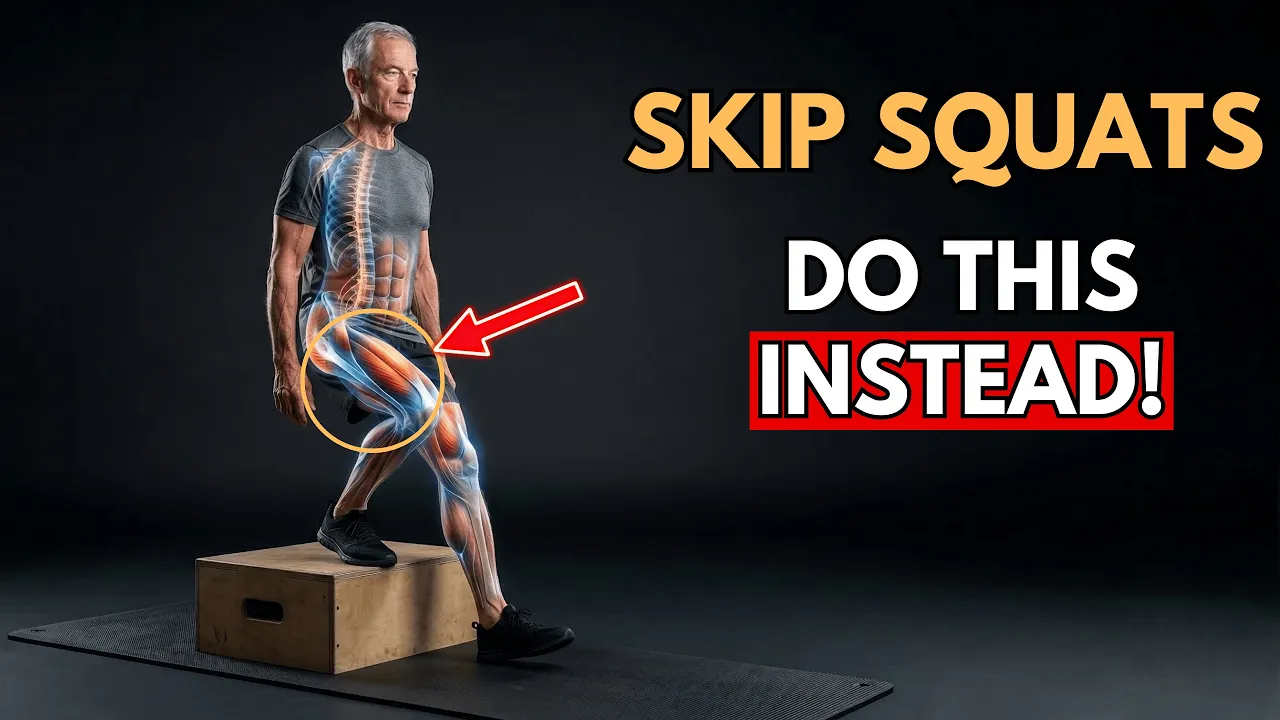
You are not trying to perform a circus balancing act; you are simply creating a gentle, controlled stretch in the back of your standing leg to remind your nervous system how to coordinate these muscles during functional daily tasks like bending over to tie your shoes. Finally, we arrive at number one, the most critical phase for restoring the direct connection to your front thigh muscles and cementing your full-body functional independence. We achieve this with an eccentric step-down.
Standing on a very low, safe surface, perhaps a four-inch step at the bottom of your staircase, shift your body weight entirely onto one leg. Now, lower your other foot toward the floor incredibly slowly, taking three to five full seconds before your foot softly touches down. Do not rush the descent.
That agonizingly slow lowering phase is exactly where your brain is forced to rapidly fire signals to the quadriceps. Your thigh and hip are working in unison to act as the biological brakes for your body weight. You conclude this entire sequence with a movement known as a farmer's carry, which is the ultimate test of your newly restored wiring.
Pick up two light objects of equal weight, such as small dumbbells or even two water bottles. Stand perfectly tall, pull your shoulders back, brace your stomach gently, and walk down your hallway in a straight line with deliberate, controlled steps. This simple action forces your core to stabilize, your posture to remain upright, and your entire neurological system to fire simultaneously, mirroring exactly what your body needs to do when you are carrying groceries safely from the car to the kitchen.
You might be wondering from a medical perspective why these incredibly slow, specific movements work so much better than traditional, fast-paced gym exercises. The physiological science is quite fascinating but straightforward. When you lower a weight slowly or resist gravity over several seconds, which we call the eccentric phase of muscle contraction, you actually recruit different motor units within your nervous system compared to when you lift a weight quickly.
This slow, controlled tension acts like a mandatory software update for your brain. It forces the nervous system to bypass the tired, overused muscle pathways and actively seek out and recruit dormant muscle fibers that have been ignored for years. I highly recommend running through this gentle sequence three times a week.
For the first week, focus entirely on slow control using only your body weight. By the second week, try to hold the difficult positions for one second longer. By the third week, you might feel ready to hold a very light weight.
As a token of my appreciation for you taking your health seriously and staying with me through this explanation, I want to leave you with two bonus tips. First, please adopt this simple daily habit: when you are walking, make a conscious effort to strike the ground with your heel first, and then roll smoothly through to push off your toes. It instantly improves your posture and engages the correct muscles.
Conversely, I urge you to stop the harmful habit of violently rocking your torso back and forth to generate momentum when trying to stand up from a deep chair. Plant your feet securely, lean forward slightly, and demand that your leg muscles do the work they were designed to do. If this medical, joint-friendly approach to rebuilding your physical independence resonates with you, please consider saving this video so you can easily find it later, and share it with a friend or spouse who might also be struggling with joint pain or weakness.
Please let me know down in the comments which specific movement you are going to practice first today, and remember to subscribe to the channel for more calm, medically sound guidance tailored exactly for your stage of life. I look forward to supporting you in our next conversation.