Get Ready For The Once-in-a-Lifetime Stellar Explosion in 2024 The long-awaited star explosion is finally going down! For millennia, people have been captivated by the idea of witnessing a star's last moments. Astrophysicists and stargazers alike have long been fascinated by the prospect of witnessing the next big cosmic explosion.
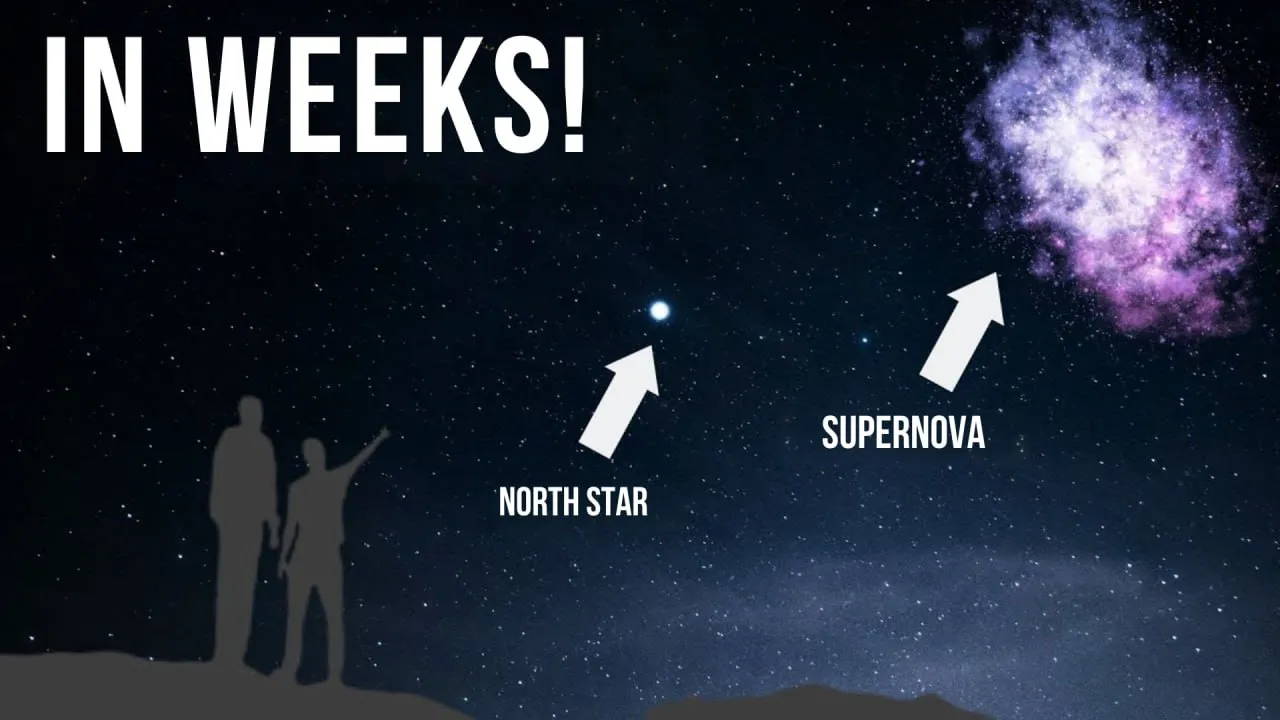
And now, the wait is finally over! For years, the scientific community has kept an eye on Betelgeuse, hoping to witness a rare and stunning star explosion. Surprisingly, the focus has recently switched to a recurrent nova star system, T Coronae Borealis (T CrB), which is expected to explode in the next weeks.
According to a recently published paper, during this explosion, T CrB will dramatically brighten by 1,500 times, making it visible to the naked eye. This much-anticipated event has everyone on the edge of their seats. When exactly will this occur?
What makes it such a once-in-a-lifetime spectacle? Stay with us to find out! Only a few astrophysical events attract the public's attention as much as the blazing end of a star's life cycle.
Yes, the April 8 solar eclipse was a sight to behold, but the death of a massive star is a cosmic spectacle like no other. As they run out of fuel, gravity takes over, resulting in a catastrophic collapse that ends in a supernova. This massive explosion produces vast amounts of energy, briefly outshining entire galaxies.
The blast also disperses heavy elements, allowing for the formation of new stars and planets. This powerful event has fascinated and terrified astronomers alike. But what's actually fascinating is that T Coronae Borealis is on the cusp of a cataclysmic explosion, which might overturn everything we thought we knew about stars.
Keep watching as we will explore the fascinating science behind this recurrent Nova, explain the process causing its spectacular brightness, and show you how to observe it. But, first, let's introduce you to the star system that is set to erupt in a spectacular supernova. T Coronae Borealis, or T CrB, is a binary star system that has captured the attention of astronomers for decades.
Although it's only a 10th-magnitude object, meaning it's not visible to the naked eye and requires a decent telescope to observe, this binary system offers valuable insights into the complex dynamics at play in our galaxy. Here’s a fun fact: binary stars are incredibly common - in fact, most of the stars we see in the night sky are part of binary or even multiple-star systems. There's an intriguing theory that our own sun may have once had a companion star, billions of years ago, orbiting a shared center of mass.
While this idea is still hotly debated in the scientific community, it highlights just how dynamic and interconnected stellar systems can be. The binary system T CrB is a fascinating pair of stars - a red giant and a white dwarf - that orbit around a common center of mass every 228 days. Their orbit is nearly circular and tilted at an angle of 67°, with the two stars separated by a mere 0.
54 astronomical units. To put this into perspective, that's closer than the distance between Venus and the Sun. The gravitational forces between these two stars are quite significant, as they are so close to each other.
The red giant, which is the largest star in the system, is in the final stage of its life before it transforms into a white dwarf. Meanwhile, the hottest component of the system is the white dwarf, which is encircled by an accretion disk. This accretion disk is responsible for the creation of novae.
Now, things get more interesting as we explore how exactly these Novas are produced. Hey, guys, just a moment Before we continue, be sure to join the Insane Curiosity Channel. .
. Click on the bell, you will help us to make products of ever-higher quality! What Is A Nova?
And What Triggers A Nova? A nova is a fleeting celestial event that creates the illusion of a brand new star suddenly appearing in the sky. The term "nova" comes from the Latin word for "new," which is fitting, given the dramatic change in brightness that occurs.
However, this "new" star is only temporary, lasting anywhere from weeks to months before fading back into obscurity. So, what triggers this sudden burst of light? A nova is the result of a binary star system, where two main-sequence stars are orbiting each other.
Typically, one of these stars is more massive than the other, which means it burns through its fuel faster and reaches the end of its life cycle sooner. As the more massive star evolves into a red giant, it sheds its outer layers, casting off the material into a planetary nebula. Eventually, only the star's core remains a white dwarf that's incredibly dense, with a mass similar to that of the Sun, but a volume comparable to that of Earth.
This white dwarf is still gravitationally bound to its companion star, which has yet to reach the end of its life cycle. When the second star finally reaches its last stages, it begins to expand into a red giant, shedding its outer layers. However, instead of dispersing into space, these layers are drawn into the white dwarf's gravitational pull, forming a disk of hydrogen around it.
As the white dwarf absorbs this hydrogen, its temperature increases dramatically, causing the hydrogen to ionize. While the white dwarf's surface can sustain stable hydrogen fusion, this process is often thermally unstable, leading to the creation of heavier elements through exothermic reactions. This buildup of energy eventually culminates in a massive explosion, ejecting gas from the white dwarf's surface and producing an intense burst of light – what we call a nova.
The duration of this explosion varies depending on the size of the star, with some novae fading rapidly, while others take longer to decay. On average, a nova will take anywhere from 25 to 80 days to decrease in brightness by 2 or 3 magnitudes from its peak intensity. Before we dive into the fascinating details of T Coronae Borealis's nova, it's worth asking: what's the big deal about this nova, anyway?
Why does it deserve our attention? Now, let’s take a look at the significance of this rare and breathtaking event. As one of the closest novae to Earth, it offers a unique opportunity to study the intricate dynamics of a binary star system.
The interactions between the red giant and white dwarf, particularly the mass transfer, are crucial to understanding the life cycle of stars and the behavior of binary systems. The 80-year cycle of outbursts allows astronomers to prepare for and capture these events with unprecedented precision, providing valuable data that can refine existing models of stellar evolution and behavior. This recurring phenomenon is a remarkable display of cosmic forces at play, showcasing the white dwarf's gravitational pull as it accretes material from its companion star's outer atmosphere over decades.
As the accumulated material, primarily hydrogen, reaches a critical density and temperature, it undergoes a thermonuclear runaway, resulting in a sudden and intense release of energy. This dramatic brightening is not merely a spectacular display; it provides astronomers with crucial insights into thermonuclear processes and the behavior of matter under extreme conditions. The explosion ejects material into space, enriching the interstellar medium and offering a laboratory for studying the nucleosynthesis of elements.
Each outburst of T CrB thus enriches our understanding of the processes driving stellar evolution and the chemical enrichment of the galaxy. These regular and intense outbursts provide astronomers with exciting opportunities to test their understanding of binary star systems and stellar explosions. As the global astronomical community eagerly awaits the next outburst, equipped with advanced technology, they anticipate new insights and potentially groundbreaking discoveries about the universe's stellar phenomena.
The significance of T Coronae Borealis lies not only in its predictability but also in its ability to reveal the intricacies of the cosmos, making it an invaluable subject for continued study and exploration. Now, the question on everyone's mind is: how can we be so certain that T CrB will erupt soon? The American Association of Variable Star Observers (AAVSO) has recorded two significant events: the first on May 12, 1866, and the second on February 9, 1946.
Both instances reached a magnitude of 2, making them visible to the naked eye. However, astronomers have noted that before the star's luminosity increases, it experiences a slight decrease in brightness. In 2015 and 2016, scientist Justin D.
Linford of West Virginia University's Department of Physics and Astronomy conducted research on the star's activity. He discovered that during this period, the star underwent a significant increase in brightness and emitted a higher amount of X-rays. By collecting data from various radio telescopes and telescopes, Linford created a model of the star's behavior.
The findings are striking: the star's current behavior is eerily similar to its activity in the 1940s, just before the last explosion. By comparing the data from 2015 and 2016 with that from 1938, the similarity is undeniable. The star's behavior during those periods is almost identical, with a decrease in brightness preceding the explosion.
This pattern is consistent with past T CrB explosions. In 1945, a year before the 1946 explosion, astronomers observed a two-magnitude decrease in the star's brightness, from +10 to +12. To put this into perspective, the human eye can only observe stars with a magnitude of 6 or 7 at most.
Anything beyond that becomes increasingly difficult to perceive, requiring specialized telescopes or binoculars. The implications are clear: T CrB is following a predictable pattern, and based on its current behavior, it's likely to explode in 2024. This prediction is not a guess, but rather a well-informed conclusion drawn from a thorough analysis of the star's history and activity.
You might be like “Great! So, how do we know that it will erupt in few weeks? ” This brings us to a seminal scientific study on T CrB, which provides a precise forecast for the upcoming Nova.
Based on calculations by Louisiana State University's Professor Emeritus of Astronomy, Brad Schaefer, in collaboration with astronomers from the American Association of Variable Star Observers (AAVSO), we can expect the nova to erupt within a few weeks, maybe months from now. Here is the point: before the star T CrB explodes as a nova, there is a distinct pattern that repeats. First, the star's brightness decreases for approximately one year, then returns to its initial brightness.
About seven years after this initial dimming, the star's brightness decreases again, this time for a few months. Finally, roughly one year after the most recent dimming period, T CrB explodes in a nova that increases in magnitude up to 8 times, making it visible to the naked eye. Astronomical observations indicate that in 2023, T CrB exhibited the characteristic decrease in brightness that has historically preceded its nova explosions.
Given that this dimming occurred seven years after the previous one in 2016, the data strongly suggests that T CrB will undoubtedly undergo a nova explosion in 2024, which will be visible to the naked eye. How and where to observe it? Observing the impending nova outburst of the star T CrB can be a unique and rewarding experience, but it does require some preparation.
The constellation of Corona Borealis, where T CrB is located, is a relatively quiet part of the sky, making it easier to spot the star using a smartphone stargazing app. To locate T CrB, first find the constellation Corona Borealis, which resembles a semicircle, and the star is positioned just outside this pattern, between the bright stars Vega in Lyra and Arcturus in Boötes. Familiarizing yourself with this part of the sky in advance is essential for quickly identifying T CrB when it begins to brighten.
Timing is crucial, as the exact moment of the outburst is unpredictable. Historical observations have shown that T CrB's brightness typically drops just before an outburst, and this recent dimming has been observed, suggesting that the nova event is imminent. However, the precise timing remains uncertain, so regular observation of the star over the next few weeks will be key to catching the outburst as it occurs.
By preparing your observing location, familiarizing yourself with the star's position, and keeping a close watch on T CrB in the coming weeks, you'll maximize your chances of witnessing this rare and rewarding astronomical event. As you prepare for this event remember that this star is approximately 3000 light-years away from us. This means that the light we see today has been traveling through space for 3000 years, giving us a glimpse of the star's past.
Any events that are currently unfolding on the star won't be visible to us until the year 5024. In other words, if a nova were to occur this year, it would have actually happened 3000 years ago - we're just seeing the light from that event arrive now. Finally, unlike the solar eclipse on April 8, which was a widely visible event, this celestial spectacle may not be as easily observable from every location.
Keep in mind that T CrB is a magnitude 10 star, which means it's not visible to the naked eye from everywhere. And for now, we don't know the exact date when the nova will occur - but we do know that it's close. So, we'd love to hear from you: when do you think the T CrB Nova will make its appearance this year?
Feel free to share your prediction in the comments! If you liked this video, then you should check out the one on your screen. This video on Betelgeuse Star Supernova will blow your mind!
Thank you for watching.











![Journey to the Andromeda Galaxy [4K]](https://img.youtube.com/vi/-ybiXR2WCFQ/maxresdefault.jpg)