Many cases implicating the fair use doctrine have been decided by the federal courts since 1976, when section 107 was added to the federal statute. The most important of those cases are, of course, the three United States Supreme Court decisions that I reviewed in the previous segment of this lecture. But those three decisions leave many issues unresolved.
Some but not all of the gaps left by the Supreme Court have been filled by the lower court's rulings. In this segment of the lecture, I'll try to describe the shape of the fair use doctrine today. I'll attempt both to identify the dimensions of the doctrine that are now reasonably well settled and to highlight the dimensions that remain contested.
For this purpose, I'll be using the now familiar map of copyright law. As we've seen, courts almost always analyze their fair use defenses by considering the four factors listed in section 107. I will follow their lead in this regard.
In other words, I will describe to you what each factor has come to mean and the role it has come to play in the overall landscape of fair use. The first factor, as you now know, concerns the purpose and character of the defendant's activity. The courts look askance at some kinds of behavior and regard much more favorably other kinds of behavior.
Four subfactors under this general heading can be distilled from the case law. These so-called subfactors identify the kinds of things that the courts attend to when discussing the character of the defendant's behavior. The first subfactor is whether the defendant is engaged in commercial or non-commercial activities.
As you might imagine, the more commercial the defendant's conduct, the less likely is the defendant to be given the benefit of fair use. This subfactor, as we've already seen, figured prominently in the Betamax case. It has been declining in importance since then but has not disappeared altogether.
You might think that the application of this subfactor would be straightforward, and often it is. But difficulties arise out of the ambiguity of the term "commercial. " Courts rarely define that term explicitly.
Most often, they seem tacitly to assume that "commercial" means revenue generating or perhaps profit making. But occasionally, in borderline cases, courts will attempt to define the term more precisely. One such definition can be found in the Harper & Row case.
There, Justice O'Connor defined "commercial" as "whether the user stands to profit from the exploitation of the copyrighted material without paying the customary price. " This would be an altogether conventional definition but for the term "customary," which seems to imply that some potentially profit-making activities are nevertheless not commercial in character if it's not customary for firms engaged in the activity at issue to pay for access to works of the sort claimed by the plaintiff. It's unlikely that Justice O'Connor intended to narrow the meaning of "commercial" in quite this way.
But judicial definitions sometimes assume lives of their own, and this one has. So for example, the phrase set forth on your screen can be found in the 11th Circuit's opinion in the Letterese case and the Fourth Circuit's opinion in the AV case. A much more generous definition of the term "commercial" can be found in the Ninth Circuit's opinion in the Napster case.
Now, we'll discuss Napster in some detail in the 11th lecture when we examine, as I said, the doctrine of contributory copyright infringement. But the basic facts of the Napster case are undoubtedly familiar to most of you. The Napster file sharing service did not itself redistribute sound recordings, but it facilitated unauthorized copying and distribution of sound recordings by its subscribers.
One of the issues in the infringement suit brought against Napster by the record companies and the music publishers was whether the conduct of Napster subscribers qualified as fair uses, just as the conduct of Sony's customers, as we've seen, qualified as fair uses in the Betamax case. The Ninth Circuit concluded no. One of the steps in the Ninth Circuit's analysis that led to this conclusion was the judgment that the behavior of the individual Napster users should be considered commercial in character.
That highly counter-intuitive finding rested upon the capacious definition of "commercial" set forth on your screen. In the Ninth Circuit's judgment, the term included, quote, "repeated and exploitative copying in order to save the expense of purchasing legitimate copies. " Thus, even though the Napster users were not making any money, they were engaged in commercial behavior, said the Ninth Circuit, because they were avoiding paying money.
This is an outlier position. It's far from clear that other courts in analogous circumstances would follow the Ninth Circuit's lead. In some fair use cases, the defendant's behavior does not give rise directly to an increased revenue stream but contributes to an overall process or enterprise whose ultimate objective is plainly commercial.
The courts have not yet worked out a consistent way of handling such cases. So here are two influential decisions involving this general issue that resolved it in different ways. The first case is Sega Enterprises versus Accolade, which was decided by the Court of Appeals for the Ninth Circuit in 1992.
To understand the decision requires a bit of background. In the context of computer software, the term "interoperability" refers to the ability of one program to talk or work with another. An especially important context involving interoperability concerns the relationship between operating systems and application programs.
The intellectual property questions implicated by this issue have been examined most thoroughly by Julie Cohen, who teaches copyright at Georgetown. As Cohen observed in an article some time ago, there are three main business models adopted by different groups of software firms pertaining to the issue of interoperability. The first approach, exemplified by Microsoft, grants the developers of application programs free or more or less free access to the interfaces necessary to render their programs compatible with a proprietary operating system.
The second business model, which was pursued at least at one time by several game console manufacturers, including Nintendo, entails permitting the developer of application programs-- in this case, games-- to manufacture and distribute games that would run on a proprietary operating system console, but only if the game developers pay license fees. The third strategy, exemplified by MAI Systems Corporation, repudiates interoperability. Manufacturers adopting this approach seek to maintain complete control over application programs as well as their operating systems.
The Sega case involved the second of these three approaches. The plaintiff, Sega, manufactured and sold game consoles which included operating systems. A small piece of the operating system consisted of a bit of code known as a lockout program.
Sega's own games as well as the games produced by independent but licensed game manufacturers included the key necessary to open the lock on Sega's system. The defendant in this case, Accolade, wished to manufacture and distribute games compatible with the Sega system without obtaining a license from Sega and without paying the associated license fees. To do this, Accolade engineers make copies of significant portions of Sega's software, used decompilers to ascertain the crucial piece of source code, and then included the essential bit in its own games, thereby rendering them compatible with the Sega system.
Sega brought suit asserting, among other things, that by copying Sega's software in the course of this reverse engineering process, Accolade had engaged in copyright infringement. The Court of Appeals for the Ninth Circuit ruled that Accolade had indeed violated section 106(1) of the statute, but it escaped liability under the fair use doctrine. The central theme in the Ninth Circuit's opinion was that Accolade's purpose was legitimate and socially beneficial.
It's not altogether obvious why, unless one believes that increasing the availability of video games enhances social welfare. But in any event, our main concern here is with the portion of the court's opinion that addresses the nature and character of the defendant's activity and specifically whether Accolade's conduct should be described as commercial or not. The Ninth Circuit, when addressing that issue, conceded that Accolade was a for-profit company and the ultimate ambition of the challenged behavior was, of course, to enhance Accolade's profits.
Nevertheless, the Ninth Circuit refused to classify Accolade's unauthorized copying as commercial in character. Here's the relevant passage from the opinion. Quote, "Taken together, these facts indicate that although Accolade's ultimate purpose was the release of Genesis-compatible games for sale, its direct purpose in copying Sega's code, and thus its direct use of the copyrighted material, was simply to study the functional requirements for Genesis compatibility so that it could modify existing games and make them usable with the Genesis console.
Moreover, no other method of studying those codes was available to Accolade. On these facts, we conclude that Accolade copied Sega's code for a legitimate, essentially non-exploitative purpose and that the commercial aspects of its use can best be described as of minimal significance. " OK, that's one approach.
The second case was decided a few years later by the Court of Appeals for the Second Circuit. The essential facts were as follows. Texaco employed between 400 and 500 researchers nationwide.
Their job was to conduct scientific research in order to develop new products and technologies in the petroleum industry. Texaco subscribed to various scientific journals. However, it did not purchase enough copies of those journals to serve fully the needs of its many researchers.
A custom seems to have developed within the Texaco facilities under which individual scientists would either make themselves or ask to be made for them xerox copies of articles contained in the print journals that the scientist might find useful in their own research. The publishers and copyright owners of the articles challenged this practice as copyright infringement. Texaco's primary line of defense for this behavior was fair use.
The Court of Appeals for the Second Circuit ultimately sided with the publishers and rejected the fair use defense. The step in the court's analysis with which we are primarily concerned here involves whether the behavior of the scientists qualified as commercial. The Court of Appeals equivocated on this point.
Unlike the Ninth Circuit, the Second Circuit did not discount altogether the profit-making objective of the company as a whole. However, it too accorded some weight to the fact that the immediate objective of the scientists was research. Here's the key passage in the Second Circuit's opinion.
Quote, "In this particular case, the link between Texaco's commercial gain and its copying is somewhat attenuated, the copying at most merely facilitating Chickering's research--" Chickering was one of the scientists-- "that might have led to the production of commercially-valuable products. Still, we need not ignore the for-profit nature of Texaco's enterprise, especially since we can confidently conclude that Texaco reaps at least some indirect economic advantage from its photocopying. As the publishers emphasized, Texaco's photocopying for Chickering could be regarded simply as another factor of production utilizing Texaco's efforts to develop profitable products.
Conceptualized in this way, it is not obvious why it is fair for Texaco to avoid having to pay at least some price to copyright holders for the right to photocopy the original articles. " So where does the combination of these two cases leave us? The answer is, unfortunately, without clear guidance.
When employees within a for-profit enterprise engage in unauthorized copying whose immediate purpose might be characterized as research or study, the employer may be able to contend that it should not be hit with the label "commercial. " But how much latitude it will be given on this score is, unfortunately, hard to predict. As I said, the question of whether a defendant's behavior is commercial or non-commercial in character remains a significant part of the fair use inquiry.
However, that subfactor is being eclipsed increasingly by the second subfactor highlighted on your screen, which asks whether the defendant's behavior is transformative. As we saw, this theme was highlighted by the United States Supreme Court in the Campbell case. Since the Campbell decision, the issue of transformativeness has grown further in importance.
Today, it's fair to say that defendants unable to persuade a court that their activities are transformative are unlikely to prevail on fair use grounds, whereas defendants who are able to assume the mantle of transformativeness are quite likely to prevail. As one might expect, litigants now spend much of their time struggling over who has the better of the argument on this issue. Unfortunately, as we will see, there remains significant ambiguity concerning the possible meaning or meanings of the term "transformative.
" This uncertainty destabilizes fair use analyses and increases the notorious unpredictability of the doctrine as a whole. The only dimension of this issue that is clear cut concerns the status of parody. It's now well settled that parodies, even bad parodies, do qualify as transformative uses.
Plaintiffs no longer contended parodies of their works are not transformative. Instead, plaintiffs seek to persuade tribunals that, in borderline cases, the defendants' works do not constitute parodies. Much hinges on this issue.
When evaluating disputes of this sort, courts commonly make reference to the definitions of parody that were offered by the Supreme Court in Campbell. You've seen these definitions once before in this lecture. Here they are again.
Quote, "Modern dictionaries describe a parody as a 'literary or artistic work that imitates the characteristic style of an author or work for comic effect or ridicule' or as a 'composition in prose or verse in which the characteristic turns of thought and phrase in an author or class of authors are imitated in such a way as to make them appear ridiculous. ' For the purposes of copyright law, the nub of the definitions is the use of some elements of a prior author's composition to create a new one that, at least in part, comments on that author's works. " The ambit of this definition is perhaps best illustrated by example.
Annie Liebovitz, as you likely know, is a famous and accomplished photographer. In 1991, she took a nude photograph of the pregnant Demi Moore which appeared on the cover of the August 1991 issue of Vanity Fair magazine. The photo plainly alluded to Botticelli's Birth of Venus.
Here's a closeup. In 1994, Paramount Pictures began to promote its upcoming movie Naked Gun 33 1/3. One of its posters included this composite photo of Leslie Nielsen, the star of the film.
Liebovitz brought a copyright infringement suit. Interestingly, Paramount conceded that its poster violated Liebovitz's rights under section 106 but sought refuge in fair use. The district court granted summary judgment for the defendant, and the Court of Appeals affirmed.
A key step in the Court of Appeals analysis was a determination that the poster constituted a parody of the Demi Moore photo. The court justified that determination in the following terms. Quote, "Being different from an original does not inevitably comment on the original.
Nevertheless, the ad--" meaning the poster-- "is not merely different. It differs in a way that may reasonably be perceived as commenting through ridicule on what a viewer might reasonably think is the undue self-importance conveyed by the subject of the Liebovitz photograph. A photographer posing a well-known actress in a manner that calls to mind a well-known painting must expect or at least tolerate a parodist's deflating ridicule.
Apart from ridiculing pretentiousness, the ad might also reasonably be perceived as interpreting the Liebovitz photograph to extol the beauty of the pregnant female body and, rather unchivalrously, to express disagreement with this message. The district court thought such a comment was reasonably to be perceived from the contrast between a serious portrayal of a beautiful woman taking great pride in the majesty of her pregnant body and a ridiculous image of a smirking, foolish-looking pregnant man," close quote. A very similar analysis underlay the determination five years later by the Ninth Circuit Court of Appeals that a series of photos by Thomas Forsythe constituted parodies of Mattel's copyrighted character Barbie.
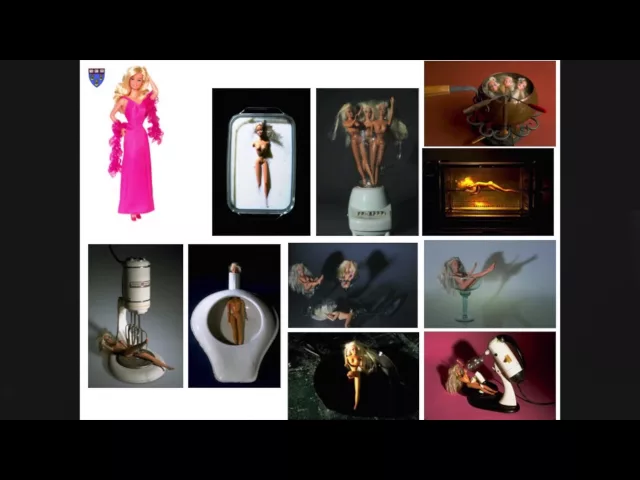
Here's a familiar image of Barbie. Mattel owns copyrights to parts of this figure-- specifically, in the court's words, quote, "to the unadorned Superstar Barbie head and parts of the figure, including revisions to the hands, feet, neck, shoulder, and buttocks," close quote. Forsythe, without permission, took a series of photos of naked Barbie dolls.
Here are some of Forsythe's photos. The Ninth Circuit, when the case arrived at its doorstep, concluded that Forsythe's photos plainly qualified as parodies. Quote, "Mattel, through impressive marketing, has established Barbie as the ideal American woman and a symbol of American girlhood for many.
As abundantly evidenced in the record, Mattel's advertisements show these plastic dolls dressed in various outfits, leading glamorous lifestyles, and engaged in exciting activities. To sell its product, Mattel uses associations of beauty, wealth, and glamour. Forsythe turns this image on its head, so to speak, by displaying carefully-positioned, nude, and sometimes frazzled-looking Barbies in often ridiculous and apparently dangerous situations.
His lighting, background, props, and camera angles all serve to create a context for Mattel's copyrighted work that transform Barbie's meaning. Forsythe presents the viewer with a different set of associations and a different context for this plastic figure. In some of Forsythe's photos, Barbie is about to be destroyed or harmed by domestic life in the form of kitchen appliances yet continues displaying her well-known smile, disturbingly oblivious to her predicament.
As perpetrated in some of Forsythe's photographs, the appliances are substantial and overwhelming, while Barbie looks defenseless. In other photographs, Forsythe conveys a sexualized perspective of Barbie by showing the nude doll in sexually-suggestive contexts. It's not difficult to see the commentary that Forsythe intended or the harm that he perceived in Barbie's influence on gender roles and the position of women in society," close quote.
An important procedural issue lurks in this passage. The Ninth Circuit is not interested in what the public at large thinks of Forsythe's photos. Indeed, it approved the trial court's refusal to consider a survey that Mattel had commissioned on the issue.
Why? Because, quote, "the issue of whether a work is a parody is a question of law, not a matter of public majority opinion," close quote. OK, so those are two cases in which the defendant successfully invoked the privileged status of parodies.
To repeat, parodies are not per se entitled to the fair use defense, but attaining that status helps you a great deal. In part because of the importance of this issue, courts are not always so receptive to defendants' claims that their works constitute parodies. For example, the Second Circuit brushed aside the contention of Jeffrey Koons that when he used this photograph as the reference work for this painted wooden sculpture he meant to mock the conventional, saccharine character of the photo.
The court rejected Koons' claim that his work was a parody of the plaintiff's. Its rejection was based in part on the fact that the photograph in the upper left of this slide was not widely known to the public, and thus most viewers of the sculpture would not know what it was aimed at. But in addition, the court was not persuaded that the sculpture meant to critique the photo.
Quote, "The problem in the instant case is that even given that String of Puppies is a satirical critique of our materialistic society, it is difficult to discern any parody of the photograph Puppies itself. We conclude, therefore, that this first factor of the fair use doctrine cuts against a finding of fair use. The circumstances of this case indicate that Koons' copying of the photograph Puppies was done in bad faith primarily for profit-making motives and did not constitute a parody of the original work.
" The same court was similarly unimpressed by the efforts of the defendants in the Castle Rock case, which I discussed in the preceding lecture, to establish that their trivia book was a parody of the Seinfeld television series. The defendant argued, our trivia book, quote, "is a quintessential example of a critical text of the TV environment, exposing all of the show's nothingness to articulate its true motive forces and its social and moral dimensions. " The court was unmoved.
Quote, "Any transformative purpose possessed by the defendant's book is slight to nonexistent. We reject the argument that it was created to educate Seinfeld viewers or to criticize, expose, or otherwise comment upon Seinfeld. The book's purpose, as evidenced definitively by the statements of the book's creators and by the book itself, is to repackage Seinfeld to entertain Seinfeld viewers," close quote.
OK. So to repeat, parodies definitively qualify as transformative under factor number one. What about a defendant's work that criticizes a plaintiff's work but does not mock it?
These too are highly likely to be treated as transformative. Here's an example. One of John Lennon's most famous songs is "Imagine.
" Portions of its lyrics are critical of organized religion. Here's an excerpt. It isn't hard to do.
Nothing to kill or die for, and no religion too. Imagine all the people-- In this case, the defendant, without permission, included this segment of Lennon's recording of the song in a movie that defended theories of intelligent design and criticized theories of evolution. The Southern District of New York ruled that the use of the excerpt from Lennon's song was transformative because its purpose was, quote, "to criticize what the filmmakers see as the naivete of John Lennon's views," close quote, and the court went on to rule in the defendant's favor.
That non-parody criticism counts as transformative is not quite so clear as the proposition that parody counts as transformative. Indeed, at least one case, the Free Republic decision decided by the Central District of California in 2000, seems to stand for the opposite position. But the privileged status of criticism nowadays approaches that of parody.
Beyond this point, the meaning of "transformative" becomes increasingly contested and murky. Here's a graphic representation of the nature of the ongoing debate on this front. Parody, as we've seen, clearly qualifies.
A work by a defendant that criticizes the plaintiff's work is also highly likely to qualify as transformative. Outside of this central zone, there are currently four main competing interpretations of "transformation. " The first treats works that physically modify the plaintiff's work as transformative.
The second equates the term "transformative" with "socially beneficial. " The third attaches the term "transformative" to works by defendants that have purposes that are different from the purposes of the plaintiff's works. And the fourth associates the term "transformative" with creative uses of plaintiff's works.
This diagram intentionally depicts these interpretations as overlapping because, as you might imagine, some works will qualify as transformative under more than one interpretation. But in its current form, the diagram is misleading to the extent it suggests that each category has crisp boundaries. In truth, they're all matters of degree.
For example, one defendant's work might be slightly socially beneficial, while another might be strongly so. Thus, a more accurate depiction would recognize that each category varies in density-- strong near the core, weaker near the edges. If one maps onto this diagram the leading cases involving fair use, the result would look something like this.
I've tried, by locating each case or set of cases, to suggest which and how many of the meanings of "transformative" they might qualify for. The colors of the case names indicate who won or was favored. In the green cases, the defendant prevailed-- in other words, the court either ruled in the defendant's favor or indicated the fair use was likely.
In the red cases, the plaintiff prevailed in the same sense. In the black cases, the issue of fair use was never resolved. Some of these cases you already know about.
Others I will discuss later, and still others will be addressed in the classes and seminars that accompany this lecture series. One of the functions of this map is to suggest the relative strength of these four competing interpretations within the current case law. For a while, the physical modifications approach seemed to have a significant following, but it has since faded.
Why? Most likely because this interpretation is hard to reconcile with the proposition that, as you know, copyright owners enjoy under section 106(2), the right to control the making of derivative works. Thus, as you'll notice, many of the cases within this zone are red, meaning that the fair use defense failed.
More popular is the second approach, which looks to the degree to which a defendant's conduct can be thought of as socially beneficial. However, you'll also see some red cases in this zone. More popular still is the different purposes approach.
Most of the cases in this zone, especially recent cases, you'll see are green. The last approach finds as yet only modest support in the case law, although it figures more strongly in scholarship. We'll return to this fourth option when we discuss cultural theory in the next lecture.
So that's where things currently stand with respect to transformation. Because of the prominent place of this issue in modern fair use doctrine, the struggle over the meaning of this term will likely continue for some time. I've devoted disproportionate attention to the first two subfactors of factor number one because they're particularly important.
The current status of the other subfactors and of the second and third factors in the list in section 107 can be described much more quickly. You'll recall that Justice O'Connor in Harper & Row decreed that fair use presupposes, quote, "good faith and fair dealing," close quote. As you might expect, lower courts give that statement some weight, but as it turns out, not much.
Here's a representative statement by the Second Circuit. Quote, "Just how much weight within the first factor should a court place on this subfactor of bad faith? Campbell provides support for the proposition that while the good or bad faith of a defendant generally should be considered, it generally contributes little to fair use analysis.
We believe this analysis further supports our conclusion that a finding of bad faith is not to be weighed very heavily within the first fair use factor and cannot be made central to fair use analysis. The Court recognized the continuing relevance of Harper & Row but clarified that the bad faith subfactor can be de-emphasized and will not be dispositive of the first factor or fair use. " The Harper & Row opinion also included a statement suggesting that customary activities were more likely to qualify as fair than unconventional ones.
Quote, "The fair use doctrine was predicated," said Justice O'Connor, "on the author's implied consent to reasonable and customary use when he released his work for public consumption. " This perspective associates the concept of fair use with a implicit license issued by a copyright owner. Some scholars-- for example, Lloyd Weinreb in an influential article in the Harvard Law Review-- have endorsed this perspective.
But it has little following currently in the case law, in part because so many fair use cases nowadays involve new technologies as to which custom is essentially irrelevant. If the first statutory factor focuses on the defendant, the second focuses on the plaintiff. The basic idea here is that some kinds of copyrighted works deserve stronger protections against unauthorized activities than do others.
The way this is achieved is by making it harder for defendants to assert fair use when they make unauthorized uses of the former than the latter. So what kinds of works are more deserving of protection? There are two well-recognized answers to that question and one additional answer that is implicit in the case law but not expressly recognized.
The two well-established variables are A, unpublished works get more protection than published works, and B, creative works get more protection than factual ones. The Second Circuit's decision in the Blanch case summarizes these two variables nicely. Quote, "Two types of distinctions as to the nature of the copyrighted work have emerged that have figured in the decisions evaluating the second factor-- one, whether the work is expressive or creative, such as a work of fiction, or more factual, with a greater leeway being allowed to a claim of fair use where the work is factual or informational; and two, whether the work is published or unpublished, with the scope for fair use involving unpublished works being considerably narrower.
" Close quote. This point bears emphasis, because it's not often recognized. Not all works, it turns out, enjoy the same degree of protection.
The closer you are to the bottom left corner of this diagram, the stronger your legal shields. The closer you are to the upper right corner, the weaker your shields. The implicit supplement to these two variables is that, in practice, computer software seems to get less protection than other sorts of copyrighted works.
In other words, in the software context, defendants have an easier road to hoe. The third factor is the least surprising component of modern fair use doctrine. The more you take from a plaintiff's work, the weaker, in general, is your fair use defense.
As from the Harper & Row case, the inquiry under this factor is both quantitative and qualitative. If you take a small slice but it's a very important part of the plaintiff's work, you're in trouble on this front. Note that, at least ostensibly, it doesn't matter whether the slice you take forms a large or small portion of your own work.
It's only relevant whether it's a large and important part of the plaintiff's. The only thing that's surprising about this variable is how often it does not prove decisive. Think of the cases we've considered thus far.
In the Betamax case, the VCR users were making verbatim copies of entire copyrighted works and yet were found to have engaged in fair use. In Harper & Row, by contrast, the Nation took some 300 words from Ford's vastly larger manuscript and still lost. We come finally to factor number four.
For many years, this was said to be the most important factor. Today, it may have to play second fiddle to factor number one and the transformativeness inquiry in particular, but it's still given great weight. The core idea is straightforward.
The greater the injury sustained by the plaintiff as a result of the defendant's conduct, the less likely it is that the defendant's conduct will be deemed fair. But as we'll see, complexities and conflicts lie just under the surface of that statement. The first guideline when applying this factor is that not all kinds of what might be considered injuries count.
In particular, it's now reasonably clear that four types of what might be considered losses by the plaintiff are excluded from consideration. First, a plaintiff cannot claim that he suffered economic harm because he was prevented from charging the defendant a license fee. Among the reasons that foregone license fees from the defendant are excluded from the analysis is that otherwise the fourth factor would always favor the plaintiff, which was plainly not Congress' intent.
Second, loss of revenue resulting from the plaintiff's inability to charge the defendant or others for the right to make transformative uses of the plaintiff's work also do not count. As you can see, this subfactor dovetails with the first factor. It reinforces the privileged position within the fair use calculus of transformative uses.
To illustrate, a plaintiff cannot assert under the auspices of the fourth factor that he suffers economic losses because of his inability to charge parodists fees. Third, as we saw in the Campbell case, plaintiffs cannot assert as economic injuries diminution in their markets resulting from defendants' criticism or ridicule of their works. The borderline question, the answer to which is not yet clear, concerns injuries arising from what might be called tarnishment of the plaintiff's work-- in other words, corrosion as result of the defendant's conduct of the positive associations that the plaintiff's work has in the minds of consumers.
Finally, at least one court has held that a plaintiff can only complain of injuries to the market for the copyrighted work at issue in the case, not collateral injuries to other copyrighted works owned by the plaintiff. These exclusions are important, but they leave many opportunities for plaintiffs to identify economic harms. In particular plaintiffs may count under the fourth factor not only damage to the existing markets for the copyrighted works but also damage to, quote, "potential markets," close quote, for the work, and they may also claim injuries that have not yet occurred as a result of the defendant's behavior but that will occur if the defendant's conduct becomes widespread.
The most important and fraught word in this formula is "potential. " As I say, it's now clear that injuries to potential markets count in the plaintiff's favor. What's unclear is what constitutes a potential market.
One can find in the case law a broad spectrum of approaches to this key question. Near one extreme is the position apparently taken by the Ninth Circuit in the Galoob case. Potential markets consist of markets that the plaintiff has developed or is likely to develop.
This approach would exclude, for example, markets that the plaintiff lacks the technical capacity to exploit or that are within the defendant's control. Near the opposite extreme is the position that, as we saw, was taken by Justice Blackmun dissenting in the Betamax case. Any group of people who would pay for access to the plaintiff's work constitute a potential market, even if the plaintiff is unable or uninterested in exploiting that market and even if the market would not exist but for the defendant's initiative or technological innovation.
In between these positions are several intermediate options. The formulation that seems to appear most often in the case law is the one listed on the third tier on the chart. The markets cognizable under the fourth factor include, quote, "traditional, reasonable, or likely to be developed markets," close quote.
But some courts expressly or implicitly adopt positions more favorable to plaintiffs or more favorable to defendants. A possible explanation for why this crucial issue remains unresolved is that no court has convincingly connected its stance on this question to any of the underlying theories of copyright. Until that happens, litigants and judges will struggle to define the set of harms that plaintiffs may point to when resisting fair use defenses.
This concludes our examination of the current state of the fair use doctrine in the United States. In the final segment of the lecture, I will briefly examine the ways in which some other countries address the kinds of issues that here in the US are handled using section 107. Your job will then be to decide which approach is optimal.