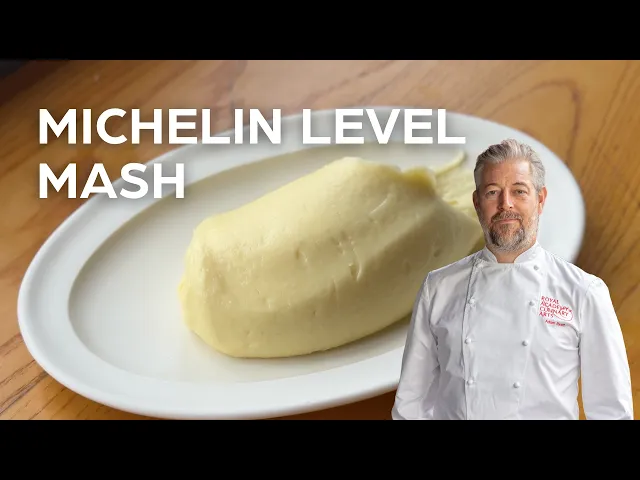
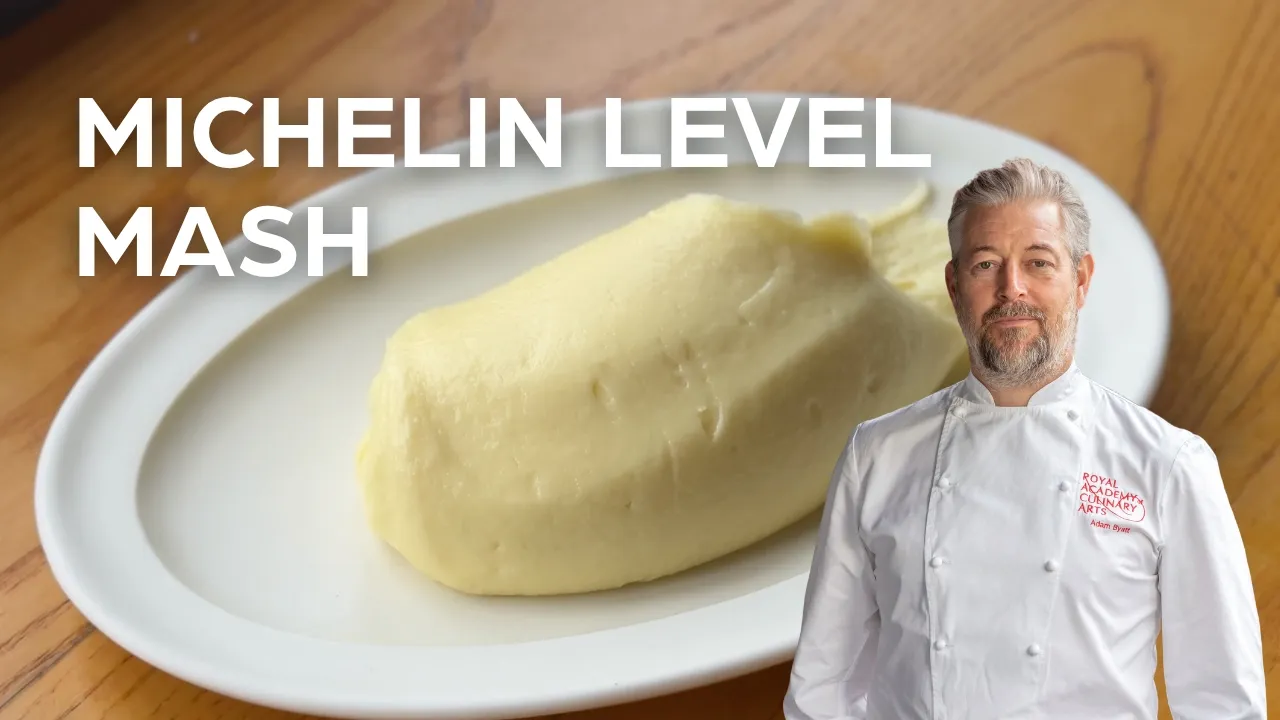
Here's a recipe you've all been after for a long time. This is how you make mashed potato in a Michelin star restaurant. Stick around.
So, there's a couple of things with mashed potato. If you're going to make that creamy droppy mash that we all make in great restaurants, there's a few things you need to know. We start with rat potatoes.
These are a waxy French potato. They're sort of gnarly and odd-shaped. I peel them.
I drop them into salted boiling water. And then we're going to cook them, but we're not going to boil them. We're just going to cook them on a very low simmer.
So, you're almost just single bubbles coming up there, really slowly, until those potatoes are perfectly cooked. Means you can drop a knife into them and the knife will fall off the potato. And that's that point you want to reach.
You carry on going like that until the potatoes are completely cooked and then you take them off and just let them cool a little bit in the water. The key to a great mashed potato is they never cool down. That temperature is always the same.
So, we cook the potato, we pass it while it's hot, we get it back in the pan while it's hot, in goes all that beautiful butter and cream. I'll show you. While I've got you on this amazing channel, I'd like to say a huge thank you to all those people subscribing on to our YouTube channel.
I wanted to update you as well on a couple of things. This year, in May, not long away, I'm going to be announcing two of probably the biggest projects I've ever done. They're getting dropped on here on YouTube.
So, if you're ever going to subscribe, now is the time. And thank you to all of you that are subscribing. Okay, there's my potatoes all peeled, into cold salted water.
Going to bring that up to a boil. What's key here is nice and slow, only a very gentle simmer. Simmer?
Simmer. Only a gentle simmer. So, it will take about 40 minutes to get those potatoes cooked, but that's okay.
You need to give it that time. If you rapidly boil them, it will change the whole composition of the mashed potato. So, that's what we're looking for.
Potatoes are perfectly cooked. They'll drop off nicely. The water's nicely seasoned.
Now, off they come. Let's drain those potatoes. Set yourself up a nice tammy.
You can use one of those ricers, but it won't be quite as smooth. Be aware of that. Or you can put it through a shimmer at the end.
But ultimately, what you need to start with, for me, is a really lovely tammy like that. You need a card to pass that through. And all we need to do now, remember, these potatoes are hot.
They must stay that way as well. And this is, I guess, the the hardest part of the whole job. It's the bit that's a bit boring and a bit annoying to do, but, you know, if you want nice, smooth, buttery, creamy mashed potato, this is the way to get it done.
Pop it through like that. Just using my card, couple of potatoes at a time. And I'm just putting them through.
While I'm doing that, I get time to think about all our other things, think about people, my business, new dishes, can be creative, I can do all sorts. I'm not getting too worried about it. Gives my arms a good workout.
And a ricer will do this for you, but a ricer, which I have a ricer at home, I don't do this at home. I'd use a ricer at home, but the pieces are bigger. They just they just are.
And so, that means that the pieces left in your mash at the end are bigger. They just are. So, it's up to you.
If you want a really fine mash, use a really fine sieve. It's quite simple. It's not rocket science, is it?
Potato science. And we make about 4 kilos of this. So, that's 1 kilo of potatoes.
We make about 4 or 5 kilos of this every day at Trinity. Um and have done for a long, long time. There is another option here, actually.
You can bake the potatoes. You can use a red Desiree potato and you can bake that on a bed of salt, roast them. Like a sort of baked potato.
And then you scrape out all the insides and you do exactly the same. It does work well, but I just this is just my preferred method. We've always done IT LIKE THIS.
SO, THAT'S WHAT I'M GOING TO SHOW YOU. There you go. There's my potato into a nice heavy pan like this.
Pan needs to be big enough. That's very important. And let's put that on a nice low heat.
Keep that for another day. Nice cup of tea. Right, we're going to go in now with a wooden spoon.
Nice low heat, really low heat. First thing that's going to go in there now is some butter. All right, so this is just cubed unsalted butter.
All right. There's no weights and ratios because there's a method here I'm going to show you as we do it. So, don't worry about weights and ratios.
Now we're going to add some double cream. If you want to end up with really good quality mash, you need to use a bit of double cream. I don't use all double cream, but I do use an amount of it.
So, in that goes and we're just going to gently mix in the butter and the double cream. I'm going to add a little bit more salt at this point as well. Remember, those potatoes are warm.
If you let those potatoes go cold, you will be in a whole world of pain. A bit of salt in there. I don't put pepper in cuz you'd have sort of big black pepper pieces all over it.
I remember my trial day at The Square. Actually, this is a long, long time ago. Um and I was asked to make mash and I made mashed potato, really nice actually, lovely mashed potato, but I cranked up the black pepper from the pepper mill.
So, every single portion of mashed potato, which was on a skate dish that day, went out with all this sort of black pepper inside the the uh the mash. It didn't go down a treat, that one. I wasn't I wasn't best loved for that little move.
Tasty, though. All right. We're going to work that butter in now.
Let's get some more butter in there. And, you know, one of the reasons you don't really want to make this at home is the volume of butter, actually the expense of that as well, is incredible. Um and the and the amount of calories, you know, it's not something that people at home necessarily want to be doing and I totally get that.
That's why that's why restaurants exist, I think. I hope. >> [clears throat] >> It's working that in really nicely.
Takes a bit of time to work all that butter into it. And what I'm basically looking for is an amount of butter that is essentially going to split my potatoes. So, I want that potato to not be able to absorb any more butter and so it will start to split and I'll show you how that what that looks like.
And then we bring it back. The art is to split it, bring it back and finish it. So, that's the way.
That's the way I do it, anyway. So, just take your time, get a spoon in here and just keep going until that butter cannot be absorbed anymore and the mash starts to boil. We actually want to boil that mash.
That's really important. So, I switched over to a whisk, which is important for me. I really want to work some of that starch so it can be a firmer potato and accept more of the butter.
So, that's kind of my take on it. So, in in with the whisk, give it a really good whisking up. You're working all that starch and you'll see it start to transform a little bit.
See how it's moving around the pan like that? That's basically because all the butter's trying to trying to seep out. A little bit of cold milk and that's what's going to emulsify that, bring that back.
I'm going to turn that off now and just use the residual heat of the pan for a second, but I will reboil it with that milk in there. And you see it starts to emulsify back again. It's getting a lot thicker now and that's exactly where I want it to be.
The whisk is also helping to work out any of those little lumps. You know, if you don't have a mega fine sieve, then uh the whisk will help with that. So, little bit more milk.
That's basically it, but I want to boil that again now. I'm just going to bring it up to boil again. I'm going to clean up my detritus everywhere.
Mash is not you know, it's not a clean thing to make. It It makes a mess. You're a mash purist, chef.
Would you like to put this stuff in your mash? No, I don't want anything in my mash. Absolutely don't put anything in the mash.
I might put olive oil in it, but then I wouldn't put dairy in it if I put olive oil in it, but I wouldn't be putting anything in it. Apart from parsley puree, chlorophyll. Great video for that.
Scroll down. Right, that's looking good. Let's turn that off now.
Right, if you come over here, Sam. What you can see here is really beautiful mash coming together, but I want to serve this in my restaurant, Trinity. And for that, we want it to be the very best it could possibly be.
And I want smoothness to the point that when you eat it, there's absolutely no resistance, no texture, no nothing. It's just velvet. Beautiful harmonious mash.
To do that, we need to do one pain in the ass job. And I'll show you. Hold that for me, Sam.
Look at that. One camera. One shimmer.
How many other cameramans holding shimmers? Look. Well done.
All right. So, that goes through a shimmer. You don't have to do this, but if you want to produce mashed potato like we do in a restaurant.
This is unfortunately the way. Okay, mash back into our pan like so. Can I have a look at that, Sam?
That's beautifully smooth. Incredible. Mash.
Before we serve that, just going to go there with one more knob of butter and a tiny splash of cream just to just to kind of finish that off. I'm going to check the seasoning. Tiny splash of milk.
There you go. So, like I said, it's not This is not a weights and measures thing. This is not a weights and measures thing.
This [clears throat] is a feeling and a process thing. You know, I can't tell you how much butter goes in that because every time I make it, it's slightly different. You have to do that by eye.
Split, add the butter until the whole thing splits out, then bring it back with cold milk, then pass it, then get yourself a nice pan and bring it back with a bit of butter and a bit of cream. That is a huge effort. It's a huge amount of calories.
It's a huge amount of work. But I'm telling you now, you'd be hard-pushed to produce a better mash potato than that. Jesus Christ.
Okay, my mash is now ready. So, you get a nice big quenelle like that. Cool.
Stay still. That right there is how you make mash potato. Do you know what that needs, Sam?
Well, I could just eat that. Pull that with gravy and I could serve it. >> [snorts] >> In fact, I used to serve that just with mash and gravy.
Do you know what that needs? That needs chicken pie. Let's do it.
I love making that. I mean, I'm glad I'm not working on the garnish anymore. Making that every day.
I did my years making mash potato, but bloody hell, what a nice thing. That's about as good as mash potato can possibly be. I would stand by that.