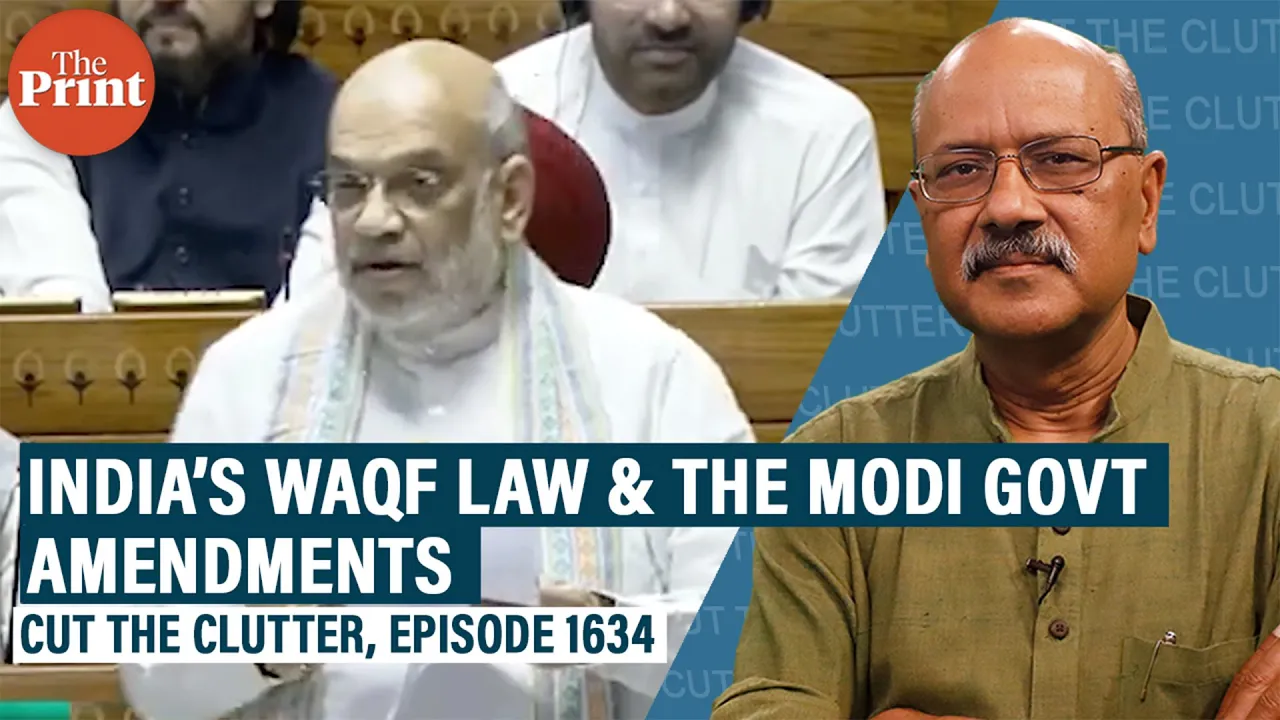
this is the right [Music] time Mutual Funds top this is the right time of mutual fund Investments are subject to Market risks read all scheme related documents carefully for two full days we have seen both houses of Parliament L SAA first and then rajas saaba holding really animated debates over over the new wak law the new wak bill or work which has now become act which will become act in fact after the president signs it it's been passed by both houses of Parliament this has been a very impassioned animated debate and you can see it's
been a very polarizing issue now you've you've been watching this very very wise people from both sides have spent nearly 20 hours debating it however I can say it that in spite of how convincing each one's arguments might have been in their own mind and in their own Hearts more importantly it will not convince the other side because this is a divisive issue it's a very very polarizing issue there are people who believe that the earlier law was bad that was a case of appeasement of a minority there are those who say that this new
law is unfair to a minority India's largest minority and also it is meant to at the at the very least troll them and irritate them and and and more substantively to Target them and to reduce their power and to diminish their religious institutions the freedom of which is guaranteed by several section several articles of our constitution 14 15 25 26 several several uh sub Clauses of 26 and so on so that is the larger argument now what do I do I can't summarize this debate for you that'll take two hours I cannot go into what
is good what is bad that is also not the nature of cut the Clutter I can I can do what we do which is just cut the Clutter and give you Clarity on what are the arguments on both sides what is going to change with the law what was the existing situation and what are each side's points so first of all first of all what is what is the basic issue basic issue is that in the Islamic system in the Islamic system and Islamic tradition there is the there is the tradition of wak so wak
in fact simply means it can mean to restrict it can mean to end it can be it can be restrict and devotion which means something that you give away to work is ceases to exist as anybody else's property or belonging and it is given to devotion in fact to understand this there is a very good one and a half minute video that I found on the W Foundation or Oka Foundation of of United Kingdom so I will share a link with you watch that that is the clearest definition what it also does is that anything
that you give away anything that you give away is gone forever you can never claim it back plus the spirit of this giving is such that what you've given should be like a Perpetual charity because you can't take it someone else can't take it so this should continue to serve the person purpose for which it was given so wak is like a Perpetual donation you've given it it's forever and it will keep on yielding income for the purpose for which it was meant so in Arabic the concept is sad jaria which means like continuing charity
or an Ever flowing charity in fact there are many reference to charity in the Holy Quran but there is one in particular of which I will give you a short truncated translation which says when a man dies only three deeds will survive him one continuing arms that is Charity second profitable knowledge the knowledge that he created that will survive him and will be used will be of benefit to Future generations and third a child who prays for him so those are the three things that matter charity has been put as first of the three this
goes to the vak the organization and the controller is a mwali mut is like the is like the custodian who looks after your donation and and make sure that your donation is used for the right purposes and then to then to manage it in perpetuity there are V organizations that is that is the tradition how old the tradition is Amit sha in his speech and it's very impressive speech in fact there were many impressive speeches you can see you can hear Amit sha I will share some links with you you can hear Amit sha and
Kiran riju on the side of the government backing the law you can also you can also watch a Udin oesi who's actually delivered a very impassioned speech at the end of which he said I'm tearing off this law just as Gandhi had to torn away the racist law in South Africa so just as Gandhi said I reject that law I am saying that I reject this law so I will share that with you also Mano ja of rjd and some of the others opposing opposing the bill as well so so you will see those links
and you can make up your own mind going back to Amit Sha's speech he said that this tradition of Bak in fact he got his reading of Islamic history right he said that this goes back to the to kif Omar's times kif Omar was the second rashidun kff he was a contemporary of Prophet Muhammad in fact a little bit younger than Prophet Muhammad prophet Muhammad was born in 570 ad kif Omar was born in 584 ad initially he was an argument with Prophet Muhammad and then he became Muslim it is he in whose times this
tradition of of wak began and the tradition is drawn from the Hadith Hadith or the Hadi now Hadith are not part of the Quran hadit are stories literally it means the stories happenings which are verbally mostly orally recounted by one generation to the other then over time they are studied by Scholars these these have then been qualif qualified as good not okay and and bad and then later these have been codified as laying down the Sharia law so this this is the next most important source of Islamic theology or Islamic practice after the Holy Quran
so Amit Shah said correctly that the okaf tradition or the wak tradition okaf is okaf is like plural for wak that goes back to the era of the second Calif second rashidun Calif Calif Omar he's got that right then he also says correctly that in India this tradition came in the gorit times that is in mamad gor's time or thereabouts and since then it continued and then he says that once we came to the 19th century initially there was an 1863 British era act which was the religious endowments act that that governed all the religious
endowments in India just six years after 1857 and 6 years after the crown taking over the rule of India then he says after that in 1890 a new law came in that was the charitable properties act again it covered all properties 1913 however a specific law was made for V Properties and then that law evolved in 1937 the law codifying the Sharia act that was passed and then in 1954 1954 under neru again the buck Act was passed which was further amended in 1995 1995 was effectively a new law now now you have to go
back to 1995 and understand what period that was that was the period narara was in power that is when Muslims were very angry after the after the destruction of the babri Masjid and nar's government did many things to assuage them it was in that period that a new Buck Act was also passed there was some compulsion to do so because over time the buck properties had gone into disrepair many had been encroached uh this is something that Indra Gandhi had written about in a letter to Chief ministers on 26th March 1976 in fact you can
see that letter on your screens I found that letter in the sucher committee report remember UPA had set up a sucher committee Justice sucher committee to look at the to examine the conditions of Muslims in India so she also said that look too much of it has been engrossed and a lot of these properties work work properties are where government buildings and installations are sitting now you can't demolish those buildings and hand these lands back so at least start giving a reasonable rent for these and if you are if you face the limitations of rent
control act now it's very difficult for me to explain in two sentences to current generation most of our viewers what rent Control Act was except to say that there was an ERA in the license quota Raj when even rents were fixed by the state right that led to so many shortages and other mess and ultimately so much so much of the disaster in our cities but that is something that we'll talk about later in that letter she says that where possible please relax the rent rent rent control act so the V bodies can get more
rent for these properties purpose of the bu was actually to use these properties or use these assets it can be property it can be jewelry it can be cash it can even be a car anybody can donate anything to W the purpose of of a w institution is to use it for charity the purpose for which it is meant however to cut the long story short the 1995 law gave some very sweeping powers to the V bodies this was the 1995 law not the earlier law that that power those Powers then got further strengthened and
actually made very strong in 2013 2013 in the last months of the UPA government they They carried out another bunch of amendments in the 9 1995 law and Amit sha said I'm giving giving you his explanation first that but for those amendments it would not have been necessary to bring out this particular law now what these 2013 amendments read with the 1995 work fact what they said was they actually gave total power to V boards or V bodies to declare any property as Buck property so notionally anybody could say that the house where I live
and where I'm recording this from this is a v property that was the intent and that was the that was the outcome of those sections so there was there was section 40 of that law red B red B say section six if you read section 40 with Section six one empowered The Works board to declare any property as V property then if I got agreed that this is my house how can you call it w property where would I go in appeal I would go in appeal to the wak tribunal that vak tribunal's decision was
then final it was then final and I would not be able to challenge it in a civil court in a civil court I can still challenge it legally but it'll be challenged under the RIT jurisdiction so I'll have to file a RIT against this and Rit have limitations RS don't apply everywhere I have to go to the high court right away so that became the final court of appeal so first the W board said the ex the earlier W board or the existing W board that this is not your home this is this is our
work property then I went in appeal to a tribunal tribunal said no no no you are wrong this is actually work property then if I still contested it I had to go in r in a r petition to a high court which was quite honorous the other thing with this was that all members of the V board and the V tribunal had to be Muslim so in a way and that is the bjp's argument this the these amendments gave this tribunal and bubo jurisdiction also over non-muslims which they wanted to rectify now besides also making
making these bodies judicially accountable so any body agreed could also seek judicial accountability or a judicial review of the situation so a judge could then decide who's right who's wrong whose property it is this other thing this the statute of limitations the W boards or the V or the V FLW as it existed earlier on then the limitation Act of 1963 did not apply what is the limitation Act of 1963 that is if you a civil dispute say on a property you can go and address it you you can seek redressal in a court of
law within 12 years if you haven't done it for 12 years too bad see you later or maybe not see you later you've lost your case but there's a 12 year 12 year limitation you have to do it within 12 years for the under the w law for w boards there was no such limitation they could make these claims without any time limit 12 years 24 years 36 years whatever number of years how however the Agri party had to had to protest or file file their protest within one year so they were limitation on one
side and and a very severe limitation on one side and no limitation on the other side what's happened under the current law I'm trying to make it as as succinct as possible and if I fail if I fail please forgive me because it's a very complex thing and I know that you don't have forever particularly if you've been reading about these debates and also watching these debates because these debates have had a lot of lot of air time and a lot of audiences a lot of the audiences have been glued to television also because it
was such good parliamentary craft it was such a healthy debate and a very good parliamentary environment what does the new law do new the new law says there will be W boards and W councils both of which will be fully fully people by Muslims right now the doubters or those who are concerned particularly on the Muslim side they said that look you will pack these with Hindus Christians all the others so Muslims will lose their freedom under article 1425 26 ABC etc etc to conduct their own religious Affair so you are taking that constitutional Freedom
away from the Muslims government says look the W organization the w f self right the uh the mwali and and the vakif vakif is the person who donates to vak all of them are Muslim they will never be a non-muslim with any of this however I'm giving you both arguments Listen to If you listen to oesi he says this is nonsense you want to pack these with non non-muslims so you take away my my freedoms under article 14 15 25 6 and so on and so forth the government argument which Amit sha puts out is
that look mwali who's the custodian of this of this property or his donation is also a Muslim then vak itself that manages this is also consisting of all Muslims however wak board and the wak Council the new wak board which will be set up at the state level now and the v v Council which will be Central those will have some non-muslims so say about two non-muslims however the majority will be Muslim the law says that even the chief executive of these boats and the central Council can be a non-muslim now to which the argument
from the Muslim side and the opposition side let me not just say the Muslim side the argument is that how can you put non-muslims into these bodies because ultimately these bodies will be educating ultimately these bodies would be adjudicating on a traditional Muslim practice and traditional Muslim Charities to which the government's reply from Amit sha again that is the most succinct government reply that is that is that look don't you have trust you can have a j trust a Hindu trust a sick trust any such trust all those trusts are fully all those trusts fully
consist of people of that Faith they can be a Pary trust so in that trust there will be only parses however every state has a Charities commissioner Charities commissioner then oversees all the TR trusts that their activities are all right their accounts are all right there is no there is no corruption there is no wastage that they are all sticking to their purpose of their Charter of objectives Etc and he says has anybody ever said that your Charities commissioner can only be Hindu or can can only be Muslim or can only be sick and if
you take it Forward what will happen I'm giving you arguments and he say he says if you take it Forward what what will happen that means if you have a Muslim Charities commissioner that Charities commissioner cannot look at Hindu Charities and vice versa and so on so it sounds a bit rhetorical in the way that he's put it but this is the argument obviously the other side is not convinced because the other side is not convinced of the intentions of the government uh under the new law if even if you see Mrs Gandhi's letter and
also a chapter on on on vck issues in such a committee report that is Page 238 in such Comm committee report that chapter also talks about the fact that the vck properties have not been looked after very well many have been lost many have been encroached upon and many have been sold illegally or have been rented at throw prices and such a committee also reports at that period that even in terms of Book value which will be a fraction of the real value at that point just the properties owned by the vak in Delhi in
Delhi was then worth 6,000 cror and their income was just 163 crores which is 2.7% but again 2.7% only on the book value out of that 7% the work board can keep for its own upkeep its salaries etc etc rest has to be spent on charity on the purpose for which these lands for donated that is too little so there is need to free up these properties so so more money can be raised from these these can be monetized a lot better so the purpose of Charity is served that much better so what has changed
now number one the bit will function like a trust that will have only Muslims they will be a body overseeing within the V system these vs members they also in that Council also will be all Muslims this however will be will be further overseen by a state level bu board in which there can be two non-muslim members majority will be Muslim the chief executive can be can be a non-muslim their amendments came in and some members particularly BJP allies wanted to raise the level of the officer level of the officers who will be members of
this body and also the law now says this body will also have two women and people from bori and other communities who are usually not observant of Islamic practices in the same way that traditional say Sunni Muslims are so Shia sh Boris and some more will be given representation in that body at the top that is not the body managing the buck property on the ground and the decisions of all these bodies will then be exposed to judicial oversight so it's not as if this will be one Divine body whose order will be final you
will be able to challenge it judicially in a civil court that is the big change then there will be a survey there will be a nationwide survey of all work properties this was also meant to be done under the earlier law what was never done never done in reality now the original draft of the law said that the collect ctor or the Deputy Commissioner will carry out the surveys but with an amendment again coming in from a TDP member it's not been decided that this will be a designated officer higher more senior to the Deputy
Commissioner then the question of can a property become a buck property by use now listen to this carefully what do you mean by use a mo a mosque may be St standing on a piece of land for a 100 years right but they not be documentation that that land was given by somebody in in indonation to V then what happens so by use under the existing law by use you said look since I've been sitting on this land this mosque is there the example that's been mentioned often is a mosque that stands right in front
of Parliament House that mosque conforms to this this description in fact one of the objections from the BJP side is that after the 2013 amendments 123 properties in Latin Delhi were handed over to the vak board and these were all very highly valuable properties including properties of Northern Railway I presume this mosque is this mosque is among them as well now can you then can you then get ownership of buck property by use that is again something that has been made arguable a challenge to this has been made arguable under the new law and again
the again an important change is that only a Muslim can make a vak donation a non-muslim that wasn't the case earlier a non-muslim cannot make a v donation and even if a Muslim or maybe a new convert makes a v donation that Muslim has to have been in the Muslim faith for at least 5 years now who will certify that how will you how will you find evidence that somebody has been Muslim for 5 years but not 5 months or 5 days right that's the question that oesi also ra is that how will you determine
when somebody became a Muslim by checking their beard or by as and says quoting obviously Narendra Modi from an earlier election campaign these are questions that the opposition is Raising and that's got the Muslim side really feeling insecure because they think that this is an encroachment into what was so far entirely their domain which they handled within their faith and within the institutions of their faith so in that now the government has been brought in the government is now right there the argument from the government side would be that look so many Hindu temples have
been taken over by the government and those are being run by endowments controlled by the government and and and and managed by Chief Executives who are government bureaucrats then the opposition would say in that case why don't you allow Muslims to be on the boards of the or Muslims to be on the board of Hindu temples right again the counterargument will come that look the charity commissioner or or the secretary in the state who's in charge of all endowments can be of any faith and that's the distinction we are now creating we are creating multiple
levels of the management of buck properties there have been many dramatic cases somebody lays claims to a big Temple right U somebody in Gujarat laid claims to the municipal operation building claiming that this is where in the mul era Muslim pilgrims going for Hajj used to rest it was a Sarai where they used to rest these kind of claims based on history can be made because there was no law of limitations similarly in Gujarat somebody made claims to the two islands of bet bet dwarka this reached the high court of Gujarat and high court of
Gujarat was so astounded they refused to admit this and they said how can how can you claim W wak rights in what is actually Krishna nagri right so all these issues were coming up because there was no ST statute of limitations this also fueled public opinion on the Hindu side that this law was being misused that this was this was appeasement and this was a special dispensation only for one Community there are many cases in Kerala in which the church is involved in Tamil Nadu where temples are involved in Tamil Nadu also a case where
a farmer could not sell his land because it was then said the buck board meant and claimed that the entire Village had been donated to V by the nawab of that era more than a 100 years ago now those those issues are also the reality of the subcontinent all of these will not end but all of these will also keep feeding into the politics now I I also know that you keep hearing astounding figures of how much land buak has and how much land the others have so one fact is correct that after defense and
Railways w w boards in India have the largest amount of land so formally I'm giving you data that's formally available Ministry of Defense according with according to a 2022 report had 17.99 lakh Acres 18 lakh Acres Railways had 12 lakh acres however Amit sha claimed that between 1913 when the first V act came in and 2013 when the Amendments by UPA took place Buck properties had become 18 lakh Acres whereas after the Amendments of 2013 because sweeping Powers were given to W vs who say this is W that is W in these 10 10 and
a half years or 11 years that number has gone up to 39 lakh Acres that's what he claimed in his spee so he said in a 100 years you got 18 lakh acres in these 11 years you've added 21 lakh Acres now whatever the reality the fact is that this is this has all fed into a very divided public opinion and it's in that situation that this new law has come so once again I tried to explain it however I know I cannot convince anybody either on this side or that side so all I've done
is classical cut the Clutter I've tried to simplify the issues for you as much as possible [Music] [Applause] [Music]