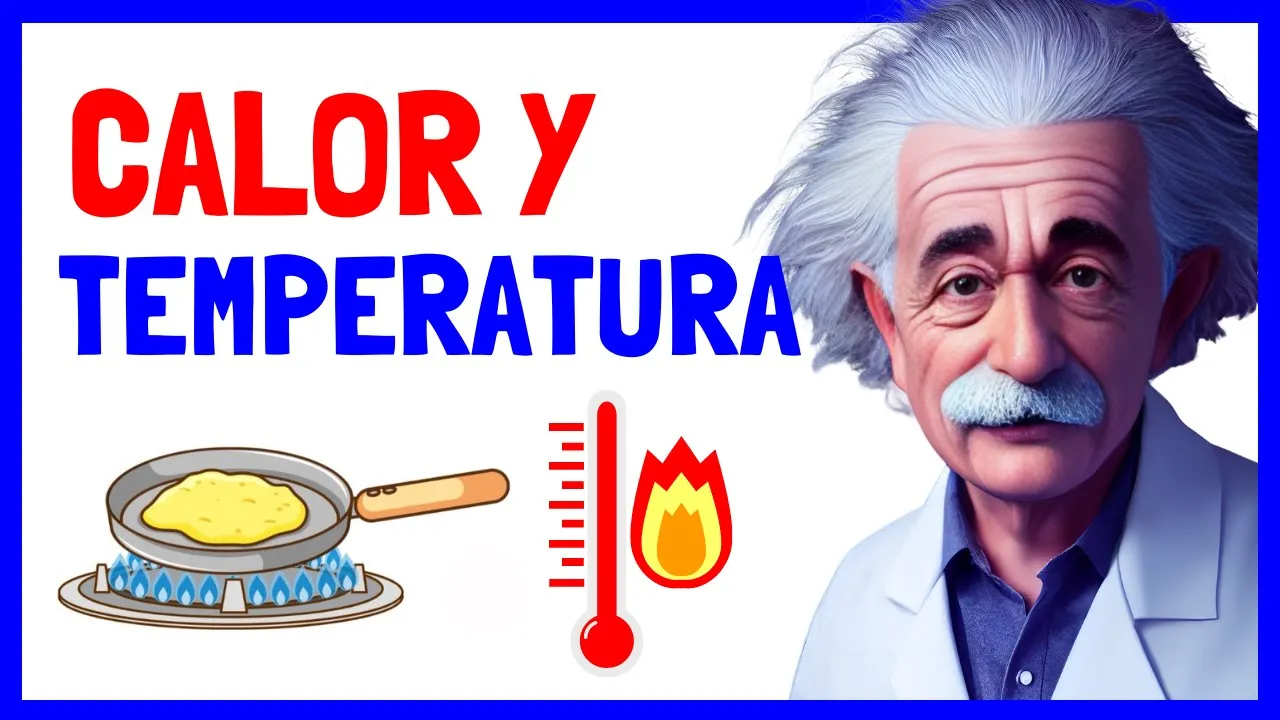
Hello! Good to see you here. In this video I will explain what heat and temperature are and their differences.
Give a like with desire to send you strength to learn and subscribe to the channel. Heat and temperature are closely related. The most important difference between these two concepts is that heat is related to the thermal energy of a body, while temperature is related to molecular kinetic energy.
Heat indicates the transfer of thermal energy between molecules in the same system, and can be measured in Joules. What heat measures is how energy moves. An object gains or loses heat, but cannot have heat.
On the other hand, temperature describes the average kinetic energy of the molecules within a system and can be measured in degrees Celsius, Kelvin, and Fahrenheit. Temperature is a physical property of an object. What is heat?
Heat is the energy that is transferred from one body to another, due to the difference in temperature. When two bodies with different temperatures are brought together, energy is transferred, so heat flows from the hotter object to the cooler object. Ways of heat transfer There are three ways that heat can be transferred.
The first is transfer by conduction, which occurs in solids or fluids that are at rest. The second is transfer by convection, which occurs in moving liquids or gases. The third is radiation transfer, which occurs without a carrier material.
Conduction Heat conduction is a process of transmitting energy from one particle to another, which occurs while both are in direct contact. An area with higher kinetic energy transfers thermal energy to an area with lower kinetic energy. High-speed particles collide with slow-speed particles, increasing their kinetic energy.
This type of heat transfer happens when there is physical contact between two bodies or objects. Convection Convective heat transfer occurs when molecules in a fluid move from a region of higher temperature to a region of lower temperature. As the temperature increases, the liquid also increases, which is known as displacement.
The clearest example is boiling water, where the denser molecules move at the bottom, and the less dense molecules move upwards, generating a circular movement. Radiation Heat transfer by radiation is very present in our daily lives, as it is generated by the emission of electromagnetic waves. The waves take energy away from the body that emits it.
Radiation can occur through a solid or liquid medium and is the result of the random motion of molecules. To measure it, a device called a thermocouple is used. How is heat measured?
The units to measure heat transfer are the Joule, in the International Metric System, the calorie, which is used in scientific or technological applications. Joule The Joule is equal to the energy that is transferred to an object when a force of one Newton acts on it in the direction of its motion, through one meter. Calorie A calorie is defined as the amount of heat that one gram of water must absorb to raise its temperature by one degree Celsius.
Instrument for measuring heat A calorimeter, a device that measures the amount of heat produced during a reaction , can be used to measure heat transfer . With a calorimeter you can specify the amount of heat that a body receives or supplies, as well as the amount of heat that is released or absorbed. Examples of Heat A common example of conduction is the process of heating a pan on the stove.
The heat from the burner is transferred to the surface of the pan. Another everyday situation with heat transfer by conduction occurs when walking without shoes. The material you walk on transfers heat to your feet.
Copper pipes can be used to transfer heat to a house very efficiently, which is why they are commonly found in heating appliances. With diamond powder, components of electronic devices can be made to transfer heat, without affecting the most sensitive areas of the mechanism and thus prevent them from overheating. Radiant heat can be experienced by staying close to a fire, as heat is transferred from the source, which may be, for example, a campfire, to the body kept nearby.
What is temperature? Temperature is the measure of warmth or coldness of an object or body that is established with reference to a standard value. It is a property that manifests thermal energy and is present in all matter.
How is the temperature measured? The basic unit for measuring temperature is the Kelvin (K). The Celsius (C) scale can also be used, with 0 degrees Celsius being the value that corresponds to the freezing point of water.
In the United States, the most common scale is Fahrenheit (F), where the freezing point of water corresponds to 32 degrees Fahrenheit. Kelvin The Kelvin scale is the most widely used absolute scale in the world and is defined by the third law of thermodynamics. Since this is an absolute scale, temperatures reported in Kelvin do not have degrees.
The zero point of the scale is absolute zero. Each unit on this scale is 1 part in 273. 16 parts of the difference between absolute zero and the triple point of water.
Celsius Celsius is also called Celsius and is a scale based on 0 for the freezing point of water and 100 for its boiling point. This scale was invented by a Swedish astronomer by the name of Anders Celsius and is also called the centigrade scale, due to the interval of one hundred degrees between the defined points. Fahrenheit The Fahrenheit scale is based on 32 degrees for the freezing point of water and 212 degrees for the boiling point.
It is used mainly in the United States, while Celsius predominates in the rest of the world and also in scientific research. This scale is due to the German physicist Daniel Gabriel Fahrenheit, who took the temperature of a mixture of ice and salt as the zero of his scale. Instruments for measuring temperature The most common instrument for measuring temperature is the glass thermometer, which consists of a glass tube that is filled with mercury or another liquid.
As the temperature increases, the liquid expands and allows you to determine the temperature by measuring the volume of the liquid. Another instrument that can be used is the thermocouple, a sensor that is made up of two different metals that are joined at one end. When this junction is cooled or heated, it produces a voltage proportional to temperature.
Thermistors detect temperature thanks to a semiconductor material that shows a change in resistance when there are variations in temperature. These types of instruments are very stable and, over time, maintain their performance. A pyrometer or laser thermometer can measure temperature without being directly in contact with the material.
These instruments are widely used in industrial processes where there are very high temperatures or in situations where it is risky to use another measuring instrument. Examples of temperature The regular temperature of a human body is 37 degrees Celsius. In some temperate climates there is an average temperature of 20 degrees Celsius.
Water freezes at 0 degrees Celsius and boils at 100 degrees Celsius. A coffee seems hotter than an ice cream because we compare the temperature of one and the other, which leads us to determine that the ice cream is colder. Hot, humid days are perceived as hotter than hot, dry days.
We have already reached the end. As an exercise to check what you have learned, leave an example of heat and another of temperature in the comments. Give a like if you liked the video, share it with your friends and subscribe to receive other videos as interesting as this one.
Happy day, see you soon!