[Music] Welcome to History for Granite. Join me to explore ancient Egypt. Please subscribe and together we'll uncover secrets from the past written in stone.
The last 10 years have been an exciting time for the pyramids with an unprecedented amount of science applied towards scanning them to discover new secrets. My own research journey was inspired by the scan pyramids mission which proved how much more there was to learn about these fantastic monuments. Their enormous size and mysterious designs lead our imaginations towards hidden chambers filled with treasures or secrets about the ancient past.
A pile of rocks this big just seems like a great place to hide something. And I don't blame anyone for hoping that undiscovered rooms still lay inside. On that note, I'm sure many of you will be thrilled to learn that a new paper published about scans on the eastern face of Manari's pyramid opens up this very possibility.
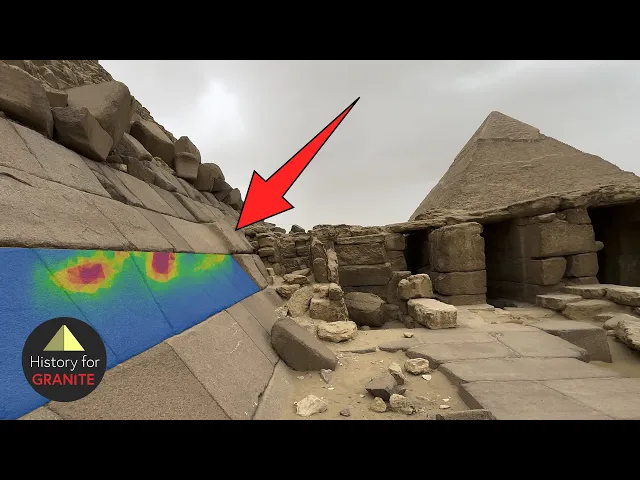
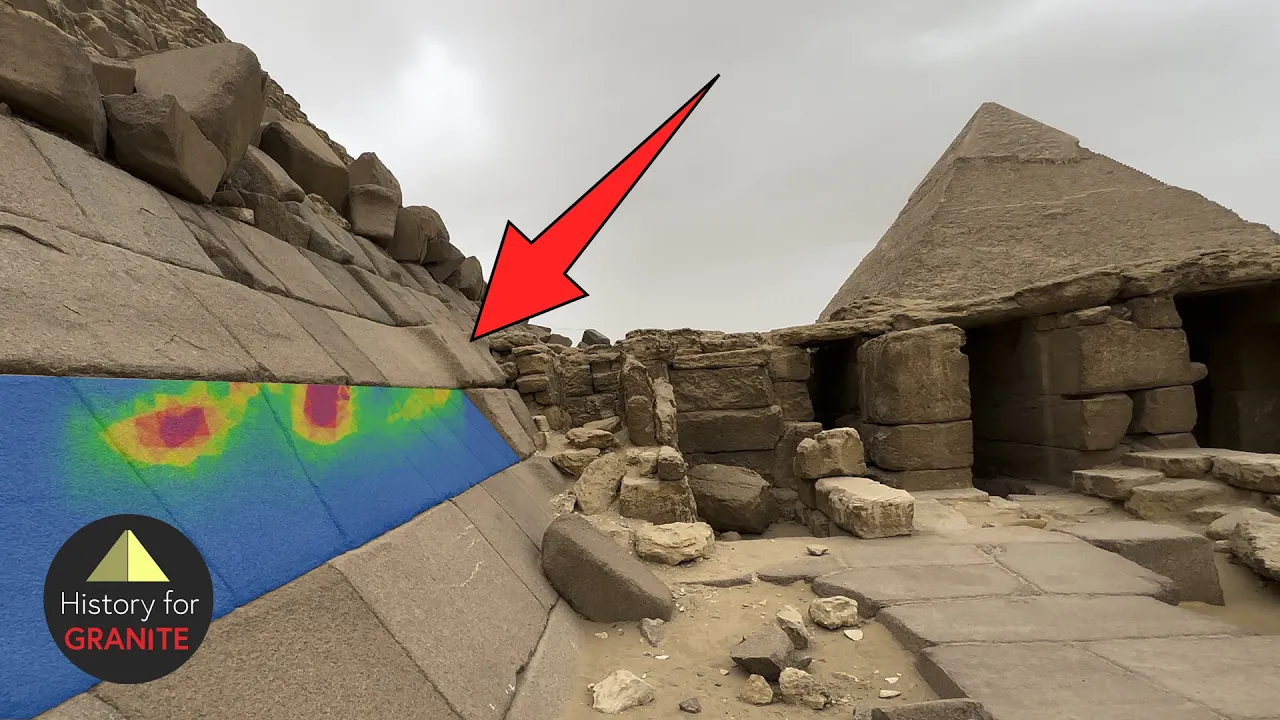
I can't help but laugh at how an anomaly has been found where any casual observer would hope to find one. It is centered on the eastern face in the middle of a squared portion of casing stones that were dressed fully smooth. This smooth section mirrors the north face of the pyramid where the entrance is found on the fifth course of casing stones.
It was rediscovered and first documented by Howard Vice in 1837. Given the similarity between these sections of smoothed casing stones, it's amazing nobody in the past removed the blocks on the eastern side hoping to find a similar entrance. Although perhaps one modest effort towards this goal was attempted with a small corner of a block chiseled away.
This small breach was made at an unknown time in the distant past based upon photos from George Risner's excavations in the early 20th century. The damage must predate the removal of casing stones on the pyramid, which created a huge debris pile, obscuring this smoothly dressed section. Once fallen casing stones pile up, it takes an enormous effort to remove them.
My trained eye estimates this single casing stone weighs 5 tons. The new scientific study is a paper published in the journal NDT and E International, short for non-destructive testing and evaluation. Manari's pyramid was scanned using three non-destructive techniques.
Electrical resistivity tomography, ground penetrating radar, and ultrasonic testing. Data from all three scans are merged in a technique called image fusion, and thus a more reliable approximation of empty space can be determined. It should be recognized that authors of this paper have a strong track record of accurate results, including scientists like Hani Halal.
He and others also worked on the scan pyramids muography which precisely predicted the northface corridor of the great pyramid with non-destructive tests. This proven success stands in contrast to recent publications on synthetic aperture radar scans of the Giza pyramids which use methods that have never been demonstrated to accurately scan subsurface voids before. It's no wonder the public has been confused about which scientific studies can be trusted when prominent Egyptologists have a poor track record of endorsing or refuting remote scans.
I am working in arch for 45 years. Technology never showed to me anything convincing at all. A decade ago, Zahi Hawas proclaimed radar never made any discovery.
Yet, he is also a co-author of this new paper which uses ground penetrating radar. Egyptologist Sarah Parkhack proclaimed the big void inside the Great Pyramid was a noise echo despite a five sigma confidence level from three independent teams, which is about the highest standard you could possibly hope for. The messaging about science with respect to pyramids has been inconsistent.
I admit that I am not qualified to evaluate this new paper on its technical merits, but the methodologies used and the people using them have proven to be accurate before and so I have no reason to doubt their conclusions. But an empty space inside a pyramid is only the beginning of a discussion and I can give some context and insight into what the possibilities are for this anomaly at manare. I also want to give special credit to the authors of this paper for acknowledging independent researcher Stein Vanhovven who published his hypothesis about a hidden entrance to Manari's pyramid here in 2019.
Van Denhovven's publication was not peer-reviewed and I'm not sure if his hypothesis was the catalyst for these new scans, but he deserves credit for presenting the idea in a comprehensive way. It should also be noted that the introductory section of this new scanning paper, which covers the Egyptology background, contains sloppy errors. I presume this section is written by Zahi Hawas, as he's the only Egyptologist author for the paper, and his writing style has become all too familiar.
He claims that Manari's pyramid once had 16 to 18 courses of granite casing stones, and that the pyramid was originally intended to be fully covered in granite. There's no evidence to suggest the limestone casing at the top was a change of plan. And I have no idea where the upper boundary of 18 granite courses comes from.
I think Hawas invented this number out of thin air because there is no historical source nor physical evidence for granite casing above the 16th course. I made a video about this very topic which reveals the backing stones on the pyramid are visually distinct in the lower 16 courses. Combine this with pieces of granite still in situ on the 16th course and an ancient Greek account which corroborates the number and there isn't any credible doubt about the original granite on the pyramid.
Imagine how frustrating it must be as an engineer which requires precise and accurate data management to co-author a paper with an Egyptologist who just makes up numbers. Over three and a half million people know Manari had precisely 16 courses of granite on his pyramid. But Zahi Hawas still doesn't know this.
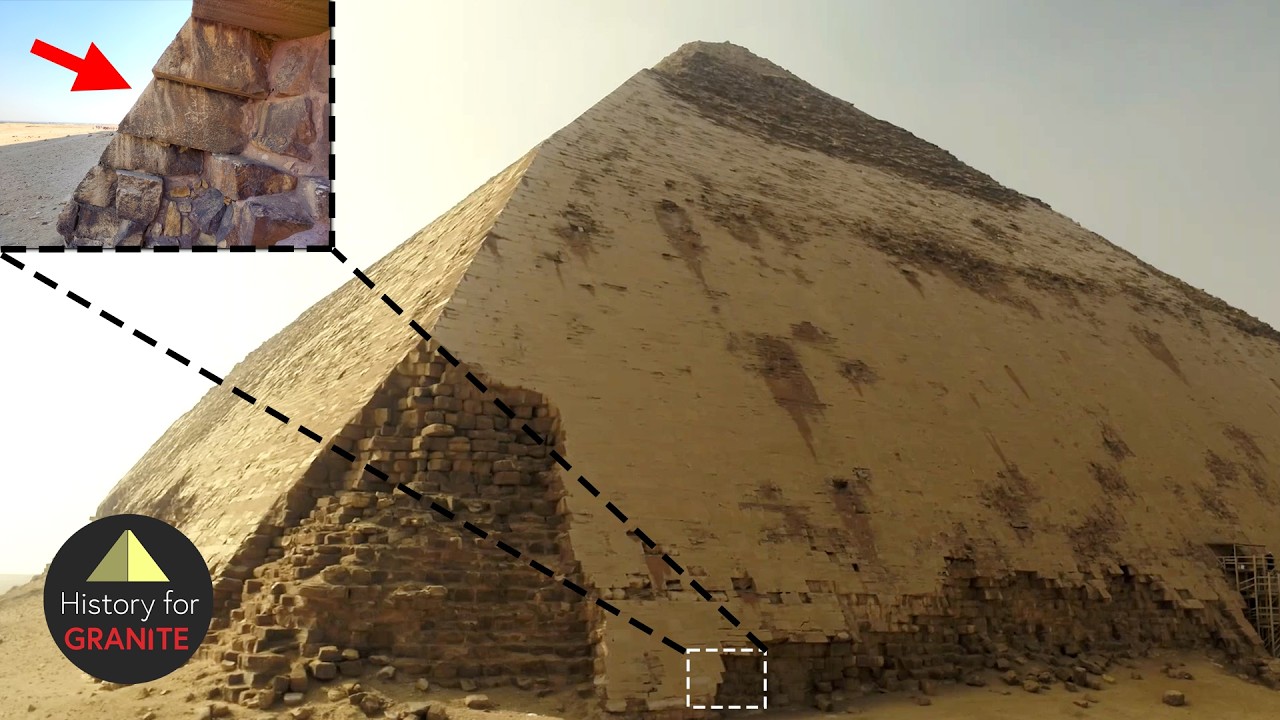
With that said, this paper may still receive one final revision at a later time, and so perhaps these errors will be corrected. The paper also claims only seven rows of granite remain on the pyramid. There are eight courses intact on the north side, with the bottom course being presently buried, eight intact on the south side, and even a small section up to course 11 intact on the west side.
Just over a year ago, Egypt announced it was planning to receat fallen granite casing stones back onto the pyramid. The public outcry against this canled the project and cost Mustafa Wizeri his job as secretary general of the Ministry of Tourism and Antiquities. As someone who has probably spent more time studying the casing stones than any Egyptologist, I have no confidence the stones could be receded accurately.
This matters because the layout of casing stones is a critical clue to determine how the pyramids were originally constructed. But enough about the casing stones themselves. This new paper is about what could be behind them.
And that is where imaginations tend to run wild. The three non-destructive scanning techniques identified two air gaps directly behind the granite casing stones. Anomaly A1 is 1 by 1 1/2 m square, slightly above the trapezoidal block in the middle of the smooth section.
Anomaly A2 is. 7 by. 9 m in size just to the left.
The larger anomaly A1 begins 1. 4 m deep, whereas anomaly A2 is shallower at 1. 13 m deep.
Both anomalies are interpreted as air gaps from the combined scan data. The scan data could not determine the depth to which the air gaps penetrate into the pyramid. The paper states 3.
5 m was the maximum depth to which data could be obtained. But this does not mean the air gaps extend that far. Thus, the space could be anything from small isolated pockets of pyramid that were never filled in to a hidden passage leading into the heart of the pyramid.
Here is some context to help determine the probabilities for those scenarios. The evidence against an original hidden entrance to Manankari's pyramid is quite strong based upon every fourth dynasty pyramid design that we can see. Entrances to these pyramids were not disguised.
They always have enormous lentils above passages, including the northern entrance at Manari's pyramid, which leads to the most impressive vault and sarcophagus of its time. Even when a pyramid has a secondary entrance which is later sealed, the passage has a large lentil centered above it. Pyramids with two entrances always connect them and Manari can't have a secret connection inside.
The reason being the chambers and passages are cut into the bedrock and don't contain any masonry that could possibly disguise a hidden connection. Additionally, almost all of the casing stones are missing from pyramids, and we don't see any isolated passages or hiding spots that would have been revealed once the casing stones were removed. Pyramid entrances also open evenly onto one course of stone in contrast to the anomalies which do not match the horizontal joints.
This is why Vandenhovven's hypothesis selected one block as sealing a possible entrance and not multiple stones. Lastly, the two voids are not the size of a fourth dynasty pyramid passage. Anomaly A2 is half the standard size, and anomaly A1 is.
5 m wider than passages found in other pyramids. So, whatever this air gap is, it's almost certainly not an original passage leading to Manari's burial. Ancient Egyptians from later dynasties also identify Manare near the northern entrance and interred a wooden coffin in the chambers in his honor.
The fact that there are two anomalies instead of one also make it more likely that the gaps are a byproduct of how the pyramid was built rather than secretly concealed spaces. It's not all bad news, however, and there are still some tantalizing possibilities to consider. The larger anomaly A1 is so perfectly centered onto the pyramid's dressed section that it seems like an enormous coincidence to be random.
I've previously proposed that the dress sections on the east and north sides were done to accommodate temple structures built around them, but there are other parts of the temple abuing the pyramid where the casing is still rough. The reasons for smoothing the casing stones here remain somewhat mysterious, but clearly there was something important about it. It's not crazy to think that some architecture or artifact was embedded into the pyramid here for which we have no precedent.
The one detail that really grabs me is the large trapezoid casing stone, which mostly covers anomaly A1. This shape for a casing stone is extremely rare. In fact, it is the rarest version of a trapezoid found on the pyramids.
Almost all trapezoid casing stones with two tapered vertical joints have the longer side of the polygon on the top rather than the bottom. The reason may be a byproduct of how the casing stones were maneuvered into place from either behind or the side and not from the front. Stones inserted laterally would not be well served by a narrow corner as a leverage point at the bottom.
This combination of factors makes a widebased trapezoid almost non-existent on the pyramids. The best reason to make a casing stone this shape is if you were going to push it onto the pyramid from the outside. If someone was going to conceal a hidden space in the pyramids after it was constructed, this casing stone shape is suitable for doing so.
It's possible ancient Egyptians could have inserted these few casing stones after the pyramid was completed. Casing stones often overlap the backing stone row beneath them and remain supported even when most neighboring casing stones have fallen away. This could be a well- disguised intrusive burial from later dynasties or something hidden during the reign of Manare as well.
If something was hidden behind these casing stones, it was a wellexecuted disguise because the granite in front of the anomalies has joints as perfectly fitted as the rest of the pyramid. A single piece of evidence stands out where an apparent levering point is found in the block below the trapezoidal stone. Was this block pushed onto the pyramid from the front after it was dressed, or is this random damage that is unrelated?
This is a particularly vexing mystery, and there's no interpretation I find overly persuasive. If an anomaly like A1 was found anywhere else on the pyramid, I'd assume it was very likely a construction gap and nothing of significance. That type of air gap probably explains the thermal anomaly at the base of the Great Pyramid discovered by Scan Pyramids nearly a decade ago.
It's only that the large anomaly is centered here on Manari's smooth casing stones which gives me pause. There's always the chance that something entirely new exists about the pyramids that we have yet to encounter. To make any kind of determination, more non-destructive testing is the best approach for the time being.
I noticed scan pyramids muography plates inside Manari's pyramid in 2023. So clearly other methods have been employed in the search. As the scan pyramids team did not mention any voids revealed by muography in the paper, I think it's a safe bet that the cavity behind Manari's east face is quite small.
Certainly don't expect anything like the spacious chambers encountered from the northern entrance. If fallen casing stones were cleared on the pyramid above the anomalies, perhaps gaps in the limestone backing stones could be exploited with an endoscope or additional non-destructive tests could be deployed from the angle above. I don't love the idea of moving the fallen stones here, although it was done at the Red Pyramid by Rainor Stotleman far more extensively, and there was a lot learned about the pyramid by doing so.
So perhaps a very minimal and selective approach to moving the blocks here would be in the best interest of science. Other fallen casing stones around manare have already been moved and rearranged so many times that I fear determining their original locations may never be achieved. At the very least, we have one more new mystery to ponder.
And perhaps this project can reignite interest in studying Manari's fallen casing stones without the unnecessary step of cementing them back onto the pyramid. There is still a great deal to be learned from these stones, and leaving the pyramid in its present state is not preserving the ancient past. Most of these fallen stones are from destruction that happened no earlier than 600 years ago.
If you ever visit Giza, wandering among them is highly recommended. There's something magical about these giants lying in the sand. They whisper that insight into the ancient past is as close as the underside of a single stone sitting in plain sight.
Thanks to everyone who watched this video to the end. Please subscribe to the channel to see more of this content. Give a like or comment as you see fit.
And above all, remember to ask your friends if they take their history for granted.