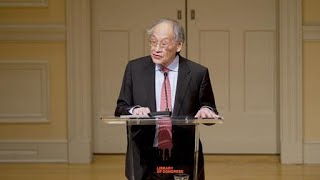
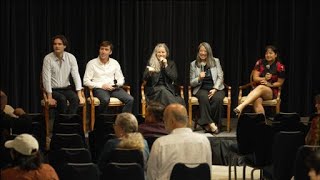
>> Eugene Flanagan: Welcome to the Library of Congress. And welcome to our special guests, Joan Nathan and Michael Twitty. Joan will make her proper introductions in a minute. First, a quick show of hands. How many people are new or relatively new to the Library of Congress here this morning? This afternoon? How many rather familiar with the Library of Congress? All right. About 50/50. So I want to provide a little quick overview of the library for those of you who are new and appreciate you joining us for this particular event, and also for those who are
more familiar with the library, you can tell me what you think about the little overview of a place you're more familiar with. We are many libraries under one roof, a national library, a preeminent research library, a congressional library. But above all, I think we aspire to be a library for all. A place that is welcoming to all and encourages more people from more walks of life to visit us on site and online and use our many resources and services. And today's program is courtesy of the Libraries of Break section in our African and Middle Eastern
Division. And the section is, I think, a great example of how you and anybody you care to tell and please tell can engage with the Library of Congress both on site and online. The break section itself includes a wide range of materials, more than 300,000 as it happens in Hebrew and other Jewish languages, covering topics such as biblical studies, rabbinics, Jewish law, music, folklore, poetry, language, and history. With an expansive collection of rare books, manuscripts and historical documents, the section is a vital resource for those studying or simply curious about Jewish heritage and culture from
antiquity to modern times. Recently, we digitized and made available free and online hundreds of manuscripts written in Hebrew and cognate languages such as Judeo-Arabic, Judeo-persian and Yiddish, and these, along with many other resources also available online, offer a rich and often intimate glimpse into Jewish life over the centuries. Yoram and his team also provide live programming, and today's is a perfect example and others are forthcoming. Additionally, I encourage you, while you're in the building to visit our new Treasures Gallery on the second floor. This exhibition draws from the library's rich holdings of Americana and international
collections, bringing together a mix of voice recordings, moving images, diaries, manuscripts, photographs, art, maps, books and more. And in all of these endeavors, the library is constantly exploring how culture preserves memory. We look to actively preserve collective memories, representing entire societies important moments in history and individual lives, and we look to reach more communities from more backgrounds with our work, to engage with it and to help us shape it. And what better way to engage with culture and memory than through the topic of food and family? So with that, I'll hand it over to Yoram
to make proper introductions. Enjoy the interview. Thank you. >> Yoram Bitton: Okay. Thank you, Eugene. Good afternoon. My name is Yoram Bitton and I am the Hebraic section head. And thank you for joining us today at the Library of Congress. The Hebraic section at the African and Middle East Division is pleased to welcome you to this exciting event. Today we are honored to have Joan Nathan with us. Joan, known as the Queen of Jewish Cooking, needs little introduction. The author of dozen books, she has done more than any other cookbook author to bring a Jewish
and Israeli cooking to American kitchens. She has won numerous prizes and awards, including the prestigious James Beard Award and the Julia Child International Association of Cooking Professional Awards multiple times, among others. Joan was the producer and host of two award-winning PBS documentaries, and is known as the preeminent authority on Jewish cooking in America. Her new book, "My Life in Recipes, food, Family and Memories," has just been released to glowing reviews, and her next book, "A Sweet Year: Jewish celebrations and Festive and Festive Recipes for Kids and Their Families" will be released in November. Despite her
significant accomplishment in career success, Joan is an example of humility and kindness, and I put there the New York Times piece to read later. As Sarah Wildman recently wrote in her New York Times opinion piece titled "Joan Nathan taught me to show up and bring a dish, she speaks to people's heart through her food. She demonstrates how to show kindness to someone in need." We are also pleased to welcome Michael Twitty today, Michael W. Twitty, who will be moderating the event. Michael is culinary historian and National Jewish Book Award winner and is the... And he
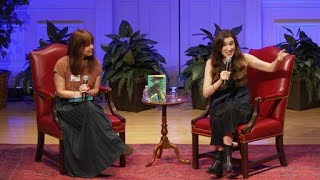
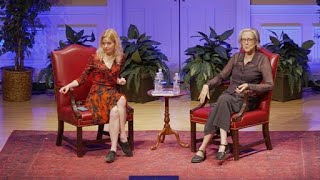
is the author of "Koshersoul: the Faith and Food Journey of an African American Jew." Please welcome Joan Nathan and Michael Twitty. (applause) >> Michael W. Twitty: Okay, so this is really wild. Lots of different things. I'm a native Washingtonian, so was my late father. I used to come to this building when I was 16 years old with my principal's permission note. I am 47 now, and about 20... I don't think we should even say the number. It was over... years ago. I had a professor through the consortium. I went to Howard University, and I took
classes in Jewish studies at American University and a professor named Pam Nadel. And I said to Doctor Nadel, I said, "Do you know this lady, Joan Nathan? She said, "Sure, I know Joe Jonathan. So what do you want to know?" I said, "I want an introduction," and I probably was 20 years old. Yeah, at least 20 years old and 19-20, and she said, sure. And I ended up at Joan's house. And that's how I learned how to make challah. And not just any challah, the best challah. And, like, really. And so I'm not going to
spend a lot of time on this, but the reason why I was overjoyed to talk to Joan is not only did she help me out, when I was in Philadelphia, I was at the Jewish American Jewish Museum. Right? And it was a big, beautiful crowd. But Joan has been foundational to part of my journey as a food writer and as a Jew, many other ways. And as a person who loves food, and I could not wait to do this interview with you. Yeah. Those who know, you know. So we have to... We have a lot
to talk about. So we're not good... We're going to spend a lot of time on this work and what it means to you. Because you traveled a lot. You've seen a lot. Done a lot. I mean, you worked for Mayor Teddy Kollek. You know, when you admire somebody as an author and as a as a culinary role model, you learn about everything they do. You get really nosy. You get really... what's the current word, parasocial about who they are and what they do? And the first question that I'm going to ask you, we're going to
get the basic you know what? Everything we have to know out of the way is in looking back on this entire body of work that you produced, both visual and in cookbooks and in demonstrations. What is Jewish food? >> Joan Nathan: Okay, well, before I answer that, I just want to tell you that the Library of Congress was really my home when I first moved here. I wasn't very happy about leaving Boston. I was happy about being with my husband and whatever we were doing. But I came here when I was researching my second book,
"The Jewish Holiday Kitchen" and I worked in the Hebraic section with Peggy Pearlstein, and I forget his name. Oh my gosh. No, he was sort of an odd duck, but he was wonderful. Was it Wayne somebody or Myron? Myron Weinstein, he was fabulous. And the two of them helped me so much. But what I would do is on my birthday, I would come into the stacks of the Library of Congress and spend a day alone there. And I love doing that. And it was just my treat, especially when I had little kids to go there.
So it's really has a big place in my heart. And I used to call Peggy. I didn't know you then, Yoram. Whenever I write articles for the New York Times, I would always call her to make sure that I got my facts correct. So I used to call her my secret weapon. Anyway, okay, so what is Jewish food? Well, I think of Jewish food as a definitely dependent on the dietary laws. No question about that. Even if it's just in the back of your head that you really don't follow them, you know about them. And
that's what makes Jewish food Jewish. But it's also other things. It's food that has adapted along the lines of kashrut to different locales and different foods. For example I was in El Salvador and I had a latkes that were yucca latkes with cilantro cream. Well, because yucca grows better there than potatoes and they were delicious. But that's what Jew, because Jews have always had to adapt. The other thing that I do think about with Jewish food is always looking at the properties of food, and Jews always being curious because Jews were peddlers forever. I just
read an amazing book about a... I don't know if you saw my article in the New York Times and a woman named Marina Kaufman. Marina Pinto Kaufman from originally from Tetuan, Morocco, and she grew up in Tangier, and she had the private I don't know if you have it at the Library of Congress, but if you don't, I'll give you the copy. It's in written in four languages a diary of her uncles, great uncles going from Tetuan to Brazil when the rubber became... when Michelin tires came in and rubber was so important, they went up
the Amazon selling things to all the different communities up there. And that's how they made their living. And I realized they did that in Morocco. This woman's father did green tea would go up to the mountains with green tea and sugar. And of course, they'd add the mint to it. But that's what he sold. And so that Jews have always been merchants and so that they're always looking for... and it actually it goes back to King Solomon because he made people do what's it called? They give not money but give each tribe of Israel, 12
tribes had a month that they would give to the Temple in Jerusalem. So they would go out on these wooden boats, day boats D-E-O-U-G-H or something. And they would learned about this from the Phoenicians. They'd go out looking for food or looking for stones. I mean, there was nothing like computers in those days. They would have all these... they would look what could embellish the temple or embellish their lives or change their lives. And so they've always done that. And that to me is part of food because it's the way they looked at food. That's
the long answer. But Jewish answers are always long. (laughing) >> Michael W. Twitty: Well, I even say things like (inaudible) bacon is a Jewish food. >> Joan Nathan: Bacon. Yeah. >> Michael W. Twitty: A relationship to it even if even if you're making even if you're eating in a transgressive way or you're making things kosher that could taste like bacon. There is still, like you said, I am still breaking down what it is to me. Jewish food is anything that has a Jewish meaning or context how you swing it. Coming from New England, nobody knows
about Jews, from New England. >> Joan Nathan: From New England? >> Michael W. Twitty: Yes. You are from New England? >> Joan Nathan: I know, I do. >> Michael W. Twitty: And what I find really special about your particular journey is, it's not a New York journey. It's not an LA journey. It's not a Miami, it's not a Chicago journey. It's a Rhode Island journey. It's an American journey. But it's just like when somebody says, I'm Jewish and I'm from Tennessee. Eyes are like, go up and go, oh, I can't place you in my Jewish
geography. But in Rhode Island, which has a very old Jewish community, not that your family necessarily a part of that, but you grew up there and you actually have an artifact from your childhood that you wrote into the book. And I just want to know more about what is it like to grow up Jewish in Rhode Island and what that artifact in your book is about your early childhood experience there? >> Joan Nathan: Okay. Well, I thought you were going to ask a different question about what makes me what I am. But this is I'm
going to just tell you. Read this. It's my favorite thing to read from the book, because when I was writing this book, I found my mother's box of everything that every article I had ever written. Also, all my report cards, everything, all the letters that I had written from Israel, from France. They were all in this box. And one thing I had never seen, and I think it tells me who I am. This is the home report from the two year old group at the Gordon School in Providence, Rhode Island, 1945. Joan has been giving
birthday parties for her classmates. She has enjoyed making all the arrangements and carrying them out. On the whole, the children accepted her plans, but sometimes she ran into a snag and had to come up with solutions. She really enjoys her morning lunch. She is quite self-sufficient. She enjoys the routine and is quite happy in her busy little way. I haven't changed. Anyway, of course I didn't realise growing up what it meant to be Jewish in Rhode Island. But I'll tell you, it's not different from many other places in America. In Rhode Island, most of the
Jews that came maybe started out in New York and had one relative that was in Rhode Island and came to Rhode Island. Most of them were from Ukraine or near Ukraine. Some of them were from Romania. There's a cookbook that if I knew you were going to ask that question, but they must have it here. It's called, oh my gosh. But it's the Woonsocket Cookbook, and it was written during the war, Second World War. And these women went... The men were in the war. And the women, the people that wrote the book went to their
homes and watched them cook. And there are all these recipes that I always look at this. It's called Community Cookbook. What else? Of course. Whenever I'm looking for old recipes from this country, I start there. And because it was a small community, Richard Darman remembers him as secretary of whatever the Treasury was he... Anyway, he was from that community, was Jewish, from that community. Now he says he's Episcopal, but it's his family name right in there. But what it was tight knit. And that's what the early communities all over the country were. And the recipes,
they were stuffed cabbage, but maybe not sweet and sour stuffed cabbage. I've just found all kinds of really interesting recipes from this book. Not my recipes because my father was German Jewish, and he came 1929 from Germany. So he was like a new comer. And to Rhode Island he came. He did not come as an immigrant, I mean, as a refugee. He came first class in the Bremen. He was one of the first people that took the Bremen, the ship. And he came with a what do you call it, a recipe for water repellent fabric.
And he had my family had part of a factory in Rhode Island called Warwick Chemical. And that's what he did when he came over. So it was a totally different immigration. However, what he did was he really loved those recipes of his childhood that were already inscribed in the settlement Cookbook. So most of the recipes that my mother, who was an American Jew from New York, my father went to, I forget what the place his name. It's in the book. He went to this place to meet women. All the guys from Rhode Island wanted New
York girls. So they would go and and they accepted him even though he had a German accent. This was before the war. And he had a company. So they were very, very nice to him. And a lot of it I learned actually when he died from other people that he had known early on and they said, well, he kissed women's hands when he met them. And anyway, so he met my mother at this, like Marjorie Morningstar type place. And she was there with some friends, and she had been to Europe and he was European, but
she was her parents were from the Lower East Side, but she was smart. She went to Barnard College on scholarship and they got married. And but the point is she felt as far as her background, she wanted to be American. And so she would make American Jewish food and she didn't want to be so much American that we didn't have the background of a Jewish community in Rhode Island. So she'd go to the bakeries that were from that earlier migration, the Eastern European migration. And Rhode Island, again, was a small... They had a conservative and
Orthodox and Reform synagogues, but they were a small community within a bigger community, which is what the Jewish community has always been. And so my mother, she would get most of her recipes from the settlement Cookbook until forever. Even when I wrote a cookbook. But anyway, and she learned to make the things that my father loved that were German, and that's what made me start to really want to learn about Judaism and Jewish food was... And I wasn't so interested at the beginning in Jewish food, I was interested in ethnic food. So I would go
up to Italian Federal Hill. I'd go with my father to my aunt's. He brought his sister over and his parents, and went there every Saturday afternoon to listen to the opera and have a good German meal. So I had brains when I was little, I loved them. I had, I don't know how you know. I'm sure my brothers didn't. They never came with me. Also, they were very much thinner than I was always. But they would have Schaller and Weber sausages and stuffed cabbage that I mean, really, and lots of baked goods that my aunt
would make for Hanukkah. But instead of putting red and green on them, she'd put pink sometimes and she'd have these cans of cookies, of German cookies in the breezeway so that again, my family had lived in Germany since the eighth century. So they came over because of the Holocaust. But that's what they always ate. And what's so interesting is I was just with a cousin. Should I keep going on? >> Michael W. Twitty: Yes. >> Joan Nathan: Okay. A cousin of mine from Germany who is one quarter Jewish. So some of these recipes he kind
of knew, but because his mother wasn't Jewish, and it was during the... He grew up after the war, I guess everything you didn't eat Jewish food, but he when my book came out, he made the sweet and sour. Well, it was carp, but it was salmon in my book, which is one of my favorite books. It's got ginger snaps in it. And I realized that maybe the way that I... And he made it in Germany and he thought, oh my God, it's so good. He had never had it. So that food is always changing. But
there's some things that never change. >> Michael W. Twitty: You know, when you talk about that, I think that a lot of people assume there will always be somebody to remember a recipe, or because it's written down and digitized and that's not true. You have to do in order to preserve. You can't just think about it. Because eventually what happens is the ingredients get lost, the techniques get lost, the flavors and the smells get lost to the point where there's a scene not seen, but this moment in what is the book? I can see the
cover in my head and Miriam's kitchen where she's talking to her mother in law and she says, I found the mushrooms you used to eat in Poland. And they get the mushrooms and they look the part, but when they make the dish, it doesn't taste right. And German Jewish food is an endangered part of the Jewish people assume it was all the same. Not at all. German food was different from Austro-Hungarian food, and even that is broken into multiple parts. So when one of the most amazing things that we have to give you credit for
is reintroducing us to the power of community cooking. You go in your books. You go into communities on your show, you have preserved. You preserved customs that are documented nowhere else. You know, for example, the Passover documentary. And I knew all these people from (inaudible) custom of the Seder plate above the head during the Seder, you all are like, what? Yeah, and the leeks. And everybody knows the leeks and the scallions now. But those other customs, those songs, if you don't record them and don't see them and they're a part of our food lore, does
that excite you? Does that give you... What does that do to your heart to see those things preserved? >> Joan Nathan: First of all, Passover. Where's Gale? Gale's family was in my Passover traditions of freedom. And you know, just when you were saying that, I thought, oh my God, I mean, I would love to have that resurrected. It was on PBS, what, 13 years? And my TV series was on equal more, let's say 15, because it's not lucky number 13. But it was a long time. Those are the things that really excite me more than
anything. And just last week when I did this article on this woman, Marina Kauffman, who before it went to press, called me and said, I don't want you to write the article. And I thought, what is? So I had to. I never do this, but I read her the entire article and she realized she was going to be okay. But anyway, she was very anxious. But what I when I was doing research for this article, I looked at this one Moroccan cookbook I really like. I had written the article in Martha's Vineyard, and then I
came home and I just had a little bit of time, and I looked in this book from the 80s and I forget what it's called, but I'm sure you know it. But anyway, it's in the I think they mentioned it in the article. Anyway, it said that this recipe that I was writing about, which was about seven foods for Rosh Hashanah, seven good luck number and that were basically boiled and then you know, then served with sugar and a little bit of cinnamon anyway. And many people do it differently. But she was from Tangiers, so
this woman did tangier tétouan. That's what was the one thing that she did. And but in this book said, was usually this was served with the head of a calf and boiled for 3 or 4 hours. And I got so excited because I realized how... And other people have just put the head of the sheep or whatever, just, or the fish for the new year, and it's in different customs. And I realized how customs change, how as our tastes change, as our whatever. But nobody does that anymore. And it was like, oh this was a
good luck dish. And I got really excited because I had found something that people were not... We just hadn't thought about. But unfortunately, they didn't let me... They included it. And I don't know how many people realized what I realized. You know that this is what it was once, but it is no longer because we've changed, right? >> Michael W. Twitty: This book is I have this word called food steps to kind of like bridge together our footsteps and our foodways and all of that. And as I was going through my life and recipes and
I don't know if I should bring this up, but I should bring it up, maybe. >> Joan Nathan: Yeah, you can. Whatever. >> Michael W. Twitty: One of the most endearing parts about this book is you documenting your love story with your husband. May he rest in peace and also the growth of your children. And I don't want to center that, because I feel like one of the big mistakes I made with my mother was my mother was not my mother. My mother was her own woman, her own girl, her own teenager, her own daughter,
her own person. And that's what we always do, right? This is my mom. No, this is Patricia Townsend. This is not my mom. Yes, she's my mother. I'm not here without her. Right. But you know, that kind of thing. And I didn't want to do that. But at the same point in time, you put at the front not only your professional journeys, but your familial journeys. And how did you go about selecting what those food steps were going to be? I mean, the recipes, of course, you can always tie a memory to a food or
a moment, but also just that whole process. This is not an easy book to write. >> Joan Nathan: No, it's not easy. Well, first of all, every step of the way was not easy. It was, I started it... I was supposed to start it before the pandemic. And then my husband got sick. He had Creutzfeld-jakob disease, and I'd never even heard of it before he had it. And they said he will die within a year. Well, it took him three months, that's all. I think he knew something was going to happen. And knowing him, he...
Anyway. So I had and I had read Joan. I mean, nothing was just it took everything. Took a long time. It took a long time, first of all, just to go through all that I had and then to put it in years and then sort of outline what I wanted to say. And my editor actually had to cut 30,000 words. >> Michael W. Twitty: Wow. >> Joan Nathan: And she said, sometimes I've told people that they're in the book and then they're not in the book. But anyway, and then so we did that and then
you know, I had to think I had she said... Food is the essential of this book, but everything else, the way you know, I like stories and I... And then I wanted to involve my family in it. So I read just after Alan died, I read Joan Didion's the... What was it? The book that she wrote after her husband died and hers was like a rep for those of you who've read it, it was a repetition over and over again. It was sort of like Kaddish, in a way. And that's what mourning is you go
over everything, and I thought, that's not what I want to do. I want to include him in what I'm writing about life. And so what I did was I decided I would just write, and I got up very early in the morning, and I do I love to write in bed. Do you like to write in bed? Yeah. So I would write in bed and I just wrote. And then a lot of it I did in New Orleans, where my daughter was. In fact, she wrote a modern love piece on it because she thought we
would last together for five days, and I stayed there for 50 some days. Anyway and I wrote and then I walked and then I went back and I looked at, I wanted to make sure that I was correct and that I didn't make any mistakes. So a lot of it meant calling the Library of Congress, calling different people, looking at things that I'd written, looking at the files that I'd put together of all of my articles and all of the letters especially the nasty letters. I loved keeping those letters. I always do. And when I
started writing for The New York Times, if you get a they originally they don't do this anymore because who's on the phone if you made a mistake and it would show up on your phone 1111, the date that the article came out, my heart would sink. Anyway, so there had been this one article that I wrote, and then I thought, what would be fun to write? You know, I wanted to write this not only what my life was like, but sort of the behind the scenes of being a food writer. So I wrote this after
9/11. They, for some reason, were not going to write anything for Rosh Hashanah. They forgot about it. So the editor called me and asked, this is like Monday and Rosh Hashanah was Wednesday or something like that. And I said, well, I have these gorgeous hollows coming out of the oven. If you can send a photographer over, I'll write about the meaning of writing of making bread. So I did. So everybody these were gorgeous hollies. And what happened was in those days, you'd call your article into the times if you weren't in the newsroom because it
wasn't before computers, but that was, anyway. And also they didn't... Water was not and it still is not an ingredient. Anyway, somebody on the other end made a mistake. So everybody was making my halla and I got all these letters, all these phone calls about. It was like the Valdez oil spill and so I saved all those. So I put them in the book because I thought people would like to read about. And then I realized what happened. The person who accepted whatever I did, she put the amount of water as oil and a tiny
bit of water, anyway. So I was lucky because they had the photographs twice. They put them in twice of the hollows. But the other thing was it was we were invited to the Israeli ambassador's for Rosh Hashanah. And I said, I remember two things. One was I had promised my older daughter was coming home that I wouldn't do anything on food writing for the holidays so that we could just have a holiday. And then here was this thing, you know, and it was... So I said, look, my daughter's coming home from school. I don't want
to have anyone calling me from the times. It said, from then on from it's the holiday. And then we were I knew we were going to go to the Israeli ambassadors. And I remember the one thing that I learned that night was that they put a date on everybody's plate. We don't usually do that as a new fruit of the year. >> Michael W. Twitty: Okay. >> Joan Nathan: Yeah. But anyway, so I try I didn't want to do it. I didn't want to dote on my children, but I made sure that the equal amount
of times I mentioned each child and of course. But so I wanted to talk about my life, and I think I did a good job of that. >> Michael W. Twitty: We think so. It's because people think that writing a book is like, write a dissertation. And then the worst question you can ever ask an author is especially with cookbooks or food books, is are you done yet? How's the book coming? It's like gestation. You would never say, have the toes formed yet. You know, it's just let it happen. Let them do what they got
to do. And when it's done, it's done. Don't bother me. Don't get on my case. And then, of course cookbooks are not remunerative. >> Joan Nathan: That's true too. >> Michael W. Twitty: People need to understand it. Just because you have notoriety does not mean that that cookbook is like your everything. No. There's a reason why, especially now she can tell you more than I can what that's how that's changed. Cooking on TV, doing demos, doing that, doing talks. That's your bread and butter. Not that book. That book is basically your excuse to be on
a stage. We want to make sure we have time for questions. But I do want to ask about your Washingtonian ness, because this is a very... this is a place, a very special place. And I don't think people realize how special it is who come from off. And how has it shaped your culinary life and the opportunities you've been able to experience in this work? >> Joan Nathan: Well, and actually, one thing that's been really helpful to me has been that people are from everywhere. And when they learn that you write about food, and especially
Jewish food, if they're Jewish or just stories, I mean, I love writing stories. They tell you about their relatives, they tell you about where they're from. And so I've gotten so many, especially when I wrote Jewish Holiday Kitchen not only from Magen David. I went there when they had their, like fairs or whatever, and I met all the women. This was 1977 when I was pregnant with Daniella and I met Annie Toda. I met just all the... And I met this, who was the woman Gail that I met. She was Moroccan, and she had no
children. And she was a great cook. But this one woman, I'll think of it in a second. She had no children and she wanted to give me recipes. And these were really, really good recipes. And that book is still in print in the... now it's called Joan Nathan's Jewish Holiday Cookbook, but since 1979. So that I realized that there were these little pockets of Jews even in Washington, but not as old. Much of it started post-war. But then there were some, like the Hechinger family early on I got their matzo ball recipe where you broke
up the matzo? That's pre matzo meal. You broke up the matzo, you sauteed some onion, you put it with egg and that was what my family did in Germany. And they were from... And what I found out that that family was friendly with my family in Germany. And the reason I knew it was. And I can't find this. I don't know what happened to it. I have the list of gifts that my grandparents got when they got married in Germany, and there were a lot of Hechinger's that gave them from Hechingen, which is where they
were from. So it's... And then when I was testing Sweet and Sour Tongue, John Hechinger Jr. This was for... And I went to a potluck at Sidwell Friends. And John was the only one besides me that liked the sweet and sour tongue, because it was the same recipe both families had from Germany. I mean, so that's pretty interesting. >> Michael W. Twitty: I mean, it's also a city of embassies and the Smithsonian and the Library of Congress and academic institutions and cultural institutions. >> Joan Nathan: It's a great place to live. >> Michael W. Twitty:
Yeah. And to learn from me. And I just thought about this the other day ago. I said, had I grown up in the Rust Belt, like many of my cousins, as a part of the Great Migration, not the same opportunity, not the same exposure to go to free museums here. Whereas if you're in Chicago and you're living in a primarily neighborhoods of color, you got to cross all these rivers and pay all this money to go to the institutions that I used to go to. Remember when the metro was under a dollar? Right. Okay. >>
Joan Nathan: Yeah. But you were unusual. >> Michael W. Twitty: Yes, I was unusual. But my parents were tired of taking me to the movies. They would like. Look, the minute you turn 13, here is the $5. You have nothing more to spend than $5. You go to the museum, you come back home. Be home before the lights come back on and that's it. And I got an education that way. What's your favorite recipes in this book? >> Joan Nathan: Well, I do like that sweet and sour salmon. It's really lovely. I love my rugelach
recipe, which is from Canada. Again, we were wandering around Montreal. Somebody said to go to this kosher baker and the baker had worked in LA, I mean, San Francisco. And they said, you're going to love the rugelach. And I thought, oh my God, this is the best rugelach I ever tasted. So I asked him for the recipe and he said, oh, well, I'll tell you what's in it, but I won't give you the recipe. And I realize it's just that the simple cream cheese dough. And then I figured it out. >> Michael W. Twitty: So
Montreal has something good to good they can share with the rest of us. >> Joan Nathan: Yeah. And so you never... It's like going fishing, writing cookbooks. Don't you think it? You never know what you're going to... You know what's going to be good. And I remember going, well, not in this book, but even in this book. Going in France, in Bordeaux. And I was at a rabbi's, what do you call it, the rabbi that went over the what took care of the kosher. I wanted to do a kosher wine, and I wanted to see
the process. And it turns out that this rabbi, who didn't want me to have anything to do with what he was doing had gone to Annecy in France. And my family, the Moss family the family that brought the whole all the North Africans to the community, to Annecy. And that he had a crush on my cousin. So this guy, I said, well, do you know the Moss family? He said, oh, come for Shabbat. So I went to his house and this woman made the most delicious hollow that I'd ever had. And now my hollow always
has anise in it, which is what she did. And then I asked her. I asked her or I asked them, would she, this woman let me come to her house. And this is like French is a much more closed society than ours is. And they said, no, she'll never let you. She did. So I climbed seven flights of stairs and I thought, how can she climb with all that she's got to? Anyway, she made the hollow for the Jewish community, and she made it in a very easy way, that it took 45 minutes basically from
start to finish. And it was delicious. And it was I'll never forget, you know, that I went there. But you really have to push yourself you can't do all these things on the phone. You've got to get out there. >> Michael W. Twitty: You have to go there. You have to watch people's hands, not their faces. People think that they're these armchair anthropologists with their smartphones. This doesn't work. Hey, Joe, Nathan show me how to make this thing. Nope. You have to look at what are they buying from the market? What are you know what...
You have to feel the ingredients in your hands. You've done all this community to community, and we applaud you for it because there's a lot of figureheads in the food game and you know the majority of them. But as far as Jewish community life, it's more for that for us, it's more than just food. It's like we were discussing before you arrived. It's memory. It's bringing people back that we've lost. It's looking forward. It's acknowledging that this recipe will be given to a great grandchild. It's personal. Remembering who you are, who you've been, who you're
going to be. And it's also... It's more than just that. It's our collective survival. Without that, we're nothing. >> Joan Nathan: And especially during this very difficult time, food has become so important to the Jewish community, but also to the Arab community. And just I'm part of something called food ish, which is with the what the anu the the Museum of the Jewish People in Tel Aviv, and they've gone out to older people since October 7th and gotten all these old recipes. And it's just something that helps nourish you. >> Michael W. Twitty: Yes. Well,
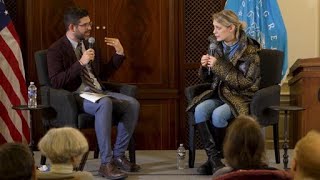
before we do whatever, I know we have questions from the audience. >> Joan Nathan: We hope. >> Michael W. Twitty: What you got no testimonies? I know I'm the only person who comes from a well, might not be the only person who comes from an Afro Baptist origin, but questions. Questions, particularly about my life and recipes. >> Joan Nathan: No questions. Come on, there'll be questions. >> Michael W. Twitty: They got questions. Trust me. >> Joan Nathan: Oh, there's one. >> Michael W. Twitty: You need a microphone. Yeah, we got you. >> Can you speak
a little more about your favorite Sephardic recipes, which ones you like the best, and maybe a story about how you got them? >> Joan Nathan: Okay, well, I love Sephardic food and there's a Sephardic fish recipe that has been in one family, the Corcos family in Spain and wherever. It's a big, big Sephardic family. And by the way, there's this guy that I know that's doing the DNA of Sephardic males. And so he's been able to tell throughout history because I guess he can I don't understand any of this stuff, but you can do it
better through males and females. So he's told me where to go for these recipes. But anyway, it's just a simple Moroccan fish recipe for Friday night, but you can see how some more sophisticated recipes have certain things, like preserved lemon in it and olives and some don't. There are certain spices that are different, but it's pretty much the same recipe that I like very, very much. I also like all the Sephardic salads. I think about them at the beginning of like always for me, for Rosh Hashanah, I'll have several. I have the roasted pepper salad,
I'll have the carrot salad. I don't know. Actually, this year I had a bok choy salad from my garden in Martha's Vineyard. And that, by the way, was eaten before anything else beats salads. All these Sephardic, because you can make them ahead and Sephardic salad, Sephardic housewife. You know, you always have to have at least two kinds of eggplant. One boiled and then one fried. You just have to have two. So you'd have at least 12 different salads that are just delicious. And of course, this vegetable salad dish that I made for Rosh Hashanah is
also with different kinds of carrots and zucchini. And it just depends, again, where somebody's been. But the number seven is always there. Dates, it might have in it, raisins. That doesn't have... Well, maybe it does have pomegranates in it. Yeah. So, right. And sometimes they're separately. Yeah. He's from a Moroccan family. You know, I love Adafina, which is like the Sephardic chant really. It's a Sabbath dish. I like visuals. I don't know, I like lots of Sephardic, loads of Sephardic dishes. And these are all Rosh Hashanah dishes. You know, I just I like Jewish, good
Jewish food. I don't like bad Jewish... Yeah. >> I hadn't really eaten shakshuka until I was in Israel, but I wonder if it's sort of like the what happens with hummus, like, where its origins are and what's common and what is your favorite and what are the different types as far as shakshuka? And like I said, where did it come from? >> Joan Nathan: It's actually it's Libyan shakshuka. It's which is not Sephardic because Sephardic really means it's from Spain. >> Michael W. Twitty: It's (inaudible). >> Joan Nathan: Yeah, and it's North African, that's what
shakshuka. Okay. Oh, right. Okay, good. Okay, good. And actually, it comes from Arabic, and it basically the story is according to Nawal Nasrallah. Do you know her? She's a wonderful Iraqi food historian. And she said that she told me that in Libya women that had an affair with somebody and had to cook something quick for dinner, quick made shakshuka because it was you just put egg in a tomato sauce and that's what they... That's the origin of it. Now, I don't know if it really is, but that's what she says. >> Michael W. Twitty: So
what is the green shakshuka come from? >> Joan Nathan: But they're everybody, you know. But now, now it's part of what is considered Israeli cuisine shakshuka, which is another Libyan dish. It's potatoes and meat. And it's sort of like there are certain things that you like hummus, and all of them come from different places. And of course just getting to hummus, let me just say that hummus is one of the oldest foods known to mankind. And they've traced it chickpeas back like 5000, 6000 years. And it's of the land. And it's in the Bible. It
was written in biblical Hebrew. As, like said that it was vinegar. And where's the harm? But there was in the Bible there's a story about a shepherd in a field, and he had his servants. I mean, the workers. And he had gave them bread, and it said he had something like (inaudible) that they served him them this for for dinner. I mean, for lunch. And they translate it as vinegar. But the biblical word for chickpeas is this same word. And if you served a worker vinegar and bread and you want them to go back into
the fields, you're crazy. I mean, so it was hummus and hummus. If you go to Akko or you go to the old city of Jerusalem, there are all these places that where they only sell hummus and bread. And you realize that workers would go there for breakfast for hundreds of years, and because it would fill them up and it was it's the oldest protein known to mankind. And it's going to be the newest protein. There's such a demand for chickpeas. On the one hand, people like it. There's a lot more vegetarianism because there has to
be, it requires very little water. And it can come to fruition in 32 days. So it's really going to be the food of the future. >> Michael W. Twitty: Also, I tell people all the time, hummus is nonpartisan. It is a food that was invented by a woman who was pre-Judaism, pre-Islam, who had hungry kids and wanted them to shut up and go to bed. She took the chickpeas, the garlic and the olive and said, "Here, take this, y'all can eat this." So like most foods, it's our mother's, our mitochondrial mothers who never get the
credit. Who were like Brunswick Stew was not some dude in the woods. Brunswick stew was a Native American woman. And southern food, you don't have to go there with me. So, I mean, just that's the point of it. And I think right now what we're dealing with is a lot of tug of war over not ownership of food, but where the food comes from. And I think those stories, I think it was you that told me one time that, like, people think like just because a dish is Moroccan and Jewish, that it's the same dish
that you eat if you're a Berber or if you eat another part of the Moroccan community, it's not necessarily the same dish. It's been adapted like it may contain a similar pattern, but it's not exactly the exact same copy. And we just, and I say that because sometimes people will be like, oh, you guys, you know who they mean by you, the vase. You took this from us like, you take everything and you don't have any culture of your own. Well, when you're living in the same area of the world for thousands of years, and
you're marrying and you're fighting and you're trading and you're exchanging ideas, and how can you not eventually share good things, things that are exciting and beautiful and lovely with each other, despite the political effects of it? It's a very deep part of the story that is very present on social media now. >> Joan Nathan: Oh, for sure. But I don't even pay attention to social media. (laughing) But actually hummus was originally was chickpeas. Sesame came from China a long. You know, we have to realize that when and I think and all these ingredients came much
earlier than people realize, like eggplant. I think that there was a lot more going on in the Mediterranean than we ever thought because they found China, China, China from China in Cyprus way, way earlier than they ever expected to. So if they found that there's going to be other things that are going back... >> Michael W. Twitty: Things from Africa and they all over. >> Joan Nathan: So some hummus with tahini came later. >> Michael W. Twitty: Wow. One last question. Sir. Yep, that's you. >> So I recently inherited a bunch of recipes from relatives
in Hungary that were handwritten in books. >> Joan Nathan: Beautiful. >> Translating them and even actually just trying to determine the handwriting and just to even get the individual words. I'm just wondering how... Because I can't imagine you haven't run across this yourself and you found recipes from different places. And how would you go about translating them and getting them so that you could actually work with them again? Like Michael said, they're dead on the page until I actually can work with them. I'm a chef, so I mean, it's something that I really look forward
to wanting to get my hands into and to be really... >> Joan Nathan: So are you Hungarian? >> Yeah. >> Joan Nathan: So what he said is that it's a really good question that he found some recipes in Hungarian, and it's a big problem. I'll tell you why. Because the way that they wrote them is very people can't read that writing anymore. And I have the same problem. I have about six German cookbooks from my family handwritten, and I've let found the Leo Baeck Institute, and they have been helpful to me because I really want
to if I kept saying, I'm not going to do another book, but maybe I will do something on German Jews. We'll see. But anyway so I don't think I want to, but anyway, maybe. But so... And even in cookbooks, there are different generations of writing and people cannot read it. So there must go to the Library of Congress. They'll tell you who is the person that will, in whichever division, one of you will know the European division, they will know somebody who's really good at Hungarian recipes and it's hard, it's exciting, it's important. And you
know, you might find little things in there like I found in one of the books. Well, actually I went to a few. It's in all these stories are in this book. But when I wanted to learn some of the German cookbooks that I had gotten one cookbook, somebody called me. This was before cell phone, but there were answering machines in those days, and she said, I'm getting ready to die. My husband, who's already dead, had these cookbooks and thereby true to Lehmann, Luhrmann, Lehmann, and true to Nathan Lehmann. And I thought, that's my aunt. And
she said, I thought she must have known her about me from my TV show. And so she sent this beautiful cookbook, actually the best of all of them that I have. And I found it and it said things like left for America in there, early left for America. So you can learn a lot more than just the food from these cookbooks but they're a puzzle and keep persevering. Maybe you'll find some great recipes. >> Michael W. Twitty: Wow. Wow. >> Joan Nathan: Anyway, and I just wanted to tell you that I do have a few
cookbooks if anybody wants to buy them here. Just two, actually. But I have some in the car. (laughing) >> Michael W. Twitty: I want to thank you for this opportunity. >> Joan Nathan: This is fun. >> Michael W. Twitty: I'll never forget this. Never forget this. This lady and Marci Cohen Ferris. One day, I'll never forget this. We got in on this little story. Just before smartphones, before flip phones, cell phones period. And I was... I'm habitually late for everything. I was early today. And Joan said to me, "Look, we gotta... I have to pick
her up and pick you up from the metro. If you were late, this ain't happening. We are leaving without you. And I was there. And that day changed my life. Because Marci was there at the Hadassah, Hadassah chapter in DC talking about you. You both gave a talk, and yours was about Jewish food history, and Marci's was about southern Jewish food. And I'm sitting in the back, rapt attention, like, wow. And I thought to myself, I can actually do this for a living. I don't... sort of a living. No, look, look, I've been on this
hustle for a long time, so. Yes, ma'am. And I said these ladies had taught me a lot. And one day I said, I got to do this. And without that, I would never have the path that I have. And not just that, but for my ancestors. You know that they're in this work every day. So on behalf of them, I thank you and our whole community, we thank you. (applause) >> Yoram Bitton: Okay. So thank you very much. And I want to mention that hummus is supposed to be warm, not from the refrigerator. (laughing) >>
Joan Nathan: And it's supposed to have garlic in it. >> Yoram Bitton: Okay. So I would like to thank Jonathan and Michael Twitty for this fabulous event. We at the Library of Congress are so grateful to you and thank you to everyone who came out to join us today. I would like to thank the Library of Congress staff for helping with this event. Sharon, Gail, Brian and everybody. So thank you very much. (applause)