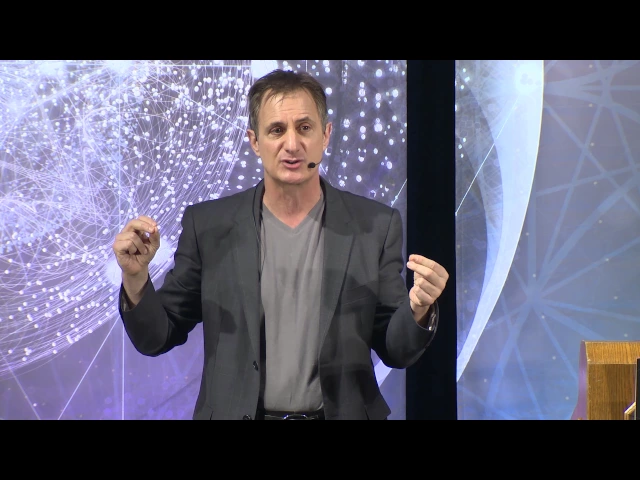
[Music] so thank you I'm excited to be here so I'm here to talk to you about the unexplained symptoms we inherit the fears the anxieties the obsessive thoughts that we have biologically inherited from our parents and our grandparents symptoms we think are ours but before I talk about this I'd like to tell you about what led me here my story like many of our stories didn't start with me about 26 years ago I began to lose the vision in one of my eyes I was diagnosed with a chronic form of retinopathy and there was no
cure and the way it was progressing the doctors told me to expect that I would likely lose the vision in the other eye as well and phases were now a gray blur and road signs I couldn't read and everything I tried hands-on healing supplements juice fasts all seemed to make things worse my worst fear was coming true I'd go blind I'd be unable to take care of myself I'd fall apart my life would be ruined the sentences would serve to be the key to my healing I just didn't know it at the time they echoed
traumas that had taken place in my family history long before I was born so here I was I'm losing more and more vision each day I'm terrified I'm desperate to make sense of what's happening to me I leave my work I leave my relationship I leave my city and I go on a search for healing a sir that takes me halfway around the world as far as Indonesia where I'm learning from some very wise spiritual masters spiritual teachers I'm sitting at the feet of gurus on chanting I'm fasting I'm meditating for days on end one
time I was sat on a cushion for three days and nights without blindfolded ear plugged 72 hours no sleep small bowl of rice in the morning water to come to know the madness of the mind that was the goal I discovered the madness of my mind was worse case scenario thinking that if I could just worry hard enough I could insulate myself from what I feared most so it was during this time that I had a satsang a meeting with a spiritual master and I waited in line all day and at date hours and by
the time I get to the front of the line I'm thinking he's going to commend me for being this awesome meditator of course I'm just moments away from total enlightenment but instead he looks right at me actually I should say he looks right through me and he could see what I couldn't see and he said go home and call your parents now I was pretty livid as you can imagine because I had given my parents up for spiritual parents divine parents better parents all these spiritually wonderful men and women who are guiding me to the
next level of awakening so I figured he was wrong and I and I sought out even a greater spiritual master one who imbued hundreds of people with his heavenly love all day long and some waiting in line again all day and I get to the front of the line and the exact same words go home and make peace with your parents well this time I listened but I just had no idea how I was going to do this my relationship with them was entirely broken in order to heal with them I had to heal the
inherited family trauma though I didn't know it at the time all the anxiety that I had inherited from my grandparents who were all orphaned in some way each of them lost their moms when they were infants well three of them lost their moms as infants and one lost her dad at one and ultimately her mom's attention because her mom's grieving and this pattern of this terror this anxiety of being broken from a mother's love this is what passed down in my family and the terror and the anxiety that lived in my body this was the
real cause of my vision loss I remember being a small boy maybe five or six running into my mother's room whenever she'd leave the house I'm panicked and I'm going through her drawers and I'm pulling out her stockings or nightgowns or her scarves and I'm breathing in the scent because I'm never going to see her again which is the truth for all my grandparents and here this is two generations later 40 years later I tell my mom what I used to do you know cry into her clothes and she said honey you did that too
I did the exact same thing when my mother left the house and my sister just reading my book calls me and says honey you did that too and I'm realizing that we all did the same thing after healing this broken bond with my mother my vision came back and I felt compelled to teach these principles that I had learned and ultimately developed a method for healing the effects of inherited family trauma the latest epigenetic research tells us this is true that when a trauma happens a chemical change happens in our DNA and this can change
the way our genes function sometimes for generations technically there's a chemical signal a chemical tag an epigenetic tag that it that happens like this reaction our DNA and the DNA communicates to the cell and says use this gene ignore this gene and then the way our genes are affected can change how we act or feel for example we can become sensitive or reactive to situations that are similar to the original trauma for example if our grandparents were born for in a war-torn country they could pass forward a skill set of sharper reflexes quicker reaction times
to deal with the trauma that they variance but the problem is we can inherit a stress response with the dial turned all the way up to ten waiting for a trauma that never happens and these gene changes and the continuous stress can be harmful to our body like it was for my eye these gene changes these are the culprit you see and we're now learning that they can be transmitted to our children and to even our children's children scientists have long accepted that something like this was happening but it wasn't until about ten years ago
that this neuroscientist from Mount Sinai Medical in New York Rachel Yehuda discovered that Holocaust survivors and their children shared the same trauma symptoms specifically the low levels of cortisol that's the stress hormone that gets us back to normal after a stressful event she also discovered a similar pattern in babies that are born to pregnant mothers who were at or near the World Trade Center when it was attacked during 9/11 and when these mothers went on to develop PTSD their kids had 16 different genetic markers low levels of cortisol etc etc symptoms like the mother's just
last year she discovered the traumatized survivors and their children share the exact same gene changes in the exact same region of the same gene technically the fkbp5 gene and which is involved in post-traumatic stress disorder she tells us that you and I are three times more likely to have post-traumatic stress disorder if one of our parents at PTSD and as a result we're likely to struggle with depression or anxiety so these patterns can be observed for two generations in humans but studies with mice tell us that this pattern can be observed for three or more
generations why mice mice have 99% of a similar genetic makeup as humans so if we have something like 30,000 genes mice have twenty-nine thousand seven hundred genes approximately similar and because a generation in mice is twelve to twenty weeks or a generation in humans is twenty years we can get rapid results in one study done at the universe Emory medical in Atlanta they made male mice frightened of a scent a cherry blossom scent every time the mice the male mice were exposed to this cherry blossom scent they electrically shocked the mice and then when they
dissected their brains they found this epigenetic alteration this modification they found that their brains were enlarged where there would be a greater amount of smell receptors to detect this smell at lesser concentrations and they found changes in the blood and changes in the sperm so they took that sperm and they impregnated female mice who were not shocked and in the next generation took the offspring male mice again and what they found in the next two generations is compelling the pups and the grand pups just experiencing the cherry blossom scent freaked out they were jittery they
were jumpy as though they too were shocked but they were never shocked they inherited the trauma response but did not experience the trauma directly they also have separated mice from their mothers and they can track the effects for three generations I'll read you a short passage from my book in one such study researchers prevented females from nurturing their pups for up to three hours a day during the first two weeks of life that without was it three hours a day take the mice away from the mothers for just two weeks later in life their offspring
exhibited behaviors similar to what we call depression in humans the symptoms seemed to worsen as the mice aged surprisingly some of the male's did not express the behaviors themselves but appear to epigenetically transmit these behaviors to their female offspring compelling yeah so how do we know if you and I have inherited family trauma well of course not all trauma is inherited there are definitely some telltale signs when it is we might experience a fear or a symptom that strikes unexpectedly or suddenly when we reach a certain age 30 when our parents break up our grandmother
is widowed and all of a sudden we start distancing from our partner thinking and our partner just doesn't do us for do it for us anymore or we hit a certain milestone in our life an event we get married everything's fine now we're married and we're shut down or we go to have a child or we get rejected for the first time by a partner or we move to a new place and it's as though there's this ancestral alarm clock inside us that starts ringing I once worked with his woman she was consumed with anxiety
as soon as she became a new mother she had no anxiety prior but when she's pregnant she's absolutely out of her mind and so using some of the questions I outlined in my book we determined that she had this horrific fear that she would harm her new baby and I asked her the obvious did you ever harm a baby no did anyone in your family ever harm a baby no wait a minute she said oh my god my grandmother when she was a young woman she lit a candle caught the curtains on fire the house
caught him fire her baby was upstairs she couldn't get her baby out her baby died but we were never allowed to talk about it she had inherited her grandmother's fear the feeling that she could harm her baby and it struck once she became pregnant the trauma language that she inherited now we're going to move into this idea of trauma language the trauma language she inherited was I could harm my baby and it wasn't hers most of us carry trauma language like this I call it core language when a trauma happens it leaves clues behind clues
in the form of emotionally charged words and sentences clues that form a breadcrumb trail that when we know how to follow this breadcrumb trail it can lead us to traumatic try traumatic events that have taken place in our family traumas that we may have biologically inherited inherited the residue of our parents and our grandparents and when we know how to find these unconscious words in us and link it to the event it's like finding the missing piece of the puzzle that lets the whole picture come into view and gives us a context for explaining why
we feel the way we feel remember my words my trauma language I won't be able to take care of myself I'll fall apart my life will be ruined this was the language of orphans now I'd like to ask you a question and please take a few moments with the answer think about the answer write it down if you have a pad and paper you're not going to be asked to share this and it's one of the questions I asked in my book but it can help you uncover inherited family trauma that may be affecting you
in your life today what you ready what is your worst fear if things suddenly fell apart if things went terribly wrong what's the worst thing that could happen to you this is probably a feeling that you may have felt like you've been born with it's before you had children because many people say Oh something terrible will happen to my child of course but go back earlier again what's your worst fear if things went south if everything suddenly went terribly wrong what's the worst thing that could happen to you take a minute and now whatever you
came to let's deepen this answer let's distill it if that happened whatever you wrote or whatever you're thinking what's the worst part of that if that happened then what for example if you said I could die take it down further and if that happened then what what's the worst part of that one woman I worked with who said I could die she said ah my children would be without me and I said so what's the worst part of that and she said I'd be forgotten can you hear how that has much more juice than I
could die and many of us said I won't achieve my life purpose okay take it down go another notch down if that happened what's the worst part of that I'd fail I'd be disconnected from people I'd let people down I'd have wasted my life I'll be shamed rejected these emotionally charged sentences sound like this I'll lose everything I'll fall apart I'll hurt someone I'll let someone down it'll all be my fault I'll be abandoned I'll be betrayed I'll be humiliated I'll go crazy they'll lock me up I'll lose my family I'll lose control I'll do
something terrible I won't deserve to live these sentences can originate in our family history with someone else and of course they can originate in childhood early childhood and in utero you can feel the quality of these sentences that have to do with a break in the bond with a mother I'll be abandoned ejected betrayed annihilate 'add a fall apart if nothing came when you thought about this ask yourself this question what's the worst thing that could happen to someone else not you the probably probably is something that happened to someone you knew from school probably
something that happened someone you knew in your neighborhood someone you read about someone when you were small what's what happened to them that's so horrible write it down it could be your sentence to or not that seperate and if you didn't get anything what's a scene from a movie you can't watch if you don't have your sentence don't worry you can work on it later but this one sentence can unlock the mystery and help you heal inherited family trauma now two more pieces say it inside once you get your son just say it inside can
you feel its reverberations in you where where do you feel it when you say that sentence where in your body can you feel it bring your hand there bring your breath there bring your awareness there now let's go deeper who in your family may have had cause to feel the same way who else shared this sentence your mother your grandmother who lost a child your father who failed and let down the family your grandfather who harmed someone start looking for the resonance of this sentence in your family history now I'd like to take you back
to the beginning with me where I learned to look for this inherited family trauma language this trauma language 20-some years ago I was working I worked with a lot of self injurers and I was working with this cutter I'll call her Sarah and Sarah the way she cut that was unusual if she would cut into her arm or her abdomen or her legs so deeply that she would almost bleed to death and her mom and her dad would have to take her to the hospital and she'd be put into a psych ward for weeks at
a time she would almost bleed to death when she'd cut so I asked her Sarah what do you think about right before you cut right as you're holding the razor blade what are you thinking and she said I deserve to die now I'm looking at a 24 year old woman whose life had just begun and I say Sarah what have you done did you harm somebody did you accidentally cause an accident somebody got hurt did you leave somebody and they killed themselves no no nothing like that so I did what I was trained to do
I looked at a relationship with her mother brilliant great relationship I looked at her attachment with her her mother secure strong I looked at a relationship with her dad loving she was able to receive love from both of her parents I was flummoxed and then I said dad tell me about your grandparents and then she dropped the bomb she said my grandmother was an alcoholic and she was driving the car drunk with my grandfather in the passenger seat and she hit into a pole and my grandfather got cut lacerated as he went through the wind
showed and died before the ambulance could get there and in that moment we made a crucial connection in that moment when she got herself it was from the grandfather like the grandfather when she felt she deserved to die whose feeling was that yes of course the grandmother Sarah's trauma language I don't deserve to live didn't belong to her most of us have trauma in our family history yet not everyone manifests inherited family trauma why is that why do some people seem to relive and others don't what makes these traumas repeat epigenetics is just one piece
of the puzzle what I found is what seems to enter these traumas what creates these repetitions is when traumas aren't talked about when the healing is incomplete when people are excluded or rejected and the pain and the grief and the shame and the embarrassment and their anger is too great and there's no healing there's no resolution and when this happens aspects of these traumas can show up in later generations unconsciously will repeat the pattern or share a similar unhappiness so that ultimately it has this trauma has another chance to heal I believe that the contraction
in a trauma is ultimately looking for its expansion and will repeat again and again until that expansion happens and for that reason I'd like to leave you with three insights first if we or one of our family members struggle with unexplained depression or anxiety or phobia OCD or something we can't explain we need to shake the family tree and see what falls out what family secrets have been hidden what stories didn't get told what traumas never healed all the way it's important to know these things especially if we are one of our children are affected
with things we can't explain struggling with symptoms I found that if we if we ignore the past it can come back to haunt us but if we explore it we don't have to repeat it we can break these destructive patterns number two talk about the traumas in your family history try to work through them so they're not passed down to future generations the more we know about these traumas and the more we talk about these traumas the more we bring relief to our children who could be struggling with symptoms and not have a clue as
to what's going on we need to identify this trauma language and linked it to the event so we can break the cycle and we can heal and lastly thirdly we need to heal the brains super-efficient trauma response that keeps us stuck in a state of suffering ultimately we need to have new experiences that are powerful enough to override the old trauma response that lives in us then we need to practice the new feelings and the new sensations of this new experience so that they can become ingrained in us and our brains can change these can
be experiences of receiving comfort or support from our ancestors our parents once we heal this it can be an experience of compassion for them for us it can be an experience of receiving or feeling gratitude generosity loving kindness especially for that part of us that's inherited this fragmentation or that got fragmented when we were young ultimately anything that allows us to feel strength and peace inside in the book I lay out these practices many of these practices so we can heal I'd like to leave you with one word one sentence biological inheritance may be a
reality but it doesn't have to be our destiny thank you [Applause] [Music]