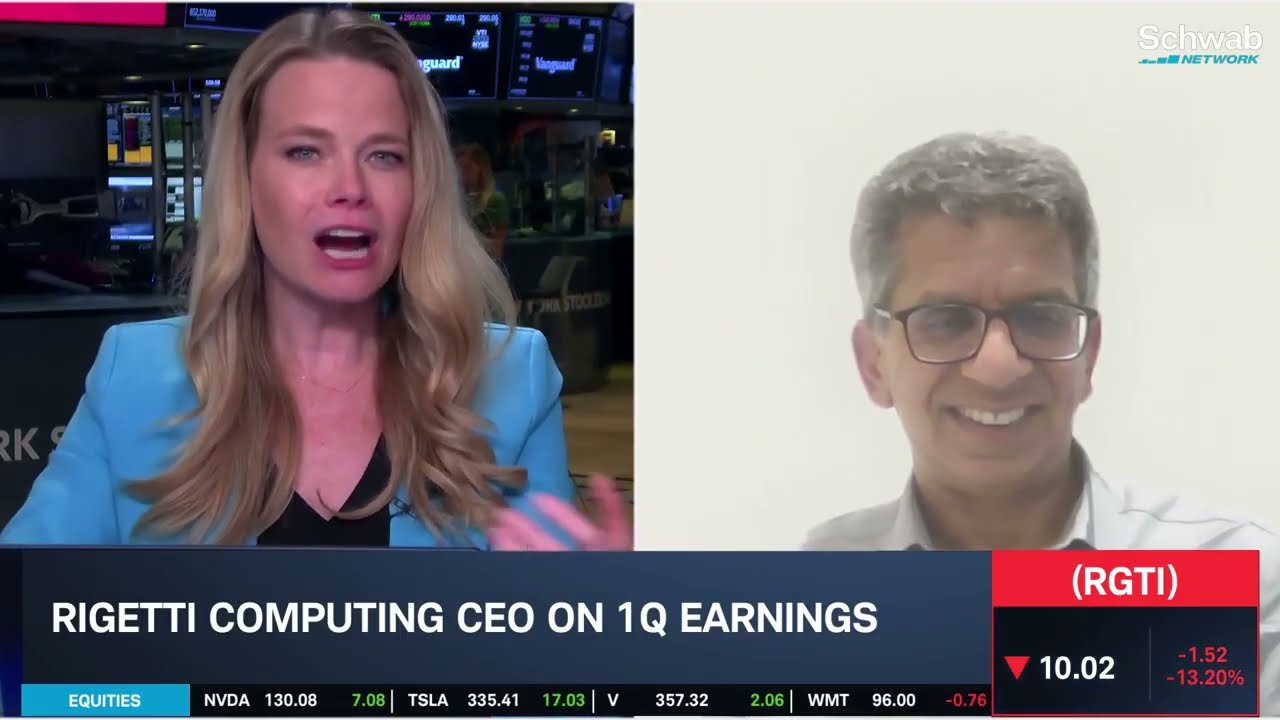
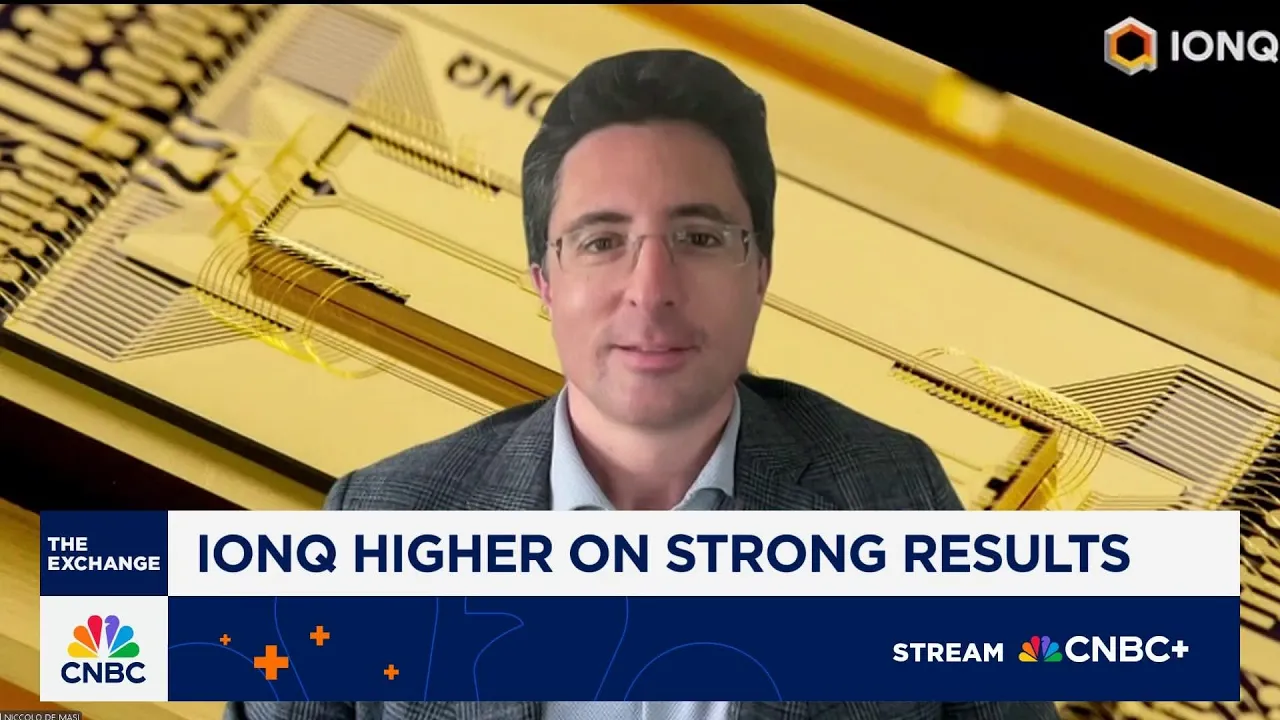
All right, Kate, thank you very much. Kate Rooney, let's talk a little more about Quantum now with shares of ION Q up about 6% on better thanex expected results and reaffirmed guidance. Shares are still down nearly 30% so far this year.
Joining us now in an exclusive interview is Nicolo Damasi. He is the CEO of ION Q. And Nicolo, it's great to see you again.
Welcome. Pleasure, Kelly. Good to be here.
You guys have faced a number of headwinds. There's been short selling reports and all the rest of it. Uh tell us what exactly happened in the quarter business-wise leading to these results.
Well, I've been in the role for 70 days. I think the last time I saw you was after uh our full year results on February 27th. Uh and it's been quite a whirlwind.
I've been really excited to be able to complete my review of the business and decide where we're going to double down and invest. Uh and the decisions we made were to prioritize continued commercialization. So, we're the biggest public company uh in the world in the quantum computing space.
We're now the biggest company in the world in the quantum networking space. And because we continue to be able to invest on both the computing and networking vector, we're leading the world in what we are calling now the quantum internet. Um we made two acquisitions yesterday.
We reaffirmed guidance for the year, which is the better part of hund00 million of gap revenue and we actually uh beat the midpoint of guidance in Q1. So we're really quite delighted with the continued inflection point here. Yeah.
And as mentioned, and we've talked about this before, and I'll probably ask about a thousand more times, but the main kind of interest I see when it comes to quantum is whether it will bake break Bitcoin's encryption. You know, when we talk to, you know, I talked to all sorts of different traders and investors and kind of tech thinkers and they all kind of come back to the same point on quantum. Um, is that a genuine concern, do you think?
Well, look, this is this is my chip. This is my QPU. It's also behind me in the screen, but you can see that it's really quite small.
Uh this is our ion trap QPU. I don't own any blockchain currencies in general because uh for years I have been confident uh that INQ is on that path. Uh I think the same thing will happen with RSA encryption.
In fact, Kelly, the reason why INQ is such an interesting business is if you if you wonder how a, you know, legitimate lawful company can make money out of breaking encryption, if you're not a bad state actor, you're not a terrorist, you're not a criminal, how do you make money off of breaking encryption? Well, it's quantum networking. As our our executive chairman said, and I said yesterday on the call, we have a duty to provide security because our computers are accelerating their path to quantum supremacy.
Uh we made two acquisitions yesterday expanding quantum networking on the ground and in space as well as ex accelerating our quantum computing roadmap. Uh and because we think the code breaking is going to happen sooner, we obviously want to be in the business of code making as well. Right.
Exactly what I was going to ask like if you could if quantum could break the current blockchain or Bitcoin encryption then could that system or could th all of those systems be re-engineered to have encryption that is quantum proof? Absolutely right. And so the acquisition we made yesterday of Lightsync in Boston a bunch of fabulous Harvard researchers gives us the repeaters to have a quantum network that can run obviously at distance of 100 km or more.
We're also accelerating that computing roadmap so we can crack encryption sooner than we thought. The prior acquisitions we made of IDQ in Geneva and Cubet in San Diego give us the rest of the pieces of the quantum network. Right?
So think about our computers as the nodes on the quantum internet. The repeaters, the sensors and the rest of our equipment that we've acquired and built organically gives you the fullness of the quantum internet via the networking and computing playing together. Explain to me also Nicolo and you were at the Nvidia developer day.
You've been very involved you know with that world. Obviously from a national security point of view there are major debates about whether uh countries like China should have leading edge Nvidia chips and so forth. If you're now hot on the heels, what's your point of view on the national security implications of Nvidia chips, quantum computing, what should we be doing now if if this is going to be an area of critical importance?
Well, we're obviously a US company. uh you know, we're based outside of DC. Uh we care about obviously our nation's national security and most importantly we care about our uh economic security.
Uh and so one of the reasons why we're expanding into quantum networking is China's demonstrated things like quantum key distribution in space. Um you know, we've announced yesterday that we're going to build a commercial quantum key distribution network in space as well. And we have aspirations of doing a lot more to connect the ground up to the space across the satellites back down to ground because the most vulnerable parts of our communication network are actually those pieces that connect to satellites, right?
So we have to find a way of securing that. It matters for our three-letter agencies. It matters for our economy.
Uh we think obviously in the US that private industry plays a big role here. Yeah. But we also said yesterday that our partnerships with three-letter agencies are going to deepen and increase as a result of the acquisitions.
yesterday. We very much believe this is a public private partnership for our country to succeed.