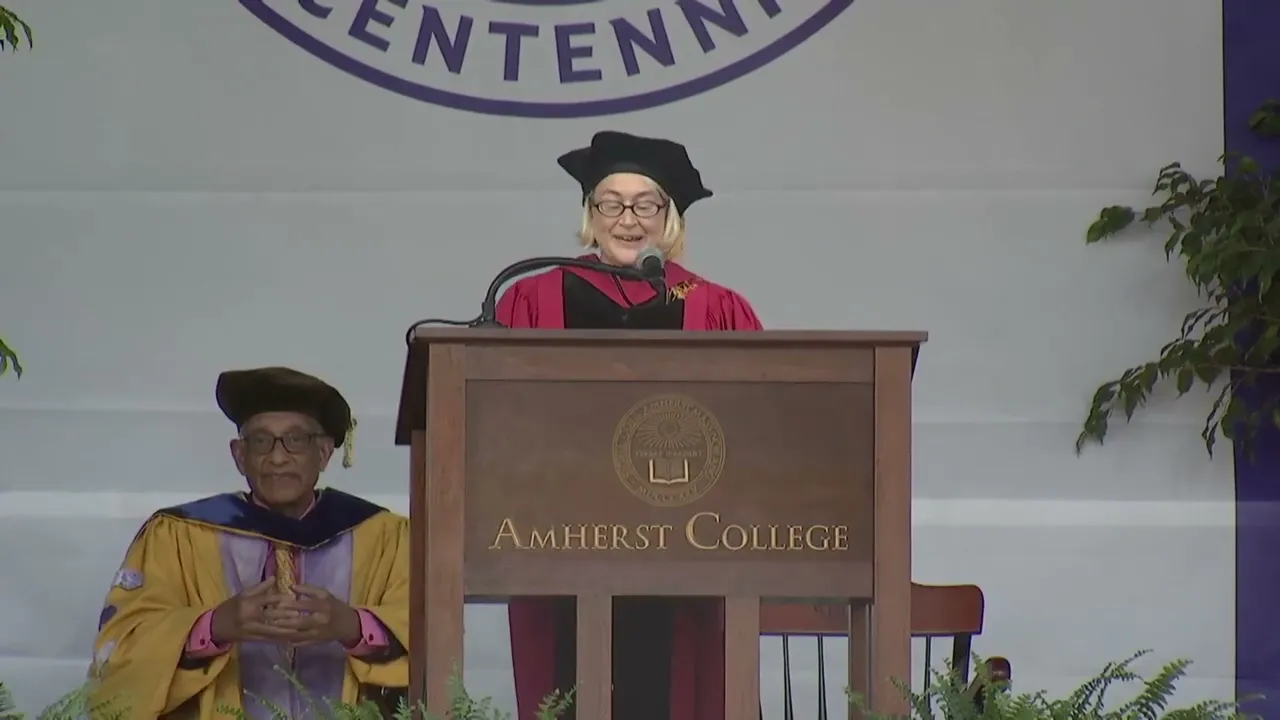
- Good afternoon. I'm Catherine Epstein, Provost and Dean of the Faculty and a Professor of History. And I want to welcome everyone to Seniors Assembly, but especially the amazing Class of 2022.
(students applauding) Class of 2022, it is terrific to celebrate you. You have been through four extraordinary years. For most of you, the spring of 2020 was your sophomore year.
And in March very abruptly, you were told to leave campus and to continue your classes on a platform that you've perhaps never heard of, Zoom. And things have never been the same. We still find ourselves in a world more profoundly unsettled than most of us can recall in our lifetimes.
We have experienced a pandemic that has changed the rhythms of daily life, including how and where we work. We have experienced a great racial reckoning in the wake of George Floyd's murder and the killings of Asian Americans in an Atlanta beauty salon. We have experienced the ravages of climate change, including wildfires and floods that have destroyed some of your home communities.
We have experienced a presidential election that resulted in an attempted coup. With Russia's invasion of Ukraine, we have experienced the greatest challenge to democracy and national sovereignty in Europe, since the 1930s. And most recently, we have experienced the likely overturning of Roe v.
Wade, 50 years of judicial precedent, a fundamental attack on our individual rights. These challenging times call for us and not least you to think critically about who you are, what you stand for and what risks and consequences you are willing to take to shape the world that you want. I want to bring you back to an event in college history 50 years ago, this week to May 11th, 1972, likewise, a tumultuous time in college and world history.
On that day, the President of Amherst College, John William Ward went to the Westover Air Force base in nearby Chicopee and was arrested for civil disobedience. Ward and many other protestors, including about 20 Amherst faculty and 400 Amherst students blocked traffic in and out of Westover. Their goal was to halt operations at the base.
Westover was a hub for the air transport of heavy equipment to Vietnam. The protestors sat in a circle near the entrance of the base. Police then took or dragged them to waiting buses, and they were brought for booking to Chicopee District Court.
So think about this. A president of the college arrested for civil disobedience. This would be controversial now and was no less so in 1972.
So days earlier on May 9th, President Nixon had announced the mining of Haiphong Harbor, the major port in North Vietnam, as well as other waterways so as to cut off supplies to North Vietnamese troops. The next evening deeply troubled by the escalation of the war, Ward announced to students and faculty right behind me, or in front of you in Johnson Chapel, that he would go to Westover to, "Join in an act of passive civil disobedience". As he told those assembled in Johnson Chapel, "My hope as president "has been not to lose myself in the role, "the office to retain a sense of my own self "while still president".
Ward wanted to act as the individual that he was against what he believed was an outrageous wrong, namely, the continued prosecution of war in Vietnam. In 1972, Ward was just finishing his first year as president of the college. He had come to Amherst as a professor of American Studies in the mid 1960s.
In the late 1960s, American Studies was the largest major at the college, and had the largest number of majors in the classes of 1966, '68 and '69. Almost one in five graduates was an American Studies major, just as roughly one in five graduates today is a math and statistics major. So the Department of American Studies had some of the most revered Amherst professors, including Leo Marx author of "The Machine in the Garden" who passed away recently.
And Ward himself wrote a classic in the field of American Studies, "Andrew Jackson: Symbol For An Age" published in 1955. As a humanity scholar focused on the United States, Ward thought a great deal about the relationship of the individual to society. In particular, he studied the contradictions inherent in the powerful myths of America.
He was fascinated by the myth of a nation of self-made rugged individualists. When in fact the United States was an increasingly industrialized nation in which individuals were dependent on each other and not least technology. He wondered how individuals could pursue their self realization in a society shaped by modern forces over which they had little control.
Ward always maintained an abiding belief in the importance of the individual. As he once stated, "What is primary is the necessity to be one's self "and to take delight in the act of being. "What is essential is the primacy of the self "and the courage to be that self.
"Love yourself enough to be what you are "whatever that may be. "If you don't do your own thing, "if you start doing someone else's doing, "then you become alienated from your own self. "The rest is ashes".
Yet Ward also believed that individuals would be at their best if they centered themselves on creating community on devoting themselves to causes and ideals greater than themselves. He came to believe that individuals could indeed had to change institutions so as to mold them to their sense of justice and fairness. And he once quipped of students in the 1960s, "They want not to be prepared to play a role in society".
He said, "They want to change society "so they might play a role in it". So Ward went to Westover because it reflected impulses that stem from his humanistic inquiries. He went to Westover because he believed it essential that an empathetic, critical citizen of a democracy must engage in protest against a terribly unjust war.
Now that said, and this may surprise you, I actually think it was very problematic for Ward to go to Westover as the president of Amherst College. I believe that colleges and universities should maintain themselves as a neutral space so that the great questions of the day can be debated. And if a president takes such an overt political stance, the institution may no longer provide the neutral space necessary for critical debate inquiry and for reflection.
What I like though about what Ward did is that he personally struggled with the issues and took the consequences. He made a decision that was right for him even though it was likely to have significant repercussions for his career. And for retaining his sense of self, Ward suffered the consequences.
He was arrested, he paid the fine. As the only sitting college president arrested for protesting the war in Vietnam, Ward also made national news. Parents complained about the school to which they had sent their sons, alumni donors withheld funds, and Ward later acknowledged that he'd made the work of college fundraisers harder.
Trustees and faculty members questioned his decision to go to Westover, and the question swirled and Ward struggled with them for years, should he have used his role at the college to advance his personal political convictions? Did his actions silence students and faculty members who held different and/or opposing views? Did he break the law and thereby encourage unlawful behavior on campus?
Why didn't he simply go over to Westover as a private citizen and be arrested without announcing his intentions to faculty and students? So for all the questions that I and others have about it, it was a courageous act and an act worth remembering 50 years on. I also take from Ward's action the tremendous power of studying the humanities, his intellectual work helped shape his convictions.
It allowed him to think deeply about the issues involved, about individual agency and its ability to shape institutions in society, about the personal consequences of promoting fairness and social justice, about the contradictions inherent in the ideals of society professes and its reality, and about the role of the private individual versus the public representative of an institution. So 41% of you had at least one major in the humanities. Raise your hands if you majored in the humanities.
Okay, all right, all of Ward power to you. And to those of you who didn't major in the humanities, you likely took, or I hope you took some great humanities courses that will complicate and inform how you think whether about patient care or public health, artificial intelligence, the investment of funds or any of the other myriad fields for which your Amherst education has prepared you. So to all of you, the liberal arts education that you got at Amherst with its strong dose of the humanities has prepared you for the challenges that you will face next.
So congratulations to all of you. And it is now time to turn to the matter at hand, the awarding of prizes. So once again, welcome to Senior Assembly Class of 2022.
(students applauding) So I'm going to just read the name of the prize, not the description or anything like that. And then I'm going to give the name. And when you hear your name, come up and Biddy will hand you your award.
I'm going to get started here at the Addison Brown Scholarship, Leah Johnson. (students applauding) - [Student] Leah we love you. - The Charles Hamilton Houston Fellowship, Joel Nicole Critchlow.
(students applauding) Howard Hill Mossman Trophy, German Gimotti. (students applauding) Not here? - [Student] Yeah.
- Oh, all right, coming up. (student chattering indistinctly) The Psi Upsilon Prize divided among Ruby and Hasty. (students applauding) Troy Colleran.
(students applauding) And Angelina Helen Witter. (students applauding) The David Kirp '65 Stonewall Prize divided between Kayla McKeon (students applauding) and Lisa Jade Zheutlin. (students applauding) The Thomas H.
Wyman 1951 Medal, Amira Riyad. (students applauding) The Doshisha American Studies Prize divided among Anna Smith. (students applauding) Jaja Zheng.
(students applauding) And Carly Grace Malloy. (students applauding) The George Rogers Taylor prize, Sage Loyama Innerarity. (students applauding) Not here?
- [Student] Not here. - Not here, Okay. The Donald S.
Pitkin Prize divided between Sonya Lasavich. (students applauding) And Ruby N. Hasty.
(students applauding) The Architectural Studies Prize divided among Margaret Elsner Drw. (students applauding) Azur Rajpa. (students applauding) Oh, okay.
And Phoenix Laylad Shaw. (students applauding) The Hasty Prize, Lauren Bell. (students applauding) The Anna Baker Heap Prize divided between Nina Kylie.
(students applauding) And Lily Saroco. (students applauding) The Athanasios Demetrios Skouras Prize Grace Elizabeth Lacate. (students applauding) The Doshisha Asian Studies Prize, Olivia Shannon Doyle.
(students applauding) The Manstein Family Award, Angelina Helen Witter. (students applauding) The Biochemistry and Biophysics Prize, Lynn Fu. (students applauding) The Harvey Blodgett and Phi Delta Theta Scholarships, Hannah Goldberg.
(students applauding) The Oscar E. Schotte Award divided between Anna Madden. (students applauding) And Andrea Marie Campbell Miro.
(students applauding) The Edward Jones Prize divided between Joel Nicole Critchlow. (students applauding) And Anaya Heaven Washington. (students applauding) - [Student] My first year roommate I love you.
(students cheering) - The Howard Waters Doughty Prize Hiojan Kim. (students applauding) - [Student] Hiojan we love you. - The Frank Fowler Dow Prize divided among Julian Oliwale.
(students applauding) Julia Ralph. (students applauding) And Angelina Helen Witter. (students applauding) The Everett H.
Pryde Research Award divided between Micha Ahmed. (students applauding) And Nicole Katherine Shanay Chung. (students applauding) The Computer Science Prize, Alex Lee.
(students applauding) - [Student] We love you Alex. - The Bernstein Prize divided between Juanita Jarlomilo. (students applauding) And Aaron Renard.
(students applauding) The James R. Nelson Memorial Award divided between Ruby N. Hasty.
(students applauding) And Benjamin Newman. (students applauding) The James R. Nelson Prize divided between Juanita Jarlomilo.
(students applauding) And David Shoe. (students applauding) The Jeanne E. Reinle Prize divided among Abdullah Brown L.
(students applauding) Juanita Jirlomilo. (students applauding) Ella Peterson. (students applauding) And Aaron Renard.
(students applauding) The Educational Studies Prize for Leadership divided between Molly Dutton Sanderson. (students applauding) - [Student] We love you Molly. (students applauding) - And Nicole Katherine Shanay Chung.
(students applauding) The Educational Studies Prize for Writing, Ronan Rodkey. (students applauding) The Elizabeth Bruss Prize, Carolyn McCusker. (students applauding) The Corbin Prize, Eliza Brewer.
(students applauding) The G. Armour Craig Award for Prose Composition divided between, Lena Lema. (students applauding) And Mays Peterson.
(students applauding) The Peter Burnett Howe Prize, first place, Mave Bramer. (students applauding) The Rolfe Humphries Poetry Prize divided between, Eliza Brewer. - [Student] Yes Eliza.
(students applauding) - And Alyssa Sophia Foreman Roberts. (students applauding) - [Student] Alyssa. (students applauding) - The Ralph Waldo Rice Prize divided between Mave Brammer.
(students applauding) And Sophia Bella Mova, who's an absentia. (students applauding) The Stephen E. Whicher Prize, Caroline Elizabeth Site.
(students applauding) The Jan E. Dizard Prize in Environmental Studies, divided among, Annie Langen. (students applauding) Andrea Munas Latafaray.
(students applauding) And Jonathan Lewis Debrow Veil. (students applauding) The European Studies Prize, Blake Austin Cromer. (students applauding) The Film and Media Studies Prize, Lena Lema.
(students applauding) The Frederick King Turgeon Prize, Jessica Valbrom. (students applauding) The Walter F. Pond Prize, Caroline Nido.
(students applauding) The David F. Quinn Memorial Award, Angelina Han. (students applauding) The Consulate General Prize for Academic Achievement, Helen Harrington.
(students applauding) The Hutchins Prize divided between Rachel Helen Rosenfeld. (students applauding) And Jorge Rodriguez. (students applauding) The ASA J.
Davis Prize divided among Ania Remrez. (students applauding) Alyssa Sophia Foreman Roberts. (students applauding) And Joel Nicole Critchlow.
(students applauding) The Alfred F. Havighurst Prize, Dean Gordon. (students applauding) The Smith Prizes first divided between Luciendo Carlson.
(students applauding) Engwi Park. (students applauding) Second divided between Olivia Shanon Doyle. (students applauding) And Rafael Vanin Munyez.
(students applauding) The Bertram Prizes, first Emery Chorwell. (students applauding) The Nasser Hussain Prize, Nicholas Graver Mitchell. (students applauding) The Frederick S.
Lane '36 Fellowship for Creative Artists divided between Isabelle Dory Torres. (students applauding) And Lisa Jade Zeitlin. (students applauding) The Robert H.
Breusch Prize in Mathematics divided among Lisa Zenick. (students applauding) Anna Dietrich. (students applauding) - [Student] We love you Anna.
- Elizabeth Pratt. (students applauding) Audrey Rosevear. (students applauding) And Noah Solomon.
(students applauding) The Robert H. Breusch Prize in Statistics, Kenny Chan. (students applauding) The Five College Statistics Prize divided between Kenny Chan.
(students applauding) And Shu Armano. (students applauding) The Walker Award in Mathematics and Statistics divided among Lisa Zenick. (students applauding) Kenny Chan.
(students applauding) Anna Dietrich. (students applauding) Robert Inez Good. (students applauding) Leah Johnson.
(students applauding) Jonathan Paul. (students applauding) Audrey Rosevear. (students applauding) And Wenzy Sang.
(students applauding) The Wise Award for Collection Research, Luciendo Carlson. (students applauding) The Wise Award for Studio Art, Brenna Kaplan. (students applauding) The Sylvia and Irving Lerner Piano Prize divided among Julie Lee.
(students applauding) Yosen Wong. (students applauding) Cion Sisi Hong. (students applauding) And Marie Leo.
(students applauding) The Mishkin Prize, Lamara Williams. (students applauding) The Lincoln Lowell Russell Prize, Nicholas Graver Mitchell. (students applauding) The Eric Edward Sundquist Prize divided between Sebastian Sun.
(students applauding) And William Fishial. (students applauding) The James Olds Memorial Neuroscience Award divided between Corey Goldstein. (students applauding) And Chris King.
(students applauding) The Gail Kennedy Memorial Prize, Sophia Feca. (students applauding) The William Warren Stifler Prize divided between Samuel Harrison Schultz. (students applauding) And Sophia Koo.
(students applauding) The Densmore Berry Collins Prize, Elianora Lundberg. (students applauding) The Robert C. Vogel '60 Senior Thesis Prize divided between Pedro Sanchez.
(students applauding) And Giamo Louis Rodriguez Medina. (students applauding) The Haskell R. Coplin Memorial Award divided between Kayla McCune.
(students applauding) And Kelly Wong. (students applauding) The Bancroft Prizes divided between Taedosi Ruskof. (students applauding) Elizabeth Holubiak.
(students applauding) And Sophia N. Harrison. (students applauding) The Moseley Prizes, first and second combined Taedosi Ruskof.
(students applauding) The Carol Prize in Russian, Rachel Helen Rosenfeld. (students applauding) The Mikhail Schweitzer Memorial Book Award, Laura Santa Cruz. (students applauding) The Rose Olver Prize divided between Jade Duval.
(students applauding) And Sophie Yuwing. (students applauding) The Pedro Grases Prize for Excellence in Spanish Caroline Elizabeth Sites. (students applauding) And last but not least the Raymond Keith Bryant Prize divided between Emma Sophie Ratchon.
(students applauding) And Marteo Denny. (students applauding) Congratulations everyone. (students applauding) (students shouting indistinctly) - Thank you President Martin and Provost Epstein.
Hello Class of 2022. (students applauding) My name is Aaron Godowa, and I join my fellow Class Marshalls, Jonathan Paul. (students applauding) And Danny Valdez.
(students applauding) And welcoming you to our Senior Assembly, Jonathan. - Yeap. Thank you.
Hi everyone. Woo. (students applauding) All right at this time, I'd like to invite this year's honorary class members to please join us on stage.
Yeah, yeah. Come on. (students applauding) So each year-- (students applauding) (Jonathan laughing) (students applauding) - All of you.
- So each year the senior class elects staff and faculty to be honorary members of the graduating class, these honorary members, sorry, these honorary class members have made a difference in the lives of the students throughout their time at Amherst. These individuals go above and beyond to serve the student body and generate meaningful interaction with students. So as I call the honorary class members name, the member will be presented with a Conway class cane and a certificate.
(students applauding) So this year's honorary class members are, drum roll. Woo. (students laughing) Renee Alvarez.
(students applauding) Hanna Bliss. (students applauding) Mariwan Dafor. (students applauding) Casey Jo.
(students applauding) Don Kells. (students applauding) Although she hasn't been arrested yet there's still time, Biddy Martin. (students applauding) Oh, Biddy.
(students applauding) Michelle Phillips. (students applauding) And last but not least, Michael A. Riley.
(students applauding) On behalf of the Class of 2022, thank you all so much. - Thank you. - Thank you.
- Thank you. And I'll turn it over to the other Class Marshal, Danny. (students applauding) - Another time honored tradition at Amherst College is selection of student speakers by the senior class for commencement activities.
Today as part of Senior Assembly, we'll hear from two graduating seniors selected by us, members of the Class of 2022. Our first speaker is Deontavious Harris, Class of 2022. (students applauding) He is a French major from Montgomery, Alabama.
Please join me in welcoming Deon Tobias. (students applauding) - [Student] Deon. - Hey, throughout this week I've heard you guys have had expectations for me, that was your first mistake.
Okay. For those who know me you all know I like to talk sometimes a little too much and a little too loud, but of course this is predicated on me not being in class. What most people don't realize is that I used to be quiet when I was young, but coming from a family of talkers with four older siblings, a mom and a dad who's a pastor, you learn how to talk when you want something.
Now I talk when I'm happy or sad, and especially when I'm nervous. Although I talk a lot, I never really got over my stage fright, so doing this in front of you all is a little nerve wracking for me. (students applauding) All right, let's get into it.
This is it almost the last day. I remember my first day on this campus, it was admitted students day. My host showed me his room and drew his two beds and then said, make yourself comfortable as he gestured toward the floor.
This man had me messed up. And then it snowed the next day, I said, this ain't it. I'm just a brother from the south and had no real experience with the snow, maybe this place isn't for me.
But I took a shot and came. So many late nights in frost or Charles Pratt second floor. My man Abdalah would always ask me if I got sleep.
(students applauding) You know how I'd be. Even now I can tell you that the sunrise as you leave the science center at 5:38 am, is beautiful. And everyone should experience that at least once in their Amherst career.
But the serious part, we made it here. Some of us took a semester off, a year off or even a decade off, but we're all here now. We've been through a lot, a whole let's stay a semi whole pandemic.
During the pandemic, I saw the effects of COVID. I'm a traditional student who came in the fall of 2018, and I've been on campus every semester except last semester. Every semester I saw the number of students dwindle just like my GPA.
(students laughing) After we received the email in March, 2020, I was one of the few who stayed on campus. I saw Val go from max capacity to having only takeaway. Guys there were only like 10 of us here, if anyone would've gotten sick, it would've been over.
Throughout this time I entered my bag, got a taste of depression and realized that this isn't it. One of the few things that got me through it was communicating with my family and friends. I set up different group chats, checked in on people and just talked to some folks who I hadn't talked to in a while.
It was nice. The convos or conversations that I had with some people were very special and they really helped me out. Now a few weeks ago after two long years of matrix dodging my germophobia and doing my vanishing act where I disappeared for one or two weeks at a time, I got COVID.
Normally I wouldn't recommend it to anyone but it was so nice that I gave it to a few of my friends. (students laughing) Guys, that's on me. But look at the bright side.
When else would you have stayed at the luxurious roadway where we played baseball with the tennis ball and the stick. Now that was rough, but in all honesty, I don't know how I would've made it there without my friends, especially my friend who was funny and always brightened up my day while I was there. He helped me practice my French and he basically ran the place so that wouldn't burn down or anything.
My friend Mofe Molondofah. (students applauding) Amherst College if you want to take a little bit of endowment and give to someone, then he's the man. But of course, don't forget to run me my check too if you know what I mean.
Now as my time runs out, here's some general advice in these last few weeks, as you roam this dusty campus with its mismatched buildings and inconsistent weather. Talk to your friends, reach out, grab a meal, this is the 21st century, we have all these avenues of communication use them. Whether that be something like Facebook, which my old advisor professor Rockwell said might not be cool anymore.
He's right. Or something that we're all tired of like Zoom. These things help us keep in touch with one another and see new opportunities.
They help us remember that we made it. We've been through a lot and we're still here. Now look around and see who you might talk to, who you might talk to after you leave, whether that be students, faculty, or staff, communicate people, especially those of you who are going to make money after you leave this place, make sure you communicate that with me.
Thank you. (students applauding) - Thank you Deontavious. Our next speaker is Emma Cape, class of 2022.
(students applauding) She's an American studies and English double major from Great Bend, Kansas. Please join me in welcoming Emma. (students applauding) - Hi, you all I don't know how I'm supposed to follow that up, but I would just like to say, if you have money or will be making the money, communicate that with me as well.
Anywho the nerves are real. I am so nervous, but I'm just going to jump right in. (students applauding) Thank you.
As some of you know, but many of you don't, I have a tattoo here on my left hand. My dad affectionately refers to this as the Michael Jackson partially due to placement. But also because the tattoo reads, this is it, which is the name of Michael's final tour and the subsequent documentary created about it.
Spoiler alert, if you couldn't already tell based upon my less than enthusiastic description, Michael was not the driving force behind my poor decision making. Do I regret going to the home of the $30 tattoo during my friend's bachelorette trip in rural Missouri? Yes.
This bit of regretfulness is perhaps what I'm most sure of in this lifetime thus far, but I don't regret the tattoo or it's meaning whatsoever. I chose "This is It" because I was tired of living to please others rather than living to please myself. For me, this is it is to say, this is life.
This right here right now is being human, embrace where you are in this moment. Don't wait for the pieces to fall into place to truly live because maybe they never will. At least not as neatly as we may hope.
So, get out there and do what it is you keep pushing off until the time is right, because the time is now. Ever since my $30 decision, I've been hyper aware of my humanity dissecting what exactly it is that makes me feel alive, because I am, and I refuse to simply live just going through the motions. Quite frankly, my ancestors didn't survive genocide for me to go to the home with a $30 tattoo, lose $30 and gain nothing else.
So I consistently ask myself, what is it that makes you feel your most human? And for me, it's my persistent sometimes naive, Midwestern need for hope. And this hope I've been chasing has been most prevalent here at Amherst, because of this I will not talk about Amherst as the cliche home away from home, because like many of you, it was not built for me.
As a fly student and indigenous woman, I am quite literally the antithesis of the originally intended Amherst alum. And since these walls were not made to nurture me, I will speak of Amherst not as home but instead as a driver of hope. A hope I have found from a $30 decision and a hope I have found from being here at Amherst with all of you.
I found hope during summer bridge, when we all thought our success at Amherst and thus our family's own livelihoods were dependent on our understanding of Billy Bud. I knew at least if I was going down, we were all going down together. I found hope as a member of the native students association, where I learned home is much less a place than it is a feeling I found hope under the guidance of Professor Brooks and Professor Vigil whose kindness, love and mentorship undoubtedly helped carry me throughout my time here.
I found hope in Webster 310, where because of Professor O'Connell and Professor Picq, I see the world differently. I found hope on every corner of this campus, where I've laughed with my friends until we were gasping for air like fish out of water. And I found hope when I learned that you all believed in me enough and trusted me enough to be here behind this podium.
Because of you all and because of what we do for each other rather than what Amherst the institution does for us, I have learned to be kind and gentle to myself, to give myself grace and to cling to my Midwestern naivety and the search for hope. I wish that you all may find the hope you have gifted me. And although my $30 could have gone elsewhere, perhaps towards saving up for a higher quality tattoo, it's helped me realize that if you let it hope can be found wherever you let it in.
I feel it here. This is hope. This is it.
(students applauding) - Thank you Emma. Before I introduce our faculty speaker, I have a few closing remarks. When Senior Assembly concludes following Professor Jagu's speech, faculty will recess first, followed by Student Marshalls then students, who should recess in the same order as they entered.
Immediately following Senior Assembly is senior celebration, a formal reception for graduates on Valentine Quad, featuring dinner and live music. Students are reminded to bring appropriate identification for entry and to change out of cap and gown before attending senior celebration. It is now my pleasure to introduce our faculty speaker this evening we have with us Professor Jagu.
(students applauding) - Thank you Aaron. How are you all doing? I see some of my colleagues are still roasting a bit in the sun.
I hope that'll get better or maybe not. Cosmologist report that the entire history of the known universe no complaints have ever been lodged or recorded that a ceremonial speech was too short. I take heart in the scientific observation and we'll keep this talk short.
President Martin, Provost Epstein, esteemed colleagues and students of the Class of 2022. A, thank you for asking me to be your speaker today. Last time I was asked to give the Senior Assembly speech was 20 years ago in 2002.
My next Senior Sssembly speech will be in 2042. (students laughing) I've heard from all the two year olds around the world, they're coming to Amherst, they're excited, noisy, and they all talk all at once. They invited me to speak and I have accepted.
Last time I chose to speak about a magnificent, magical Sanskrit play from the fourth century that did not go over well. (students laughing) So I vowed to keep Sanskrit to a minimum today. Before I speak to the students, I want to address President Martin briefly, President Martin Biddy, a little under 11 years ago, you came to Amherst bringing with you hurricane Irene.
(students laughing) In your time here, you have dealt with many storms, the meteorological ones being the least troubling. You have handled a series of campus crises with an astounding combination of clear headed-ness, empathy, decisiveness, and honesty. Compared to some other campuses Amherst has emerged from these crises, stronger, more willing to examine ourselves critically and take productive action, thanks a good part to your leadership.
But crises or not through your entire presidency you have given the highest priority to creating a college where all of our students from diverse backgrounds will feel a sense of belonging and will flourish. You would be the first to note that the wellbeing of students is not a road race with a finish line where we reach and stop, but is an ongoing undertaking that must continue. Continue to improve and adapt as times demographics and needs change.
But you have put Amherst on a clear path that the college will follow with the necessary urgency. For all these reasons I thank you Biddy for your service as president. (students applauding) Now dear students I turn to you.
Another loud cheer and congratulations to you on your manifold accomplishments. You have excelled academically and you cared deeply about community. You have taken courageous positions on issues of social justice.
Your voice is heard and taken seriously. Let's hope the COVID situation on campus eases, and you are able to have a more relaxed gathering with French fourth commencement on May 29th. Enjoy the celebratory season.
Now for the rest of it. Provost Epstein set up my remaining short speech very well, talking about the various world crises. And that's where I want to pick up on.
And the present period among other things is an age of outrage. And God knows there are many things to be outraged about. Each day's news brings additional sources of anxiety about the state of the world.
And Provost Epstein outlined those. It is as if political leaders lately, some Supreme court justices, entertainers, sports figures, entrepreneurs, and an increasing number of people whom we might call celebrities without portfolio are all in some kind of Olympics, and the gold medal goes to whoever is the most awful human being. (student laughing) So yes, yes to outrage, it can generate positive political and social action.
I don't mean to make all this about some bad people, that's too simplistic to be sure, there are structure and systemic factors behind these, behind the rise of this awful brigade. Its a worldwide phenomenon with mutations and variants across nations. Some of the most populous countries, China, India, the United States, Russia, Brazil, they all seem to be caught up in different versions of an ultranationalist virus.
But I want to raise with you a different, much more local smaller version of this phenomenon. There are serious transgressions on this campus that come to public attention only occasionally, racist attacks, sexual assault being among the most heinous. Those incidents in our midst do merit the full measure of our outrage, but outside of such truly wrenching events, there are a few downsides to a more routine kind of culture of outrage.
And I'm not saying that is the dominant thing among us, but it flares up from time to time and I want to address that. First of all, it's bad for us to be in a state of constant vexation and fury if we can avoid it, the situation doesn't call for it. Not good for our psychological wellbeing to be agitated in that way.
Just to cite a couple of examples so that I don't sound too abstract or theoretical. I watch students whose experiences and backgrounds are not that different from each other get into fierce arguments about say, this is a natural example, Warren versus Senator. Senator Elizabeth Warren versus Senator Bernie Sanders and find themselves no longer able to respect each other or be friends.
This is a singular example, I don't mean that's typical. And the more common example is that some people who criticize the state of Israel and it's treatment of Palestinians in the occupied territories are tagged as anti-Semites. In fact, my choice of the phrase occupied territories might itself convict me on those grounds in some people's views.
The actual tragic consequences of things like climate crisis or the violence based on angry nationalism here and everywhere or of racist and misogynist domestically in around the world, those tragic consequences fall unequally on different communities. The most powerless and poor who are sometimes, but not always distant from our own immediate surroundings typically suffer the greatest harm. Though moral outrage seems appropriate, we should be careful not to appropriate the voices and places of those who are most harmed just to satisfy our righteous zeal.
A related pitfall is the frothy desire to strike a blow for justice, quick blow for justice, distant targets, national leaders are too far away and too inaccessible. Distant victims are sometimes too unlike us and the people we know. So we attempted to manufacture local equivalents in our own lives and equate our day to day struggles with those around us, to the great tragedies that prompt our outrage in the first place.
We risk devaluing through over minting the currency of model urgency, by equating grossly unequal circumstances and actions. We also risk fray and further polarizing our own diverse and necessarily somewhat divergent community making us politically weaker. I want to mention one more downside to how we talk about social justice these days.
Here's a little Sirnskit. The eighth century Indian philosopher Shankara used illustrative image in one of his arguments. He said when you point a finger at someone or something, realize that three fingers point back at you, except they're hidden by your own Palm, he said that.
I think the context of his argument was metaphysical rather than moral. He was arguing for a modest position in which multiplicity of that, that, that, and that is (indistinct) I'm not going there today. My talk on Shankara's metaphysics of monism is reserved for those two year olds, and I plan to deliver it at the Senior Assembly in 2042.
(students laughing) Instead today I want to use the image for a kind of moral self-awareness. Most of us in this gathering, however, varied our privilege and oppressions on the many socioeconomic dimensions are as members of this community implicated in the great wealth and privilege of the college in an inescapable manner. To say that is not to say that therefore we ought to be silent on issues of justice and injustice, quite the contrary, I'm all for allowed and sometimes unruly protests on campus.
And when you leave in your next places of work study your residents, please don't. . .
I'm not here to echo Christ's admonition, let he who's without sin cast the first stone. Noble as that sentiment is it isn't quite right in the context stopping a mob from stoning a woman who was accused of adultery certainly, good for Christ. I'm in favor of the first metaphorical pebble, perhaps a small pebble lobed by a sinner.
Otherwise how else are pebble ever going to be heard? They won't hurt themselves, would they? And how would we bring about change?
And perhaps what I have in mind is rather wishy-washy, you know, this is often true of certain kinds of scholars. You start with a grand sort of thesis and you want to address a great problem, but by the time you get down to it, you're addressing a small problem and addressing it imperfectly, that's okay you know, somebody else will pick up on it and do something else. So this is the wishy washy way that I want to put.
I wonder if we shouldn't cultivate a social habit of calibrating of fine tuning our anger and our denunciations so that we preserve solidarity to a greater degree than we do today. So that the currency of moral urgency is not too devalued. So that to a limited extent our political polarization is diminished.
So that we have a better chance of persuading those with whom we disagree. And so that we inhabit not only the relatively impermeable intersections that constitute our identities, but also the much more porous affinities essential for a flourishing community. Again, congratulations on your impressive accomplishments over the last four years, and my best wishes for your future triumphs.
Thank you. (students applauding) - Thank you Professor Jagu. Oh, thank you Professor Jagu, Provos Epstein, our student speakers and President Martin.
Congratulations to us the Class of 2022. We look forward to seeing everyone at senior celebration. At this time I invite the faculty Marshall Gregory Call to lead the recessional.
Students please remain in your seats until the faculty have completed the recessional.