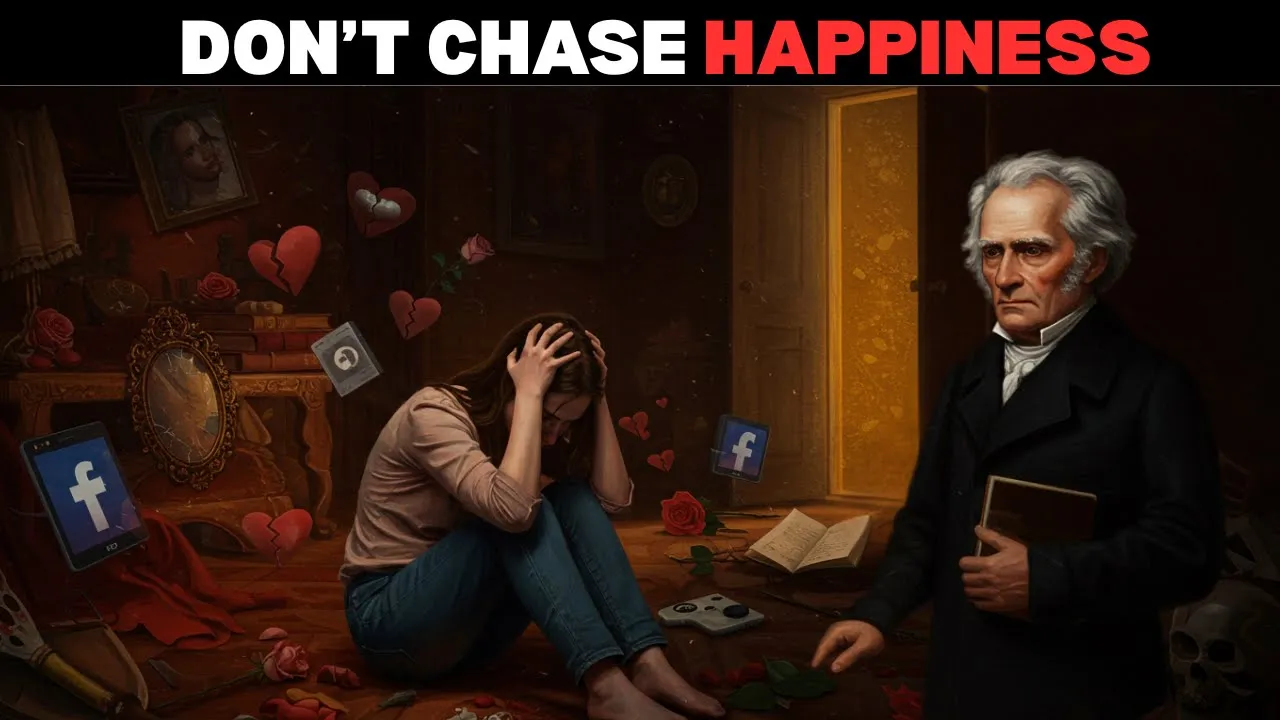
There are mornings when the weight of existence feels unbearable. Not because of tragedy nor crisis, but because everything feels dull, repetitive, like you are stuck in a loop that quietly erodess your spirit. You wake up, perform the rituals of modern survival.
Speak when you must, smile when you should, but deep down you are tired in a way that sleep cannot fix. This is not the drama of a life falling apart. It is the quieter tragedy of a soul slowly giving up.
And if you have ever felt this way, if you have ever caught yourself wondering, "What is the point of all this? " Then you are not alone. In fact, you are standing in the shadow of one of philosophy's darkest and most honest minds.
Arthur Schopenhau, the German philosopher who stared directly into the heart of suffering, wrote not with the hope of saving the world, but with the brutal clarity to name its afflictions. To him, life was not a gift wrapped in happiness. It was a struggle defined by unfulfilled desire, constant craving, and inevitable pain.
But before you look away in despair, know this. Schopenhau did not stop there. He also pointed toward the exit sign, a path out, a quiet, subtle liberation.
This video is not a celebration of misery. It is a road map through it. We are going to explore how Schopenhau, the reluctant prophet of pessimism, offers a surprisingly profound key to psychological freedom, not through blind optimism or endless striving, but through understanding the very nature of our suffering.
He believed that only by confronting life's dark foundation could we learn how to truly live. And when we pair his insights with modern psychology and lived experience, something powerful begins to emerge. You see, misery is not new.
From ancient stoics in Roman marble halls to wandering monks in forgotten monasteries, humanity has always wrestled with this inner weight. The settings have changed, scrolling social media instead of scratching on papyrus, but the ache remains eerily consistent. A deep longing for peace in a world that never stops asking for more.
Schopenhau knew that our misery often comes not from what we lack, but from how we desire. And today surrounded by constant noise, expectations and endless comparison, his ideas are not just relevant. They are urgently necessary.
So let us begin not with a promise of easy answers but with an invitation to look inward to step out of the cycle of craving and resistance and to rediscover in the stillness beneath our striving the shest way out of misery. Let us walk into the shadows, not to become lost, but to find the path through. To understand misery as Schopenhau saw it, we must begin with desire.
For him, desire was not simply a wish or a goal. It was the very root of human suffering. In his seinal work, the world as will and representation, Schopenhau argued that beneath all of existence lies a blind, irrational force he called the will.
This will is not something we control. It moves us. It compels all living things to strive toward survival, toward pleasure, toward goals that never seem to satisfy for long.
In Schopenhau's view, we are not rational beings guided by free will. We are vessels of an unending hunger. And this hunger, this constant grasping is what creates misery.
Even when we attain what we want, we do not stay satisfied. The moment we secure the promotion, the partner, the approval, our minds shift toward the next thing. Peace slips through our fingers the moment we believe we've grasped it.
Now consider this in historical terms. The idea that suffering is tied to craving is not new. Thousands of years before Schopenhau, the Buddha, came to a strikingly similar conclusion.
In the four noble truths, he taught that life is suffering, duka, and that suffering is caused by desire, tanha. The path to liberation then lies not in satisfying all desires, but in learning to let go of them. Schopenhau was a western echo of this eastern insight.
And though he arrived at it through a different path, more metaphysical than spiritual, his conclusion was remarkably aligned. The more we chase satisfaction through the world, the more we are bound to be disappointed. In ancient stoicism, the same thread runs through.
Epictitus wrote that we must focus not on controlling the world but on mastering our responses to it. The Stoics believed that suffering is not caused by events themselves but by our judgments of them, our desire for things to be other than they are. If we can align our will with nature, they said, we can find peace.
But while the stoics emphasized personal virtue and the Buddha taught the sessation of desire through detachment, Schopenhau was more radical. He believed suffering was inevitable, that existence itself was a kind of curse. He did not sugarcoat.
He did not offer religious comfort. And yet in that very bleakness, he offered a strange kind of liberation. Because if suffering is the default state of the world, then the pursuit of perfect happiness becomes absurd.
We stop chasing illusions. We stop blaming ourselves for not being eternally content. And in that letting go, a certain freedom opens up.
A freedom from comparison, from consumerism, from the need to always be more. This understanding did not appear in a vacuum. Schopenhau was writing in the early 19th century in the aftermath of enlightenment optimism.
For decades, European thinkers had painted reason and progress as the twin engines of human salvation. Science would cure ignorance, democracy would cure injustice, and education would elevate all people toward happiness. But Schopenhau looked around and saw a different reality.
He saw war, poverty, loneliness, and anxiety persisting under the veneer of so-called progress. He distrusted idealism. He distrusted the assumption that if we just tried harder, we would be fulfilled.
Instead, he turned inward. He drew from Eastern philosophy, canan metaphysics, and brutal personal observation to paint a darker yet strangely honest picture of the human condition. He saw a world not of potential but of constant dissatisfaction, a treadmill of desire where peace remained always one step ahead.
Yet, ironically, this pessimism has a kind of psychological wisdom. Because think for a moment about modern misery. Is it not often built from the same material Schopenhau described?
The endless scrolling for meaning. The curated digital lives that make us feel lacking. The pressure to achieve more, look better, earn higher, love deeper.
Yet somehow we never arrive. There is always another milestone, another craving. We live in a culture that treats suffering as a malfunction.
If you are unhappy, something is wrong with you. Maybe you need to hustle harder or heal more or buy something to fix the void. But what if the void is not a mistake?
What if, as Schopenhau suggests, it is the natural result of chasing meaning in the external world? This idea that suffering is not abnormal but foundational has deep historical resonance. The Greeks had a word for this tragic flaw in human striving.
Hamartia. It was the very thing that made heroes fall. Not evil, but excess, an inability to accept limits.
Christian mystics too spoke of the soul s dark knight. The point where external comforts fail and one is left only with the raw ache of spiritual longing, not as punishment, but as purification, as a turning inward. In every era, cultures have wrestled with this question.
Is it possible to live a good life in a world that is never quite enough? Schopenhau's answer was not to pretend the world can be fixed, but to suggest we change our relationship to it, that we stop expecting life to make us happy and instead learn to lower the volume of our cravings. And yet this is not nihilism.
It is not despair. It is realism that leads surprisingly to peace. like a storm that exhausts itself and leaves behind a strange serene quiet.
We begin to realize that perhaps the shest way out of misery is not to escape the human condition but to understand it, accept it and relate to it differently. Misery after all is often worsened by the illusion that we should not feel it, that everyone else is fine, that we are broken for being in pain. But when we recognize that dissatisfaction is not personal but universal, we can stop pathizing our suffering and start listening to what it teaches us.
From medieval monks to modern therapists, this theme remains. Suffering when understood becomes a compass, a sacred clue. And while Schopenhau may have denied the existence of salvation, he opened the door to something even more profound.
Selfawareness without illusion to stand still in the storm and say yes life hurts and still I will live it honestly. Now that we have traced the historical roots of misery and desire let us turn inward to the psychological landscape that shapes how misery takes hold and how it can be transformed. Schopenhauer es concept of the will as an endless driving force maps closely onto what modern psychology calls the hedonic treadmill.
This is the phenomenon where people quickly return to a baseline level of happiness despite positive or negative changes in their lives. Think about the joy you feel after buying something new or achieving a goal. It often fades faster than expected.
Then the mind shifts to the next desire, the next goal, repeating the cycle. This is not a failure of character or luck, but a built-in feature of the human psyche. Our brains are wired to pursue novelty and reward.
But that same wiring traps us in a loop of craving and dissatisfaction. This constant pushpull of wanting and fleeting contentment is a psychological echo of Schopenhau's will. From the perspective of cognitive psychology, much of this suffering comes from distorted thinking patterns.
One common distortion is all or nothing thinking, believing things must be perfect or they are worthless. Another is catastrophizing, where the mind imagines the worst possible outcome. These patterns trap us in a narrative of misery that feels out of control.
Yet, when we recognize these distortions, a powerful shift can begin. Cognitive behavioral therapy, CBT, teaches us to observe these thoughts without automatically believing them. We learn to step back from the relentless demands of the will, our endless craving, and see the cycle for what it is.
This psychological insight aligned surprisingly well with the ancient wisdom Schopenhau admired. For example, the teachings of Marcus Aurelius, a stoic emperor, emphasize that we do not control external events, but only our judgments of them. When we practice this inner freedom, we reduce suffering.
The will still pulses beneath the surface, but we stop giving it the reigns. Carl Jung, who came a century after Schopenhau, provides another layer of understanding. He spoke of the shadow.
The parts of ourselves we repress or deny. Often misery stems from avoiding the shadow. We refuse to face the darker aspects of our nature.
Anger, jealousy, fear. Instead, we distract ourselves or pretend they do not exist. But the shadow demands recognition.
When ignored, it manifests as anxiety, depression, or destructive behavior. Schopenhau's grim worldview echoes Jung's shadow work. The will is not just external desire but also the restless turmoil within.
True freedom arises when we acknowledge and integrate these parts of ourselves rather than run from them. On a social level, misery is contagious. Human beings are deeply relational creatures.
We absorb the moods and beliefs of those around us. If our culture constantly signals that happiness is something to be earned or bought, we internalize that pressure. Social media with its polished images of success and joy amplifies this effect.
We measure ourselves against unrealistic standards fueling insecurity and comparison. This phenomenon connects with the psychological concept of social comparison theory. We evaluate our worth based on how we stack up against others.
often to our detriment. This deepens the cycle of craving and dissatisfaction because the goalposts keep moving. Yet here too, ancient wisdom offers guidance.
Sufi poets like Roomie wrote about love that is unconditional and inward, a kind of divine acceptance that transcends comparison. When we shift from external validation to inner acceptance, we begin to quiet the will's restless demands. Modern mindfulness practices embody this shift.
By training attention to the present moment without judgment, we interrupt the endless narrative of desire and dissatisfaction. We begin to experience life as it is, not as a problem to solve, but as a flow to witness. The psychological richness of these ideas offers a hopeful bridge between Schopenhau as bleak diagnosis and practical human growth.
The will, the driving force behind misery, can be acknowledged, observed, and gradually disarmed. Pause here for a moment. Reflect on your own experience.
How often do you find yourself chasing one desire after another? How many times have you felt that brief spark of happiness fade into craving? What would it mean to step back and observe this process without judgment?
This self-awareness is the first crack in misery's armor. It does not promise instant relief, but it opens the door to a different relationship with suffering. In this space, we can cultivate patience, compassion for ourselves, and curiosity about our inner landscape.
This is where psychological science meets philosophy and ancient spiritual practice. at the crossroads of insight and transformation. Schopenhau's profound contribution then is not to tell us misery is unavoidable and meaningless, but to illuminate the machinery behind it.
When we understand the will's grip, we begin to reclaim our agency. The next step is to look at the consequences of ignoring this truth. The ways misery can seep into every corner of our lives and distort who we are.
When we fail to understand the nature of misery as Schopenhau described, its impact can ripple through every aspect of our lives, our emotions, relationships, identity, and even our sense of purpose. At a personal level, misery often hides behind common emotional states such as anxiety, restlessness, and depression. These are not just isolated feelings, but symptoms of a deeper existential condition.
The relentless dissatisfaction born from the will s insatiable demands. Imagine waking each day with a quiet but persistent sense of something missing. You might have a successful career, supportive friends or loving family.
Yet a shadow of emptiness lingers. This emptiness is often misunderstood as a lack of external achievements or a failure of circumstance. But Schopenhau teaches us it is more fundamental.
When misery is ignored or denied, it can mutate into self-lame. We tell ourselves that we should be happy because we have reasons to be. This internal conflict deepens suffering, creating a cycle of guilt layered at top dissatisfaction.
On the social front, this internal misery can isolate us. It creates a barrier between our authentic experience and the image we present to the world. The pressure to appear happy and successful leads to emotional masking, a performance that drains energy and erodess genuine connection.
In relationships, misery often breeds misunderstanding. When we carry unagnowledged dissatisfaction, we may become irritable or withdrawn. Our partners or friends feel the distance but cannot name the source.
This dynamic can spiral into conflict or loneliness, reinforcing the very misery we want to escape. Career ambitions are also caught in this web. The desire for external validation or material success often fuels a frantic pace.
Yet achieving milestones can bring only fleeting satisfaction. The hunger returns, driving us toward the next goal with little rest. This relentless striving contributes to burnout.
a state of emotional, mental, and physical exhaustion. Burnout is a modern epidemic reflecting how the will's demands can overwhelm our capacity to cope. It is the body and mind's cry for respit from endless craving.
Psychologically, this experience aligns with the concept of learned helplessness, where repeated failure to control outcomes leads to feelings of powerlessness. When misery becomes chronic, it undermines self-efficacy, the belief in our ability to influence our lives. This loss erodess confidence and stunts personal growth.
Historically, we see these consequences mirrored in myth and story. The Greek tragedies reveal heroes undone not by external enemies, but by internal flaws, hubris, unchecked desire, or failure to accept limits. Their downfall is a metaphor for the human struggle with the will.
Medieval mystics too wrote of a dark night of the soul, a period of profound suffering where one feels abandoned and empty. But this night was not a final sentence. It was a passage toward deeper wisdom and spiritual awakening.
In modern times, the narratives of depression and anxiety disorders echo this ancient pattern. Neuroscience shows how chronic stress and negative thought patterns alter brain function, trapping individuals in cycles of misery. Yet, despite its severity, misery is not a fixed fate.
It can be transformed through awareness and intentional practice. Pause for a moment and consider your own life. Where do you feel the grip of this restless dissatisfaction in your emotions, your relationships, your work?
Understanding the impact of misery is not an exercise in despair, but an invitation to compassion, both for ourselves and for others. It helps us see the hidden burdens carried beneath smiles and achievements. Recognizing these consequences allows us to break the silence around suffering.
It encourages openness, connection, and ultimately healing. The question then becomes, how do we move beyond this cycle? How do we engage with misery not as a prison, but as a teacher?
The next section will explore practical solutions, tools that combine modern psychological techniques with timeless wisdom to guide us toward freedom from misery as hold. Having traced the roots and consequences of misery, and seeing how the will's relentless striving shapes our inner world, we come now to the heart of the matter. The shest ways out of misery.
This is where philosophy meets practice, where abstract insight turns into tangible daily habits that reclaim our peace and freedom. Arthur Schopenhau did not simply diagnose misery as an inescapable fate. His reflections invite us to a profound inner shift, a turning away from the endless chasing after desires and toward a life that embraces acceptance and stillness.
But how can this be lived today amidst the noise and pressure of modern life? First, we must understand that escaping misery is not about eliminating desire altogether. That would be to deny our nature.
Instead, it is about transforming our relationship with desire, the will, so that it no longer controls us unconsciously. Modern psychology offers powerful tools for this transformation. Cognitive behavioral therapy, CBT, for example, trains us to recognize and challenge the automatic thoughts that fuel craving and dissatisfaction.
When you catch yourself thinking, "I must have this to be happy or I am worthless if I fail," pause and ask, "Is this really true? " What evidence supports or contradicts this thought? This practice, simple in principle, but profound in effect, loosens the grip of distorted thinking.
It creates space between you and the relentless demands of the will. Mindfulness meditation complements this by teaching attention to the present moment. Instead of being swept away by future cravings or past regrets, mindfulness anchors us in what is happening now, the breath, the sensations of the body, the sounds around us.
These become portals to presence. Presence is a radical act of resistance against misery. It is a way to witness desire without being driven by it.
Over time, this cultivates equinimity, a balanced mind that neither clings nor rejects. Schopenhau admired Eastern philosophies, particularly Buddhism, which also recognizes craving as the root of suffering. Buddhist teachings emphasize the practice of non-attachment, not as indifference, but as a wise letting go.
When we hold desires lightly rather than clutching them desperately, we reduce suffering. Journaling is another accessible practice to deepen this awareness. Writing down your thoughts and feelings allows you to externalize the internal dialogue of craving and dissatisfaction.
It helps you see patterns, identify triggers, and reflect on moments of peace or joy. Pair journaling with gratitude practice, regularly noting what you appreciate in your life. Gratitude shifts attention from what is lacking to what is present, cultivating a mindset of sufficiency rather than scarcity.
Schopenhau's notion of aesthetic contemplation offers a more poetic path. He believed that engaging deeply with art, music or nature temporarily suspends the will. In those moments, the mind steps outside its endless desires and experiences pure being.
Today, this might look like losing yourself in a piece of music, walking in the woods, or immersing yourself in a creative activity. These experiences reconnect you to something larger and quieter than personal striving. Another key practice comes from stoicism, a philosophy Schopenhauer respected for its practical wisdom.
The Stoics taught that while we cannot control external events, we can control our responses. This mindset frees us from frustration and suffering caused by attachment to outcomes. Daily reflection on what is within your control.
Your thoughts, actions, and attitudes can ground you amid chaos. When setbacks occur, remind yourself that the pain lies often not in the event itself, but in your judgment of it. Community and connection also matter deeply.
Misery thrives in isolation, but sharing our struggles fosters empathy and healing. Seek relationships where vulnerability is safe and emotional authenticity is honored. Therapy or counseling can provide professional guidance to navigate deep patterns of suffering.
Therapists offer support to uncover unconscious drives of the will and develop personalized strategies for freedom. Lastly, cultivating self-compassion is vital. Misery often comes with harsh self-criticism.
Learning to treat yourself with the same kindness you would offer a dear friend softens inner resistance and opens space for growth. These practices do not promise a quick fix. The will is a powerful force woven into the fabric of our being.
Yet with patience and persistence, we can loosen its hold and discover moments of peace that multiply over time. Pause here for a moment. What practices have you tried to quiet the restless cravings within?
What might it feel like to approach desire not as an enemy, but as a curious teacher? Remember that transformation is a journey, not a destination. Each small step toward awareness and acceptance chips away at misery's fortress.
As Schopenhau suggested, the path out of misery lies in a profound change of attitude. Less grasping, more seeing, less struggling, more surrender. In the final section, we will weave these insights together, reflecting on the wisdom from past to present and inviting you to continue this journey with renewed hope and clarity.
As we reach the close of this exploration into the shest way out of misery, it becomes clear that what Schopenhau illuminated centuries ago remains profoundly relevant today. His piercing insight into the nature of the human condition, the restless will that drives us ceaselessly forward, creating an undercurrent of dissatisfaction, continues to echo in our modern lives. We began with the realization that misery is not simply about external circumstances or bad luck.
It is woven into the fabric of desire itself. A fundamental feature of what it means to be human. This truth while sobering is also freeing.
It means misery is not a personal failure but a shared experience. A challenge passed down through generations and across cultures. History offers us a tapestry of responses to this challenge.
From the aesthetic renunciations of the ancient sages to the practical wisdom of Stoics to the psychological breakthroughs of contemporary science. What has shifted over time is not the existence of misery itself, but our tools and language for confronting it. Modern psychology, mindfulness, and therapy bring new ways to engage with the age-old struggle.
These methods complement the timeless teachings of non-attachment, self-reflection, and acceptance that Schopenhau and those before him championed. At the core of all these paths lies a simple yet profound invitation to shift our relationship with desire from one of unconscious chasing and resisting to one of conscious awareness and compassion. To meet our cravings not with frustration and denial, but with curiosity and understanding.
This shift is no small task. It asks us to be patient with ourselves, to accept that transformation unfolds over time, often in the subtle rhythms of daily practice rather than grand revelations. Yet each moment of presence, each act of kindness toward the self, each choice to loosen the grip of craving accumulates.
We have seen how ignoring misery can fracture our identity, strain relationships, and drain our vitality. Yet, by embracing it as a natural part of the human journey, we open doors to deeper peace and authentic connection. Imagine a life where your happiness is not tethered solely to achievement or acquisition, but arises from a grounded sense of being.
Where setbacks no longer crush your spirit, but serve as teachers, guiding you toward resilience. Where the restless energy of desire is transformed into a gentle current that fuels growth rather than exhaustion. This is not a distant ideal but a living possibility.
Schopenhau s leg legacy challenges us to become both observers and alchemists of our inner experience to hold the mirror up to the will and recognize its nature without being enslaved by it. So I ask you now, how might your life change if you saw misery not as an enemy to be conquered but as a messenger to be heard? What wisdom could arise if you learned to hold desire with gentle hands, not clenched fists?
As you reflect on these questions, remember that you are not alone on this path. We share this human condition, this dance with the will, and through shared understanding and practice, we can support one another in the journey toward freedom. Thank you for taking this time to explore such a profound aspect of our existence.
May this reflection inspire you to cultivate awareness, compassion, and courage in the face of your own restless will. The journey out of misery is a journey inward, a return to presence, to acceptance, and ultimately to a deeper peace that resides beneath the turbulence of desire. You have just journeyed through some of the deepest insights into human misery, its origins, its impact, and the ways we can begin to loosen its grip.
This is not just philosophy or psychology for the sake of knowledge. It is an invitation to reclaim your personal power, to master the restless currents within, and to live with greater purpose and clarity. If this exploration resonated with you, if you feel called to continue peeling back the layers of your own experience and embracing growth with honesty and courage, then you are in the right place.
Here, we do not settle for superficial answers or quick fixes. We dive deep into the psychology, history, and wisdom that illuminate the path toward genuine transformation. By subscribing, you join a community committed to emotional intelligence, self-awareness, and meaningful reflection.
Together, we explore how ancient ideas and modern science intertwine, offering practical tools that you can integrate into your daily life. This channel is a space where you can come as you are with your questions, your struggles, and your desire for something more. You will find content that challenges, inspires, and supports you on your journey toward freedom from misery, clearer boundaries, stronger leadership of self, and a vision aligned with your true values.
So ask yourself, are you ready to step into your power? Not the power over others, but the power over your own mind and heart. Are you ready to face discomfort with resilience and to transform it into a wellspring of wisdom and peace?
If your answer is yes, then subscribe now and let us walk this path together because growth is not a solitary endeavor.