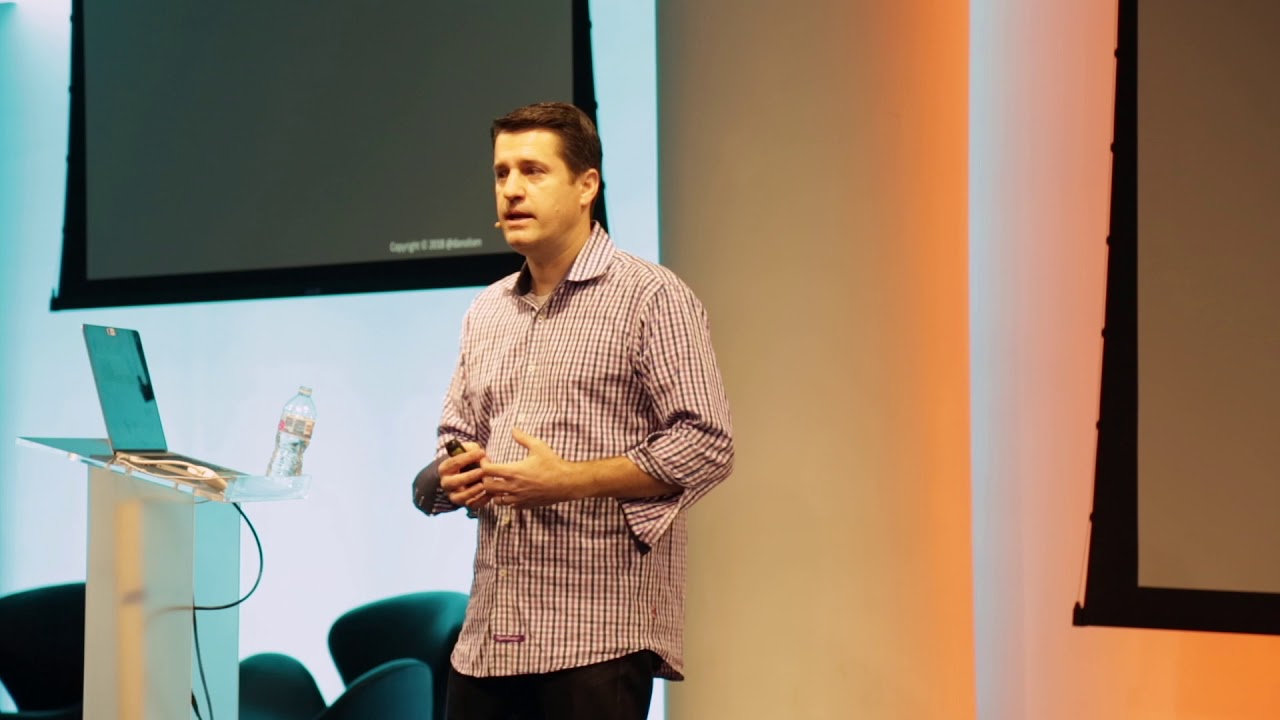
[Applause] [Music] hello that's loud hello um I'm here to talk about doing service design and actually before I start talking about that stuff I would like to ask you all question can you please raise your hand if you know what service design is that's about half three quarters okay and can you please raise your hand if you're working in service design that's way less okay okay some work to do we got dad I published a book I run also a software company called modern metrics where we develop software for service design but actually what I
want to start with for those quarter of you who don't know yet what service design is I try to explain and outline what service design is in five minutes so those of you who know that just bear with me just five minutes right and I'm totally aware that I'm the only thing between you would lunch don't worry there all right depending on the books you read or the agency you work with we like to outline design always as a process with some core activities nothing you research ideation prototyping implementation I would like to briefly briefly
talk you through the different methods and tools we use that when we design a service so when we use research methods of course we use quantifiers like surveys or any kind of data that will automatically collect like conversion analysis and so on but besides a quantity of data we also collect qualitative data and I mean I'm talking to people who all know that so I can save some time here we need both it's never the question either or we always need both we use quantum data to monitor certain KPIs over time see how it develops
but then we need qualitative data to actually get actionable insights so when we design a service the research method might look a little bit different there what we love to do is we do stuff like contextual interviews where we go out to where the service actually happens and talk with the users in this situated context of that service so they can point towards things they can show us stuff we like to do non-participant observation where we don't interfere in the processes where we sit back a little bit like those old detective movies where the detective
is sitting the lobby of hotel with a gigantic newspaper in two holes in it right we observe processes we observe how people react we try to find patterns in that like the talk we just listen to we also do the classic ethnographic work where we use participant observation and we kind of live through a service experience with our customers but likewise we also do that with employees so we do worker logs we work together with employees to understand their reality their processes their experience for me that is one of the most important aspects of service
design and if I look into my work nowadays I would say I do as much work and customer experience as I do an employee experience it's absolutely crucial for us we need to have happy employees to create great customer experience we use new modern approaches like mobile ethnography and very simple ones like Auto ethnography just become a customer yourself and then we collect all these data these primary data and we synthesize that we analyze the ad we trade key insides we write jobs to be done we visualize the head we create personas journey map system
maps and so on it's really just five minutes when it comes to ideation we do these workshops things with post-its and so on we ID 8i that is a part where I lately really get a problem with and and that's just one statement I want to make I think ideation is highly overrated if we look now what agencies or even more what consultancies cell it's very often works format I da ting with post-it notes I think ideation is overrated ideas are cheap if you invite the right people if you do your research well but what
is underrated is prototyping and that is where we really need to put our effort a lot of the talks this morning showed that so whenever we start with something with an idea with a prototype in service design we laughed a notion of a shitty first draft every draft of whatever you do the first one is always shitty and it should be shitty because it allows us to free from perfection and I might be a little bit fanatic there but I think you can't stress out that message early enough to people so this is my daughter
at the age of four months so we wear the same sweater she gonna be hating me for that and actually this shirt is not accurate it shouldn't be shitty first draft it should be first draft goods that was basically the old things he did the first month anyhow we go into prototyping so in prototype we often talked again about journey map a different kind of journey Maps we talked about future state journey Maps a journey map is not a prototype a journey map help to align the team to make sure that you talk about the
same thing maybe to identify which part of his service you want to prototype but it's not a prototype per se it helps you to get into prototyping what is prototyping stuff like that things you can test with users like a click dummy wireframe physical prototype that was a prototype of bus stop in Atlanta that we built out of cardboard in about half an hour and the great thing is you can put that out on the street and test it with users and bus drivers immediately a little bit more high fidelity that's I do working with
lufthansa on redesigning the business class so we run simulation where they did many flights and simulated many flights on the ground testing the processes there on a smaller scale you can do desktop walkthroughs where you walk through service just on your desktop using Lego figurines or Playmobil figurines and of course you have to develop and prototype your business model all along while you're working on that the last part is an implementation you just make it real and that's the process and we're listening to many talks like that and it always stops there what about implementation
what about actually doing it getting stuff out and that's very often where all of these processes suck it they don't tell you how do you actually get it out on the street so that people can use it you read books I'm guilty of that myself use this process it will guide you so we looked at some processes and we looked at how people communicate the real design process probably familiar with that one that's a squiggle for Damian Neumann more than ten years old now and should reflect the reality of a design process right loads of
iterations in the beginning once the concept clear you just work it out so we use our own book it's a three year process of writing that book and try to visualize that in the same way and somehow it looked slightly different actually got really really messy and hard in the end so we came with we tried to come up with a name for the Hat and we called that the mayhem so that's the mayhem process and once we understood that we visualized other processes and we looked at our projects that actually got implemented and we
came out with a whole list of potential processes they're just going to highlight a few of them you might be familiar with the maze thank you somehow stuck in the process you can't get out of that anymore I'm still looking for the outer bond if any of you ever experienced that please on me so I start and done if you work in large organizations are properly familiar with the black hole like everything you do is about sucked in and disappears if you work in rather traditional organizations probably very familiar with the pinball where you get
pinball between stakeholders and somehow you never get down there so let's look at the difference between consulting and actually doing stuff when we look at consulting we enter what we like to call the workshop land and workshop land we always say trust the process and then we look at how do we actually communicate the processes well it's simple design is almost a double diamond you dive it you convert your diver to convert you're done you just go through dime there two diamonds it's not one stop three it's two other folks I don't know who came
up with that stupid Eddie it says it's for clear steps and I said now for us not enough we need five five phases five is not enough design always got seven stages yeah nowadays there are so many buzzwords out there seven stages not good enough we actually need to combine all the buzzwords out there into one model to rule them or we call that their circular science circles where you can find literally every buzzword on the planet regarding design in one model I am not really sure if that really helps us to design something that
helps us as professionals to talk about things but we know that this is not reality we don't trust one process we know that there are some standards we can use and we can reuse like Jake was talking this morning a design spring can be great start but it's the start of a design process the process itself is much longer so how do we design this process and that's actually one step of a design process in itself designing the process that's not new we know that so how does it look like as a designer we have
a certain skill set different methods different tools things we can use out of these activities for any problem we have for any project we start we try to identify what is suitable what is feasible but then we live in a world with constraints like budgets so some of the stuff we would love to use we can't use because we're not allowed to it we can't afford it whatever reason and at some point we call this process yeah that's good enough we know how it would be really really cool to do we know our constraints that's
what we can go to so the question is when is a process good enough and in our book that we co-wrote again with 300 people from the community we came up with the 12 commandments of how to do service design I would like to go through all 12 of them and for a few of them I have some help from people from the community the first one is call it what you like I'm not a fan of the word service design because service design consists out of two words where people think they know exactly what
it means people hear a service and they think oh that's how a waiter brings your coffee people here designs I think oh that's aesthetics the design of my new iPhone then they put those two words together and they think service design oh yeah know exactly what it means it's the aesthetics of how its server brings to your coffee so when I work with our clients we always use the language they use some call it service design some call experience design some called design thinking some called UX design just don't limit themselves on a screen so
we asked one of our clients who I think had a very smart way of how they call what they're doing this is Jurgen from Genesis Genesis we even call it smart because by putting the customer in the center by co-creating experiences with the service design toolkit we found a smart way to make a significant impact not just for our customers but also for our employees and all the business results so if you're looking to make a difference it's smart you start just get rid of all the buzzwords and invent a new one that's it I
just call it whatever you like I think that's brilliant service design is now part of the national high school curricula in Austria and they did a brilliant trick they didn't call the subject service design because they were afraid of parents and what they would think about service design so they gave it a different name they call it business and service management what everyone needs that and then there's little asterick sand below says including service design I think that's brilliant number two really close to my heart makes shitty first drafts don't over plan prototype as quickly
as possible number three as a designer you are a facilitator and we need to understand that that's a way how we need to work so we asked a colleague this is simon from oslo why you are a facilitator there's three reasons for this one you are inherently user centric or customer experience centric in your approach to you integrate different new points and different disciplines design has always integrated function production and aesthetics or in design-thinking terms feasibility viability desirability this makes you good in terms of running teams with multiple viewpoints and three you're very good at
visualization by visualizing what's happening in a meeting different possibilities and especially what if situations as a designer you bring the team together and you create a shared ownership things so three reasons why you should go out as designers and facilitate teams number four doing not talking and you can really feel the difference if you work with a client of your work within their organizations who has a higher design maturity who really started embedding service design in their culture and these are the folks who not talk about ideas or discuss things or talk about what they
think the needs of a custom is these are the folks who do stuff if we don't know it we go out and go research if we don't know it we create a prototype prototyping is research of the future so doing not talking for me is one of the key aspects to see how far an organization actually is in implementing service design number five yes but and yes and so it's about diverging and converging it's never the question either/or we need both at the right time this is Melina talking about the difference of yes but and
yes and and remember her last sentence so yes and as a magical thing which helps people in organisations to consider things that they haven't considered before either putting ideas together or thinking about resources in a different way in a new way it gets you to a new place yes but if use well is actually useful for understanding certain problems that might be in the field for understanding constraints or certain criteria that need to be considered as part of the problem but yes but if done horley shuts down conversation so be careful when you're using best
yes but not to be a dick thanks bye I love that number six find the right problem before solving it right nothing new but the question is do different parts of the organization think alike already so we need to understand the problem we need to understand the needs of users Before we jump into solution space because we often jump way too early into solutions and then just have solutions for superficial problems for symptoms without understanding the root cause number seven prototype in the real world don't always prototype in your lab go out into the real
world we saw some great examples for that this morning the more we prototype in the real world the closer we get into actually doing an implementation number eight don't put all eggs in one basket this is a very classic saying in management and it's important for us as designers as well particularly when we go from ideation to prototyping never take just one idea into prototyping because we're falling in love with this idea you're gonna stick with this idea even though you learn it shitty you're gonna find through some biases we unfortunately all have reasons why
this prototype is not shaded but actually cool but if you take a couple of ideas into prototyping and you prototype it quickly and test different solutions you have actually variants to choose for and that helps you into building a more useful idea which ones to take further number nine it's not about tools it's about changing reality we all love our journey maps but do we actually is that service design let's say what Alex has to say it's not about the tools it's about the value that you can deliver that the tools help you it's not
about the templates it's not even about the personas it's certainly not about the blueprints it's about the reality that you can change in an organization inside people inside a movement it's about that change that's the important thing we are change agents we are not creators of beautiful tools other people can do that that's fine but what we are about is making a fundamental difference to art the way we live the way we work the way we play the way we get better in hospital all of those things it's about the outcome not the output I
always like to say and please excuse my my language I always like to say a customer journey map is not a deliverable it's not about delivering a beautiful journey map it's about what you can do with that it's a tool we use and tools don't look beautiful it's like a hammer on a construction site it needs to work number 10 plan for iteration then adapt so don't trust organizations if they put out their design process and you have to follow that step by step like a stage-gate process you need to be able to adapt and
change these plans number 11 zoom in and out let's go back to our tools the journey map can compare a journey map to map and geography in map and geography google maps get different zoom levels can zoom out to Europe to understand the big picture we can zoom into Sweden zoom into Stockholm and suddenly details arise if you want to drive from one city to another you need maps of different zoom levels so in service design we constantly switch between these zoom levels we zoom into the detail and then we zoom out to understand the
bigger picture the last one it's all services everything is a service is that right yes it's all service some anthropologists even describe human society as a total service system after all there's nothing produced by humans that can be assessed without service try to access an object without the service of craftsmanship logistics marketing engineering it's impossible and this is one of the most exciting aspect of service design the opportunity to weave a little bit of novelty into the fabric of humanity there's even a whole stream and marketing called service dominant logic when they claimed everything is
a service so I understand that they're also products are just avatars for service they provide you a certain service so how can we avoid the how can we actually start doing things and maybe also do none it's trivial but I think people don't want service design they don't care about service design they want the problems solved and yeah that sounds really stupid but then we did a little test I did a little stock image search for service design and what do you think what are the photos you find when you search for service design online
of course loads of posters sometimes you see even people pointing at posters sometimes you see also workshops situations like for people in front of like a CSI glass moving empty posted no there's not one word written on that the guy on the right holding a coffee cup in his hand while he's moving and empty post it and the lady next to it do you want that in your workshop holding coffee cup being on the phone laughing yes very engaged right gosh I think we all need to work on that because we are all guilty of
that ourself I'm guilty of that definitely but we need to change the visual narrative of service design how do we actually talked about this discipline what matters to us and when I take a look at at different examples what matters to us are people we need to bring back the human Center design into service design because somehow we got down into tools methods and post-its so if we look at that like the mobility experience it's about people buying a car it's about people in the backstage mechanics repairing cars it's about those who developing it it's
all about people if we look at that hospitality experience it's of course the people who make your coffee it's about the people who make your food but it's also about the people who clean up your hotel room when you're not there's definitely the folks who clean up tonight after a party it's all about people so no matter how you call it if you call what you're doing service design UX design design thinking experience design holistic multi-channel customer experience what-have-you thingy how would I to ask you now again because I think you all design already services
and systems just on different zoom levels and we are all in this game together thank you [Applause] I'm getting afraid now thank you so much mark to you in the sofa yes I take the red one the red one so we actually had a small quiz to the audience this morning where we asked them to tell us the job title within their organization as you can see over there the rest of this yeah I can't that there's some very specialized people out there they're font is 8 picks right now but now you talked about this
a little can we go into more into depth of what like having like there's the one way of going and just everybody makes up their own completely new thing and then nobody knows what anybody does but that could be good because then it's your brand it's part of your brand or we have sort of the confusion of is at least the word designer is in there somewhere what does that do to our own organization as a profession so for me service design is a team sport I mean if you think about who you need to
get a service out there to get it done it's design is a part of that but you need engineers you need architects you need IT coders in researching my deep psychology is trend researchers all of that designers are facilitators of this process what designers can be really really good is is getting all these people in one room and work efficiently together yes mmm so for me design is the glue between these disciplines which some friends of ours a design agency and Amsterdam has big on the wall in the office and I really like that that's
fantastic yeah the glue so no we have all heard that culture eats strategy for breakfast well my question is what eats culture I don't think it's like a food chain right and that's like I don't know it's the bigger shark coming and then there's a bigger shark coming goodness so culture is the Alpha if you wanna mean if you want to nail me down on that I think yes because if you have a bad culture in the organization that what does it mean it means that your most engaged people your best people will leave or
they shut up and just can't stop caring about it so if you have about culture in the organization it will ultimately kill what makes your organization that is the people and once you lost the main people in your organization you're doomed to go down a very dark path so for me it culture yeah I don't think there's another big chart behind it thank you so much mark for being here today and we have some gifts for you as well and please stay in stuff up here if you want to and be able to talk about
that as well begin with a little warm applause before you
![[CU2013] Marc Stickdorn: Service Design Thinking](https://img.youtube.com/vi/LUsjjOtAwcs/maxresdefault.jpg)